The Bow and the Marquette Ore Dock

The Bow

The Bow, photo by p.Gordon.

Hunt’s Guide to the UP has this to say about the Lower Harbor Ore Dock in Marquette:

Once rail cars moved onto this massive sandstone dock to unload iron ore into the holds of waiting ore carriers via “pockets” or chutes. After a 1971 strike the Lake Superior & Ishpeming rail line through downtown was no longer used. The newer ore dock by Presque Isle was enough to meet later needs. As part of a plan to redevelop the Lower Harbor and South Rail Yards, the 3,000-foot trestle approaching the docks was torn down, removing a longtime landmark across Front Street and opening up a long waterfront corridor for public use.

via the YouTube you can see a super-sweet video of a stand up paddleboarder making a complete circuit of the ore dock

Check this out big as a freighter and in p Gordon’s Great Lakes Ships slideshow.

More Marquette on Michigan in Pictures.

Happy Father’s Day, Michigan Dads

Dad and daughter

Dad and daughter, photo by Dr. Farnsworth.

Tomorrow is Father’s Day, a time to celebrate dads and fatherhood. Also fishing & golf. ;)

Hope all the dads out there have a great weekend (everyone else too!)

See this photo big as the one that got away and in Dale’s The Best of West Lake slideshow.

Safe Harbor, Copper Harbor

Safe Harbor

Safe Harbor, photo by 13Miles.

Copper Harbor, July 3rd, 2010

Check this out background big and in Dixie’s slideshow.

More boats on Michigan in Pictures

1830s Sloop Discovered off Saugatuck

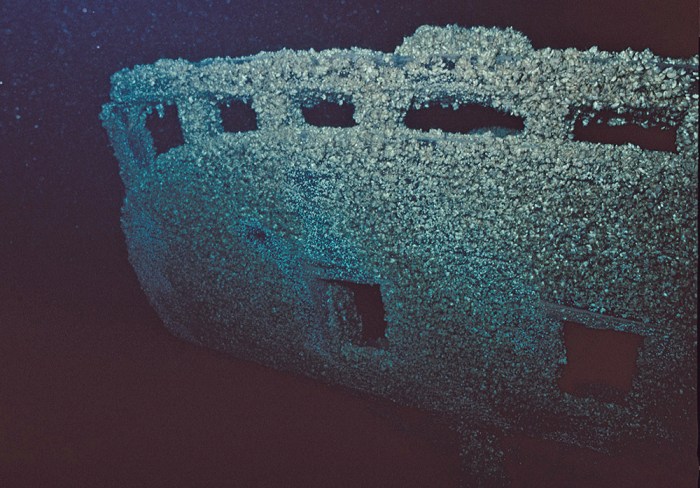
Stern of Mystery Ship, photo by Michigan Shipwreck Research Associates

Through Absolute Michigan we found out about a cool discovery off South Haven by Holland-based Michigan Shipwreck Research Associates in collaboration with nationally acclaimed author Clive Cussler and his sonar operator Ralph Wilbanks of the National Underwater & Marine Agency (NUMA).

MSRA’s historians have verified that the vessel’s construction and design is consistent with ships built in the 1820s and 1830s, making it perhaps one of the oldest vessels discovered in the southern basin of Lake Michigan. The vessel sits upright and is in surprisingly good condition considering it was built nearly 200 years ago. Exact identification will be difficult as these small, early sloops were rarely documented and most had wrecked or been scrapped before photography became available. MSRA will continue to research and explore the wreck during the 2011 season.

Underwater video of this new discovery will be shown at the annual “Mysteries and Histories Beneath the Inland Seas” evening event on Saturday, April 16, 2011 at 7:00 pm at Holland’s historic Knickerbocker Theatre.

We have all the details (including a video and sonar showing the ship) on Absolute Michigan and you can learn about and register for the conference at the MSRA web site!

Check this photo out bigger and see it and a couple more in their slideshow.

U.S. Coast Guard Icebreakers and the Great Lakes

International Partners

International Partners, photo by KathysPix.

Icebreakers and the U.S. Coast Guard is a great article from the Coast Guard Historian’s Office says that the origin of icebreaking in the United States came in the 1830s as side-wheel steamers with reinforced bows were found to be excellent for clearing harbor ice. This page tells the story of CG icebreaking around the country, and the Great Lakes were certainly a part of that. The Escanaba class light icebreakers in the early 20th century didn’t get the job done, but World War II made icebreaking an essential technology and led to the development of the Wind class vessels. In addition to to these four ships, a fifth was built in 1944, the icebreaker Mackinaw:

The final heavy icebreaker built during the war was the Mackinaw, a ship specifically for Great Lakes use. She was, according to Admiral Thiele, a “squashed down” Wind class vessel, with greater beam and length, but shallower draft than those vessels. Her powerplant and general design were those of the Wind class, but her hull was of mild steel, for fresh water operations. (The ocean going cutters were of high tensile steel.) This vessel was designed to extend the operating season in Great Lakes ports, a strategically important task considering the essential raw materials originating on the Lakes: iron ore, coal, limestone, etc.

In 2006, the Mackinaw was decommissioned and replaced by the new USCG Mackinaw, which we see in the picture above.

You can see more of what was involved in freeing a stuck freighter in Kathy’s Coast Guard Cutters slideshow.

Greater Buffalo or “When I grow up I want to be an aircraft carrier”

Greater Buffalo

Greater Buffalo, photo by joeldinda.

Joel’s Borucki’s Lakers set features photos some great old photos along with history of the vessels. He uploaded one the other day of the steamer Greater Buffalo heading toward Lake Erie on the Detroit River that was taken in August 4, 1939. On another photo of the Greater Buffalo he writes that this photo is easily the most interesting ship in the Borucki picture collection and says:

Greater Buffalo, shown here passing under the Ambassador Bridge, was launched at Lorain on October 27, 1923, for the Detroit and Cleveland Navigation Company, and made her first trip on May 13, 1925. She could carry 300 crew members and 1,200 passengers between Buffalo and Detroit on an overnight basis. Her sister ship Greater Detroit alternated on the run with her. These two Frank Kirby-designed ships were the last, largest, and (perhaps) fastest sidewheel passenger ships built on the lakes; when they were launched their construction costs were reported as $3.5 million apiece.

Greater Buffalo was requisitioned by the Navy in 1942, converted to an aircraft carrier and renamed USS Sable; she and USS Wolverine (the former Seeandbee–another Kirby design, and the other “fastest” claimant) worked as training ships out of Great Lakes Naval Station near Chicago. She was retired after the war and broken up in 1948.

There’s a couple more photos of the Greater Buffalo/U.S.S. Sable in the UD Mercy Marine Historical Collection.

Check it out big as a battleship and in Joel’s Borucki’s Lakers slideshow.

rolling fog at the mackinac bridge

rolling fog

rolling fog, photo by Through My Eyes. [nicole wamsley]. astra_amara.

Much more of Mackinac and the Mackinac Bridge on Michigan in Pictures.

Check this out bigger in Nicole’s if by sea… slideshow.

Women and children first: The Sea Scouts near Mackinac

Sea Scout whaleboat

Sea Scout whaleboat photo by otisourcat

As a Sea Scout, I promise to do my best
To guard against water accidents;
To know the location and proper use of the lifesaving devices on every boat I board;
To be prepared to render aid to those in need and;
To seek to preserve the motto of the sea, “Women and children first.”
~Sea Scout Motto (via Wikipedia)

otisourcat writes that this shows a ship’s boat used in the 1920’s by the Sea Scouts. The photo was taken somewhere near Mackinac. See it (and many more) in his amazing Photographica Nauticalia set (slideshow).

Adrift

Adrift

Adrift, photo by dthurau.

…as in Don’t worry, even though I forgot to blog a picture this morning, this blog isn’t adrift.

Check it out bigger in Dave’s Misc slideshow, and here’s hoping tomorrow’s storm doesn’t set you adrift!

More boats on Michigan in Pictures.

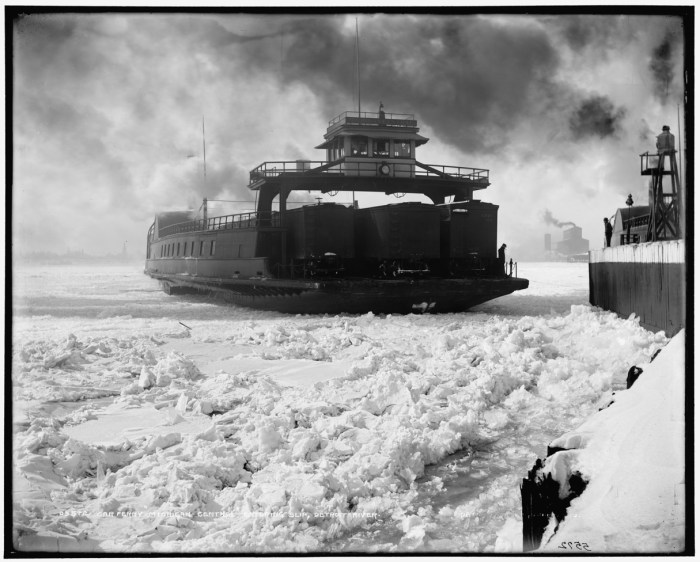
Rail Car Ferry Michigan Central on the Detroit River

Car ferry, Michigan Central, entering slip, Detroit River, photo by Detroit Publishing Co.

It’s kind of cruel to post a photo like this while it’s still November. I think we all know what’s coming though…

I spent some time learning about this photo I found in the Library of Congress aka maybe the coolest place on the internet. (You probably paid 3 cents for it last year, so check it out sometime). I finally found the same photo on the fantastic photo blog Shorpy. One of the commentors writes:

This is the Detroit side. The river flows extremely fast, and the ferry docks were set up so the boats always entered dock facing upstream. Michigan Central was built in 1884 by Detroit Dry Dock in Wyandotte, while Transport was built there in 1880. Both were cut down to barges by the 1930’s. A nearly identical boat, Lansdowne of 1884, survived in steam until 1970 for CN/Grand Trunk, until she blew a cylinder head (I remember the shock among the Detroit trainwatching community at the time).

You can see the Lansdowne of Windsor on Michigan in Pictures and check the comments at Shorpy for more including a shot of this location from the Ambassador Bridge in 1957.

See the photo background bigtacular at Shorpy.