A Polaroid Elegy

gull slide, photo by mfophotos

Frequent Michigan in Pictures contributor Mark O’Brien has just published A Polaroid Elegy – My Last Year With A Polaroid Camera. He writes:

This book is really about a journey into the slightly surreal world of Polaroid photography. Not everything you see looks the same after being shot with a Polaroid camera, and this book may give you a better appreciation for the wonderful invention of Edwin Land. The film used to create the photos in this book will no longer be available, hence the title.

Click through to preview and order the book. You can see many Polaroid photos Mark has taken in his Polaroids slideshow (photo set).

No Polaroids you say? Savepolaroid.com (where you can learn more about the history of Polaroid and Edwin Land’s work) notes that on February 8, 2008, Polaroid Corporation announced that it will discontinue production of all instant film. Apparently there is something called PolaPremium that will be revealed in a few days, so all may not be lost. Speculation is rampant.

The (Snowy) Owl on the Roof

The Owl on the Roof

The Owl on the Roof, photo by .jowo..

Joel writes:

When Joan opened the curtains this morning she found this fella sitting on the telephone pole. An hour or so later, it moved to the top of the house, where it stayed for a couple more hours.

This shot from the back yard. The bird kept its eye on me, but obviously wasn’t concerned about me. Never had an owl in our yard before. Very impressive.

Be sure to check it out bigger, this other view and Joel’s Birds slideshow.

The Owl Pages’ page for the Snowy Owl (Bubo scandiacus) has great info on the Snowy Owl, which was classified in 1758 by famed Swedish naturalist Carolus Linnaeus (the guy who laid the foundations for taxonomy & ecology). The “scandiacas” is a Latinised word referring to Scandinavia. Other names include Arctic Owl, Great White Owl, Ghost Owl, Ermine Owl, Tundra Ghost, Ookpik and (my personal favorite) White Terror of the North. The average female weighs 5 pounds and is 26″ tall with a 50-60″ wingspan, making it one of the larger owls.

The Call of the Wild Museum page on snowy owls says:

The Snowy Owl is a beautiful, majestic Bird of Prey. It is one of the most
recognized birds to visit Michigan in the winter – they actually fly south
from Northern Canada and Alaska in October and November, then fly back
north in March and April – just as it starts to warm up. Only the males will
be completely white, the females are generally larger, but their feathers
are white with dark spotting or barring. These large white, tuftless owls
are found primarily in wide open inland spaces – this includes farmlands,
marshlands and even airports! Any of these habitats in Michigan resemble
their northern tundra homes.

Being a bird of open land, some of their favorite resting spots are on the
ground, a lamp post, or a rooftop; they hardly ever sit up in a tree. In their
breeding grounds, found far north, the lemming are their primary food
source. When the lemming population is on a decline in the tundra, the
snowy owl flies further south to supplement their hunger. This leads to an
occasional influx in the number of birds in Michigan, in fact studies have
shown that this happens every 4 -5 years. the most recent invasion
happened during the winter of 1991-92. More than 100 owls were reported
seen from over half of Michigan’s 83 counties!

Also see the Snowy Owl from All About Birds (has some sounds of the snowy owl too), Nyctea scandiaca (snowy owl) from Animal Diversity Web and Wikipedia’s Snowy Owl entry.

Finally, here’s a cool YouTube video of a snowy owl in Wayne County!

Seney National Wildlife Refuge

Seney, MI

Seney, MI, photo by lilrhgerl.

lilrhgerl took this Holga photo – do yourself a favor and check out her Holga slideshow. She writes that Seney is the most amazing place, and anyone who has spent time there would probably agree.

The Seney National Wildlife Refuge encompasses nearly 100,000 acres in the central Upper Peninsula. Seney was established in 1935 for the protection and production of migratory birds and other wildlife. It supports a variety of wildlife including a profusion of birds: bald eagles, common loons, trumpeter swans, Canada geese, hooded mergansers, mallards, black ducks, ring-necked ducks, wood ducks and sandhill cranes. Animals include black bear, white-tailed deer, coyote, river otter and beaver. There’s also black flies, deer flies, and mosquitoes during warmer months.

The wetlands, which are also known as the Great Manistique Swamp provide a great haven for all these animals and birds have their roots when:

…Over a century ago, lumbering operations altered the landscape of the Upper Peninsula’s great forests. The ring of the lumberman’s axe echoed through the forests as local mills depleted the region’s valuable supply of red and white pine. After the pine forests were cut, mill owners turned their axes and saws to the Refuge’s northern hardwood and swamp conifer communities.Following the lumbering operations, fires were often set to clear away the debris. These fires burned deep into the rich organic soil, damaging its quality and killing the seeds that would have produced a new forest. On many areas of the Refuge, the scars from these lumbering operations remain visible to this day.

After the fires, a land development company dug many miles of drainage ditches throughout Seney. This drained acreage was then sold using extravagant promises of agricultural productivity. But the new owners quickly learned that these promises were unfounded. One by one, the farms were abandoned, and the exploited lands reverted to state ownership.

In 1934, the Michigan Conservation Department recommended to the Federal Government that the Seney area be developed for wildlife. This proposal was accepted and Seney National Wildlife Refuge was established in 1935.

Check out Seney National Wildlife Refuge on the Absolute Michigan map and click for the Seney slideshow from the Absolute Michigan pool!

Victory Eagle, Marshall Fredericks

"Victory Eagle" at Former Veterans Memorial Building--Detroit MI

“Victory Eagle” at Former Veterans Memorial Building–Detroit MI, photo by pinehurst19475.

Anthony Lockhart writes:

This monumental sculptural relief (twenty-eight feet tall) by Marshall Fredericks is on the north wall of what was the Veterans Memorial Building. It symbolizes both sacrifice and victory. The building is now the UAW-Ford National Programs Center. It was designed by the firm of Harley, Ellington and Day and dedicated in 1951.

He has many more statues & sculptures from Detroit (view slideshow)

Editor’s note: I’m always surprised when I find that I’ve never featured a photo from a photographer whose work I follow closely. This is one of those times – if you’re looking for architectural photographs of Detroit and the surrounding area with informed commentary … look no further.

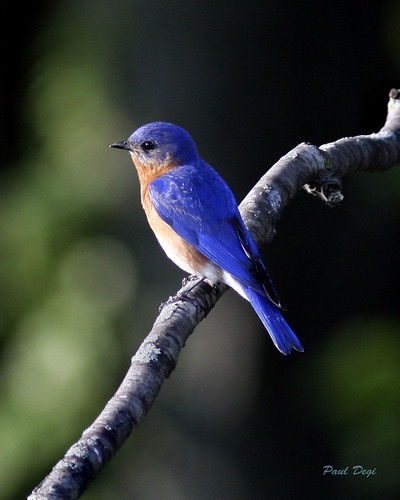
Michigan Bluebird

Michigan Bluebird

Michigan Bluebird, photo by incaseofme.

Paul suggests that you view this photo larger. It’s part of his Birds & Wildlife set (slideshow) and also appears in the Birds of Michigan group.

All About Birds: Eastern Bluebird from the Cornell Lab of Orinthology has some great information (including photos and sounds) of this lovely bird. They have a range map that shows bluebirds are seasonal residents of Michigan, preferring to head south in wintertime. You can also see the UM Animal Diversity Web’s Eastern Bluebird (Sialia sialis) and the Wikipedia Eastern Bluebird.

The Michigan Bluebird Society says that:

Back in the 1700’s when the eastern U.S. was getting populated, indications are that bluebirds were more common than they are now. As more and more farmland was created, bluebird numbers almost certainly expanded even more. Why? First, more farms meant there was more open habitat which bluebirds love. Second, the early settlers typically planted apple orchards. Apple trees are one tree which easily produces cavities which are perfect for bluebird nests. And third, in building these early farms, settlers would erect fences made of wooden posts from the trees they cleared. These many fenceposts would eventually develop rotted out cavities and woodpecker holes which again, would provide ideal bluebirds nesting sites.

Bluebird numbers are believed to have expanded up until the late 1800’s when two non-native bird species were introduced to the U.S. – the House Sparrow and the Starling. These two aggressive and invasive species quickly spread and out-competed bluebirds for natural nesting sites. In addition, as urban areas expanded in the 1900’s and pesticides started to be used in agriculture in increasing amounts, bluebird numbers declined more quickly.

They and bluebird groups across the country have worked to restore these birds and their numbers have been increasing since the 1970s.

A Michigan Osprey Pair at Wildwing Lake

Osprey Pair at Wildwing Lake 1

Osprey Pair at Wildwing Lake 1, photo by C.A. Mullhaupt.

C.A. Mullhaupt took this incredible photo (view it bigger) of a pair of osprey at Wildwing Lake in Kensington Metropark near Milford, Michigan.

The Michigan DNR’s Osprey (Pandion haliaetus) page says:

The “fish hawk” (length of 22-25 inches, wingspan of 4.5-6 feet) is brown above and white below, and flies with a distinct bend in its wing at the “wrist.” Their feet are equipped with spiny scales and long talons that give them a firm grip on slippery fish, their only prey. Ospreys usually select tall trees in marshes along streams, lakes or man made floodings. They will adapt to artificial nesting platforms. This help from humans, along with the restriction of certain harmful pesticides, has helped ospreys recover from the drastic population reductions seen in the 1950s and ’60s…

The Department of Natural Resources requests help from wildlife observers to report any sightings of osprey in southern Michigan, particularly in the Maple River area (north of St. Johns,) and in southeast Michigan (Oakland, Wayne, Macomb and Livingston counties.)

Osprey Watch of Southeast Michigan (OWSEM) is a non-profit volunteer organization based at Kensington Metropark. Their goal are to help the Michigan DNR in their efforts to restore the osprey to Southern Michigan and to educate the public about this very special raptor. On their very extensive web site they have a cool osprey sighting map, lots of reports and photos and there’s even information about osprey hacking.

You can learn more about the osprey from Wikipedia’s osprey entry and the get photos, calls and other info from
Pandion haliaetus (osprey) at the University of Michigan Animal Diversity Web

Exposure Detroit in Ann Arbor – June – July 2008

Fly by

Fly by, photo by blind lemon larry.

The Exposure.Detroit in Ann Arbor show opens this Friday (June 6) from 7-9 PM at Sweetwaters Cafe in Ann Arbor and continues through July and the Ann Arbor Art Fair. The theme of the show is “Michigan means ______ to me” and you can see the photos submitted right here.

Selected photographers for the show are: vonhaupt, rhonda marie, mike glinski, joejoesmoe , orlowski photography, kevin ridge , buckshotjones, tedguy49, paulhitz, radiospike, bobby alcott, maya fardoun, caterpillars, A2 Kathy , ledio/shqipo, ryan southen, bashas04, david sr. – lapeer photography, 1manwithacamera , keith burgess photography, kathy4, blind lemon larry , urban picasso , living in red, Rich S , Katthor , amy palomar, senecacreek/, ralph ckrawczyk jr/, alanna st laurent.

This photo is part of Larry’s Michigan set (slideshow).

Kirtland’s Warbler and the Kirtland’s Warbler Festival

Kirtlands Warbler (Dendroica kirtlandii)

Kirtlands Warbler (Dendroica kirtlandii), photo by birdman06.

The photographer notes that Kirtland’s Warbler is the rarest warbler in the US. It’s part of his cool set of photos of Songbirds and birds like Songbirds (slideshow).

The Michigan DNR’s page on Kirtlands Warbler (Dendroica kirtlandii) begins:

The endangered Kirtland’s warbler is one of the rarest members of the wood warbler (Parulidae) family. It is a bird of unusual interest for many reasons. It nests in just a few counties in Michigan’s northern Lower and Upper peninsulas, in Wisconsin and the province of Ontario and, currently, nowhere else on Earth. Its nests generally are concealed in mixed vegetation of grasses and shrubs below the living branches of five to 20 year old jack pine (Pinus banksiana) forests.

Click through to read about how the bird was named in honor of Ohio physician, teacher, horticulturist and naturalist Dr. Jared P. Kirtland, that it wasn’t until 1903 that Norman A. Wood discovered the first nest in Oscoda County in northern lower Michigan and much more about this truly rare bird. You can read more and see some pictures at Dendroica kirtlandii (Kirtland’s warbler) from the Animal Diversity Web at U-M and Wikipedia’s Kirtlands warbler entry. There’s even a Kirtland’s Warbler Audubon Society in Comins, Michigan that is a chapter of the Michigan Audubon Society and keeps track of all things warbly.

It’s maybe unsurprising then that there is an annual Kirtland’s Warbler Festival held every May on the campus of Kirtland Community College in Roscommon. The festival is billed as a celebration of nature and takes place next weekend (May 17, 2008). It features field trips to see Kirtland’s warblers, presentations about these and other rare or endangered Michigan species (piping plovers, osprey, eagles, turtles) and birding in general, plenty of activities for kids and a concert by the Great Lakes Myth Society

In addition to a ton more information about the festival and the feathered feature, the festival site features a Kirtland’s warbler video where you can hear the bird’s song.

Why Stop To Think Of Weather

Why Stop To Think Of Weather

Why Stop To Think Of Weather, photo by jbnuthatch.

jbnuthatch offers an excerpt from I’m In The Mood For Love that I everyone in Michigan probably needs to hum one day or another.

Why stop to think of whether
This little dream might fade
We’ve put our hearts together
Now we are one, I’m not afraid

If there’s a cloud above
If it should rain, we’ll let it
But, for tonight, forget it
I’m in the mood for love

I think it’s also pretty obvious that I have some sort of thing for ducks

to water

Untitled, photo by Brooke Pennington.

I know that I’m supposed to feature different photographers, and that it hasn’t been that long since the last time Brooke made an appearance.

I plead helplessness in the face of photographic awesomeness … and ducks.

Have a lovely weekend folks.