Michigan Birds: White-breasted Nuthatch

White-breasted Nuthatch

White-breasted Nuthatch, photo by Beth Crawford 65.

On their White-breasted Nuthatch page, All About Birds notes that although this is the largest nuthatch, it’s still a small bird. They say:

Nuthatches are active, agile little birds with an appetite for insects and large, meaty seeds. They get their common name from their habit of jamming large nuts and acorns into tree bark, then whacking them with their sharp bill to “hatch” out the seed from the inside. White-breasted Nuthatches may be small but their voices are loud, and often their insistent nasal yammering will lead you right to them.

For more about these common Michigan birds including photos and songs, click the link above and also see Sitta carolinensis (white-breasted nuthatch) from the UM Animal Diversity Web and White-breasted Nuthatch on Wikipedia.

That Wikipedia link shows the bird upside down, a position that Beth says this one is usually in. Check out more shots in her White-breasted Nuthatch set (slideshow).

Happy Thanksgiving from Michigan in Pictures!

Struttin' 1 9935-09

Struttin’ 1 9935-09, photo by StacyN – MichiganMoments

I hope you all have a great Thanksgiving if you celebrate it, and that if you don’t you get a chance to celebrate what you’re thankful for.

You can get a lot of absolutemichigan.com/Turkey has all kinds of Thanksgiving fun including our Totally Terrifying Turkey Trivia Test – check it out!

Stacy took this shot along the road near Ravenna, Michigan. Check it out in her Best Animal / Bird Images set (slideshow).

(way) Over the River

Geese

Geese, photo by amariefoto.

I hope you have safe travels, much to be thankful for and a Very Michigan Thanksgiving.

See this bigger in Andrea’s slideshow.

Great Egret (Ardea alba)

Great Egret ( No. 2 ) Sepia

Great Egret ( No. 2 ) Sepia, photo by Paul Degi Photography.

The All About Birds entry for the Great Egret says:

A large white heron, the Great Egret is found across much of the world, from southern Canada southward to Argentina, and in Europe, Africa, Asia, and Australia. It’s the largest egret in the Old World, and thus has garnered the name Great White Egret. In the New World, however, the white form of the Great Blue Heron is larger. In the United States, the Great Egret used to be called the American Egret but that was hardly appropriate, since its range extends beyond the Americas and indeed farther than other herons.

The Great Egret (Ardea alba) entry on the UM Zoology Animal Diversity Web adds that the ideal location for great egrets is near any form of water. Streams, lakes, ponds, marshes and wooded swamps and wetlands are the preferred location for great egrets and other heron species. There is (of course) more on Wikipedia and here’s a sweet video of a great egret nesting site along Lake Huron.

Be sure and check this out bigger or in Paul’s B&W set (slideshow).

Check out many more Michigan Birds on Michigan in Pictures!

Know Your Michigan Birds: Great Blue Heron


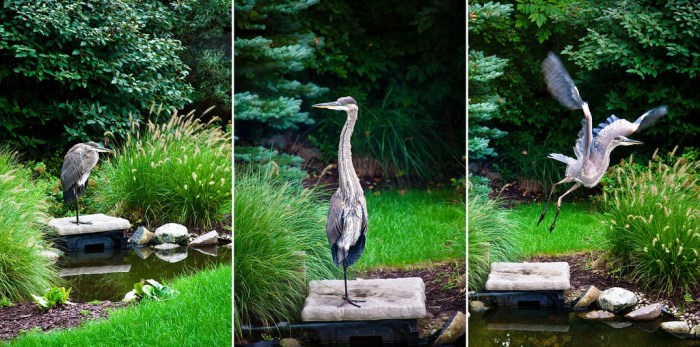
Great Blue Heron Tryptich

backyard-heron-triptych, photo by numstead.

Great Blue Heron (Ardea herodias) on Animal Diversity Web at UM – where you can get complete information, pictures & sounds – says that these birds are the largest and most common herons in North America. The Michigan DNR’s Blue Heron page explains that:

This is the familiar, large grayish-blue heron seen wading in shallow water in marshes, ponds and along lakeshores and stream edges. They are sometimes confused with the sandhill crane; the heron is smaller and flies with its neck folded back, while cranes fly with their neck extended. Great blue herons are commonly seen in small suburban wetlands (cranes are generally less tolerant of close presence). Herons feed on fish, frogs, and other small animals, captured by a quick jab of the beak. They nest in colonies, usually building their stick platform nests in trees in lowland hardwood swamps. In recent years many rookeries have been displaced by shoreline development or timber cutting. Every attempt must be made to preserve known nesting sites if these beautiful birds are to remain common in Michigan’s wetlands.

Wikipedia has more about the Great Blue Heron and you can get more info (and typical calls) from All About Birds. There’s even a short video of a Michigan blue heron on the Kalamazoo River on YouTube.

Nathan says he looked out the window, saw this guy chillin’ by the frog pond and couldn’t believe his eyes when he stretched his neck. Be sure to check this out bigger or in his Great Outdoors set (slideshow).

Where is Home?

Crystal Lake, Michigan

Crystal Lake, Michigan, photo by *ojoyous1*.

On Joy’s blog she has a post (with more photos) titled Where is Home? where she says:

I arrived here in Northern Michigan late yesterday afternoon.

I felt all the stress of the city just slip away, and I felt like I had come home. I think Maggie (her dog) sensed it, too!

And I realized this time, just how much of this place & my Michigan friends I carry with me everyday when I’m back in Ohio.

I thought I would take you with me on my morning walk with Maggie along beautiful Crystal Lake….

What spot makes your heart sing?

Where do you feel most at “home”?

Check this out bigger in her Up North slideshow.

…and yes, this too is part of the ever-expanding Michigan Duckie Photo Collection!

Return of the Duckies: Ann Arbor Summertime 2009

Ann Arbor Summertime 2009

Ann Arbor Summertime 2009, photo by RichardD72.

Check this out bigger in Richard’s Summertime slideshow and remember that Michigan in Pictures is your source for Michigan duckie photos – accept no substitutes!

Wire Watching!

Wire Watching!

Wire Watching!, photo by mdprovost ~.

Be sure to check it out bigger.

Swan Origami

Swan Oragamy

Swan Oragamy, photo by MudPhish.

…it’s apparently all the rage these days.

Be sure to check it out bigger.

Cerulean Warbler and 68 endangered friends

Cerulean-Warbler-at-Embury-

Cerulean-Warbler-at-Embury-, photo by richard.sleeman.

I’ve recently posted about the de-listing of the gray wolf and bald eagle in Michigan. The osprey was recently removed as well, but the Michigan Department of Natural Resources recently revised its list of threatened and endangered species and added 69 to the list. They say that the most notable addition is the cerulean warbler.

The All About Birds page on the Cerulean Warbler has some excellent photos and even the warbler’s song. The Audubon Watchlist for the Cerulean Warbler (Dendroica cerulea) estimates that there are about 1/2 a million of these birds in the world and says:

This wood-warbler is not easily confused with other warblers. The adult male is a deep cerulean blue above with a streaked back, and is white below with a narrow blue-black band across the throat. The adult female is bluish-green above with no streaks, and white washed with yellow below with a distinct white or yellowish line over eye. All plumages and both sexes have white wing bars and white tail-spots.

The species suffers from habitat loss and degradation in both its summer and winter range. The remaining population breeds in the northeastern and central parts of the United States as far north as s. Ontario, as far south as Arkansas, as far east as the Atlantic Coast, and as far west as Iowa. Ceruleans are not evenly distributed throughout this range.

Typically found in mature forested areas with large and tall trees of broad-leaved, deciduous species and an open understory, but may also inhabit wet bottomlands, some second-growth forests, and mesic upland slopes. Eats insects in the foliage and a small amount of plant material in the winter. Nests high in the canopy on a lateral limb of a deciduous tree above an open area. The nest is concealed from above by leaves or vines. The 3-4 eggs are incubated by the female, but both parents feed the young. As a medium- to long-distance migrant, these warblers may arrive on their breeding range from late March to mid-May and be back on their wintering grounds as early as August.

Richard took this photo at the Waterloo State Game Area. See it bigger in his Warblers slideshow.