Flow: Au Train River

Flow

Flow, photo by John Clement Howe.

John took this shot in Au Train, Michigan where the Au Train River flows into Lake Superior. Check it out bigger in his Lakeshores slideshow.

Speaking of flow, rivers and water, if you’ve never seen Irena Salina’s documentary on the World Water Crisis, I heartily encourage you to check out Flow. The New York Times review has this to say about Flow:

A documentary and a three-alarm warning, “Flow” dives into our planet’s most essential resource — and third-largest industry — to find pollution, scarcity, human suffering and corporate profit. And that’s just in the United States.

Yet Irena Salina’s astonishingly wide-ranging film is less depressing than galvanizing, an informed and heartfelt examination of the tug of war between public health and private interests. From the dubious quality of our tap water (possibly laced with rocket fuel) to the terrifyingly unpoliced contents of bottled brands (one company pumped from the vicinity of a Superfund site), the movie ruthlessly dismantles our assumptions about water safety and government oversight…

Yesterday: Sand. Today: Zebra Mussels & Quagga Mussels

Zebra Mussels

Zebra Mussels, photo by cedarkayak.

“In terms of the whole food web, I don’t think there’s any question that zebra and quagga mussels have had the largest impact on the biological communities of the Great Lakes”
~Tom Nalepa, Great Lakes Environmental Research Laboratory

Today’s villain in our Michigan Invasive Species series are Zebra Mussels & Quagga Mussels. That feature on Absolute Michigan goes in depth about who they are and what they do so I won’t go on and on here except to say that as someone who walks the beaches of Lake Michigan often, there’s few things that make me sadder or madder than these little bastards. They’ve trashed the food chain, spawned all manner of nasty plants & algae and they slice up your feet.

Todd writes:

This stretch of beach on South Manitou Island was once filled with sugary white sand. Today, the beach is covered in razor sharp zebra mussel shells. I knelt to take then photo, and when I stood, my knee was bleeding in 3 places.

Check this out background big and in his Lake Michigan slideshow.

Invasive Species in Michigan

Shell Cluster

Shell Cluster, photo by johndecember.

All week we’re going to be featuring invasive species – who they are, what they’re doing to our lakes & land and how folks are working to stop them. See the articles as we post them on Absolute MichiganMichigan in Pictures and !

I actually already blogged this photo to Pandora’s Locks: How Invasive Species got into the Great Lakes on Absolute Michigan. The book is a must-read for anyone who wants to learn how the way the shipping industry operates guarantees that invasive species will spread.

You will note that John has TWO invaders here, the zebra mussel and the Asian ladybird beetle. Check this out bigger in John’s slideshow!

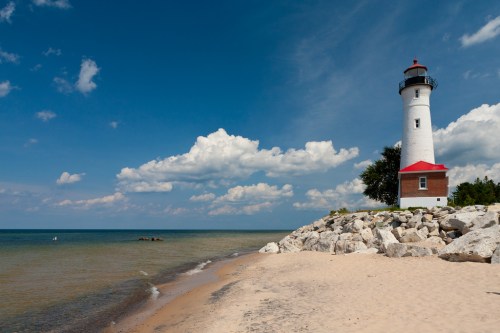
Crisp Point Lighthouse on Lake Superior

Crisp Point Lighthouse
Crisp Point Lighthouse, photo by Mario.Q

Terry Pepper says that a visit to Crisp Point is a “must” for any lighthouse fans, as it remains one of the most desolate and beautiful locations in all of the Great Lakes. He should know, as he’s the last word in Great Lakes Lighthouses. On his Crisp Point Lighthouse entry he writes:

The Lake Superior coastline between Whitefish Point and Grand Island stands as one of the most beautiful stretches of shoreline in all of the Midwest. With pleasure boaters, tour boats and kayakers making their leisurely way along the coast to soak up the natural beauty. It is difficult to imagine that during the 1800’s this stretch of seemingly bucolic coastline was known to mariners as “The Shipwreck Coast,” with the hulks of innumerable vessels pushed onto the shore by violent storms out of the north, or lost in the pea soup fogs which frequently enveloped the area.

…Congress approved the establishment of four life saving stations between Vermilion and Deer Park on June 20, 1874, one of which was designated as Station Ten, and built at an unnamed point approximately fifteen miles west of Whitefish Point. Although David Grummond was appointed as the first keeper at life saving station 10, it would be Christopher Crisp who served as keeper from 1878 until 1890 who would have the most lasting impact on the area, as Crisp became so well known that the point on which the station was established would become forever known as “Crisp’s Point.”

Much more about the lighthouse at the link above and also from the Crisp Point Historical Society.

Check it out bigger and in Mario’s Great Outdoors slideshow.

Many more Michigan Lighthouses on Michigan in Pictures.

Summer 2010, here and gone

falling sand

falling sand, photo by Funke910.

Like sand through the hourglass…

Is it just me or did summer seem to fly by unusually fast this year?

It’s probably just me.

Hope you enjoyed your summer – let’s do it again next year!

Check this out bigger in Bill’s slideshow and drive safely if you’re out and about!

Mosquito Beach in the Pictured Rocks National Lakeshore

Mosquito Beach

Mosquito Beach, photo by cedarkayak.

Todd says that Mosquito Beach favorite spot along the Pictured Rocks. Since it’s mine too I thought we could feature it today! The beach is pretty secluded, probably because the Pictured Rocks National Lakeshore doesn’t have much to say about it. It’s located on the Mosquito Falls trail – check the trail map for Chapel Basin on their map page!

Be sure to check this out big as Lake Superior and in his Pictured Rocks National Lakeshore slideshow.

Editor’s Note: The caves at the far point are known as the Caves of the Bloody Chiefs, which legend says were used by ancient chiefs to tie their captives and let Lake Superior batter them to death.

Lots more Pictured Rocks on Michigan in Pictures.

Celebrating Michigan’s Water Winner: Golden Dip

Golden Dip

Golden Dip, photo by Aver123

Our judges have selected the winner in the Celebrating Michigan’s Water Photo Contest. The winning photographer, Avery Sullenger-Wedder, will receive 2 nights at The Homestead Resort in Glen Arbor along with a Crystal River eco-tour!

View it bigger or in the Michigan Water slideshow and thanks to everyone who participated!

Burt Lake & William Austin Burt

Burt Lake Shoreline ~ Indian River, Michigan

Burt Lake Shoreline ~ Indian River, Michigan, photo by peterlfrench.

Wikipedia says that Burt Lake is a 17,120 acre lake in Cheboygan County. It was named after William Austin Burt, who, together with John Mullett, made a federal survey of the area from 1840 to 1843. I know that you want to know more about William Austin Burt, and Wikipedia has it covered again:

William Austin Burt (June 13, 1792 – August 18, 1858) was an American inventor, legislator, surveyor, and millwright.

Burt was born in Worcester, Massachusetts, and lived in Michigan from 1822 until his death in 1858. He was a member of the Michigan Territorial Legislature, 1826-1827. He served as Mount Vernon’s first postmaster from 1832 to 1856. He was a Macomb County Circuit Court judge in 1833, a state legislator in 1853, and a deputy U.S. surveyor from 1833 to 1853. While surveying, he won acclaim for his accurate work on public land surveys. In 1857, Burt moved to Detroit, where he died a year later.

Among Burt’s numerous inventions were the typographer in 1829, which was a predecessor to the typewriter. He also invented the solar compass, a surveying tool used in the Michigan Survey, employed in regions that had an abundance of minerals, which would interfere with accurate readings when using ordinary instruments. While out surveying on September 19, 1844, in what is today Marquette County, Michigan, Burt discovered one of the largest iron ore deposits in the United States. A historical plaque commemorates William Austin Burt at Stony Creek, near his home in Mt. Vernon, Michigan.

See this bigger and in Peter’s Northern Michigan slideshow and check out more Michigan lakes on Michigan in Pictures!

On a personal note, when I was a kid my family had a cottage not far from here.

Elk Rapids Beach

Elk Rapids Beach

Elk Rapids Beach, photo by kmoyerus.

Somebody told me once, “If you see a curve, take a picture.”

Check this out bigger and see more black & white photography on Michigan in Pictures.

A little beach-keh on Throw in a Petoskey Stone Day

beach-keh

beach-keh, photo by *ojoyous1*.

July 17th is Throw in a Petoskey Stone Day. If you’re unfamiliar with it, that’s because it was invented on Michigan in Pictures last July 17th. The basic goal is to preserve Petoskey stones for future generations by throwing them out into the water., but nobody can fault you if you decide to take one or more home with you.

Click that link above for more about Michigan’s State Stone. Here’s what Rose Petoskey has to say:

Many people would associate the word Petoskey with the souvenir stone found on the northern Lake Michigan shorelines. However, to my family, the word Petoskey represents much more than a souvenir.

In the Odawa language, the word Petoskey (Bii-daa-si-ga) means the rising sun, the day’s first light, or the sun’s first rays moving across the water. The Petoskey stone is a fossilized coral created by impressions made in limestone during the last Michigan ice age. These stones were named “Petoskey” because the impressions resembled the rising sun coming up over the water. Just as the image of the rising sun is implanted within the Petoskey stone, the archaeology of a person’s names is implanted within. All names within our Anishinaabek culture reflect an individual’s personal history. Rocks go deep, but names go much deeper to reveal the stories of the past.

Read on for some interesting thoughts about language.

Joy found this on the beach near Frankfort. Take a stroll along Frankfort beach with Joy and I hope you have a great weekend!