Christmas Moon, Snow Moon, Cold Moon, Oak Moon, December Moon

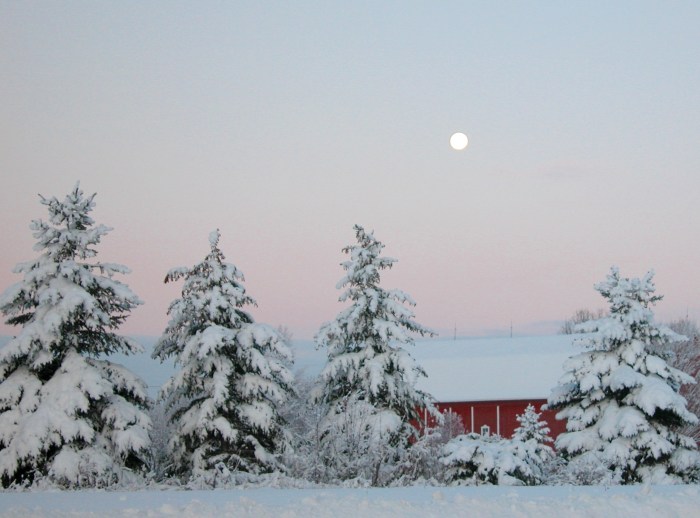
Crisp Morning in December

Crisp Morning in December, photo by CaptPiper.

The moon is officially full at 9:36 AM tomorrow morning, so tonight is the fullest moon you will get for a December night. Full Moon Names in the Farmer’s Almanac says that December’s full moon was known as the Cold Moon or the Long Nights Moon by the Algonquin.

The Full Cold Moon; or the Full Long Nights Moon – December During this month the winter cold fastens its grip, and nights are at their longest and darkest. It is also sometimes called the Moon before Yule.

The term Long Night Moon is a doubly appropriate name because the midwinter night is indeed long, and because the Moon is above the horizon for a long time. The midwinter full Moon has a high trajectory across the sky because it is opposite a low Sun.

A few other names from Wikipedia’s full moon entry and elsewhere are the Bitter Moon (Chinese), Christmas Moon (Colonial America), Snow Moon (Cherokee), and Oak Moon (England).

Check this out background bigtacular and in Julie’s Michigan Barns slideshow.

More winter wallpaper from Michigan in Pictures.

August Nights

August Nights

August Nights, photo by False Verdict Photo.

Quincy, Michigan in Branch County. Such a classic Michigan scene. Here’s hoping the August evenings are treating you well.

Check this out background big and in Lauren’s Michigan slideshow.

More Michigan barns on Michigan in Pictures.

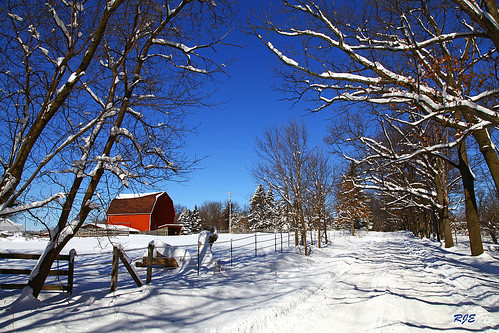
Country road in red, white & blue

Country road

Country road, photo by R.J.E..

Check this out bigger and in R.J.E.’s slideshow. (seriously – his slideshow is off the hook!)

See more barns on Michigan in Pictures, and I hope everyone has a really great weekend too!

Shaytown

Shaytown by Joel Dinda

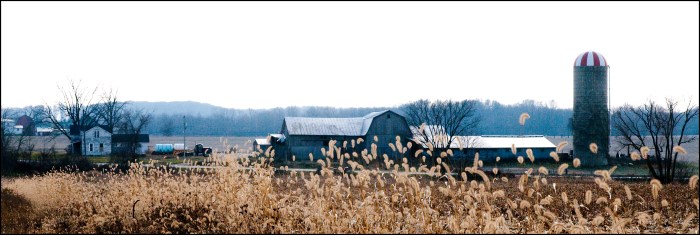
Shaytown, photo by joeldinda.

A few years ago we ran an old photo of a Shay Locomotive on Michigan in Pictures. The other day, I came across this photo in our Absolute Michigan pool on Flickr. Joel writes:

I was wandering around the local backroads a few days ago when I spotted this sprawling barn and these tall grasses; seemed like a possible photograph….

Further research about the location turned up an unexpected gem. Seems that Shaytown was named for Ephraim Shay, inventor of the classic narrow-gauge lumbering locomotive, who became famous after bestowing his name on this corner. Recovering railfan that I am, I knew who he was, but hadn’t recognized the local connection.

Near as I can tell, Shay owned this property for four years or so shortly after the Civil War, where he ran a sawmill and (probably) a general store. Those are gone, and to all appearances the existing barn and house were built by later owners.

Nonetheless, a delightful surprise. Unfortunately, and despite the truck parked in the yard, both the house and barn seem to be abandoned.

Check this out nearly lifesize and also in his The Showcase slideshow.

Stairway to Heaven

Stairway to Heaven

Stairway to Heaven, photo by sl33stak.

Check this out big as a barn and in Jamie’s Buildings & Structures slideshow.

More Michigan barns on Michigan in Pictures!

Why are most barns red?

Why are most barns red?

Why are most barns red?, photo by whitepuffycloud.

Shannon dug up the answer to the question: Why are barns usually painted red?:

Centuries ago, European farmers would seal the wood on their barns with a linseed oil mixture, often consisting of additions such as milk and lime. The combination produced a long-lasting paint that dried and hardened quickly. Now, where does the red come from?

Wealthy farmers added blood from a recent slaughter to the oil mixture. As the paint dried, it turned from a bright red to a darker, burnt red.

Farmers added ferrous oxide, otherwise known as rust, to the oil mixture. Rust was plentiful on farms and is a poison to many fungi, including mold and moss, which were known to grown on barns. These fungi would trap moisture in the wood, increasing decay.

Regardless of how the farmer tinted his paint, having a red barn became a fashionable thing. They were a sharp contrast to the traditional white farmhouse. As European settlers crossed over to America, they brought with them the tradition of red barns. In the mid to late 1800s, as paints began to be produced with chemical pigments, red paint was the most inexpensive to buy. Red was the color of favor until whitewash became cheaper, at which point white barns began to spring up.”

You may also wonder why barns have lightning rods – we’ve got that covered too!

Check this out bigger in Shannon’s Lansing, MI slideshow!

Farming in Michigan in the 1880s


Antrim County Farm, 1889, photo courtesy Seeking Michigan

The good folks at Seeking Michigan dug this gem for me and it’s one of those that you just have to check out bigger.

Teaching Michigan History is just one of many of great online features from the apparently soon-to-disappear Michigan Department of History, Arts & Libraries. Read about how this freaks out historians that this incredible cultural resource is being scrapped to save 2 million dollars and see Facebook for efforts to save HAL. They published this cool Excerpt from Charles Estep’s Farm Diary, August 1884 that gives a look at the difficult life of a farmer at the turn of the century in Michigan. It begins:

Nineteenth century farmers often kept hand-written diaries of their farming activities: planting, raising and harvesting crops. The following is an August 1884 excerpt from Charles Estep’s “Farm Diary 1883-1886.” His farm on Musgrove Highway later became the Fred Bulling Farm in Sebewa Township, Ionia County, Michigan. Today, farmers often keep track of their crops on computers. Historians and scientists use diaries and computer print-outs to study farming practices and trends over time.

Since I have no idea how long these materials will stay online if HAL is dissolved, here’s a few excerpts from the excerpt:

Friday, August 1st, 1884. Perry cut some oats yesterday. He came over this morning. I went out and found they were too green and got him to wait until next week. I worked in the corn a little and bound up some oats.

Tuesday, 5th. A little showery this forenoon. I handled over some manure. Perry helped me part of the forenoon. Afternoon he cut and I bound oats.

Friday, 8th. Perry finished cradling the oats today. I went to Portland to take my teeth to have them fixed over. They are worse than ever they were. He is going to reset them again. Ella Estep rode out to Father’s with me.

Friday, 15th. I did but little today. I finished the oat stack, marked out a headland, set a stump on fire and the fire ran all over the piece. In the afternoon my head ached, so I did not work.

Tuesday, 19th. Today I plowed and picked up stone. I am plowing my oat stubble. The weather is very warm and very dry.

Thursday, 21st. I went down home and helped thresh part of the day. The rest I picked stone and plowed. Father and Bion had 971 bushels of wheat.

Friday, 22nd. I picked up a load of stone and plowed today.

Saturday, 23rd. Foe was sick all night last night. After breakfast I went down and got Mrs. VanHouten to come and see her. She said we had better send for a doctor right away, so I went down home and started Bion after the doctor and got Mother. Then I went and got Mrs. D. Leak. In the meantime Mrs. Olry came. Dr. Smith came at two o’clock. At about four o’clock our baby was born, a bouncing healthy boy of 8 and 3/4 pounds. Foe was very sick, indeed. Mother stays all night.

Thursday, 28th. I was down to Mr. Ralstons and borrowed a baby crib. I borrowed a drag down home. I went out and dragged a while. It commenced to rain too hard to work most of the time. I went and got Mrs. D. Leak to come and dress the baby.

Click to read more entries.

Bones … and barns

Bones

Bones, photo by Cherie S..

Be sure to check this out bigger or in Cherie’s Rural Explorations set (slideshow).

If you’re interested in helping old barns like this, consider joining the Michigan Barn Preservation Network.

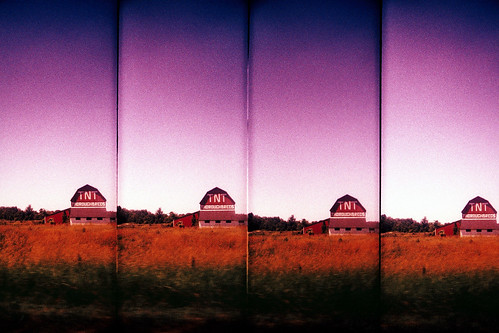
supersampler II: I dream in Technicolor

I dream in Technicolor

I dream in Technicolor, photo by Amy Palomar.

Amy says no photoshop. right out of the camera.

More about the supersampler.

Afton…now and then

Afton...now and then

Afton…now and then, photo by smartee_martee.

Marty writes:

21 September 2008; Afton, Michigan.

The postcard is postmarked Sept 2, 1920.

Patrick O’Connor opened a lumber camp in Ellis Township in 1887. Ellisville was the name given to its first post office in 1905. It was asked to be renamed Afton, for that it was thought to resemble Afton in Scotland because of the Pigeon River flowing nearby. It was officially Afton on Feb. 12, 1906.

This photo is part of Marty’s amazing Overnight Photo Trip September 2008 (slideshow). He drove nearly 2000 miles through northern Michigan and the Upper Peninsula, chronicling small towns, hamlets and crossings.