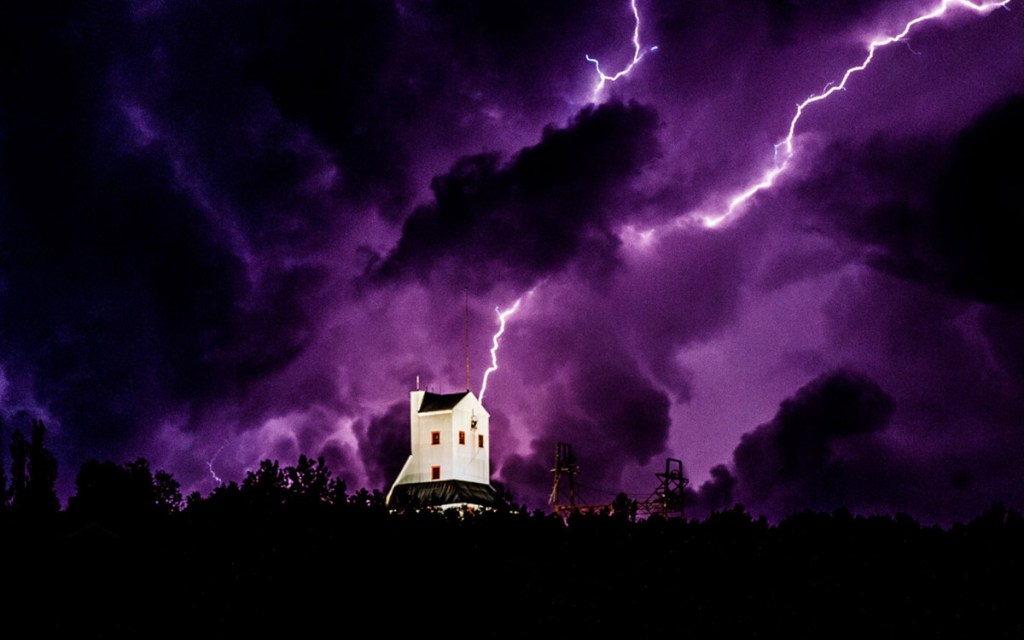
The Houghton Blitz: Lighting the Quincy Mine

2014-houghton-blitz-2978 by Christopher Schmidt

2014-houghton-blitz-2978 by Christopher Schmidt

“Our children were born here and now we have five grandchildren to celebrate also. We have proud geological roots here. We think the shaft should be bright on our birthdays, and this would be a good way to support geoheritage and the QMHA. We hope other local families will consider doing this.”
~Bill and Nanno Rose

Apparently, you can make a donation and have the Quincy Mine Shaft lit up in honor of a loved one. Click the link for details!

The photo above shows the Quincy Mine Hoist, part of the Quincy Mine complex, an extensive set of copper mines near Hancock. The mine was owned by the Quincy Mining Company . The Quincy Mine was known as “Old Reliable,” paying a dividend to investors every year from 1868 through 1920 and operated between 1846 and 1945. The Quincy Mine page on Wikipedia says (in part):

The Quincy Mine was founded in 1846 by the merger of the Northwest Mining Company and the Portage Mining Company. Due to poor communication between government offices, these two speculative mining companies had purchased the same tracts of land during the mining rush of the early 1840s. The directors met and decided to merge, with significant investment coming from Massachusetts (the town of Quincy, Massachusetts lent the mine its name). While many other copper mines were founded at the same time, the Quincy Mine became the most successful of the 1840s-era mines, and was the country’s leading copper-producing mine from 1863 (when it exceeded the production of the Minesota Mine) through 1867 (after which it was exceeded by the Calumet and Hecla).

The mine was the first Michigan copper mine to switch from fissure mining to amygdaloid mining, when the recently discovered Pewabic amygdaloid lode was found to cross Quincy property in 1856. High-grade fissure veins contained large, pure masses of copper, but the masses could take days or even months to extract, at high cost. Amygdaloid mining consisted of extracting lower-grade strataform orebodies in the “amygdaloid zones,” the upper portions of basalt lava flows. Rock bearing small pockets of copper could be blasted out immediately and processed elsewhere at much lower cost. Amygdaloid mining proved much more productive than fissure mining, and the size and richness of the Pewabic lode in particular allowed the Quincy to produce profits for 53 consecutive years. The Quincy company expanded laterally along the lode by buying out adjacent properties. The company bought the Pewabic mine in 1891, the Mesnard and the Pontiac in 1897, and the Franklin mine in 1908. This helped the mine survive longer than almost all other Keweenaw copper mining companies, except the Calumet and Hecla Mining Company and the Copper Range Company.

To attract a better class of worker, the Quincy Mining Company built and maintained housing for the workers. Over the course of operations, the types of housing ranged from simple tents in the early days, to complete three story houses shortly before the mine’s shutdown. The executives on the east coast wanted to build more elaborate and fancy homes with amenities such as electricity and running water. However, the on-site managers didn’t think it was necessary for the miners to have such high-class dwellings. But the east coast executives realized that if they offered nicer homes to the workers, the miners were more likely to stay, raise families, and be less likely to leave the area or transfer to another mining company. This strategy proved effective and helped the Quincy Mining Company retain its status as one of the premier mining companies in the region.

View Chris’s photo background bigatacular and see more in his Keweenaw Lightning slideshow.

More about the Quincy Mine on Michigan in Pictures including the second picture posted!
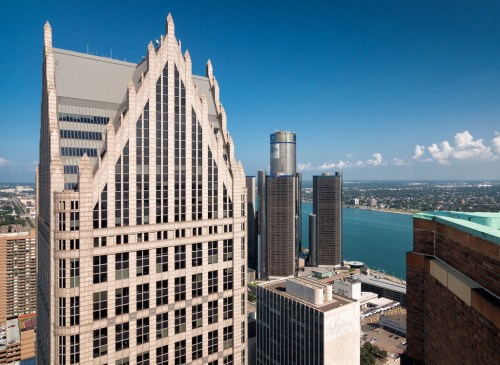
One Detroit Center (Comerica Tower) & architect Philip Cortelyou Johnson

One Detroit

One Detroit, photo by Michael G Smith

The 619 ft tall, 43-story One Detroit Center is the tallest office building in Michigan and second tallest building in the city behind the central hotel tower of the Renaissance Center. Completed in 1993, it started out as the Comerica Tower. The Detroit 1701 page on Comerica Tower says (in part):

This skyscraper is distinguished from all other tall buildings in Detroit by its neo-gothic spires. As Eric Hill and John Gallagher describe them in their book AIA Detroit, these are Flemish inspired spires.

…Philip Cortelyou Johnson was among the nation’s most influential architects and architectural critics of the Twentieth Century in the post-World War II era. Born in Cleveland in 1906, he studied philosophy at Harvard. However, he had the opportunity to take several trips to Europe while an undergraduate and became fascinated with the architecture there. In 1928, he met the innovative Ludwig Mies Van der Rohe whose work is commemorated in an historic district that bears his name located less than a mile from Comerica Tower.

In the early 1930s, Johnson affiliated himself with the Museum of Modern Art in New York and sought to support himself by promoting modern architecture and commenting about it. Apparently, that was not a financially rewarding career so he became a journalist, went to Germany and covered the rise to power of the National Socialists. Apparently, that was not completely rewarding either, so he returned to the United States and enlisted in the Army. After serving for some time, he appreciated his real calling and enrolled at the Harvard Graduate School of Design to become an architect. By the late 1940s, he began his very distinguished career.

Along with collaborators, especially Mies Van der Rhoe in the early years and John Burgee in the later years, he designed a large number of modern skyscrapers. He broke away from the classical tradition that is illustrated in Albert Kahn’s nearby First National Bank Building completed in 1922. His structures also differ from the stark modernist style illustrated by Minoru Yamasaki’s Michigan Consolidated Gas building, completed in 1965, that is almost directly across Woodward from Comerica Tower. Note the rounded corners that Philip Johnson designed for Comerica Tower conveying a sense of gentleness. All other downtown skyscrapers have right angles for their corners.

Read on for more and get One Detroit details from Emporis.

View Michael’s photo big as a building and see more in his awesome Detroit Tour slideshow.

More architecture on Michigan in Pictures.

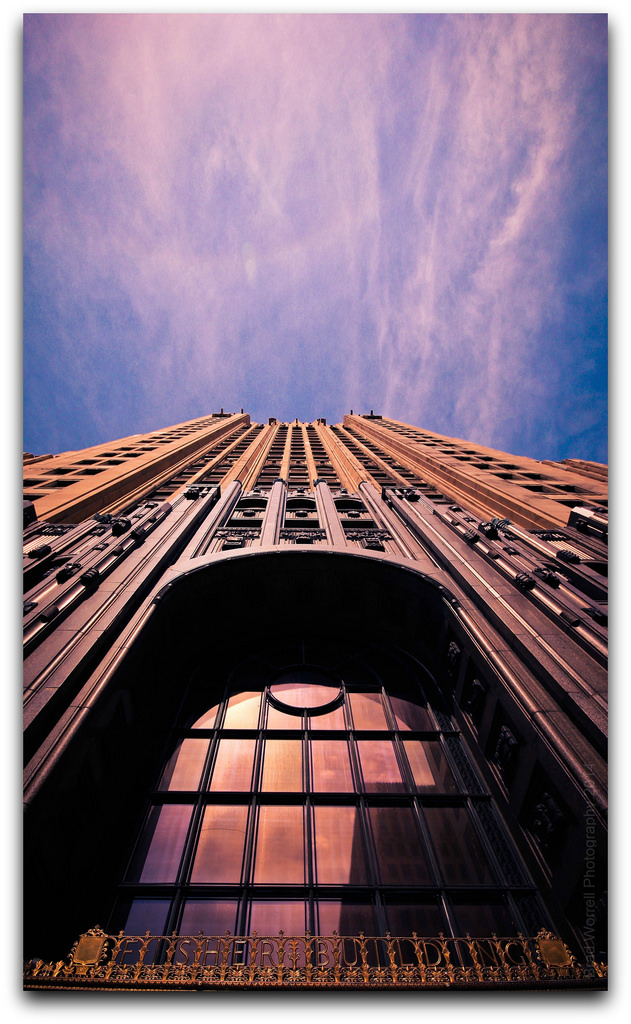
Fisher Brothers Legacy

Fisher Brothers Legacy...

Fisher Brothers Legacy…, photo by Brad Worrell

On his excellent Historic Detroit site, Dan Austin’s excellent & comprehensive article on the Albert Kahn designed Fisher Building says:

The late 1920s were a time of unprecedented growth in Detroit, especially when it came to skyscrapers. From the Penobscot Building to the Fox Theatre, 1928 saw landmark after landmark rise in the Motor City.

The 29-story Fisher is one of three National Historic Landmarks in Detroit, along with the Fox and the Guardian Building.

“The gold-capped tower has taken its proper place in Detroit’s ever-changing skyline,” the Detroit News wrote of the Fisher in October 1928, when the finishing touches were being put on the building. “This will be the most beautiful building of its kind ever created. … It is an outstanding example of the new American school of architecture, which has arisen to typify the spirit of modern progress. No expense, Mr. Kahn said, has been spared to make the Fisher building the very epitome of things beautiful.”

To achieve this feat, the Fisher was built — with only slight exceptions — entirely out of granite and marble, including on the exterior. More than 40 kinds of marble from all over the world were used. From the base of the building to 50 feet up — the first three floors — the exterior is finished in polished Minnesota pink marble and Oriental granite. Above that is Beaver Dam marvilla marble (named such because it was harvested from the Beaver Dam Quarry at Cockeysville, Md.) on the street fronts and Carthage marble on the courts. The marble was cut and positioned to give varying textures across the exterior. “The sun (plays) on differences of saw markings and grain on each block that identify the individual pieces from their neighbors,” the Michigan Manufacturer and Financial Record wrote in October 1928.

Read on for much (much) more about the Fisher Building including a sweet gallery of historic photos (including one looking up at this angle).  you can also visit the Fisher Building website.

View Brad’s photo bigger and see more in his Detroit slideshow.

More architecture on Michigan in Pictures.

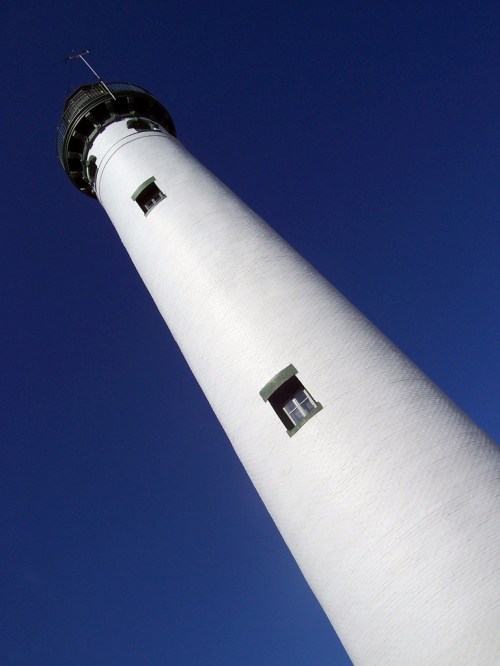
New Presque Isle Lighthouse

Presque Isle lighthouse (new)

Presque Isle lighthouse (new), photo by Jeff Rozema

Terry Pepper writes that the first Presque Isle Light was established in 1840 to serve as a guide to mariners seeking the harbor on Presque Isle, the spit of land protruding from the eastern shore of Lake Huron French trappers named “almost an island.” By 1866, the dwelling was judged to be a tear-down candidate and in March of 1967, Congress appropriated $28,000 for construction of the New Presque Isle Light according to the plan of District Engineer Orlando M Poe:

Poe’s classic design for the new tower was atypically elegant for such a utilitarian structure, and was so successful that it would be duplicated at a number of stations throughout the district, including Outer Island and Au Sable Point on Lake Superior, and at Little Sable, Big Sable and Grosse Point on Lake Michigan. Erected on a limestone foundation that extended almost ten feet below grade, the red brick tower stood 113 feet in height. 19 feet 3 inches in exterior diameter at the base, the structure tapered gracefully to a diameter of 12 feet beneath the gallery. Constructed with a double wall system, the outer walls stood 5 feet three inches in thickness at the base and the inner wall one 1 foot thick with a 2 foot three inch air space between. The inner walls did not reflect the taper of the exterior, but were erected as a pure cylinder, encasing a spiral cast iron stairway consisting of 138 steps and incorporating five landings and a watch room with four windows immediately below the gallery. Each of these windows featured a graceful arched top section, typical of Poe’s groundbreaking design.

Supported by a series of ornate cast iron corbels, the gallery provided a convenient location from which the keepers could observe vessels out on the lake during fair weather, and created a natural location from which to suspend a boatswain’s chair to conduct maintenance on the gallery supports and the masonry of the tower walls. Centered on the gallery, a prefabricated cast iron apparatus room was erected with a smaller encircling gallery. Centered within this secondary gallery, a cast iron lantern with vertical astragals was equipped with hand-holds to provide the keepers with an extra measure of safety while standing on the narrow upper gallery when cleaning or scraping ice from the plate glass lantern panes. A large cast iron pedestal to support for the lens was erected in the mechanical room below the lantern, and the massive Third Order Fresnel lens, which had been ordered from Henry LePaute Cie. of Paris assembled at its upper flare. Consisting of a brass support structure standing 8 feet in diameter, ten prismatic panels, each six feet in height and 2 feet 6 inches wide were carefully assembled within the frame to create the “crystal beehive” look typical of such lenses.

Read on for more about this lighthouse including some old pics.

View Jeff’s photo bigger and see more shots from here and far in his Lighthouses slideshow.

Many more Michigan lighthouses on Michigan in Pictures!


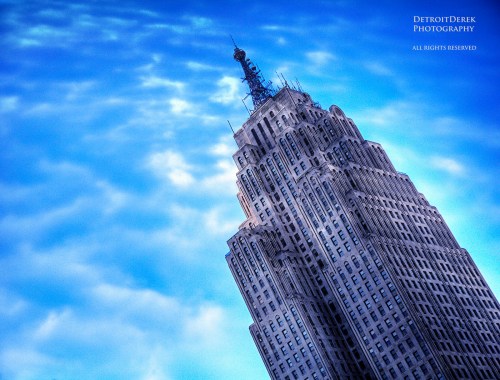
Hundred Mile High City: Detroit’s Penobscot Building

Hundred Mile High City by Detroit Derek


Hundred Mile High City, photo by Derek Farr

When I saw Derek’s photo, I remembered that I had posted a photo of the Penobscot several years ago. I found that photo has been deleted from Flickr and therefor from Michigan in Pictures as well. So here then is the definitive Penobscot post.

The Wikipedia entry on the Penobscot Building says:

Upon its completion, it was the eighth tallest building in the world and the tallest outside New York City and Chicago. Like many of the city’s other Roaring Twenties buildings, it displays Art Deco influences, including its “H” shape (designed to allow maximum sunlight into the building) and the sculptural setbacks that cause the upper floors to progressively “erode”. The building’s architect, Wirt C. Rowland, also designed such memorable Detroit skyscrapers as the Guardian Building in the same decade. At night, the building’s upper floors are dramatically lit in floodlight fashion, topped with a red sphere.

Although the Penobscot Building has more floors than Comerica Tower at Detroit Center (45 above-ground floors compared to Comerica Tower’s 43), Comerica’s floors and spires are taller, with its roof sitting roughly 60 feet taller than Penobscot’s (566′). The opulent Penobscot is one of many buildings in Detroit that features architectural sculpture by Corrado Parducci.

The Penobscot Building served as a “compass” for pilots in airplanes during its early years, due to its position of facing due north. The building also served as an inspiration of sorts for the Empire State Building in New York City, and many individuals worked on the construction of both towers.

The Penobscot Building web site says that the building serves as the fiber-optic hub for the entire Detroit area and touts it as the place for office space. You might also enjoy Historic Detroit’s page on the Penobscot Building, the Emporis page on the Penobscot and this 3D model of the Penobscot Building for Google Sketchup.

View Derek’s photo bigger and see more in his massive Detroit slideshow. He says the title of his photo came from the Ocean Colour Scene song, Hundred Mile High City.

More architecture on Michigan in Pictures.

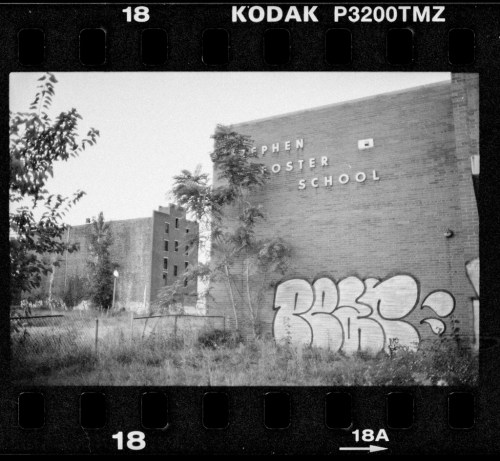
Stephen Foster School, Brush Park

Detroit T3200 Roll 2 exp. 18

Detroit T3200 Roll 2 exp. 18, photo by Marty Hogan

You’ve seen a lot of Marty’s ranging in the U.P. and lost rural places on Michigan in Pictures and he recently posted photos from a visit to Detroit.

View his photo background big and see more in Marty’s Detroit Kodak T3200 Film slideshow.

Waugoshance Morning

Waugoshance Lighthouse - Morning

Waugoshance Lighthouse – Morning, photo by lomeranger

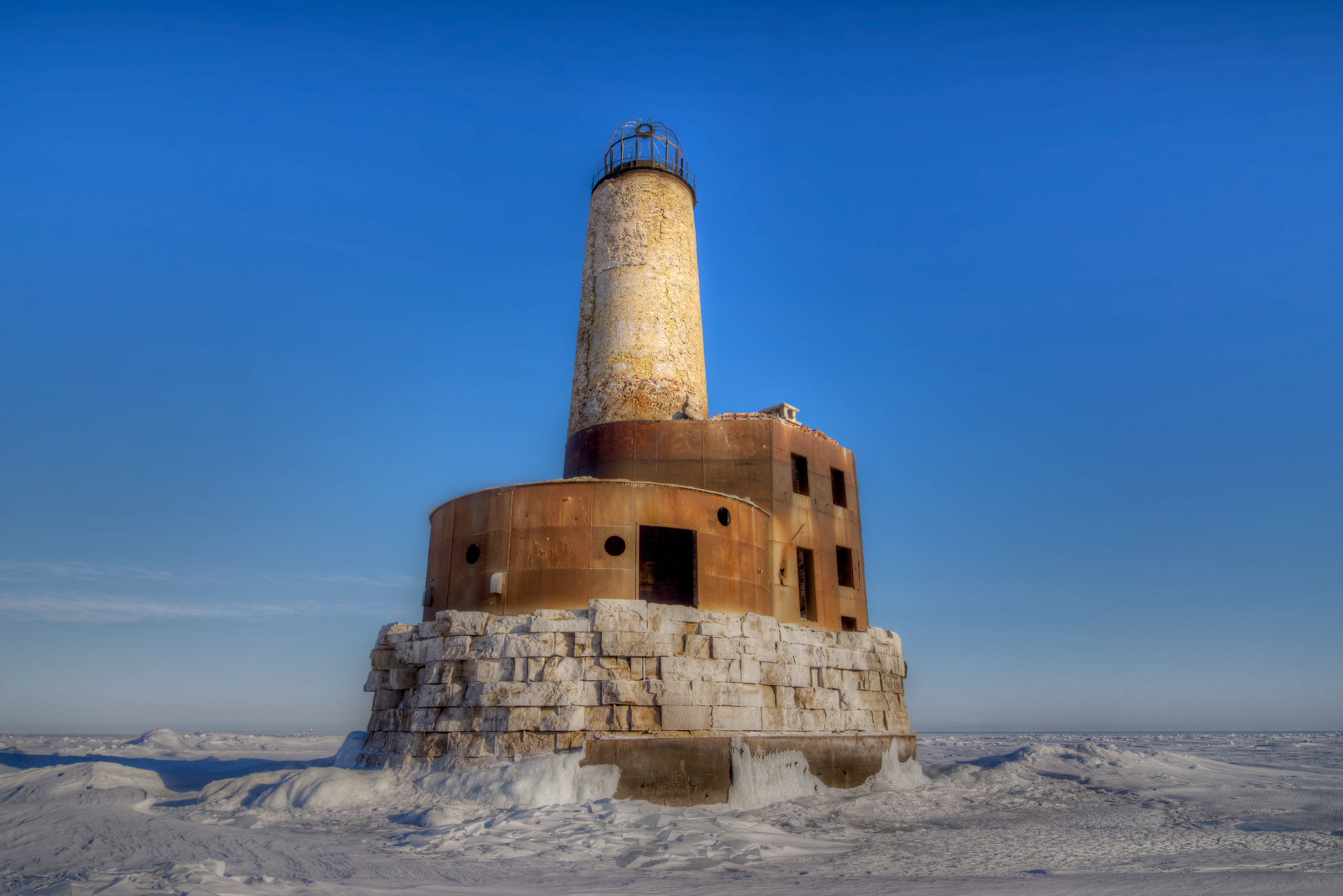
You can today’s photo under “dedication” as photographer Jason Lome hiked 18 miles hauling his camping gear in temperatures ranging from 0 to -20F to get this shot! You can purchase right here.

The Waugoshance Shoals entry at Terry Pepper’s fantastic Seeing the Light website tells the origin of this ruined light and of the significance of this site in Great Lakes Lighthouse history:

After a number of groundings in the early 1820’s, mariners began petitioning the Federal Government to construct an aid to navigation on Waugoshance Shoal. While the construction of underwater cribs had been attempted with success on the East Coast, the relatively short shipping seasons and thick winter ice of northern Lake Michigan appeared to make such an undertaking a daunting challenge.

As an interim measure, the wooden vessel LOIS MCLANE, which had been converted into a lightship, was placed on Waugoshance Shoal in 1832, thus taking her place in history as the first lighthouse to serve on all the Great Lakes.

In 1850, the decision was made to construct a more permanent light on the shoal, and work began with the construction of a timber crib on St. Helena Island. The crib was then towed to Waugoshance and sunk in place through the addition of large rocks.

…Exposed as it was to the full fury of Lake Michigan and to the great breaking fields of ice every spring, the crib began to deteriorate. Reacting to this deterioration in 1865, the Lighthouse Board appropriated the funds required to make the repairs necessary to ensure the station’s continued structural integrity, and quickly completed the work.

While the repairs of 1865 were considerable in their scope, they were no match for the relentless fury of the lake, and by the late 1880’s the crib and the soft brick of the tower had once again deteriorated to the point where major repairs were needed.

There’s much more to found at Seeing the Light including the construction of this edition of the Waugashance Lighthouse and how it came to be a ruin.

Check Jason’s photo out background bigtacular and see more in his Lighthouse slideshow.

There’s lots more about the colorful history of Waugoshance Shoals Lighthouse on Michigan in Pictures, and dozens and dozens of Michigan lighthouses.

The Tridge in Midland

The "Tridge" - Midland, Mi

The “Tridge” – Midland, Mi, phto by Bluejacket

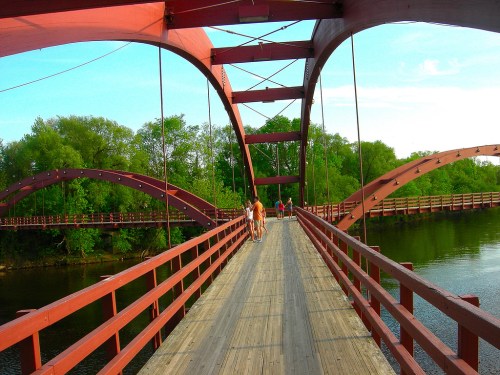
Wikipedia explains that the The Tridge is a three-way wooden footbridge spanning the junction of the Chippewa and Tittabawassee Rivers near downtown Midland that opened in 1981. It consists of one 31′ tall central pillar supporting three 180′ long by 8′ wide spokes. This apparently globally unique structure was built by Gerace Construction of Midland who add:

The walkways are eight feet, three inches wide, and the triangular observation area in the center measures 35 feet per side. The wooden decking and beams filled six train cars. Although the majority of the Tridge is wood, there are 20 tons of steel in the structure in the form of bolts and connectors. A cofferdam – an enclosed circular cell formed from steel sheet piling – was driven into the river bed and then pumped dry to keep water out while the central concrete pier was built. A causeway – essentially a road in the middle of the river – was built from concrete rubble to allow a crane to approach the center construction area.

The Kuriositas has a nice aerial view of the Tridge too!

Check the photo out bigger and see more in Bluejacket’s The “Tridge” in Midland, Michigan slideshow.

More bridges and more Midland on Michigan in Pictures!

Underwater vibe at Belle Isle Aquarium

Belle Isle Aquarium

Belle Isle Aquarium, photo by MichellePhotos2

Dan Austin of HistoricDetroit.org has an incredibly comprehensive history of the Belle Isle Aquarium. He writes, in part:

Clarence M. Burton, in his history on the city of Detroit, attributes the idea of an aquarium to Rep. David E. Heineman, who had visited Naples, Italy, and studied that city’s Anton Dorhn Aquarium.

…The firm of Nettleton & Kahn drew up the plans for the buildings. The building’s price tag: $165,000 (about $4.06 million today). At the time of its opening, the aquarium was among the six largest in the world. Its high-tech equipment allowed for the keeping of both seawater and fresh-water marine life and the keeping of the right water temperatures in the tanks. The water was recycled through the tanks because, it was said, that fish survive better in water they’ve been in before. Originally, a 8,531-gallon center tank with a railing around it occupied the center of the building. It was topped off with filtered water that snaked through 5 miles of pipes.

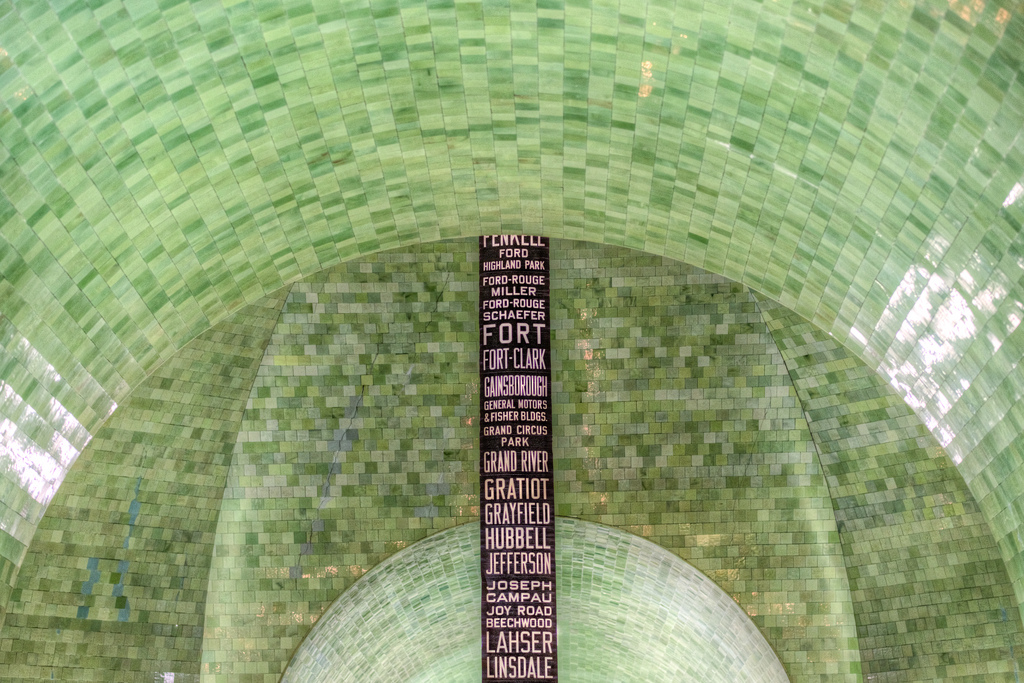
Kahn outfitted the interior with sea-green glass tiles to give visitors the feeling that they were in an underwater cavern. Forty-four tanks filled with critters from the Great Lakes and the world’s oceans line the walls. Combined, the tanks contained 5,780 gallons of water. Magnificent pillars and other details compliment the soaring arched ceilings, as high as three stories in the center of the building. A classroom sits near the main entrance.

The front of the slender, brick building features an elaborate Baroque entrance with carvings of dolphins and a grotesque of Neptune, the Roman god of water. In the center is the city’s seal showing the two maidens and the Detroit motto, “Speramus meliora; resurget cineribus” — “We hope for better things; it will rise from the ashes.” Below that, the word “aquarium” is carved in capitalized, bold letters. The intricate details are sometimes masked by robust ivy that covers the front of the building.

When opening day finally came on Aug. 18, 1904, Detroiters were champing at the bit to take a peek. By the time dawn rolled around, the line numbered into the thousands and stretched from the aquarium’s front door all the way, across the bridge, back to East Jefferson Avenue. More than 5,000 people visited on the attraction’s first day. Some half a million would gaze into its tanks its first year.

Read on for much more that takes you through nearly a century of operation as one of the largest freshwater collections, decline in the latter part of the 20th century, shuttering in 2005 and re-opening in 2012. Definitely check out his gallery of Belle Isle Aquarium photos too!

Today the aquarium is run by the Belle Isle Conservancy and open on Saturdays from 10 AM – 3 PM with free admission and parking.

View Michelle’s photo bigger and see more in her Detroit slideshow.

PS: The Kahn above is of course noted Detroit architect Albert Kahn, and Michigan in Pictures has a great shot of the same room at the aquarium in 1905.

What Are You So Afraid Of?

What Are You So Afraid Of?

What Are You So Afraid Of?, photo by Thomas Hawk

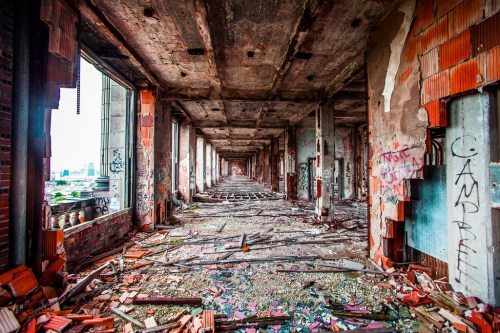
If there’s a King of Flickr, it’s probably Thomas Hawk. One of his projects is to document the 100 Largest American Cities, and back in June of 2010 he visited Detroit. His massive #11 Detroit, MI slideshow is heavy on the ruin of the Motor City but I think you’ll really appreciate it!

View this photo from Michigan Central Station background bigtacular and see more in the slideshow above and at ThomasHawk.com.