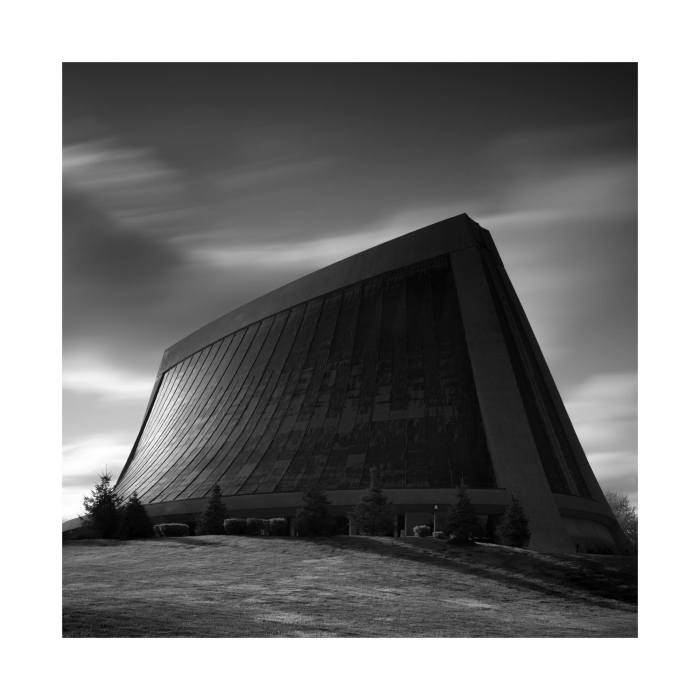
Temple Beth El by architect Minoru Yamasaki

Temple Beth El, Study #01, photo by Brian Day

Temple Beth El was established in 1850 as the first Jewish congregation in the state of Michigan. Their history page notes that there were just 60 Jews out of a population of 21,000 at that time.

The Michigan Notable Book Michigan Modern’s page on Temple Beth El says in part:

Temple Beth El is located in Bloomfield Township, Michigan, on a low rise adjacent to Telegraph Road, a wide and heavily traveled thoroughfare. Mature spruce and pine trees are present around the base of the structure to shield the worshippers from outside distractions. The unmistakable design of the sanctuary incorporates a tent-like form to recall the “Tent of Meeting” referenced in the Bible and the earliest places of worship used by the Jewish people. The cast-in-place concrete structure consists of two pairs of closely placed sloped columns, or tent poles, supporting curved ridge beams at the top of the structure and tied together by elliptical ring beams at the structure’s base. Below the ring beam is a transparent curtain wall of clear glazing that gives the illusion, from the exterior and interior that the tent-form roof is hovering above the open sanctuary space. Between the ridge beams is a transparent skylight that provides natural light into the sanctuary and further emphasizes the “lightness” of the structure. Catenary steel cables suspended between the ridge and ring beams support the gentle curve of the lead-coated copper roof which soars some seventy feet above grade.

The administrative offices, social halls and religious school are located in a one-story wing that extends north from the main entrance to the sanctuary on the building’s west elevation. The Temple Beth El comprises approximately 112,500 square feet, and can accommodate up to eighteen hundred worshippers.

Read on for more!

View the photo bigger on Facebook where there are other photos in his Metro Detroit Modern Architecture Study and see more of Brian’s photography at brianday.org.
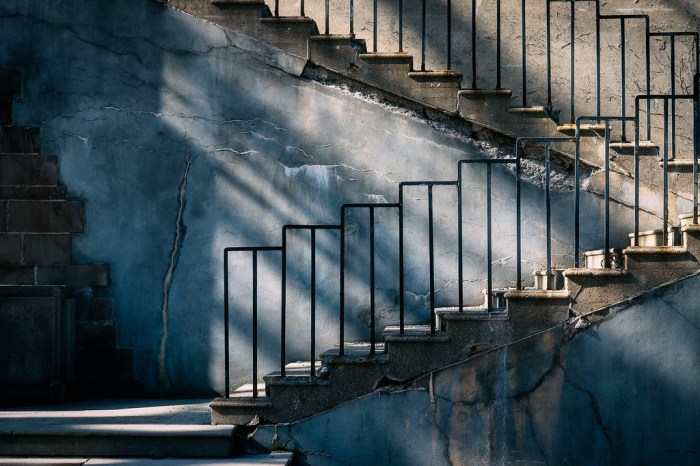
Double Stairs at Cranbrook

cranbrook-double-stairs

cranbrook double stairs, photo by GaryMB

Very cool shot from Cranbrook in Bloomfield Hills, a very unique center for education, science, and art:

Comprising a graduate Academy of Art, contemporary Art Museum, House and Gardens, Institute of Science, and Pre-K through 12 independent college preparatory Schools, Cranbrook welcomes thousands of visitors and students to its campus each year.

Founded by Detroit philanthropists George and Ellen Booth in 1904, Cranbrook’s 319-acre campus features the work of world-renowned architects such as Eliel Saarinen, Albert Kahn, Steven Holl, Tod Williams and Billie Tsien, Rafael Moneo, Peter Rose and sculptors Carl Milles, Marshall Fredericks and others. Critics have called Cranbrook “the most enchanted and enchanting setting in America” and in 1989, it was designated a National Historic Landmark.

It’s also a super-sweet place to take your camera for a walk.

View Gary’s photo bigger and see more in his slideshow.

Soo Geometry

soo-geometry-1-by-liz-glass

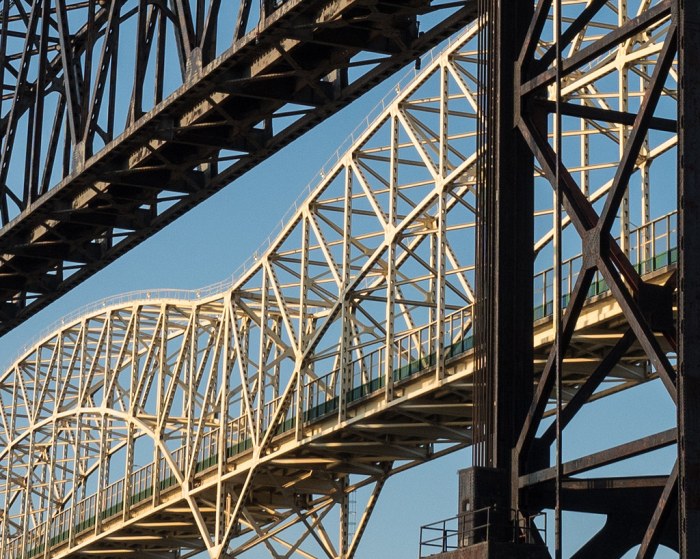
Soo Geometry I, photo by Liz Glass

Liz says she drove two-and-a-half hours last June to get a burger at the West Pier Drive-in (though she really went for the view). Check out her photo bigger and see more in her awesome Abstracts slideshow.

Political Reflections

upside-down-capitol-building

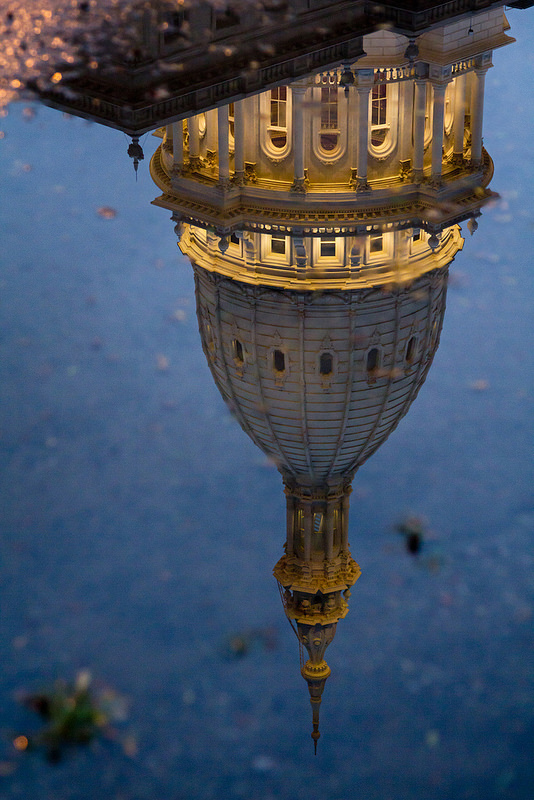
Political Reflections, photo by Matt Kazmierski

Whatever we feel about the outcome of this election, I think we can all agree that it’s nice to not have politics in our face for a few minutes.

View Matt’s photo bigger and see more in his slideshow.

Executive level in downtown Detroit

detroit-cityscape

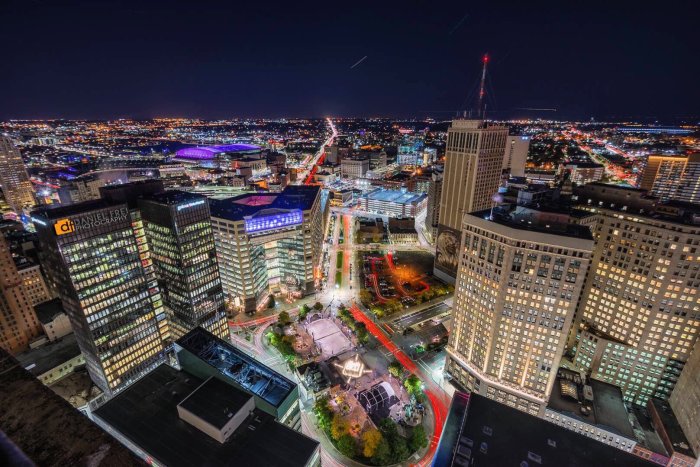
Executive Level in the city of Detroit, photo by Dan Frei Photo

Follow @danfreiphoto on Twitter and view & purchase his work on his website.

Get your (Michigan) ghost town on!

through-the-never-central-mine-powder-house

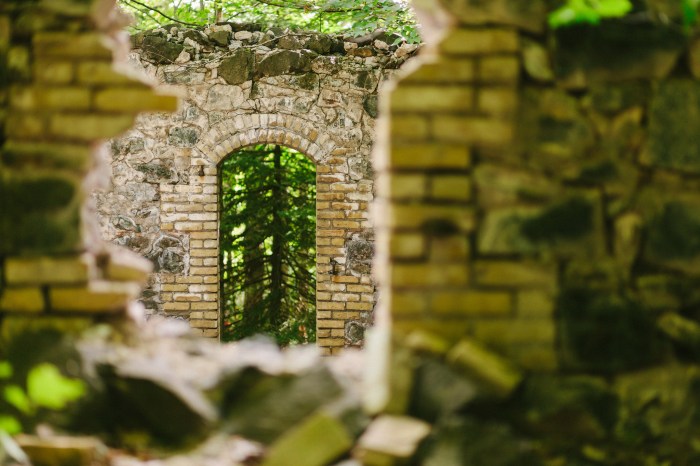
through the never, photo by Marty Hogan

mLive’s Emily Bingham has a feature on 11 eerie & intriguing ghost towns in Michigan that is definitely worth checking out. The slide for the Upper Peninsula ghost town of Central says:

This abandoned village on the U.P.’s Keweenaw Peninsula was a company town of nearly 1,300 residents, many of them German and Cornish immigrants who’d come to work in the copper mines. The town had a post office, three-story school, and one of the first telephone services in Copper Country. The mine closed in 1898, only four decades after it had opened, and residents quickly left to find work elsewhere. All that remains are thirteen houses and a Methodist church, maintained by the Keweenaw Historical Society; every year on the last Sunday of July, locals and descendants of the Central Mine villagers attend a special service at the church to honor those who lived there.

If you’re looking to get more ghost town goodness, look no further than Marty Hogan! His photo albums get up close and personal some of Michigan’s coolest forgotten communities. View this photo background bigilicious and see more in his Central slideshow.

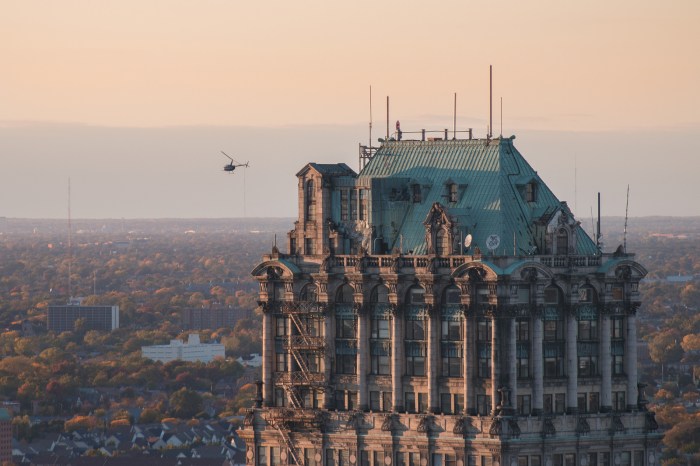
Flyby of Detroit’s Book Tower

flyby-of-the-book-tower-in-detroit

Fly By, photo by Tom Hughes

Historic Detroit is definitely one of the best websites if you want to dig deeper into the history of Michigan’s largest city. Dan Austin’s entry on the Book Tower & Book Building has current and historical photo galleries of both buildings, map and an extensive account about the history of the structure. It says in part:

She’s one of a kind. Some might even say beautiful in its ugliness.

No skyscraper in Detroit, let alone the Midwest, looks quite like the Book Tower on Washington Boulevard. It’s a rather awkward-looking building, whether you look at its unusual maze of an external fire escape or the intricate, over-the-top details on its crown that are tough to appreciate without a pair of binoculars. It’s an undeniably unique piece of the city’s skyline and a rare breed of classical Renaissance-style architecture and skyscraper. As an added bonus, joined at its hip is one of the city’s oldest surviving office buildings.

The 36-story Book Tower opened in 1926 on the southwest corner of Grand River Avenue and Washington, coincidentally, the original lot that the Books’ grandfather had bought on the boulevard. Its first tenant was Detroit Bond & Mortgage. At 475 feet tall, the Book Tower would lay claim to the title of tallest building in town. Though it would hold the honor only briefly: The 47-story Penobscot Building would overtake it two years later. Today, the Book Tower is good for only the seventh-tallest landmark in town.


…Intricately carved Corinthian columns, florets, scrolls and crests are all over the place. Horizontal bands of Italian Renaissance ornamentation break up the towering skyscraper with nude female figures gracing its midsection like a belt. Nearly from ground to the top of the 36th floor, the building is covered in detail. Ferry quotes Kamper as saying, with a trace of a Bavarian accent, “I like it varm.” “Varm” or not, Kamper’s strategy on the Book tower didn’t work. His decision has been ridiculed and criticized by critics almost from the onset for not realizing the limitations on designing a structure so tall. He didn’t take a fire evacuation route into consideration when designing it, necessitating the addition of the unusual fire escape all the way down the tower. Kamper had the building faced in a porous limestone that sucked up pollutants in the air, making it almost impossible to keep clean.

Read on for lots more and follow HistoricDetroit.org on Facebook – good stuff!

View Tom’s photo bigger, see more in his Detroit slideshow, and view and purchase work from his website.

More buildings & architecture on Michigan in Pictures.

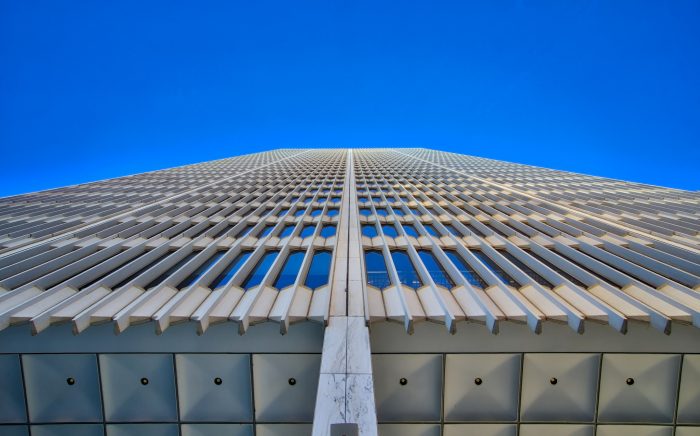
Looking up at Detroit’s One Woodward Avenue

one-woodward-detroit-michigan

One Woodward, Detroit MI, photo by sbmeaper1

Denise McGeen’s article on One Woodward Avenue at HistoricDetroit.org says (in part):

At the heart of Detroit’s Civic Center, towering over Hart Plaza, Woodward Avenue and the Detroit River stands One Woodward, one of Detroit’s most celebrated mid-century modern structures.

The building was commissioned in 1958 by the Michigan Consolidated Gas Company Building. Detroit architect Minoru Yamasaki designed the skyscraper in association with the firm Smith, Hinchman & Grylls. The building would open in 1963 and marked a first for Yamasaki, who had never designed a skyscraper before. The building incorporates a pre-cast concrete exterior, narrow windows, Gothic arches, decorative tracery and sculptural gardens that later became the architect’s signature motifs. It has been called the fore-runner to Yamasaki’s renowned World Trade Center in New York.

…The tower’s all-welded, steel frame is clad with two-story, pre-cast concrete panels that hold 4,800 vertical hexagon-shaped floor-to-ceiling windows. The panels hang above the exterior terrace as if dripping from the building’s frame. Hexagonal grillwork wraps the building’s top two stories. The roofline features delicate crenellation — an architectural feature similar to a castle’s battlements.

Read on for much more including the challenges this project posed for Yamasaki as his first project.

View sbmeaper1’s photo big as a skyscraper and see more in their slideshow.

More architecture on Michigan in Pictures.

Happy Internaut Day, Michigan!

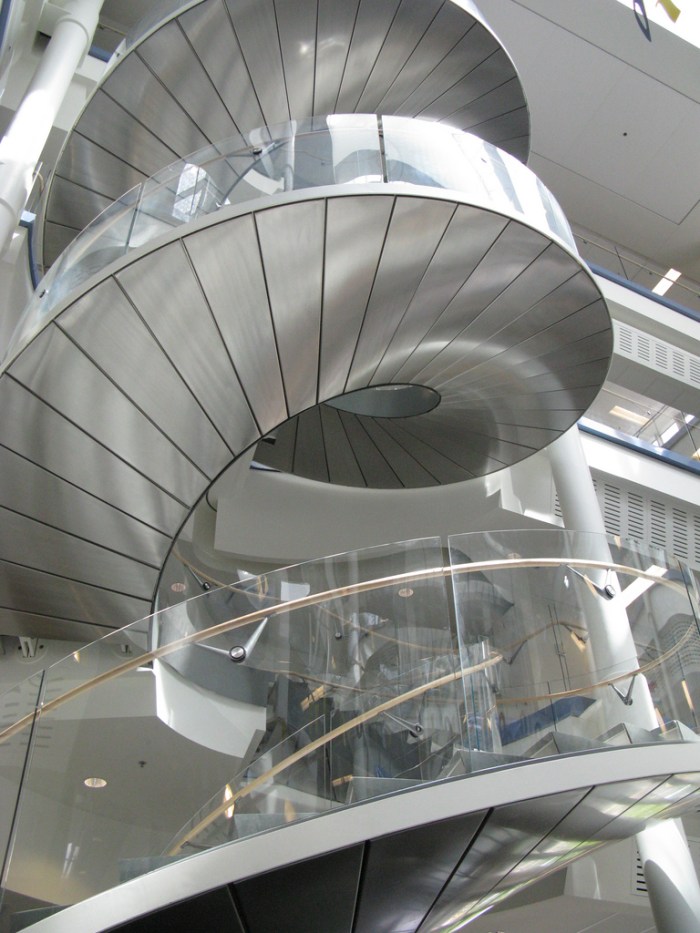
Lets Dance Audaciously by Ryan Munson

Let’s Dance Audaciously, photo by Ryan Munson

Today (August 23, 2016) is, Internaut Day, the 25th anniversary of the official launch of the the World Wide Web. Some fun facts and some not so fun ones:

  • At least 40 percent of the world has access to the internet
  • Detroit has the worst rate of Internet access of any big American city, with four in 10 of its 689,000 residents lacking broadband (NYT)
  • There are 3.4 billion internauts as of 1 July 2016, half of these are on Facebook.
  • The Michigan Infrastructure Commission is looking for input on citizen hopes for Michigan’s future connectivity.
  • There are at least 1 billion websites on the WWW
  • At least 48.5 percent of internet traffic in 2015 was generated only by bots
  • We search for 56,000 items per second on Google
  • We send 2.5 million emails per second
  • Lolcats is worth $2 million

Ryan took this photo at the University of Michigan Computer Science & Engineering building. View it background big and see more in his slideshow.

North Breakwater

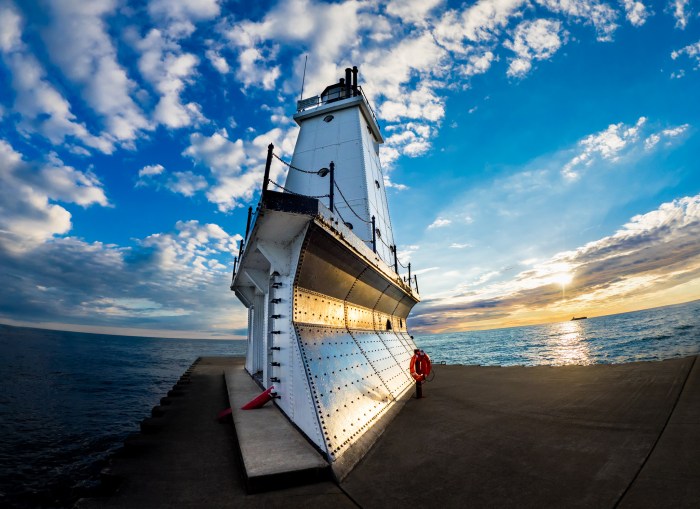
Ludington North Breakwater Light

North Breakwater Light, photo by Mark Miller

The entry for Ludington North Breakwater Light at Terry Pepper’s Seeing the Light details a ton of the history of this lighthouse including the reason for its interesting appearance:

Over the summer of 1924, a unique structure took shape at the end of the North Breakwater. The main tower, fabricated of steel plates over an internal steel skeleton, took the form of a four-sided pyramidal tower with four round porthole windows on each of the three decks within. With plans calling for the installation of an air diaphragm fog signal operated by an electrically powered compressor, there was no need for a large fog signal building, and thus the signal building took the form of a relatively small structure integrated into the base of the landward side of the main tower. In order to help protect the structure from the force of waves crashing across the breakwater, the concrete foundation at the base of the structure was formed with angled surfaces designed to deflect the force of wave action up and away from the building.

The white painted tower was capped by a square gallery and an octagonal iron lantern installed at its center. Since the standard lantern design being used by the Lighthouse Service in new construction at this time was of circular conformation with diagonal astragals, it is likely (but unconfirmed) that the lantern used on this new light was transferred from the South Pierhead beacon which the new light was designed to replace.

Click through for more including a number of old photos.

View Mark’s photo background bigtacular and see more in his slideshow.

More lighthouses and more summer wallpaper on Michigan in Pictures.