
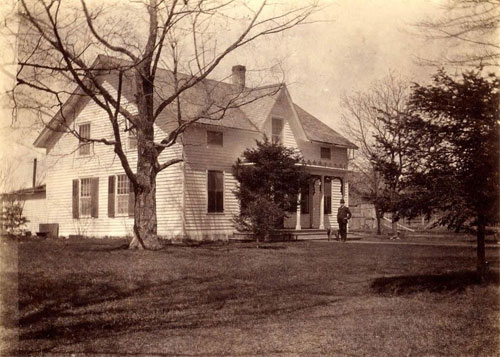
The Dougherty House, Old Mission Peninsula Historical Society
Memorial Day Weekend is the start of many things in Michigan: summer, countdown till school is out, and the yard/garage sale season. On the Old Mission Peninsula just outside of Traverse City, there will be an amazing one at the house of one of the area’s first white settlers, Rev. Peter Dougherty. Once Upon a Time in Old Mission by Walter Johnson explains:
The earliest picture we have of Old Mission comes from the diaries and letters of Rev. Peter Dougherty, a missionary sent here by the Presbyterian Board of Missions in 1838. The Indians here and at settlements along the Lake Michigan shore were Ottawas. There were gardens on the Peninsula, maple trees scarred from sugaring, indicating centuries of human occupancy, and a village at Old Mission. They lived in permanent dwellings built of cedar poles and bark and also wigwams made of evergreen boughs. None of the dwellings had windows, and all of them allowed smoke to escape through a hole in the roof. Chief Ahgosa’s shanty was a little south of Prescott Lake.
According to the terms of the Treaty of 1836, the government was to provide the Indians with missions and schools and Indian reservations. The site of Mission Harbor was personally selected by Henry Schoolcraft between the present School Road and Swaney Road.
Having spent the winter on Mackinac Island, Mr. Dougherty arrived at Mission Harbor near the present Haserot Beach in May, 1839 in a Mackinaw boat. Arrangements were made for opening a school, and Mr. Dougherty’s house was finished before fall, built with logs cut near the border of the harbor and covered with shingles and boards brought from Mackinac. The house was on the shore directly east of the present larger Dougherty house. The second house was the first frame house built in Grand Traverse County, later owned by the Rushmores and used as an inn. In the fall of 1841 there was a schoolhouse and four dwellings. The schoolhouse was used for religious services until the mission house could be built.
Today and Saturday, The Peter Dougherty Society is holding an estate sale to benefit the restoration of the 1842 Dougherty House (article in the Traverse City Record-Eagle). Plans call for an archeological survey of the property, renovation of the house and to open it to the public with exhibits and tours that will explain its place in the history of not only Grand Traverse, but also as part of the westward expansion of the country in the mid- nineteenth century. While the most historically significant artifacts are being saved for when the house is restored, it sounds as if there are thousands of artifacts spanning over 150 years.
If you’re in the area this weekend, you might want to check this out, and you can also read A Short History of the Dougherty House from the Old Mission Peninsula Historical Society.
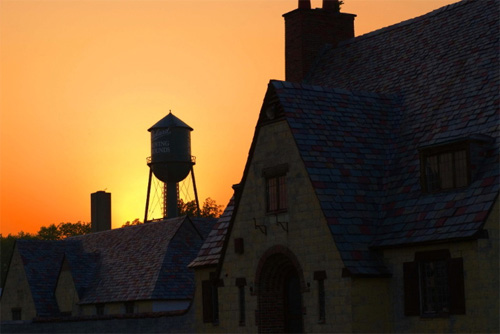
 The Packard Motor Car Company began building a proving ground on this site in 1926. Packard, like its competitors, had previously tested cars on city streets. Architect Albert Kahn designed the principal buildings. By 1929 the complex included the Gate Lodge, warehouses, laboratories, a high-speed test track, and twelve miles of roads simulating the worst conditions of the day. During World War II (1941-1945) Packard built aircraft and marine engines while leasing the grounds to Chrysler for tank testing. Packard ceased production in 1958, and the Ford Motor Company purchased the site in 1961. In 2000 Ford and the Packard Motor Car Foundation began working to preserve the design complex portion of the site.




 Michigan in Pictures