The Demolition of the J.L. Hudson building in Detroit

Hudson Implosion 2

Hudson Implosion 2, photo by ExcuseMySarcasm.

I had a post mapped out in my head that started out “When I was a little boy, my grandma used to take me down to Hudsons in Detroit on Saturday…”

I realized I couldn’t find the link to the site I found last year with all the photos of Hudson’s in its glory, so that post will have to wait for another day. Besides, this isn’t that kind of a photo…

With the press of a button at 5:47 PM on October 24, 1998, Detroit Mayor Dennis Archer dropped the J.L. Hudson Department Store from his city’s skyline and into the history books and record books.

The above from a detailed page on the demolition of J.L. Hudson Department Store CDI (the company that performed the demolition). It understandably touts their work, explaining that at 439 feet tall and 2.2 million square feet, Hudson was both the tallest and the largest single building ever imploded.

Hudson’s Implosion at the Fabulous Ruins of Detroit tells the tale the best (with photos). I know it’s cheating to skip to the end and post that, but after watching a video of the implosion and hearing the cheers, I was very moved by it, especially given what has happened in Detroit and Michigan in the decade since and appears to be continuing:

The cheering had stopped as the immense reality of the event sobered all who viewed it. An emptiness followed and the guilt of our cheers weighed upon us.

The choking clouds dissipated and a ghastly scene was revealed. An inch of dust covered everything for blocks around and there, in the midst of it all, lay the smoldering and shattered heart of 20th Century downtown Detroit.

For more photos (and to see the above larger) check out ExcuseMySarcasm’s Hudson Explosion slideshow and also the Hudson’s Detroit slideshow on Flickr which also contains some pics of the Hudson car and this photo by Paul Hitz of the space where Hudson’s used to be where he suggests that a park or something would be nice where the Hudsons building used to be.

Here’s a video with a good view of the charges going off (this person has a number more too!), another video from across the river in Windsor and a third titled “Detroit Hope” showing Hudson’s rising like a phoenix.

Abandoned Mill, Ripley, Michigan 1997

Abandoned Mill, Ripley, Michigan 1997

Abandoned Mill, Ripley, Michigan 1997, photo by Bill Schwab.

A number of years ago, I built a site for an excellent local photographer, Greg Seman. I remember him praising the work of Detroit photographer Bill Schwab.

It was a pretty cool feeling when I saw some lovely black & white photos roll into the Absolute Michigan pool on Flickr and realized that they were Bill’s.

This photo is part of Bill’s Michigan set (slideshow), but don’t stop there

DeVos Place in Grand Rapids

Ode to Grand Rapids

Ode to Grand Rapids, photo by Billy Jack O’Toole.

So I’m going to the 1st annual Grand Rapids International Wine & Food Festival today and wondered what the venue is like. It it cheating for me to turn that into a blog post?

The DeVos Place Convention Center web site says:

The Convention Center features a 162,000 square foot, column free exhibit hall, 40,000 square foot ballroom and 26 individual meeting rooms (32,000 square feet). Twelve spacious loading docks (with a wash bay and marshalling area), allow for easy access into the exhibit hall.

In addition, DeVos Place features a 2,404 seat performing theater with two independent loading docks and one loading ramp. Home to the Grand Rapids Symphony, Grand Rapids Ballet Company, Opera Grand Rapids and Broadway Grand Rapids … part of a vibrant downtown entertainment district featuring over 50 dining establishments, nightclubs, four museums and the 12,000 seat Van Andel Arena, all within walking distance.

You can get an idea of the scale of the facility with their virtual tours and get the nuts and bolts details from Wikipedia’s DeVos Place Convention Center entry. Also check out this Devos Place slideshow and locate Devos Place on Absolute Michigan’s map.

Check out more Grand Rapids photos from Billy Jack!

Piquette Plant sunset … or is that a sunrise?

Piquette Plant sunset

Piquette Plant sunset, photo by LindaB..

Yesterday on Absolute Michigan we featured an article from Michigan History Magazine titled Where the Model T began and I found this photo while looking for a picture to pair with it. I decided to find another and feature this one here!

Jerald Mitchell calls the Ford Motor Company’s Piquette Avenue Plant in Detroit “a fulcrum point of human history [where] the balance of history shifted.” It was at this factory in Detroit that Henry Ford and his cohorts conceived the Model T automobile. For nine months, these men labored through fifteen-hour days, scrawled rough diagrams on the blackboards, fiddled with auto parts and patterns, argued and probably repeated the words “what if” a thousand times. When they were done, they had created the design for one of the most revolutionary automobiles ever built.

Read the rest on Absolute Michigan and learn much more about the museum that Jerald and others have created at tplex.org – the Model T Automotive Heritage Complex.

Linda writes she and her husband took a tour of the Ford Model T Piquette plant where restoration is underway. She says that the plant has special meaning for them as her husband’s great great grandfather was the winning bid for the plumbing of the building with a bid of $2,035! She also notes that these are the original windows to the plant.

You can see her other photos from the Piquette Plant, check out these Piquette photos from Miz Jelly Bean and dive into the Piquette slideshow on Flickr.

The Zilwaukee Bridge

The Zilwaukee Bridge

The Zilwaukee Bridge, photo by Mario.Q.

This photo is part of Mario’s Zilwaukee Bridge set (slideshow). He writes:

The Zilwaukee Bridge carries northbound and southbound I-75 125 feet over the Saginaw River at Zilwaukee, MI with a total length of just over 8,000 ft. This high level bridge replaced a drawbridge at the same location that caused major backups on I-75 with frequent openings for ship traffic going from Saginaw, MI to the Great Lakes. With a major and widely publicized construction mishap and huge budget overruns this is one of the more widely know bridges in the State of Michigan.

You can read much more about this star-crossed bridge in Wikipedia’s Zilwaukee Bridge entry, but the best resource is michiganhighways.org. There you can find The Zilwaukee Bridge: From the Beginning by MDOT. This details the whole story including “The Accident“. There’s also a bunch of photos of the bridge including an aerial view and an annotated aerial view.

Detroit from metroDevious

Untitled, photo by metroDevious.

Check out the Detroit gallery at metroDevious.com or his mDv DETROIT slideshow on Flickr.

Yow!

Exposure.Detroit November 2008 Exhibition

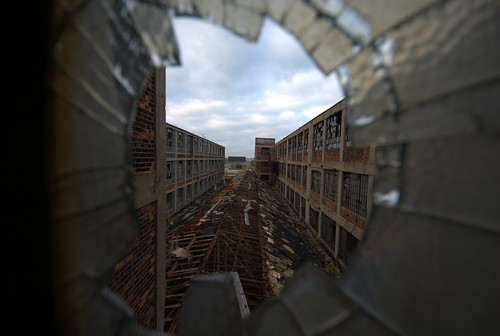
Broken Alley

Broken Alley, photo by Kcjacoby.

The photo is part of Ken’s Packard Plant set (slideshow) and you should check it out bigger right here. Please feel free to deluge him with comments asking him to post the other photos from his trip to the plant faster. ;)

The next Exposure.Detroit show opens next Friday (November 14) from 7-10 PM at the Bean and Leaf Cafe in Royal Oak. In addition to Ken Jacoby, the photographers are:

Brett Lawrence

Niki Collis (Luna.Nik)

Aaron Fortin

Rebecca Gutierrez (Luna’s Eyes)

Poster designed by Ajit.

A Haunting at Historic Fort Wayne

A Haunting at Historic Fort Wayne

A Haunting at Historic Fort Wayne, photo by milminedesign.

On the last Wednesday of every month, Absolute Michigan has a “Weird Wednesday” – a day dedicated to sharing creepy tales and strange photos from all across Michigan. Today is no exception and you can click over to read the legend of Dog Lady Island, a special excerpt from the great book Weird Michigan by Linda S. Godfrey.

Linda doesn’t have a corner on the unexplained though – here’s a photo from the Absolute Michigan pool by Karen who writes:

I took this photo on a sunny spring day in early April. Late afternoon at Historic Fort Wayne in Detroit. No one was in front of me when the photo was taken, nor did I see this apparition until reviewing my photos. I am an investigator with Metro Paranormal Investigations here in Michigan and we were preparing for an investigation. Notice that the figure does not have a head. Pictures taken immediately before and after this one show normal lighting and look nothing like this one. This photo has been analyzed many times by several individuals and the current conclusion is that it is unexplained.

At the Metro Paranormal Investigations you can check out paranormal reports and more photos in their gallery.

The Wikipedia entry for Fort Wayne in Detroit doesn’t mention any hauntings, but you should probably go there to check! One thing I do know about Fort Wayne is that the whole facility is in peril due to a lack of funding for historic preservation. You can learn more about that from the Historic Fort Wayne Coalition and at Save Fort Wayne.

Art goes green – the Grand Rapids Art Museum

GRAM, photo by numstead

View this photo larger right here and see many more in Nathan’s architectural photography set (slideshow). The Grand Rapids Art Museum (GRAM) was the world’s first LEED gold certified art museum complex. The case study of the museum from GreenSource Magazine observes:

This handsome temple of art is, in many respects, a myth-buster. Art museums are widely believed to be “sustainability-proof” because they expend enormous amounts of energy maintaining constant temperature and humidity levels to protect their precious contents. Yet this building reveals that a balance between art and environmentalism is possible if architects, clients, and contractors pursue an integrated approach and factor energy savings into every aspect of the design equation. Sometimes that means borrowing green strategies from conventional structures; sometimes it means using new techniques to satisfy the needs of this demanding building type.

“Typical green solutions are often not best,” says a LEED case study of the museum, prepared by the design and construction team and submitted to the U.S. Green Building Council as part of the museum’s LEED submission.

Designed by Thai-born architect Kulapat Yantrasast of Los Angeles-based wHY Architecture and open since last October, the $75 million, 125,000-square-foot museum fronts on a vibrant, Maya Lin-designed public plaza in the heart of downtown Grand Rapids, western Michigan’s largest city. Home to renowned furniture makers Steelcase, Herman Miller, Knoll, and Haworth, the region already has a rich lode of LEED projects. This one owes its green streak to former Steelcase executive Peter Wege. In 2001, he pledged $20 million, with one string attached: The building would have to be LEED-certified.

The Christian Science Monitor notes that there’s a trend for museums across the country to use green design & construction practices. Also check out this feature from the New York Times about the construction of the museum, the excellent Grand Rapids Art Museum: LEED Gold Certified / wHY Architecture in Arch Daily and this article on the GRAM from Greenline blog (who uses Nathan’s photo).

Here’s a slideshow of views of the GRAM on Flickr and some photography by Kevin Beswick on YouTube.

The cities we love

The Water Board, photo by Allan M

The Water Board, photo by Allan M

“The cities we love we cannot build anymore.”
– City philosopher Charles Landry

Landry was one of the keynote speakers at the Creative Cities Summit in Detroit and he wondered why we usually build monolithic and ugly boxes when that’s not the architecture we say we love. Here’s a look at some of the amazing architecture of Michigan’s cities courtesy the Absolute Michigan pool.

Allan (an architectural student) says that one of his favorite buildings downtown is the often overlooked Water Board Building. This photo is part of his Downtown Motown set, which is best seen as a slideshow I think.