Broken Souls: Wilson Tavern

Wilson Tavern

Wilson Tavern, photo by Marty Hogan.

Handmade dwellings with forgotten dreams is what Marty writes about his massive Broken Souls set of photos.

Check this out big as a house and in his Broken Souls slideshow. If you’d like to follow along, Marty posted the itinerary for his October Photo Trip.

Michigan in Pictures has a lot more photos from Marty.

A little trip up north… and Thomas Story Kirkbride

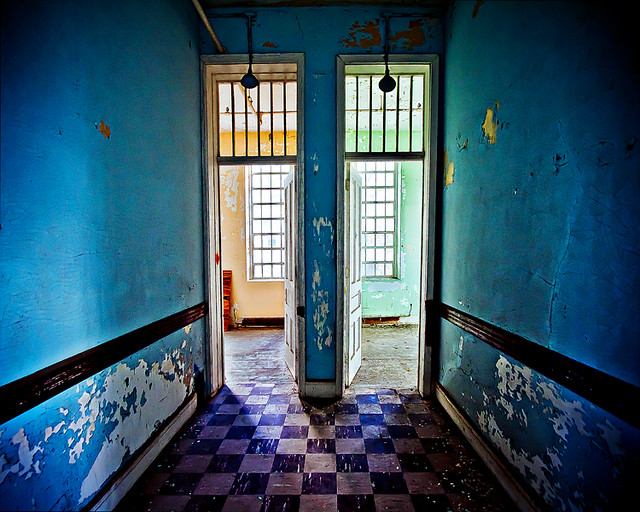
2 Doors Down by Carolyn Gallo

Last weekend, I had the good fortune to lead a photo walk for a group of Michigan photographers at the place where I work, the The Village at Grand Traverse Commons in Traverse City. We were touring the as yet un-renovated parts of what was known as Building 50 when it was the Traverse City State Hospital. Also known as the Northern Michigan Asylum for the Insane and the Traverse City Regional Psychiatric Hospital, the building was a Kirkbride Institution, designed by Dr. Thomas Story Kirkbride.

Kirkbride was a Pennsylvania Quaker and founding member of the Association of Medical Superintendents of American Institutions for the Insane who developed a concept of treatment known as the Kirkbride Plan. This plan proposed a particular way of housing patients that included segregating by severity of mental illness and fresh air and natural light where possible:

It was believed crucial to place patients in a more natural environment away from the pollutants and hectic energy of urban centers. Abundant fresh air and natural light not only contributed to a healthy environment, but also served to promote a more cheerful atmosphere. Extensive grounds with cultivated parks and farmland were also beneficial to the success of an asylum. Landscaped parks served to both stimulate and calm patients’ minds with natural beauty (enhanced by rational order) while improving the overall aspect of the asylum. Farmland served to make the asylum more self-sufficient by providing readily available food and other farm products at a minimal cost to the state.

Patients were encouraged to help work the farms and keep the grounds, as well as participate in other chores. Such structured occupation was meant to provide a sense of purpose and responsibility which, it was believed, would help regulate the mind as well as improve physical fitness. Patients were also encouraged to take part in recreations, games, and entertainments which would also engage their minds, make their stay more pleasant, and perhaps help foster and maintain social skills.

There’s lots more from Kirkbride Buildings where the author has done some spectacular scholarship and created an excellent resource for these amazing structures. The Kirkbride System produced a photographic environment of uncommon richness that is evident in the slideshow from the group A little trip up north…, the Flick slideshow for the “atripupnorth2010” tag and in the streams of the photographers in the group. They also visited some wineries and other spots in the area.

As an added bonus, and unlike many of Michigan’s ruins, the Village at Grand Traverse Commons is actively being redeveloped. In fact, this week a crew began work to restore much of the North Wing where we toured!

See this photo bigger in Carolyn’s Photogs Up North slideshow.

Search Kirkbride on Michigan in Pictures for more about the history of this remarkable place.

Michael Moore to help restore Michigan’s downtown movie theaters

Bohm Theatre, Albion

Bohm Theatre, Albion, photo by I am Jacques Strappe.

One of the cool things that came out at this year’s Traverse City Film Festival was Michael Moore’s plan to to bring back downtown movie theaters. John Flesher And Mike Householder of the AP write in USA Today:

For generations, Americans viewed films in stately, single-screen theaters that were pillars of city business districts — an experience that faded with the rise of suburban multiplexes and the decline of downtowns.

Michael Moore wants to bring those theaters back. The Academy Award-winning documentary filmmaker has a plan to refurbish or prop up downtown movie houses in his home state of Michigan— and eventually nationwide.

Such efforts have been made before. But Moore’s approach has a twist, modeled on the successful resurrection of the State Theatre in Traverse City, his adopted hometown in northern Michigan.

The way to rescue downtown movie houses, Moore says, is to run them as nonprofit ventures staffed mostly with volunteers. That slashes costs and gives the community a stake in the theater’s survival, he says.

Moore plans to provide grants and training to theater operators who use those methods. The money would come from a fund he’s creating with his rebate from a state film tax credit earned by producing his documentary, Capitalism: A Love Story, in Michigan. He expects the refund to total about $1 million.

“One of our goals is to create an economic boost, particularly in struggling downtown areas,” he told The Associated Press this week during the annual Traverse City Film Festival, which he and others established six years ago. “Another is to save the art of cinema and encourage great films to be made.”

The Flint native moved to the Traverse City area in 2003 and took an interest in the State Theatre on the resort town’s main street. Opened in 1916, it had become a shuttered relic.

As someone who lives in Traverse City and has seen the amazing impact that the re-opening of the State Theatre has had on downtown Traverse City by driving traffic to restaurants and shops, I have to say that this is an economic development idea that communities should take a good look at!

If you want to see these theaters, there’s no better place than Marjorie O’Brien’s amazing Theaters of Michigan set. The theaters are organized alphabetically by city name. She hopes to do a book and writes that although it’s probably an obsession:

This project is, however, the least I can do to raise public awareness about the plight of historic movie theaters.

Each theater featured in this set is unique and different from the next. Each theater has had very different stages in its life; each has its own storied history.

Check them out, beginning with Albion’s shuttered Bohm Theatre, in her Theaters of Michigan slideshow.

PS: If you want to learn more about Marjorie, check out our Michigan in Pictures photographer profile of Marjorie O’Brien.

It’s your birthday Detroit, how about a history lesson?


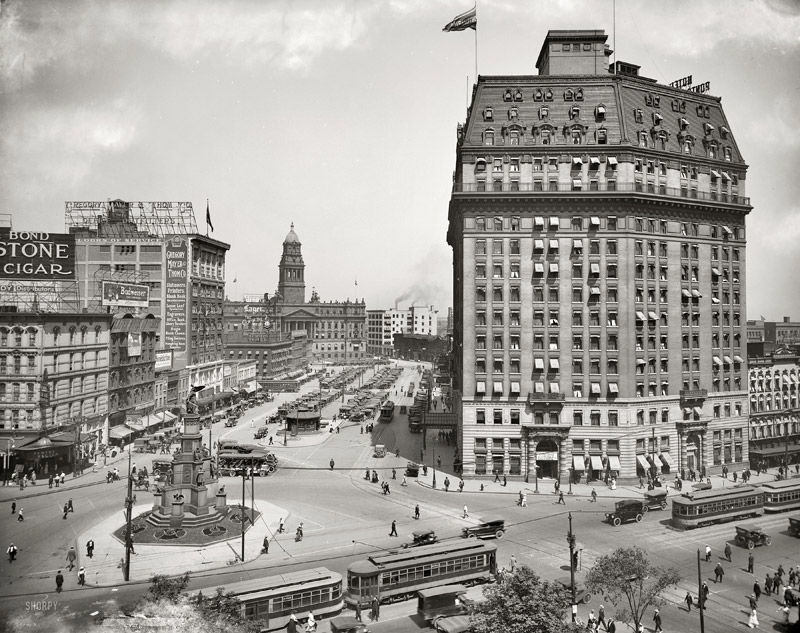
Hotel Pontchartrain and Cadillac Square from City Hall, 1916, photo by Detroit Publishing Co, via Shorpy

Hello Detroit, it’s your birthday!*

History Detroit tells the story of Cadillac and the founding of Detroit on July 24, 1701. They explain how Antoine de la Mothe, Sieur de Cadillac made a plan with his mentor and Governor General of New France, Louis de Buade, Comte de Frontenac, to found a new settlement at the south of Lake Huron to increase security of French interests on the Great Lakes. Frontenac died, and his successor was not fond of Cadillac so:

Cadillac set sail for France in 1698 in order to convince King Louis to allow him to found a new settlement lower in the Great Lakes. Specifically, he was interested in the area south of Lake Huron known as le détroit, or the straits.

The area known as le détroit was ideal for a new settlement because the land was fertile, the location on the river was felt to be easily defended against the British and the climate was more hospitable than that in the more northern settlements like Michilimackinac.

Cadillac returned to Quebec, then travelled to Montreal where he gathered canoes, farmers, traders, artisans, soldiers, and Native Americans to accompany him on his quest. The men set sail on June 4, 1701.

Cadillac and his men reached the Detroit River on July 23, 1701. The following day, July 24, 1701, the group traveled north on the Detroit River and chose a place to build the settlement. Cadillac named the settlement Fort Ponchartrain du Detroit in honor of King Louis’s Minister of Marine.

Read More About Fort Ponchartrain and Cadillac.

You have to check this photo from Shorpy (a great blog where you can also buy these old prints) background bigtacular to see the amazing detail and activity captured including the Soldiers and Sailors Monument in the bottom left corner. Here are earlier views of the hotel circa 1907, minus the upper floors, and 1910, minus most of the cars, and here’s Shorpy’s entire Detroit Michigan historic archive.

Need more? There’s a whole lot more Detroit on Michigan in Pictures and at absolutemichigan.com/Detroit.

* I feel a little weird giving a history lesson as a birthday present.

The Dime Building in Detroit

Inside the Dime Building Dime Building
Inside the Dime Building and Dime Building, photos by Adore707

Detroit 1701’s page on The Dime Building relates how Daniel Hudson Burnham found fame as a city planner and was influential in the founding of the City Beautiful Movement. His architectural firm, Root and Burnham, designed the 20-story Masonic Temple Building in Chicago in 1893, one of the nation’s first skyscrapers, and they were tapped by Dime Bank:

The Dime Bank wanted an appropriate building for their facilities. The first floor was to serve as a banking floor where patrons would make their deposits and withdrawals. The higher levels in this 23-story building provided the many offices the bank needed for business, undoubtedly growing as the vehicle industry boomed in Detroit. Burnham designed the attractive lobby that you see with its skylight and numerous decorations. Electric elevators for tall buildings were first successfully installed in the 1890s, so they were still a new invention when Burnham designed this Dime Building…

Air conditioning was unavailable in 1910 and electric lights were, apparently, less efficient than the ones we have today. This motivated Burnham to incorporate a design that provided a window for ventilation and light in every office. You will notice the light well as soon as you enter the lobby of the Dime Building. This one faces Griswold and clearly illustrates this typical feature of Burnham’s Chicago style skyscrapers. Just to the east on Griswold, you will see the Ford Building that Burnham designed for its 1909 opening. In that one, Burnham’s light well is invisible from Griswold.

The Dime Building has its own web site and there’s a little more about the Dime Building on Wikipedia. You can see an old photo of the Dime Building from Wikipedia and another of the Dime from the early 20th Century at Shorpy.

See these other other photos bigger in his Detroit MI slideshow.

Roadside Ramblings in the Michigan Radio Picture Project

towers
towers, photo by mfophotos

This “castle” in Owosso was actually a place used for entertainment and a writing studio for James Oliver Curwood. Now owned by the city of Owosso, it overlooks the Shiawassee River. Curwood made a living as a writer of wilderness adventure stories, some of which became screenplays for early movies. The castle was constructed to resemble a French chateau. August, 2009.

The above picture is one of many in the latest photo essay at the Michigan Radio Picture Project: Roadside Ramblings, the photography of Mark F. O’Brien. Mark is a regular on Michigan in Pictures (as is his daughter Marjorie) and shoots with all kinds of cameras. He writes:

Michigan is a state criss-crossed with highways. As the home state for the auto industry, the roads have played an important part in connecting communities, bringing in tourism, as well as being the main thoroughfare for commerce. Exploring Michigan’s roads, whether the major highways or the gravel backroads, has become one of my photographic pursuits. I often shoot with a “toy camera” — simply a plastic camera with a cheap plastic lens, limited exposure control, and infinite possibilities for photography. While I use all kinds of really nice cameras, it’s the Holgas, Dianas, and thrift-shop wonders that produce many of my most memorable and endearing photographs.

A full tank of gas, some maps, and a few cameras inevitably leads to a long day traversing some part of the state. If one is curious enough, just traveling all of the roads in a single county can take a long time to complete. Driving around and letting serendipity take its course is one way of learning about my state, as well as coming back with some photographs that sometimes offer a surreal aspect of what’s off the side of the road.

Click through to see the photos and I hope you get to do some roadside rambling of your own this weekend or soon!

Be sure to check this out bigger and also his whole Michigan Roadsides set (slideshow).

Grand Rapids is a winner

crossroads
crossroads, photo by pentax hammer (gary syrba)

The U.S. Chamber of Commerce BCLC & Siemens have named Grand Rapids, MI the most sustainable mid-size community in America. Grand Rapids was selected based on efforts to achieve complementary economic, environmental and social goals, as well as to improve the overall quality of life within the city.

See this photo bigger in Gary’s In the City (Grand Rapids) slideshow and connect with Grand Rapids photographers and photos of Grand Rapids in the Grand Rapids, Michigan group on Flickr!

Detroit, Old & New

This post is technically for Saturday and Sunday, so I’ll use two photos. Happy weekend, Michigan.

the book cadillc 1960s
the book cadillac 1960s, photo by detroitmi97

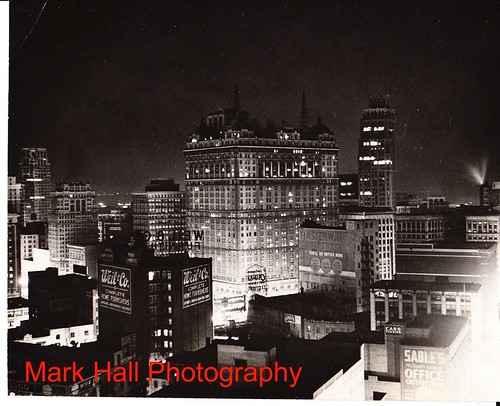
This photo must be seen bachground bigtacular, preferably as part of Mark’s old detroit slideshow.

The star of the photo is best met through the awesomely awesome Buildings of Detroit. Their page on the Book Cadillac Hotel begins:

The Book brothers sought to make Washington Boulevard the most opulent, most successful retail destination in Detroit. By 1923, the siblings had built the Washington Boulevard Building and the Book Building and had already cornered much of the real estate on the boulevard. But the Statler Hotel, which opened Feb. 6, 1915, anchored their boulevard on the north and was drawing their tourists. The brothers decided they needed a hotel of their own.

On the south end of the boulevard, bound my Michigan Avenue, stood the venerable Cadillac Hotel. The Book brothers – Herbert, Frank and J. Burgess Book Jr. – were born within its walls and played along the landscaped mall that stood outside it…

Read on to go from the razing of the Cadillac Hotel through many owners to shuttering to the present day when it is once again open as the Westin Book Cadillac Detroit.

I could stop there, but when I read the first post in Noah’s The People of Detroit Photo Documentary, I really felt I had to share it. Head over to The People of Detroit: Outlier on Flickr for a good read (PG for brief language and sexual reference).

The People of Detroit: Outlier
The People of Detroit: Outlier, photo by Noah Stephens

Morning view

Morning view

Morning view, photo by Mike Lanzetta.

Top of the morning to you.

Mike says Yup, no photoshop, she really was right there. See it bigger along with more from this shoot in his slideshow.

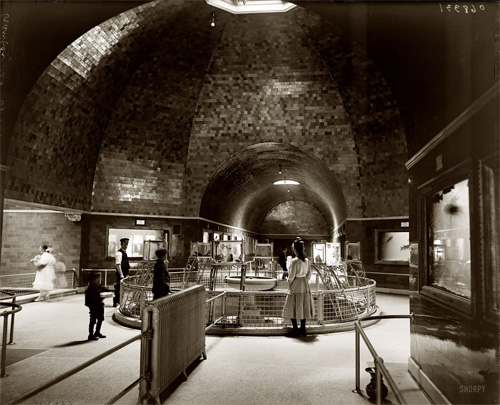
Belle Isle Aquarium – 1905

Fishbowl: 1905, photo via Shorpy Historic Photo Archive

The Friends of Belle Isle Aquarium history page (click through for some great photos & historic postcards) says:

It was August 18, 1904 in Detroit when architect Albert Kahn’s new aquarium would open to the public … The Belle Isle Aquarium, which opened adjacent with the new horticultural building on Belle Isle at a cost of $160,000, would quickly become, “one of the most popular attractions on the Island.”

…The interior of this aquarium were framed cypress tank-lined walls that were filled with fresh and salt water fish. The water contained in many of these tasks were brought direct from the ocean for the aquarium. Under the domed ceiling in the center of the building was a deep pool that was encircled by several small tanks. Later this pool would become the home to a large tank that would sit in the middle.

The most magnificent part of the interior was the grotto ceilings lined with shinny jade green titles, giving visitors a unique feeling of being underwater. Underneath this aquarium was a basement, that would be used by many as a speakeasy during Prohibition.

This photo is one that you absolutely have to check out bigger. You can get more shots from Belle Isle at Shorpy and prints too! and get more view & buy Detroit pics right here!