
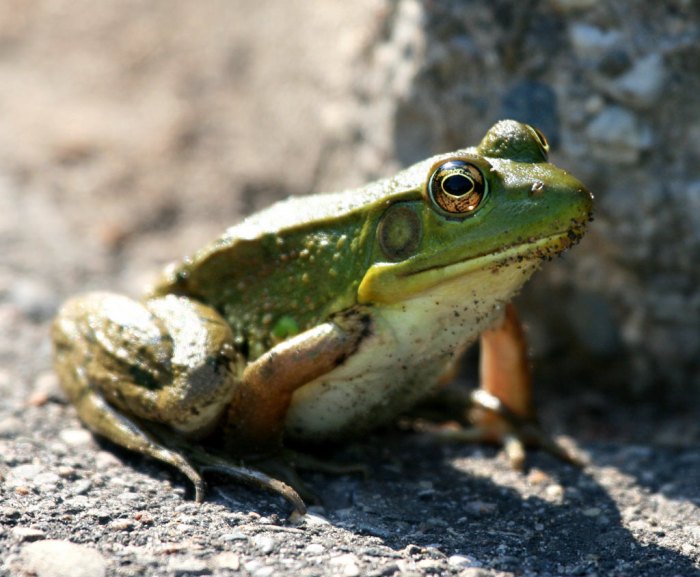
Northern Green Frog

Northern Green Frog

Frog!, photo by StormchaserMike Photography.

I nearly misidentified this guy as an American Bullfrog, likely confusing a whole new generation of readers just as they were recovering from Turtlegate.

The Michigan Herps page on Michigan’s Frogs & Toads says that misidentification is common – the trick is the fold of skin running from their eardrum to their back. The UM Animal Diversity Web entry for Lithobates clamitans (green frog) says you can find them all over the eastern US and that:

Green frogs are found in a wide variety of habitats that surround most inland waters, such as: swamps, wooded swamps, ponds, lakes, marshes, bogs, banks of slow moving rivers and streams, oxbow lakes, sloughs, and impoundments. Juveniles may disperse into wooded areas or meadows during times of rain. Green frogs overwinter in the water usually buried in the substrate.

Green frogs produce as many as six different calls. Males attracting a mate give an advertisement call and a high-intensity advertisement call. Their advertisement call has been compared to the pluck of a loose banjo string. Male frogs defending a territory from an intruding male usually give aggressive calls and growls. The release call is given by non-receptive females and by males accidentally grabbed by another male. Finally, the alert call is given by males and females when startled or attacked by a predator.

Green frogs have an excellent sense of vision and use this to detect and capture prey.

You can hear one of their calls at the link above and also read about them at Wikipedia and the MIchigan DNR’s page on the Green Frog.

Check this out bigger and see it in context in Mike’s Cass Lake set (slideshow).

More about Michigan’s animals from Michigan in Pictures.

Hello 2010!

molly in snow 006

molly in snow 006, photo by northern_latitudes.

Happy New Year everyone! I hope you’re waking up relatively unharmed and eager to dive into 2010.

In no particular order, I’m hoping for snow, sun, a lot of trips to Michigan’s parks, more time on my bike, a championship by the Pistons, Tigers, Red Wings or (hold your laughter please) Lions, more pictures of ducks, continuing rebirth in Detroit and other Michigan cities and many, many more amazing pictures of the Great Lakes State.

How about you?

Check this out bigger in Tim’s Harbor Springs slideshow.

The Fantastic Mr. Fox … Michigan Red Fox that is

The Sly look

The Sly look, photo by taterfalls.

A little nonsense now and then is relished by the wisest men.
~Roald Dahl

Wes Anderson’s film Fantastic Mr. Fox (based on the book by Roald Dahl / view trailer) opens tomorrow, so I thought it a good time to take a look at the red fox. The Michigan DNR’s Red Fox (Vulpes vulpes fulva) page says:

Red foxes can be found in every county in Michigan but are especially common in areas with fallow and cultivated fields, meadows, bushy fence lines, woody stream borders, and low shrub cover along woods and beaches. They can also be found in suburban and, less commonly, urban areas where food is readily available. Foxes are highly mobile, which means they can use a large area to find food and shelter.

Red foxes resemble slender, small dogs, with the head and body typically around two feet long. Red fox tail is long and bushy, usually around 15 inches. The size and weight of foxes are commonly overestimated, because their long fur masks a bone structure that is slighter than that of most domestic dogs. Red foxes have a characteristic red coloration (hence their name), with the face, top of head, and neck having yellow or orange coloration. The tail is reddish mixed with black, and always has a white tip. The outer sides of the ears, lower parts of the legs, and feet are dark or black, while the insides of the ears, and the lips, chest, and belly are creamy white.

Much more about red foxes at Wikipedia and at Vulpes vulpes (red fox) on the UM Animal Diversity Web.

Be sure and check this out bigger also have a look at Tate’s slideshow of this brave fox in action.

Hiking Isle Royale: Trails, Wolves and Minong Mine

Minong Mine

Minong Mine, photo by nasunto.

Nina went to Isle Royale in September and has been posting accounts on her awesome blog Black Coffee at Sunrise. This photo of Minong Mine appears in Day Five, which features a detailed description of their encounter with a pack of wolves:

Since the vegetation along the narrow trail was dripping with dew and leaning inward, it wasn’t long before we were both soaking wet from hip to ankle. Ten minutes after leaving our campsite, the ground became marshy and we found ourselves walking a long stretch of protective plank bridge. Just before reaching the stream crossing, the trail curved to the right and Craig suddenly stopped in front of me, turned around and said very calmly, “Uh…a whole pack of wolves…”

His voice trailed off as he turned back around to face forward again. I thought he was trying to be funny since I couldn’t yet see what was around the corner. After inching forward another foot or so, he turned to me again and the look on his face was priceless. “I’m not kidding,” he said. “There are at least five wolves on the trail ahead of us.” The next few moments were the most surreal and exciting I’ve ever experienced.

Read on at her blog for the rest of the account or see them all in her Isle Royale section.

Be sure to check this out bigger or in her Isle Royale set (slideshow).

You can learn a little bit about Minong Mine and see a picture of a 6000 pound copper nugget right here.

Check out many more Isle Royale photos on Michigan in Pictures.

Leelanau County Cougar Photos

Leelanau County Cougar photos

Leelanau County Cougar photos, photo by Dr. Jerome Wiater.

These photos were taken by Dr. Jerome Wiater and appear courtesy the Michigan Wildlife Conservancy.

Check these out bigger, read the report from the Michigan Wildlife Conservancy and read more at Michigan Cougar Confirmation? Leelanau photos seem to say “Yes” on Leelanau.com.

You can read more about the Michigan cougar controversy at Absolute Michigan and read all about cougars (puma concolor) from the UM Animal Diversity Web.

Riding out for Labor Day

Double J Ranch Riding

Double J Ranch Riding, photo by Jeff Milton.

Absolute Michigan’s 2009 Labor Day Roundup says that AAA Michigan estimates 1.4 million Michiganians will travel during the 2009 Labor Day holiday. Click that link for a bunch of Labor Day events from all over the state and also see the 52nd Annual Labor Day Bridge Walk on Michigan in Pictures.

Be sure and check this out bigger or in Jeff’s My Favorites slideshow.

Hard at work

Untitled, photo by Brooke Pennington.

Sure it’s a tough job but the scenery is great. See it bigger in Brooke’s slideshow.

Return of the Duckies: Ann Arbor Summertime 2009

Ann Arbor Summertime 2009

Ann Arbor Summertime 2009, photo by RichardD72.

Check this out bigger in Richard’s Summertime slideshow and remember that Michigan in Pictures is your source for Michigan duckie photos – accept no substitutes!

flight patterns

vimeo.com/5676816

vimeo.com/5676816, photo by Charlie McC.

Charlie has put together a really cool look at an iconic summer sight: bugs, lights and their flight patterns.

Calico Pennant Dragonfly

Calico Pennant Dragonfly

Calico Pennant Dragonfly, photo by jbnuthatch.

Wikipedia doesn’t have much to say about the Calico (or Elisa) Pennant, Celithemis elisa. The Calico Pennant Dragonfly – Celithemis elisa page at North American Insects and Spiders says that Calico Pennants are of the order Odonates and that:

Dragonflies have excellent eyesight. Their compound eyes have up to 30,000 facets, each of which is a separate light-sensing organ or ommatidium, arranged to give nearly a 360° field of vision, important for taking prey on the wing, as has done the female shown above. Odonates are completely harmless – they do not sting or bite. Indeed, they are beneficial in the same respect spiders and other predators are beneficial – they keep the burgeoning insect population in check..

Dragonflies are among the most ancient of living creatures. Fossil records, clearly recognizable as the ancestors of our present day odonates, go back to Carboniferous times which means that the insects were flying more than 300 million years ago, predating dinosaurs by over 100 million years and birds by some 150 million…

Dragonflies are the world’s fastest insects and, although estimates of their speed vary wildly, most credible authorities say they are capable of reaching speeds of between 30 and 60 km/h (19 to 38 mph). A study showed that dragonflies can travel as much as 85 miles in one day.

Here’s some more general information about dragonflies.

Check this photo out bigger or in John’s Critterz set (slideshow).