Michigan moose viewing isn’t hard when there’s a Bull Moose in the road

Bull Moose

Bull Moose, photo by Pure Michigan.

The entry for Alces alces (moose) at the UM Animal Diversity Web says that what we call “moose” are known as Eurasian elk in Europe. Moose live near water ponds, lakes, rivers and swamps that hold their favorite foods and help keep them cool. Their large bodies, inability to sweat and the heat produced by fermentation in their guts mean they can’t endure temperatures above 80 degrees for long. Also see Moose on Wikipedia.

Moose are native to Michigan but although Michigan granted moose full legal protection in 1889, moose had disappeared from the Lower Peninsula in the 1890s and only a handful remained in the Upper Peninsula. (Moose in Michigan whitepaper). The February survey of Michigan moose estimates 500 total moose, with about 433 of these concentrated in Marquette, Baraga and northern Iron counties.

The DNR’s Guide to Moose Viewing in the Upper Peninsula includes maps and suggests that to while moose locations are difficult to predicta:

…there are three areas where visitors would do well to begin their quest. The center of the moose country in the western U.P. is Van Riper State Park. In the eastern Upper Peninsula, Tahquamenon Falls State Park and Seney National Wildlife Refuge offer the best chances of seeing moose.

…Look for moose in the early morning and evening when summer temperatures are coolest.

Moose often are associated with water, so areas around beaver ponds and along the edges of lakes, streams, and swamps are good places to look. Van Riper and Tahquamenon Falls state parks have moose information centers with interpretive materials including a kiosk and a video on Michigan moose recovery efforts. Interpretive staff can provide the latest information on the local herd and recent sightings. In addition to moose, loons, eagles, black bears, deer, foxes, and even wolves may be seen in moose country.

Caution must be taken when watching moose. Moose should not be approached. They can be unpredictable and aggressive. Most dangerous are cow moose with young, or bulls during the mating season (September and October).

Pure Michigan has the name “Susan Ballreich on this photo so I assume she caught the shot of the bull moose on the Peshekee Grade road near Marquette. Check it out bigger and in their massive Fall 2010 slideshow.

Many fish will bite if you got good bait…

Fishing in Bay

Fishing in Bay, photo by ETCphoto.

Betcha goin’ fishin’ all of your time, baby’s goin’ fishing too
Bet your life, your sweet life, catch more fish than you
Many fish bites if ya got good bait, here’s a little tip i would like to relate

Big fish bites if ya got a good bait, I ‘a goin’ fishin’
Yes i’m goin’ fishin’, and my baby’s goin’ fishin’ too.

~Taj Mahal (check out this sweet video)

There’s a boatload of Michigan fishing information at www.michigan.gov/fishing. They note that Michigan has about 146 kinds of fish, ranging from tiny minnows to giant lake sturgeon – hope you get a chance to tell a couple fish stories this year!

Check this out bigger than the one that got away and in Terry’s West Bay slideshow

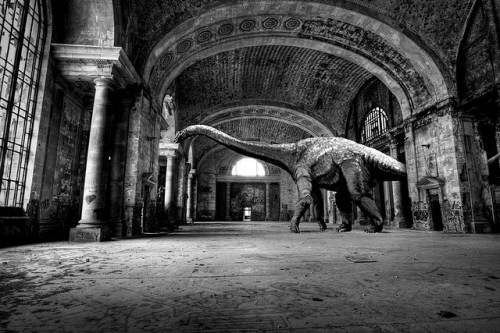
jurrasic station

jurrasic station

jurrasic station, photo by hardyc

You never know what you might find when urban exploring these days. More photographic fun today on Absolute Michigan.

Make sure to check this out big as a brontosaur and see some of Chris’s other work in his creative – modified slideshow!

Get (April) Foolish at Festifools in Ann Arbor

tibihxE deeF toN oD esaelP

tibihxE deeF toN oD esaelP, photo by jenny murray.

This Sunday (April 3, 2011) is the Festifools parade in Ann Arbor. It’s annual street festival of “HUGE PUPPETS and random acts of April Foolishness”. New this year is FoolMoon – April 1 from dusk to midnight. It’s a FREE event that invites you to bring your luminary (or kazoo / chicken suit / saxophone / what have you) to one of their three “Constellation Stations” and join fellow frolickers for the Foolish stroll! More updates about this Foolish weekend on Facebook!

If you’re not already familiar with FestiFools, you can get a sense of what we’re about by watching some videos on the YouTube FestiFools channel and at photographer Myra Klarman’s blog that includes a neat look behind the scenes at Festifools!

Jenny says that this was Anorexicsaurus or TyrAnorexicsaurus … from the Starvaceous Period. Check it out big as a bulemiasaur and in her Festifools slideshow.

There’s a ton more foolishness to be found in the flickr FestiFools group!

Remembering Jeff Lamb

Music is what life sounds like.
~Eric Olson

Leelanau Shore, photo by Jeff Lamb

A photographer I have long admired and was fortunate enough to spend a little time with passed away yesterday.

Jeff Lamb took photos of urban landscapes and landscapes that were not urban, blending a love of his fellow humans with his love of the structures they created in his work.

New Orleans to Northern Michigan, Ann Arbor to Amsterdam, he took so many photos that he needed two Flickr accounts, jeff lamb and leylabunny and a photo blog.

See this bigger in Jeff’s Leelanau slideshow and explore his work through the links above.

woolies

woolies

woolies, photo by jenny murray.

Check this out bigger and in Jenny’s holga slideshow.

More black & white photography on Michigan in Pictures.

Would the Loch Ness Monster be considered an invasive species?

The Loch Ness Monster

The Loch Ness Monster, photo by Eridony.

Because the Emerald Ash Borer isn’t very photogenic, we’re taking a break from Invasive Species Week to bring you a reminder of another kind of invasion that’s about to descend on Michigan: the fabulous Grand Rapids ArtPrize! 2009 brought all kinds of incredible sights to the city, including the Nessie Project. See a bunch of them in our ArtPrize Video from 2009.

ArtPrize starts next Wednesday (September 22) and continues through October 10th. We will once again be On Location with Absolute Michigan, and we encourage you to attend and to share your photos from ArtPrize in the Absolute Michigan pool and also to the ArtPrize Promotion Group for anyone who wants to share their photos & video of ArtPrize installations and the accompanying hoopla with bloggers and online media outlets.

Be sure to check this out monstrously massive and see it and many more in Brandon’s ArtPrize slideshow!

Yesterday: Sand. Today: Zebra Mussels & Quagga Mussels

Zebra Mussels

Zebra Mussels, photo by cedarkayak.

“In terms of the whole food web, I don’t think there’s any question that zebra and quagga mussels have had the largest impact on the biological communities of the Great Lakes”
~Tom Nalepa, Great Lakes Environmental Research Laboratory

Today’s villain in our Michigan Invasive Species series are Zebra Mussels & Quagga Mussels. That feature on Absolute Michigan goes in depth about who they are and what they do so I won’t go on and on here except to say that as someone who walks the beaches of Lake Michigan often, there’s few things that make me sadder or madder than these little bastards. They’ve trashed the food chain, spawned all manner of nasty plants & algae and they slice up your feet.

Todd writes:

This stretch of beach on South Manitou Island was once filled with sugary white sand. Today, the beach is covered in razor sharp zebra mussel shells. I knelt to take then photo, and when I stood, my knee was bleeding in 3 places.

Check this out background big and in his Lake Michigan slideshow.

End Of the Day … for fishing on the Great Lakes?

End Of the Day

End Of the Day, photo by Rob the Photog.

This week is Invasive Species Week on Absolute Michigan and Michigan in Pictures and today on Absolute Michigan we took a long look at the 800 pound gorilla of invasive species in Michigan, the Asian carp. These frightening fish have made their way up the Mississippi River and can weigh up to 100 pounds, grow to four feet in length, eat voraciously and make rabbits look like pikers when it comes to reproduction. Via TIME Magazine:

“They just eat so much,” says David Ullrich, executive director of the Great Lakes and St. Lawrence Cities Initiative. “They’re like the locusts of the river.”

That’s what makes them so dangerous to the lakes. Asian carp aren’t direct predators, but they eat plankton, which knocks out the bottom layers of the food chain. If they were to successfully establish themselves in the Great Lakes and start breeding, they could utterly disrupt the existing ecosystem, potentially starving out the trout and other native fish that make the Great Lakes a tourism hot spot.

Estimates put the Great Lakes sport and commercial fishery at $2.5 to $7 billion. While the loss of this would be a terrible shame, the thought that one day you wouldn’t see photos like this of a parent and child enjoying Michigan’s amazing fishery seems worse to me.

Rob feels this is one of the best photos he’s ever taken. Check it out bigger and in his slideshow.

And if you can, make sure you write your representatives to tell them how important it is to stop the Asian carp in Chicago!

Invasive Species in Michigan

Shell Cluster

Shell Cluster, photo by johndecember.

All week we’re going to be featuring invasive species – who they are, what they’re doing to our lakes & land and how folks are working to stop them. See the articles as we post them on Absolute MichiganMichigan in Pictures and !

I actually already blogged this photo to Pandora’s Locks: How Invasive Species got into the Great Lakes on Absolute Michigan. The book is a must-read for anyone who wants to learn how the way the shipping industry operates guarantees that invasive species will spread.

You will note that John has TWO invaders here, the zebra mussel and the Asian ladybird beetle. Check this out bigger in John’s slideshow!