

Altaic Warrior, photo by country_boy_shane.
Apparently the Detroit Tigers got loose.
Check it out background big and in Shane’s Featured in Flickr Explore slideshow.
Altaic Warrior, photo by country_boy_shane.
Apparently the Detroit Tigers got loose.
Check it out background big and in Shane’s Featured in Flickr Explore slideshow.

Loon and friends at Brown Bridge Pond, photo by SBodjack.
Apparently sometimes we all can just get along. Hope your weekend is filled with fun and friends.
Check this out background big and see this and many more in her Brown Bridge Pond slideshow or see where she took it on her map.
The pond is in the 1300-acre Brown Bridge Quiet Area just south of Traverse City. They say that five known species of endangered, threatened, or special concern status have been documented at the Brown Bridge Quiet Area: bald eagles, osprey, red-shouldered hawks, common loons, and wood turtles.

“Impossible Dream”, photo by Hilarywho
Tigers? Lions? We can dream, can’t we?
Hilary writes:
This spray-paint mural was made by Kobie Soloman. It covers the side of a building at the Russell Industrial Center in Detroit and is made up of elements of Detroit’s sports teams, aspects of Detroit industry, and representation of creative activities at the Russell.
Check this photo out bigger and in her Art slideshow.

It ain’t easy…, photo by stevedontsurf.
Steven writes that: Actually, on this day, it seemed pretty easy being green. This guy was eating fly after fly as I snapped away. Must’ve had 5-6 flies in about as many minutes. He looked like lack of food was not an issue. Check it out background big and in his slideshow.
Coincidentally, I came across an article this morning about a nasty fungus called chytrid that has been the culprit of 94 out of 122 frog extinctions since 1980 and that can also affect some toads and salamanders. Brian Gratwicke of the Smithsonian’s National Zoo says:
“There’s frogs all around the world being affected. There’s amphibians that have gone extinct in Australia, in the Caribbean, in North America, in South America, in Central America.”
…There is also a real cost to humans from the frog extinctions. Frogs’ skins are anti-microbial factories. They’ve produced compounds that kill superbugs in hospitals.
“There’s a species of frog in Australia that produces a chemical called caerin, which blocks HIV transmission to T-cells,” Gratwicke says. “The untapped resources of our amphibian biodiversity are virtually unknown.”
Click through to read much more and also check out the Gray Tree Frog (Hyla versicolor) on Michigan in Pictures.

37/365/1132 (July 18, 2011) – Squirrel on a very hot day in Ann Arbor (University of Michigan), photo by cseeman.
This squirrel isn’t the only one broasting in Michigan’s hottest run of weather since 1995. You know I couldn’t resist Motown’s own Martha Reeves and the Vandellas. Beat the Heatwave and stay cool with Absolute Michigan!
Check this out background big. He’s got one even flatter and hotter! See more from Corey and others in the hilarious Squirrel Pancakes photo group.
And don’t worry, while you might find a chipmunk or two, there’s no dead squirrels allowed!
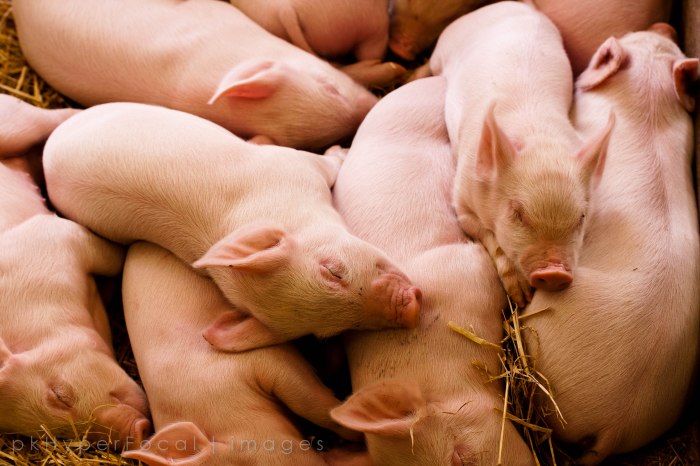
Pile-o-Pigs, photo by Kensington slideshow.

The Michigan DNR says that White-tailed Deer (Odocoileus virginianus) are the smallest of the three members of the deer family found in Michigan – the others being elk and moose.
“White-tailed” refers to the distinctive white tail that when raised is a flag and provides a flash of white, signaling other deer when there is danger. Deer are graceful and swift runners (up to 35 miles per hour), but do not generally run long distances, preferring to seek the nearest shelter whenever possible. Male deer are called “bucks”, females “does” and baby deer “fawns”. These deer tend to live in female-led family groups of up to 25 deer and may live to ten years or more.
Their size ranges between 125 to 225 pounds, although really healthy bucks may be even larger. Their coat is a reddish-brown color in the summer, but becomes much more gray in the winter. This change helps to hide them as the colors of their environment change. Their tubular or hollow hairs provide insulation, allowing them to lie on snow without melting it, as well as creating enough buoyancy for swimming.
Check this out background big and in Andrew’s giant and cool Whitetail Deer slideshow.

Eastern Hog Nose Snake 2, photo by ShaneWyatt.
The Michigan DNR page on the Eastern Hog-nosed Snake (Heterodon platirhinos) says this is a:
A thick-bodied, slow-moving snake with a flattened, upturned “nose.” Color is variable some have dark spots and blotches on a yellow, orange, or brown background, but other specimens are solid black, brown, or olive with little or no visible pattern. Easily identified by defensive behavior. Adult length: 20 to 40 inches.
A snake of open, sandy woodlands – found in the wooded dunes of western Michigan. The upturned snout is used to burrow after toads, a favorite food. When threatened, hognose snakes puff up with air, flatten their necks and bodies, and hiss loudly. (This has led to local names like “puff adder” or “hissing viper.”) If this act is unsuccessful, they will writhe about, excrete a foul smelling musk, and then turn over with mouth agape and lie still, as though dead. Despite this intimidating behavior, Hog-nosed snakes are harmless to humans.
You can see a lot of pictures at the UM Animal Diversity Web and definitely check out Hog Wild on the Herping Michigan blog.
Shane writes that it was pretty intimidating to see the snake flair like a cobra and start hissing at him. Check it out bigger and see some more shots in his eastern hognose slideshow.
More Michigan snakes on Michigan in Pictures!

Champion coming!, photo by Frankenmuth Fun.
Frankenmuth invites you to Dog Bowl 2011, the Midwest’s largest Olympic style event for dogs. This annual event takes place Memorial Weekend (May 28 & 29) at Frankenmuth River Place and includes events for dogs including agility competitions, dock dives, dog disc competition, fashion shows, canine cruise and (of course) biggie dog & weiner dog races! The event is FREE – there’s even a hot air balloon show – and you can click the link above for all the details!
Check this out bigger than a beagle and also see their huge 2008 Dog Bowl and 2009 Dog Bowl slideshows!
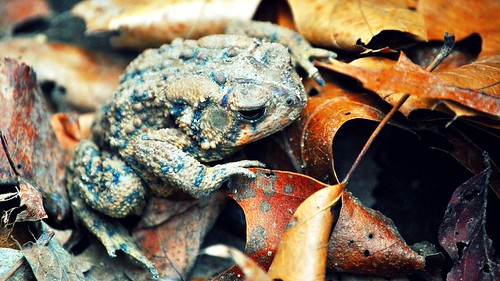
I Am Toad, photo by DavidGuthrie.
The Michigan DNR Frog & Toad page answers the question “How can you tell a frog from a toad?” saying:
It’s been said that a toad is just a lumpy frog! Toads do have thicker, more warty skins compared to the smoother skin of most frogs. Toads are adapted for drier conditions than frogs, though they spend much of their time burrowed into moist soil during times when the air is drier. Toads have shorter hind legs than frogs, comparatively speaking, and move in short hops or simply walk instead of making long leaps.
They say that Michigan has two species of “true” toads, the American Toad and Fowler’s Toad. This little guy is an Eastern American Toad (Bufo americanus) and you can read more about them on Michigan in Pictures. If you’re in a friendly mood, consider building a toad house!
Check this out bigger and in David’s Spring slideshow.
 Michigan in Pictures