it’s magic you know, never believe it’s not so

Its magic you know, never believe its not so

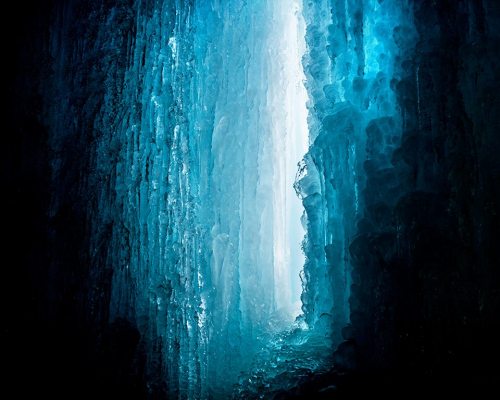
it’s magic you know, never believe it’s not so, photo by Lake Superior Photo

Shawn says the ice formations of Munising are amazing right now and says she’ll be sharing more soon.

She recommends you check with Munising CVB, the rangers at Pictured Rocks National Lakeshore or the Alger County Sheriff to learn if the ice is safe. Ice conditions are constantly shifting, and as you can see, these are massive structures of ice that you want to be pretty darned careful around.

View her photo background bigtacular, visit LakeSuperiorPhoto.com for galleries like Blue Ice and to purchase pictures, and definitely follow Lake Superior Photo on Facebook.

Now about that title, here’s Pilot singing “Magic” … never believe it’s not so.

#TBT Fortress of Solitude Edition at the Grand Island Ice Caves

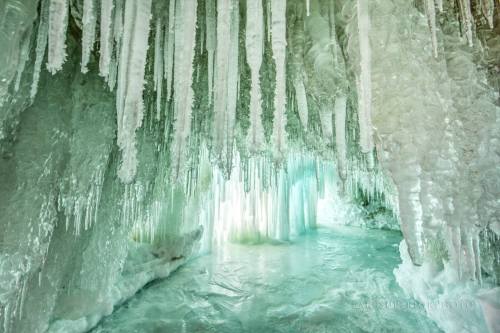
Grand Island Ice Cave

Grand Island ice cave, Winter 2012/13, photo by Ash W Photography

A cool site that really gives you to tools to have a lot of fun in the Upper Peninsula is Things to Do in the U.P. #64 is visiting the Grand Island Ice Caves. After providing very detailed tips & information about how to get to these spectacular formations on Lake Superior off Munising, Brian Marticcui writes (in part):

For an intimate look at nature’s awesome power, sidle up to one of the columns and peer into its core. Expecting a solid tower of frozen water? Not a chance. These columns, especially the newer and/or sun-exposed ones, are actually made up of tiny beads and icicle-like formations separated by vertical channels that allow water to pass through them. It’s one of those mind-numbingly complex natural things that’s simultaneously random and orderly – kind of like a geode, but mostly frozen and not quite as colorful.

Inside, things are a bit more stable – and a whole lot more interesting, if that’s possible. For starters, many of the “entrances” to the caves are little more than elevated holes between solid ice columns. Depending on how the caves have set during the weeks leading up to your visit, you may have to scramble up a mound and squeeze yourself through an opening to actually gain access. (Clip-on crampons might be a good idea.)

Once you get in, be careful, both for your own physical safety and for the integrity of the caves themselves. The floors are often mirror-smooth, making regular walking a major challenge. Meanwhile, the ceilings can be low and/or spiky, and some of the most intricate formations – the fuzzy, mold-like bits of “shaved” ice that project from the bare rock of the walls and ceilings – are extremely fragile. Don’t be the guy or girl who ruins a particularly awesome formation for everyone else – those things don’t reform in their original states.

Since the caves’ outer walls aren’t comprised of a single, solid curtain, and blockages abound, you’ll have to enter and exit several times to get the full measure of their interior spaces. Be careful each time you do; in particular, don’t lean on any dubious-looking columns. Ice is heavy, and you’ll probably see the chilling remains of spectacular collapses. You don’t want to be under an unsafe formation when it goes.

Read on for much more and also follow Jesse’s Things to Do in the U.P. on Facebook.

Ash took this shot at Grand Island’s ice caves a couple of years ago. View it bigger on Facebook and see more of her work in her Upper Peninsula of Michigan gallery at ashwphotography.com.

PS: If you’re in the Marquette area, Ash be displaying February 17 through the end of March at Sweet Water Cafe in Marquette from Feb 17th to the end of March, just a few doors down from Zero Degrees Artist Cooperative where she has her work.

PPS: For a little discussion on current conditions on the crossing to Grand Island, see this thread on Facebook, and before you go be sure to talk to someone who knows something about it. Feel welcome to use that advice for anything that’s possibly dangerous that you know little about.

2015 Michigan Ice Fest this weekend!

DSCN0507

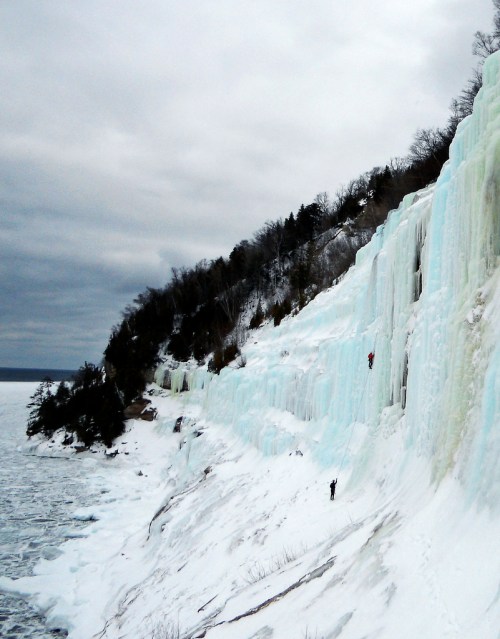
Untitled, photo by Greg Maino

Every year at the beginning of February (Feb 5-8, 2015), ice climbing fans from all over descend on Munising for the Michigan Ice Festival. The weekend features presentations and instruction from some of the top climbers in the world, gear demos, climbing socials and the premier of the trailer for the Michigan Ice Film.

You can see some of the climbing locations (formed by frozen waterfalls and seepage) right here, and if you do head up and pack your camera, consider entering their 2015 Ice Fest photo contest.

View Greg’s photo background big. Most of the climbing is not this extreme – see more of it in his Icefest 2011 slideshow. Be sure to also check out his Icefest: Early Years slideshow and follow his adventures at juskuz.com.

#TBT The Ice Caves of Leelanau from Ken Scott

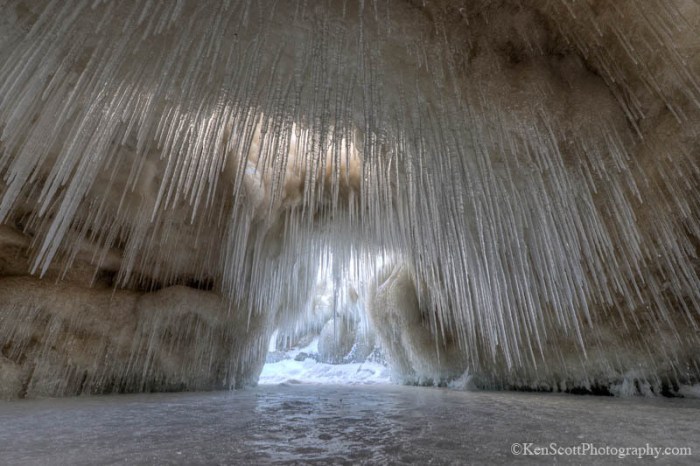
Ken Scott Ice Cave

Lake Michigan … crystal cave II, photo by Ken Scott Photography

“My creative eye is always on. It doesn’t get bored. A lot of people get stuck on seeing things only one way, like the wide view or closeup view … but there’s everything in between. Boredom would come when you’re getting stuck in seeing things only one way. You just have to shift it a little bit and it can open up a whole other world.”
~Ken Scott

Kudos to Michigan in Pictures regular Ken Scott, whose photography of last winter’s ice caves on Lake Michigan is featured in the Huffington Post today. They write:

Scott’s documentation of the ice caves last year on Facebook drew likes, attention and, eventually, the book deal. In Ice Caves of Leelanau, he shows numerous views of the caves, blue ice, volcano ice, pancake ice, the large sheet of anchor ice along the shore, and the rounded and smoothed chunks of ice known as ice balls. Meteorologist Ernie Ostuno captioned Scott’s photographs for the book, and nature writer Jerry Dennis introduced them:

The caves were the surprising thing. Many of us had seen similar structures during other winters, but never many of them, and never this large. These were big enough to stand in — for a dozen people to stand in — and as elaborate as caves in limestone. They were domes and keyholes and grottos. Wave spray and intermittent thawing and freezing had embellished them with columns and pillars. Their surfaces were so smooth they gleamed in sunlight, and from their ceilings dripped hundreds of daggers of clear ice, like crystal stalactites.

George Leshkevich, a researcher with the North American Ocean Administration’s Great Lakes Environmental Research Laboratory, noted that last winter was particularly severe for the Great Lakes, resulting in unique conditions where ice reached peak thickness two separate times in the season.

Different kinds of ice formations occur because of a confluence of reasons, Leshkevich explained, including meteorological conditions, the physical location and wave action, so they’re hard to predict and will vary widely along the shore.

Click through for more great photos. You can check out a short video or a long one from this particular formation, and definitely get a copy of Ice Caves of Leelanau if you can!

PS: I hope all this ice caveyness isn’t bothering you – I’m so happy to see Michigan getting some wintertime love.

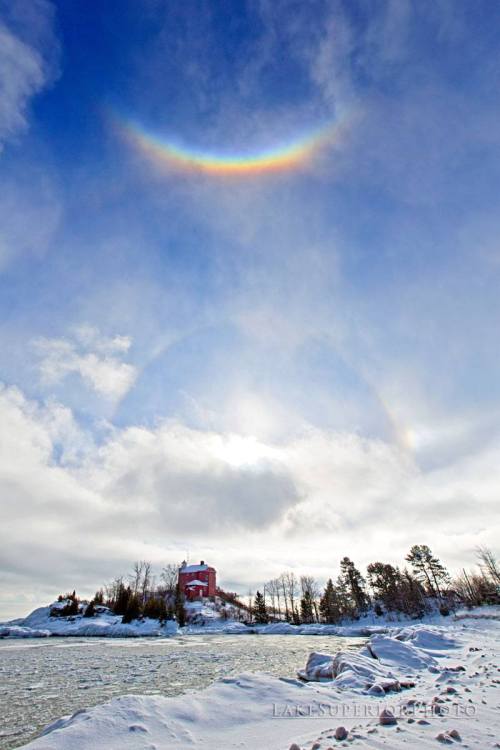
Halo, Sundog & Circumzenithal Arc over Marquette

Solar Halo over Marquette Lighthouse

Welcome to the Smile High Club, photo by Lake Superior Photo

Today’s photo is one of the most incredible pictures I’ve seen. In addition to the Marquette Harbor Light and the frozen Superior shore, there’s a cornucopia of solar optics that fairly defies imagination.

Atmospheric Optics is a wonderful website, certainly the best I’ve found for describing solar phenomena in a clear and inspiring manner. Here’s a bit of decoding of what’s happening in the skies of Marquette yesterday, but definitely follow the links to explore. There’s so much information and some great photos too!

First, above the lighthouse, there’s a 22º radius halo:

…visible all over the world and throughout the year. Look out for them (eye care!) whenever the sky is wisped or hazed with thin cirrus clouds. These clouds are cold and contain ice crystals in even the hottest climes.

The halo is large. Stretch out the fingers of your hand at arms length. The tips of the thumb and little finger then subtend roughly 20°. Place your thumb over the the sun and the halo will be near the little finger tip.

The halo is always the same diameter regardless of its position in the sky. Sometimes only parts of the complete circle are visible.

There’s also a sundog, known also as parhelia or mock sun. These appear in the 22º halo, even when you can’t see the halo. You can see one at the visible base of the halo on the right:

They are most easily seen when the sun is low. Look about 22° (outstretched hand at arm’s length) to its left and right and at the same height. When the sun is higher they are further away. Each ‘dog’ is red coloured towards the sun and sometimes has greens and blues beyond. Sundogs can be blindingly bright, at other times they are a mere coloured smudge on the sky.

They advise you’ll see one or two a week if you look and if you click over you can learn about how they form & moon dogs.

Finally, we come to the circumzenithal arc (CZA), the upside down rainbow at the top:

…the most beautiful of all the halos. The first sighting is always a surprise, an ethereal rainbow fled from its watery origins and wrapped improbably about the zenith. It is often described as an “upside down rainbow” by first timers. Someone also charmingly likened it to “a grin in the sky”.

Look straight up near to the zenith when the sun if fairly low and especially if sundogs are visible. The centre of the bow always sunwards and red is on the outside.

The CZA is never a complete circle around the zenith, that is the exceptionally rare and only recently photographed Kern arc.

Read on for more, and definitely be sure to check atoptics.co.uk when you see solar & lunar phenonmena you’d like to know more about.

View Shawn’s photo bigger and join thousands of others in following Lake Superior Photo on Facebook … and on the Twitters. You can purchase this photo on the Lake Superior Photo website.

PS: Check out Dominic B. Davis’s photo of the solar halo in the morning too!

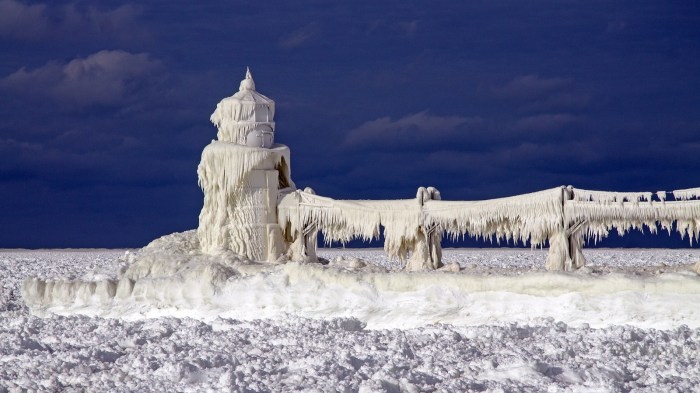
Encased … and Encammed at St. Joseph Lighthouse

Encased

Encased, photo by John Burzynski

While the St. Joseph Lighthouse just made an appearance in my 2014 roundup, sometimes you can’t have too much of a good thing. Speaking of good things, there’s a webcam at the St. Joseph lighthouse that allows you to look in on this incredible scene whenever you want!

View John’s photo bigger on Flickr and see more in his Great Lakes Lighthouses slideshow.

PS: Also a shout-out to Michigan in Pictures regular John McCormick whose 2013 pic of the St. Joseph Light has (according to USA Today) “gone viral” as the face of the Polar Vortex!

Lots more lighthouses on Michigan in Pictures.

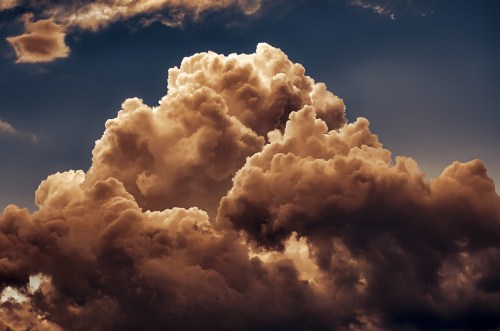
and then I saw this cloud…

Untitled

Untitled, photo by Scottie Williford

Hoping you see some cool sights and enjoy a great weekend!

View Scottie’s photo bigger and see more in his slideshow.

More clouds on Michigan in Pictures.

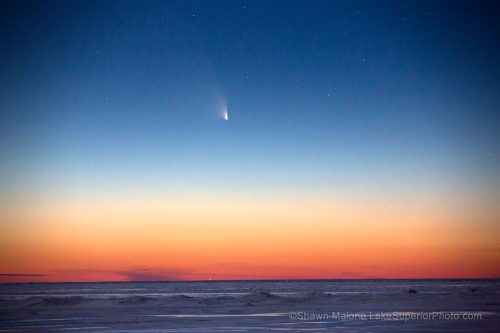
Into the cold clear night with Shawn Malone … and NASA

Shawns Comet

Comet Pan-Starrs over Headlands International Dark Sky Park, photo by Shawn Malone/Lake Superior Photo

Michigan in Pictures regular Shawn Malone of Lake Superior Photo is one of the best photographers of the Michigan night sky around, and on the evening of November 22nd , you have a chance to learn from her at a Night Sky Workshop. She writes:

The Upper Peninsula of Michigan is a wonderful place to discover the magic of night sky photography, due to the abundance of easily accessible dark sky locations. These night sky workshops are designed for those looking for a basic understanding of the equipment and technique necessary for capturing the night sky.

Photography workshops will take place at LakeSuperiorPhoto- gallery/studio on 211 S. Front, Marquette Mi. 49855. There will be an hour class at the studio where I will cover techniques for capturing night sky photos, from basic camera set up and settings, to a brief discussion of post processing to helpful websites and software to help you come away with great night sky photos.

During this workshop we will concentrate on the techniques necessary to capture low light and night sky photos. Hopefully the weather cooperates and we have a chance to photograph the stars or maybe even possibly the northern lights. No matter what weather conditon – we will conduct the workshop and you will come away with everything you need to know about capturing great night sky images.

She has 4 spaces left – click here to register!

You can purchase this photo of Comet Panstars at Lake Superior Photo. Be sure to follow her at Lake Superior Photo on Facebook and see more of Shawn’s photos on Michigan in Pictures.

Speaking of comets, NASA’s Rosetta Mission is going to go all Bruce Willis on a comet THIS MORNING! EarthSky reports:

The Philae (fee-LAY) lander is scheduled to touch down on Comet 67P/Churyumov-Gerasimenko on November 12, 2014 at 10:35 a.m. EST (15:35 UTC). We on Earth – 300 million miles (500 million km) away – won’t know the lander has set down successfully until a signal is received back at about 11:02 a.m. EST (16:02 UTC). Both NASA and ESA will provide live online coverage of this first-ever attempted landing on a comet.

Rosetta spacecraft will do the equivalent of transferring an object from one speeding bullet to another, when it tries to place its Philae lander on its comet. Read more about the mission’s dramatic attempt to land on a comet here.

After landing, Philae will obtain the first images ever taken from a comet’s surface. It also will drill into the surface to study the composition and witness close up how a comet changes as its exposure to the sun varies.

Philae can remain active on the surface for approximately two-and-a-half days. Its “mothership” – the Rosetta spacecraft – will remain in orbit around the comet through 2015. The orbiter will continue detailed studies of the comet as it approaches the sun for its July 2015 perihelion (closest point), and then moves away.

Click through for more and follow it live from NASA right here!

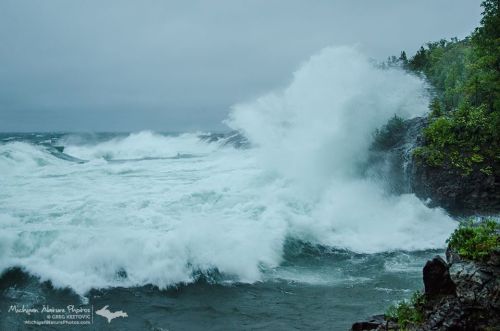
Lake Superior Wave Explosion

Lake Superior Wave Explosion

Lake Superior Wave Explosion, photo by Michigan Nature Photos

“These are not lakes. These are the world’s 8th seas, and her bottom is littered with the wreckage of over six thousand ships.”
~Rick Jones from Three Sisters by Song of the Lakes

It’s wave week on Michigan in Pictures!

Greg shot this on the evening of September 10th at Black Rocks near Marquette, MI. View it bigger, check out his Lake Superior Storms gallery and follow Michigan Nature Photos on Facebook.

Greg also has a video of these waves, some topping 15 feet, and you can venture further out in the Big Lake with this video of a freighter on Lake Superior from the Sep 10th as well.


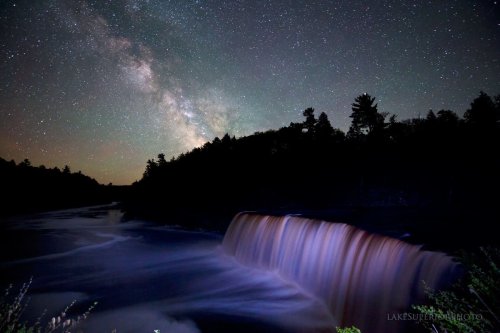
The Upper Peninsula Night Sky

Tahquamenon Falls by LakeSuperiorPhoto

Tahquamenon Falls, by LakeSuperiorPhoto

It’s certainly no secret that one of my favorite Michigan photographers is Shawn Stockman Malone of Lake Superior Photo. The latest national outlet to recognize her work is Huffington Post Detroit, which assembled a collection of her UP Night Sky photos in a nice feature that says (in part):

Stockman-Malone runs photography gallery LakeSuperiorPhoto in Marquette, Michigan, a bustling college and former mining town on the Lake Superior coast.

…While Stockman-Malone does monitor sun weather to try to catch views of the Northern Lights, much of her work is guided by chance — and by being ready to photograph at any time. Once, her dog was scared and woke her up when lightning struck, and she caught a shot of the Northern Lights over the storm.

“You never know what Mother Nature has up her sleeve, and just hope you catch it,” Stockman-Malone said about her night photography practice in an email to The Huffington Post. “The Milky Way moves across the sky and can be found rising and setting in different directions throughout the year, so there will always be new perspectives in new locations. Same thing goes for moonrises and moonsets. Then there’s meteor showers, conjunction of planets, appearance of comets, etc. so there’s always something new happening.”

Click through for more and lots more incredible night shots!

View this photo and more bigger at Huffington Post Detroit, purchase prints at lakesuperiorphoto.com and get your daily dose of Upper Peninsula Amazing through the Lake Superior Photo Facebook.