
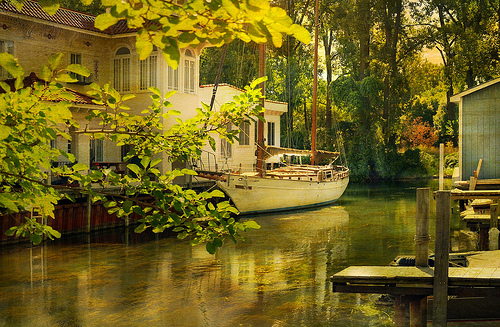
Lake Michigan, photo by GLASman1.
Wikipedia’s Lake Michigan entry begins:
Lake Michigan is one of the five Great Lakes of North America and the only one located entirely within the United States. The other four Great Lakes are shared by the US and Canada. It is the second largest of the Great Lakes by volume and the third largest by surface area, after Lake Superior and Lake Huron (and is slightly smaller than the U.S. state of West Virginia).
Hydrologically, the lake is a large bay of Lake Michigan-Huron, having the same surface elevation as Lake Huron (among other shared properties). It is bounded, from west to east, by the U.S. states of Wisconsin, Illinois, Indiana, and Michigan. The word “Michigan” originally referred to the lake itself, and is believed to come from the Ojibwa word mishigami meaning “great water”.
It makes complete sense to me that the Lake was first. However, since I’m pretty much never able to leave ambiguities un-investigated, I dug up a discussion thread about the origin of “Michigan” from the Ojibwe Language Society Miinawaa. One member listed a few variants:
mishigami = large lake
mishigamaa = large lake
mishi’igan = large lake
mishigaam = large shoreline
and then another member wrote
my understanding of the word ‘Michigan’–which may be different from others’–is that it comes from ‘michi-zaaga’igan’, which means ‘only/just/nothing else but a lake’ [michi ‘only, just, that’s all there is’ + zaaga’igan ‘lake’].
If you think about Lake Michigan and Lake Huron and how you might perceive them before aerial capability or maps, wouldn’t they seem like one big lake to someone questing to walk or paddle the shoreline of Michigan’s Lower Peninsula? The “only lake”? Love to hear your thoughts in the comments.
Check this out bigger and in Mark’s Point Betsie Lighthouse slideshow.
More Lake Michigan on Michigan in Pictures.
Share Michigan in Pictures:







 Michigan in Pictures