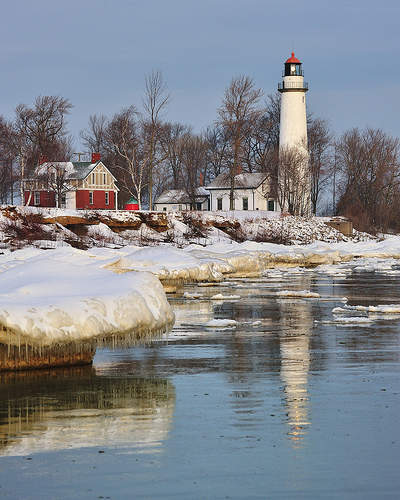
Wintertime at Aux Barques Lighthouse, Port Hope, Michigan

Wintertime at Aux Barques Lighthouse, Port Hope, Michigan

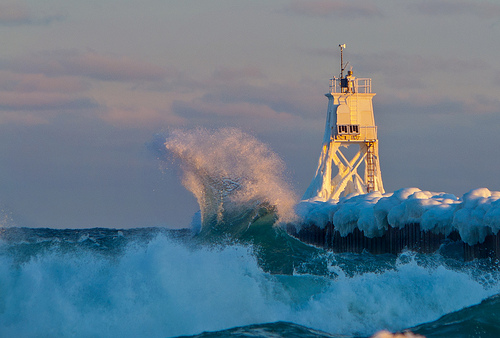
Wintertime at Aux Barques Lighthouse, Port Hope, Michigan, photo by Michigan Nut.

The page on the Pointe Aux Barques Lighthouse at Terry Pepper’s Seeing the Light says that about 75 miles north of Fort Gratiot light and two miles from shore in Lake Huron, there’s a shallow reef with only two feet of water above it. It was right where northbound vessels made their swing into Saginaw Bay, and Michigan State Representative Isaac Crary entered a motion in Congress in 1838 to establish a lighthouse on the shore to warn mariners and mark the turning point:

Congress responded with an appropriation of $5,000 for the Light’s construction on July 7, 1838.

While conducting his annual inspection of lighthouses on the lakes and selecting sites for proposed new stations a month later, Lieutenant James T Homans arrived in the area to select the site for the new station. In his report to the Fifth Auditor of the Treasury for the year, Homans reported that he selected “the most westerly of the two points, known as Point-aux-Barques, near the entrance to Saganaw Bay (sic), for the light there, because it is sooner seen by vessels approaching from the northward and westward, by which it will be most used; also, as being near a shoal, dangerous to the navigation of its vicinity.” Homans went on to report that “There is stone in considerable quantity near this location, which can be used in constructing the buildings. The land, I presume, belongs to the Government, or can be had for a moderate price, there being no settlements within several miles, and the soil very barren.”

Government apparently moved no faster then than now, and it wasn’t until 1847 that the structure was completed. There’s much more about the lighthouse and the Port Hope Lifesaving Station including photos if you read on at Seeing the Light.

The Pointe Aux Barques Lighthouse Society has the text of the contract to construct the light along with a few photos and more information including the keeper logs from 1923.

John took this photo at the end of January. You can see it bigger and see more from the area on his map. Don’t miss the Michigan Nut Photography Facebook page either!
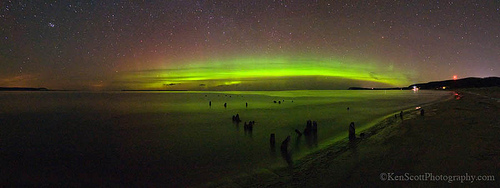
Good Harbor Bay … aurora borealis panorama

Good Harbor Bay ... aurora borealis panorama

Good Harbor Bay … aurora borealis panorama, photo by Ken Scott.

The northern lights made an appearance over the weekend, and Ken Scott was one of the Michigan photographers who made the scene!

Click to see it on black and see more in his northern lights slideshow.

A couple others were Shawn Malone of Lake Superior photo and Guy Strong who nabbed a SWEET time-lapse of the northern lights!

Click for many (many) more photos of the Northern Lights in Michigan!

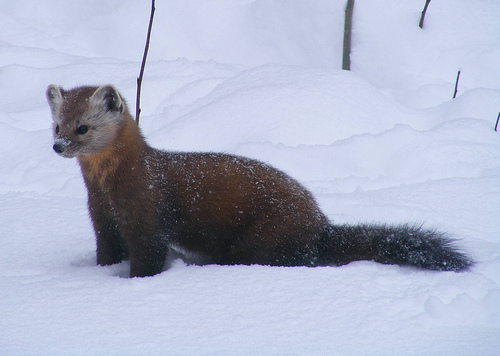
American Marten: A Michigan wildlife success story

American Marten 1

American Marten 1, photo by 13Miles.

The UM Animal Diversity web page on the American marten (Martes americana) says that American marten, also known as pine marten, are found in the northern reaches of North America and sporadically in Michigan, primarily in mature, northern forests:

These animals are closely associated with lodgepole pine, Douglas fir, spruce, and mixed harwood forests. They tend to be found in structurally complex, mature forests, and can occur at all elevations where such habitat exists. They den in hollow trees, crevices, or vacant ground burrows.

…American martens are somewhat arboreal (tree dwelling) and move with great ease in trees. They mark scent trails from tree to tree with their strong scent glands. In spite of this, they are reported to do most of their hunting on the ground. Most hunting occurs at dusk and dawn, when prey species are most active. In addition, these animals are accomplished swimmers and can even swim under water.
…Home range sizes vary considerably with habitat and prey densities. American martens do not hibernate and is active all winter.

You can read more and see pictures from Animal Diversity Web and on the American marten page at Wikipedia. The Michigan DNR’s page on the American marten says that:

According to records, the American marten was eliminated from Michigan around the 1930s. Removal of the mature evergreen forests and unregulated harvest of martens reduced the species to small populations in the Upper Peninsula. These eventually disappeared from the state. The 1927-28 Biennial Report stated, “They (marten and fisher) are so nearly exterminated in Michigan that there appears no chance they will ever come back.” Recovery efforts were initiated as early as 1958 with releases of captured martens into the Upper Peninsula Porcupine Mountains. Additional releases in the UP were conducted in the 1970s.

…Biologists have followed their progress over the years tracking pine martens to learn about their habitat use and home range needs. These studies along with sighting reports from hunters and other recreationists and incidental catches indicated the martens were readapting to their native Michigan.
During the review of the current Endangered Species List, biologists felt the population has recovered enough to upgrade its status. Martens are frequently becoming a part of the outdoor experience in Michigan with more and more encounters reported by hikers, campers, trappers, and hunters.

Once gone, the martens have returned home due to the efforts of many private organizations and agencies, but especially due to the support given by the donations of Michigan’s taxpayers to the nongame income tax checkoff.

Dixie took this photo last February around Grand Marais. Check it out bigger and see a few more shots of this beautiful animal in her marten slideshow.

More Michigan animals from Michigan in Pictures.

Goin’ skiing

DSC_9141copy2

DSC_9141copy2, photo by kensingt0n.

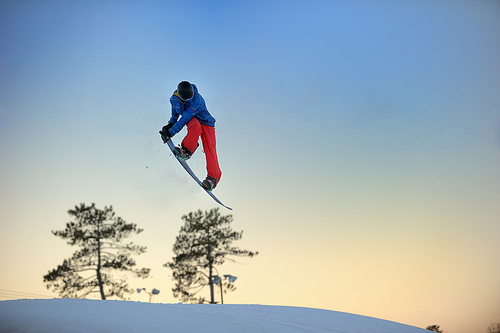
…and snowboarding. Have a great weekend!

Check this out big as this air and in Arnold’s 2/6/12 Jonas snowboarding at Pine Knob slideshow.

It’s a Free (ice) Fishing Weekend!

Vintage Ice Fishing Michigan

Vintage Ice Fishing Michigan, photo by UpNorth Memories – Donald (Don) Harrison.

Two times a year, the State of Michigan has free fishing weekends, once in the summer (Jun 9 & 10, 2012) and once this weekend (Feb 18 & 19). All fishing regulations still apply, but fishing license fees are waived for residents and out-of-state visitors who can fish on both inland and Great Lakes’ waters for all species of fish.

All over the state there are special fishing events including the Ellsworth Shiverfest in Antrim County, the Winter Festival at the Bay City State Recreation Area, the Dam to Dam Ice Fishing Contest in Newaygo, the Higgins Lake WinterFest and the Free Fishing Weekend Special Event at Brighton Recreation Area.

You can get more on the weekend and some ice fishing videos on Absolute Michigan.

Check this out on black and see a lot more cool old photos, ice fishing decoys and memorabilia in Don’s ice fishing slideshow.

Catch more fish & fishing on Michigan in Pictures!

Fogbow: a White Rainbow over Big Red

fogbow-at-big-red-by-steven-karsten

White Rainbow, photo by stevedontsurf.

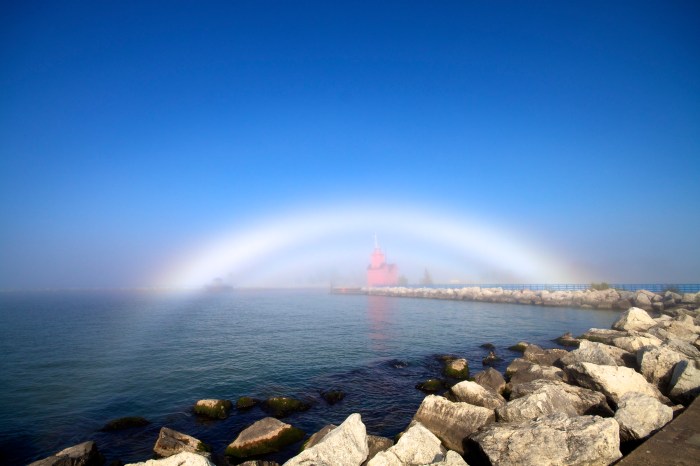
Today’s photo shows a fogbow. According to the Fogbow entry from Atmospheric Optics:

Fogbows form in the same way as rainbows. A small fraction of the light entering droplets is internally reflected once and emerges to form a large circle opposite the sun.

But… …beyond that there are major differences. Rainbows are formed by raindrops which are so large that rays passing through them follow well defined ‘geometrical optics’ paths. Fogbows are formed by much smaller cloud and fog droplets which diffract light extensively.

…Fogbows are almost white with faint reds on the outside and blues inside. The colours are so washed out because the bow in each colour is very broad and the colours overlap.

Read on for more, including some photos and get a little more at Wikipedia’s page on fog bows.

Steven shot this at the Holland Harbor Lighthouse aka Big Red and writes that he’s still amazed he was able to stumble upon one of these. Check his photo out big as the sky and in his Holland slideshow.

Jump into Valentine’s Day!

Rockford Sweetheart Splash 2012

Rockford Sweetheart Splash 2012, photo by DJ Wolfman.

Happy Valentine’s Day Michigan! Here’s hoping that you find someone in your life who will stick with you in times hot and cold.

Check this out bigger and see more in Daniel’s Rockford Sweetheart Splash slideshow.

Sunrise at Copper Harbor Lighthouse

Bounded Light - Copper Harbor Lighthouse (Copper Harbor, MI)

Bounded Light – Copper Harbor Lighthouse (Copper Harbor, MI), photo by Aaron C. Jors.

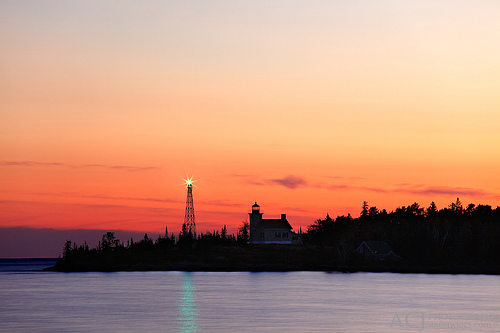
The Freep had a feature on the most romantic places to visit in Michigan. I was happy to see that two of their 5 sunset spots were in my native Leelanau Peninsula. There’s bunches of Leelanau on Michigan in Pictures, so I figured I’d pick another. Since there are also a whole lot of sunsets, how about a romantic sunrise over the Copper Harbor Lighthouse on the Keweenaw Peninsula?

Terry Pepper’s Seeing the Light says that the discovery of copper in the Keweenaw drew so many immigrant Cornish and Finnish miners seeking their fortunes that one pioneer observed that “the shores of the Keweenaw became whitened with tents.” Terry’s entry on the Copper Harbor Lighthouse says that the original light from 1849 was exemplary of the poor planning and tight budgets of the administration of Stephen Pleasonton. Pleasonton was also the man who saved the original copy of the Declaration of Independence, so you win some and lose some I guess. In any case:

By the early 1850’s a cry arose in the maritime community, voicing concern over Pleasonton’s tight-fisted administration of the nation’s aids to navigation. A clerical administrator, Pleasonton had no maritime experience, and it showed-up in the sub standard workmanship and poorly chosen locations of many of the lighthouses erected under his administration. A study commissioned by Congress recommended the establishment of a nine-member Board to oversee the administration of aids to navigation. Staffed with Navy officers and Engineers from the Army Corps of Engineers, the Lighthouse Board was established in 1852, relieving Pleasonton from any further involvement. One of the Board’s first orders of priority was the upgrading of illumination systems from the dim and poorly performing Argand lamps to the far more efficient and powerful Fresnel lenses manufactured in Paris. However, with the Copper Harbor Light not being of major importance in the greater scheme of things, it would be some time before its lens would be upgraded, and thus the Argand lamps continued to light the way into the harbor.

…In 1856, a work crew finally arrived in at the station and removed the Argand lamps from the lantern, and replaced them with a single fixed white Sixth Order Fresnel lens, thus increasing the station’s range of visibility to ten miles at sea. Three years later, the Light was upgraded further through the replacement of the Sixth Order lens with a more powerful fixed white lens of the Fourth Order.
As was the case with virtually all of the lighthouses built on the Great Lakes during the Pleasonton administration, the true costs of inferior materials and shoddy workmanship began to show. After his 1864 visit to the station, the Eleventh District Inspector remarked that the Copper Harbor lighthouse required “extensive repairs.” On subsequent investigation, the condition of the tower was determined to be beyond repair, and the following year the decision was made to raze the old tower and erect a completely new structure.

Read on for more on the construction of the new light and to see some great old photos. Also see Terry Pepper’s explanation of Argand and Fresnel lamps.

Check this out on black and in Aaron’s Great Lakes Lighthouses slideshow.

Break Wall Sunrise

Break Wall Sunrise

Break Wall Sunrise, photo by Gary of the North.

Here’s yesterday’s sunrise in Grand Marais, Michigan … it’s pretty clear that Lake Superior was wide awake.

Check it out background bigtacular and see a lot more photos from the area on Gary’s map.

More winter wallpaper from Michigan in Pictures!

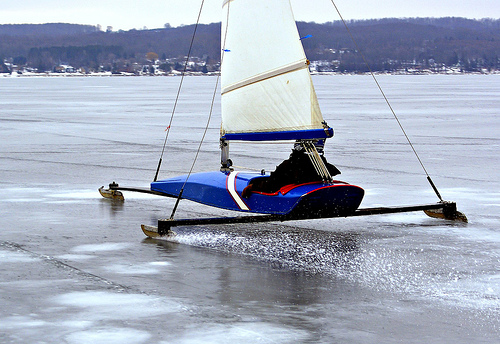
Ice Boating on Lake Charlevoix

Gordon in his Nite- Lake Charlevoix, Boyne City, Michigan

Gordon in his Nite- Lake Charlevoix, Boyne City, Michigan, photo by rickrjw.

Yesterday we took a trip under the ice of Lake Charlevoix, so it was very fitting that this morning Rick shared a photo from the other side of the ice on Lake Charlevoix! Our recent warm spell has cleared the snow and smoothed the ice on many lakes in Michigan, and that has brought ice boaters out in force.

Sail Michigan’s Michigan iceboating page explains

There are some peculiarities to ice boating (ice yachting) which are not seen with “soft water” sailing. First, most iceboats carry a single individual (so the need for crew is removed), however two or more person boats do exist. Second, because of the speeds involved (iceboats in general can travel 5-10x wind speed), ice sailors wear protective gear, including helmets. Third, iceboats do not require standard ramps for launching. And lastly, an intimate knowledge of ice conditions and lake topography is essential for a safer experience (although ice boating cannot be made 100% “safe”).

The iceboating season can’t start until snow-free hard ice is established on the lakes, usually after Christmas.

Check this photo out background big in in Ricks Iceboating 2012 slideshow!

Here’s one of our favorite iceboating videos: Ice boat vs Chevy on Lake St. Clair!