Set your backgrounds for spring

Macro Crocus

Macro Crocus, photo by MightyBoyBrian.

Brian shot this on yesterday’s toasty-warm and not very March-like Sunday and writes:

Go ahead, set your background. I declare that it’s spring. The flowers think so and I do too.

I was slithering around on the ground with my new macro lens (EF format vs EF-S with canon full-frame) to get up in close with this patch of crocuses.

Here’s a tip: instead of a typical green or brown backgound, position yourself so that other flowers are in the background of the scene giving their color to the awesomeness.

Good advice, Brian, and with highs predicted for Wednesday in the SEVENTIES around Michigan, you might need to find us a strawberry so we can go directly to summer…

Check his photo out background big or settle back for his bokeh slideshow.

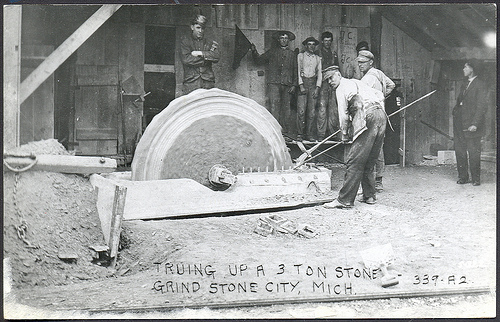
Truing up a 3 ton stone in Grindstone City

Grindstone City MI Lake Huron Village home to the old Grindstone Quarry LL Cook Card S322 1935 vintage Stamp Box Unsent

Grindstone City MI Lake Huron Village home to the old Grindstone Quarry LL Cook Card S322 1935 vintage Stamp Box Unsent, photo by UpNorth Memories – Donald (Don) Harrison.

“Grindstone City received its name in 1870. It happened in this way. Mr. James Wallace, one of the owners of the quarry at that time was talking to Mrs. Sam Kinch Sr., when she remarked that the village was growing so fast that it ought to have a name. They were discussing Stonington as a name when Mrs. Kinch suggested Grindstone and Mr. Wallace added City and from then on the village has been known as Grindstone City.”
from Mabel Cook’s “History of Grindstone City, New River and Eagle Bay” (1977).

The excellent history of Grindstone City from the Michigan State University, Department of Geography tells the fascinating story of the Huron County town that was once where the world turned for grindstones. This was due to the particular qualities of “Grindstone”, a special rock formation from Marshall Sandstone that made the finest sharpening stones. It all began:

In the year 1834, Capt. Aaron G. Peer, with his Schooner, the Rip Van Winkle, was forced to take haven in this natural harbor, during a storm. Capt. Peer is known as the “father” of Grindstone City, and located the first land in what is now Huron County. The sloop took anchorage here in a storm, and that Capt. Peer, his crew and his father came ashore to what was then a wilderness of pine, cedar, ash, beech, and maple, the cedar being so thick that snow remained in places although it was midsummer. In their exploring they found some big flat stone along the beach and on further examination, found evidence that these strata of rock was underlying the area to a lesser or greater extent . Samples were taken to Detroit where they were found superior to the Ohio flagstone which city officials were planning to use to pave some of the streets.

…On one trip, the sailors rigged up in a crude fashion a stone slab and used it to sharpen their tools. That year (1838) Capt. Peer, getting the idea from the sailors began shaping the grindstones at the place later known as Grindstone City.

Definitely read on to learn about the process that produced the grindstones from quarry to turning the stones shown above and ultimately to market.

One of the most commented posts on Michigan in Pictures is Not much remains of Grindstone City which featured a photo of one of the few remaining grindstones by Marty Hogan on a beach that was once covered in them. Here’s the Google Earth of Grindstone City, and there’s also a Grindstone City Facebook page with some photos and folks sharing memories and photos.

Don says the postcard above is from 1935. View it background big or settle back for his Grindstone City postcard slideshow.

Michigan Wild & Scenic Rivers: Manistee River

Ox Bow on the Manistee River

Ox Bow on the Manistee River, photo by jimflix!.

Michigan has 16 nationally designated Wild & Scenic Rivers. The Wild & Scenic Rivers Act of October 2, 1968 provided for federally designated rivers that “possess outstandingly remarkable scenic, recreational, geologic, fish and wildlife, historic, cultural or other similar values.” A 26 mile section of the Manistee River was added in 1992 from the Michigan DNR boat ramp below Tippy Dam to the Michigan State Highway 55 Bridge. On the Manistee’s page at the Wild & Scenic River website they say:

The Manistee Wild and Scenic River is well known for beautiful scenery, excellent fishing and a variety of recreational activities. In the spring and fall, high numbers of anglers are attracted to the superb salmon and steelhead runs. During the summer, walleye and pike fishing become the primary recreational activity. The river supports a variety of other recreational uses including wildlife viewing, hiking, canoeing and hunting.
Private businesses and government agencies have developed a variety of facilities and services to meet the expanding recreation demands of the public. Commercial guided fishing is one of the most popular activities on the Manistee River. The amount of recreational use fluctuates from year to year, mostly based on the fishing runs and local economic factors. There are eight developed river access sites within the wild and scenic river corridor. The Forest Service maintains sites at High Bridge, Bear Creek, Rainbow Bend and Blacksmith Bayou. The state of Michigan operates a river access site at Tippy Dam. Private recreation sites include Big Manistee Riverview Campground and Coho Bend Campground. The Forest Service developed recreation sites along the Manistee River require a vehicle parking pass under the Recreation Enhancement Act.

View this photo background big and in Jim’s Manistee River slideshow.

More Wild & Scenic Rivers on Michigan in Pictures!

Butterflies are blooming in Grand Rapids

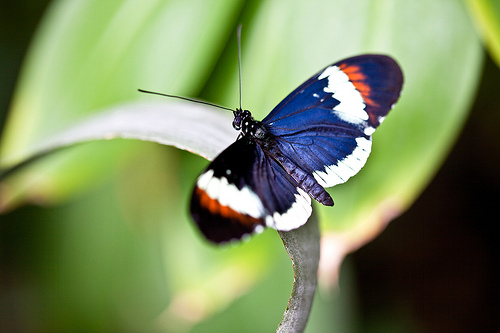
Wingspan

Wingspan, photo by TerryJohnston.

…at Meijer Gardens to be precise, where Butterflies Are Blooming is:

…Meijer Gardens’ most popular annual exhibition and the largest temporary tropical butterfly exhibit in the nation. March 1–April 30, visitors can escape the Michigan winter and mingle with more than 6,000 tropical butterflies flying free in the 15,000-square-foot Lena Meijer Tropical Conservatory.

The exhibition boasts more than 40 different species from the Far East, Africa and Central America. Each week hundreds of chrysalises arrive at Meijer Gardens and are painstakingly sorted, inspected, labeled and pinned in our sealed Butterfly Bungalow. The chrysalises are then placed in a special emergence area of the Bungalow where visitors can witness through a window their magical transformation into butterflies!

Once ready to be released into the conservatory, the butterflies are placed on plants where they acclimate to the environment and gain strength before taking to the air. It’s a wonderful place for photos and just one of the opportunities for visitors to observe the butterflies up-close and personal. Throughout the tropical environment, butterflies can be viewed drinking nectar from the flowering plants and feeding stations, lighting on the odd nose or shoulder, and congregating along the stream beds, as well as in flight all around.

Here’s a little butterflies & Beethoven for you in this video! Many more great ways to get out and about in our March Event Calendar on Absolute Michigan!

Check this out bigger than a butterfly and see many more in Terry’s butterfly slideshow.

Build-up: Inside the Eben Ice Caves

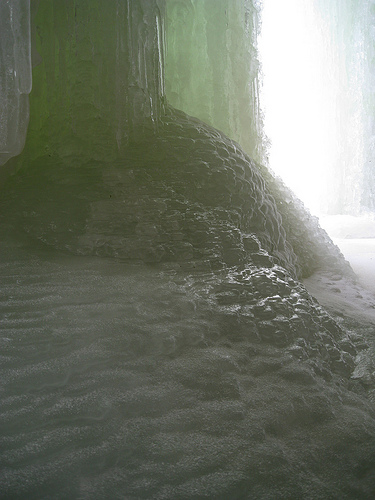
Build-up

Build-up, photo by nasunto.

“The drips of water falling from above created wonderful echoes and added to the cave atmosphere. There is much variation of color and texture to the ice in different parts of the cave. Some formations were smooth and clear, others were bumpy and hollow-sounding, and there were some columns that looked like dripping candle wax.”
~Nina Asunto on being inside the Eben Ice Caves

This may be the latest I have ever posted a Michigan in Pictures. Busy, busy I guess.

Nina took this photo at the Eben Ice Caves, which are a very popular subject on Michigan in Pictures. In Monday’s Daily Michigan email (which I think you might enjoy as it is Not Too Terribly Long and also Filled With Michigan Stuff & Giveaways) we featured Nina’s video from these seasonally forming caves in the Rock River Canyon Wilderness Area.

Nona has a great blog called Black Coffee at Sunrise with writing and photos from some of Michigan’s coolest places, and her Eben Ice Caves feature is a must-read. View her photo as big as you like and see her other shots and the video in her Eben Ice Caves 2012 slideshow.

PS: Separated at birth?

Winter Marches On

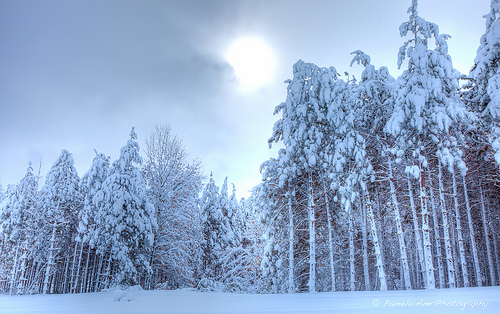
Snow Storm Traverse City, Michigan

Snow Storm Traverse City, Michigan, photo by Pamela Bevelhymer.

While the winter of 2012 has been one of the mildest in Michigan history, the month of March has come in like Ndamukong Suh, dumping over 2 feet of snow in some spots and knocking out power for 250,000+ Michiganders!

Today on Absolute Michigan we posted Five Things You Need to Know about Michigan snowstorms that has the details about this and other snowstorms in Michigan.

Check this photo from Traverse City out bigger and see more in Pamela’s Michigan slideshow.

Michigan Snakes: Blue Racer (Coluber constrictor foxi)

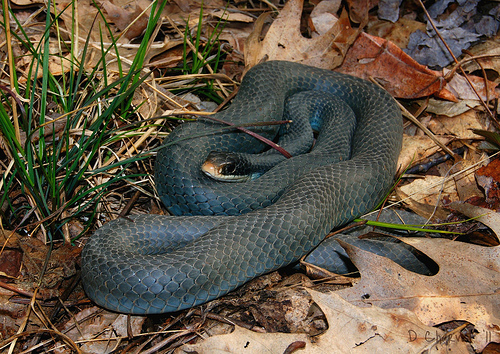
Blue Racer

Blue Racer, photo by d charvat.

“I liked to go on the road and catch the blue racers and sort of scare my brothers,” she said. “I’d drape them around my neck and around my wrist. I was the ultimate tomboy when I grew up here in Manistee and I loved the Great Lakes. “
~Ann Romney recalling her Michigan childhood (article)

While Mitt Romney’s “the trees are the right height” memories of Michigan drew some laughter, I doubt that anyone would laugh at tomboy Ann Davies with a couple of blue racers draped around her arms.

The DNR’s page on Michigan snakes says that Michigan has 17 native species. Their Blue Racer (Coluber constrictor foxi) page explains:

A large gray or blue snake with smooth scales. The head is usually darker than the body, though the chin and throat are white. The belly is light blue or white. Young racers are grayish, with a pattern of darker blotches and spots. Adult length: 4 to 6 feet.

Racers inhabit a variety of places, including open woods, meadows, hedge rows, marshes, and weedy lake edges. They are alert, active snakes that may climb into low bushes to escape enemies. These snakes feed on rodents, frogs, smaller snakes, birds, and insects. Although they will bite if cornered or grabbed, racers are not venomous.

Females lay 6 to 25 eggs in rotting wood or underground during June and July. The young racers hatch in late summer and, as noted above, are colored differently than the adults.

Racers have been found through most of the Lower Peninsula (except the northernmost sections) and the southern tip of the Upper Peninsula. Once common, their numbers have fallen in many places. Needless persecution by humans as well as habitat loss are probable factors in this decline.

The Coluber constrictor Eastern Racer entry from Animal Diversity Web says that the blue racer is one of several different racer subpopulations and adds a lot more information and photos including that in the wild, racers have been known to live over 10 years. You can also watch a cool video of a BIG blue racer by the Saline Snake Guy.

d charvat writes that they saw this good-sized blue racer while hiking in the Middleville MI state game area. Check it out background big and see a lot more cool shots from out and about in their slideshow.

Trees such as these … Happy Birthday Dr. Seuss

Explosions in the sky

Explosions in the sky, photo by MightyBoyBrian.

He was shortish. And oldish. And brownish. And mossy.
And he spoke with a voice that was sharpish and bossy.
“Mister!” he said with a sawdusty sneeze,
“I am the Lorax. I speak for the trees.
~The Once-ler

Today is the birthday of Theodor Seuss Geisel aka Dr. Seuss. Geisel was the author of 46 children’s books and had such an impact on the genre that his birthday has been adopted as National Read Across America Day. Here’s hoping you can read something wonderful to the special young people in your life today!

While the new movie The Lorax based his book is drawing fire from both the right and the left, there’s little doubt that few people have had the kind of impact on children’s literature that he did.

You can see the Lorax trailer at the link above, and you might also want to check out the TV special from 1974 which featured voices of Eddie Albert and Bob Holt and originally included a hummingfish bashing Lake Erie with the line “I hear things are just as dreary down in Lake Erie”. In a nearly Michigan connection, twenty years later two research associates from the Ohio Sea Grant Program wrote to Seuss about the clean-up of Lake Erie and got the line removed from the book. Also see the full text of the Lorax and check out a whole world of Seussian fun at Seussville.com.

About the photo, Brian asks “What does it look like to you?” To me, it was Truffula trees. Check them out background bigtacular and in Brian’s Top 30 slideshow.

In like a lion … a very confused lion at least

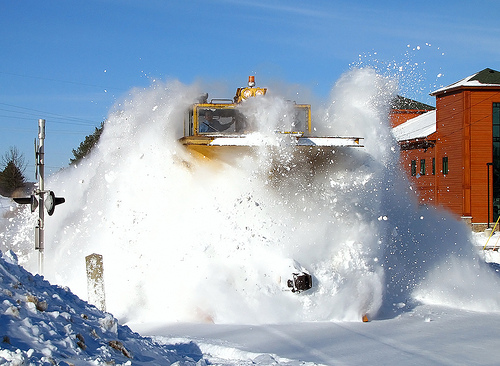
Plow Extra Grant

Plow Extra Grant, photo by amtrak_russ.

March roared into Michigan a (leap) day early, dumping up to 16 inches of snow in parts of the UP. The Lansing State Journal reports that while the UP was buried, southern Michigan was boiling:

The National Weather Service says 10 to 16 inches fell in the Iron Mountain area, while the Ironwood area got up to 14 inches and the Menominee area up to 13 inches.

Icy road conditions were reported in parts of the southern Lower Peninsula early Wednesday, but warm winds pushed highs to spring-like levels. The weather service says Three Rivers hit 64 degrees, Kalamazoo 63, and Coldwater and South Haven 62.

The rules of folk wisdom dictate that with such a ferocious beginning, the month will end lamb gentle … but is that only for folks in the UP?

About this photo from last year Russell writes Marquette Rail ran a plow extra after the 2011 blizzard that dropped over 2 feet of snow and 50+ MPH winds. Here it is seen busting through the crossing in downtown Grant. Check it out bigger and in his Trains 2011 slideshow.

There’s a yard-full of trains on Michigan in Pictures!

Leap Day!

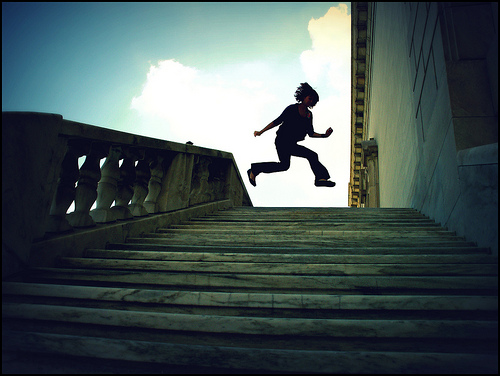
hello, museum.

hello, museum., photo by singlecupofcoffee.

By my calculations, Leap Day only comes once every 1461 days.

How are you going to make it special?

Megan Elizabeth took this at the Detroit Institute of Arts, where she appears to be a frequent visitor. Check this out bigger and in her impressive [hello, 365]. slideshow  featuring a photo a day of her leaping all over the place. Very cool, very creative, very appropriate!