
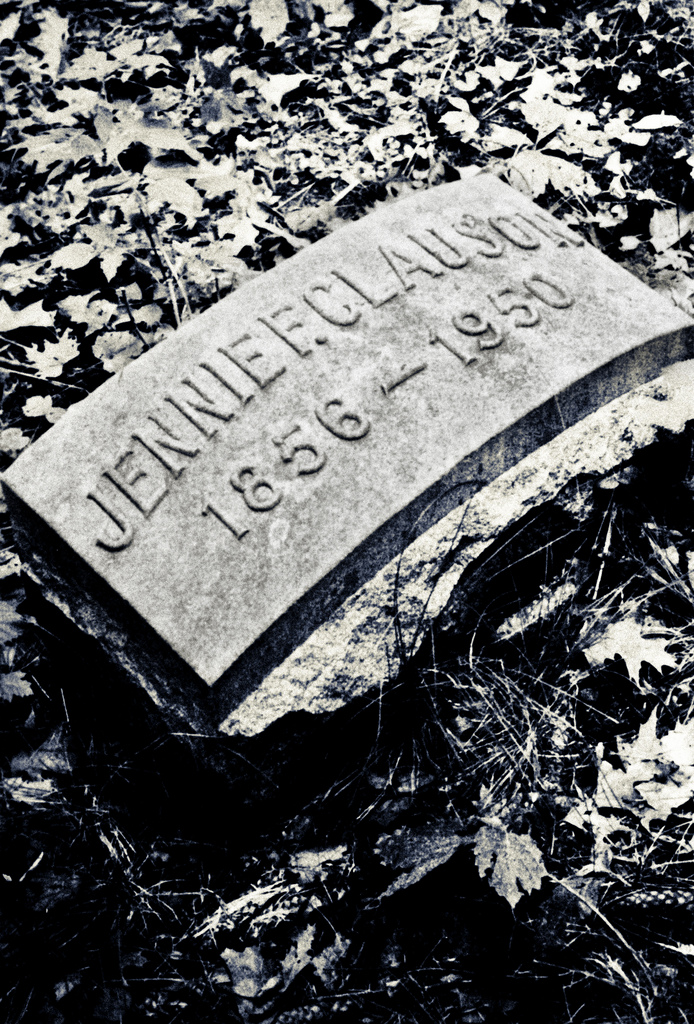
Jennie F. Clausen, photo by Marty Hogan
View Marty’s photo background big and see more in his Michigan Burying Grounds slideshow.
The December 7th anniversary of Pearl Harbor is one of the sign posts in American history. Marty writes that in nearly a century, Jennie F. Clauson from Grand Rapids, Michigan saw a world change. Here’s the entirety of his post:
1850 Grand Rapids population: 2686
1856 Jennie F. Clauson is born
1857 The Dred Scott ruling–slaves are not citizens
1859 Charles Darwin’s The Origin of Species is published
1859 The French take over Saigon
1859 British scientist John Tyndall describes carbon dioxide (CO2) and water vapor trapping heat in the atmosphere; and he suggests that change in the concentration of gases could bring climate change
1859 The first successful oil well in the United States is drilled, in northern Pennsylvania.
1860 Grand Rapids population: 8085
1861 The Union Army reacts to the CSA; the Civil War begins
1862 The Homestead Act encourages naturalization by granting citizens title to 160 acres
1865 General Lee surrenders to the Union Army; the Civil War is over
1865 President Lincoln is assassinated
1865 The Calumet Company is formed, soon to become Calumet & Hecla Mining Company. The copper mining industry is in full swing in Michigan’s Keweenaw.
1866 Jennie F. Clauson is 10 years old
1866 The American Society for the Prevention of Cruelty to Animals is founded
1866 Congressional Reconstruction begins in the South
1867 The Grand Rapids & Indiana Railroad began passenger service; the first in Grand Rapids
1867 Dating trees by their annual rings begins
1868 The Sweets Hotel was built in Grand Rapids; the Amway Grand Hotel sits at this location today
1869 The Central Pacific RR meets the Union Pacific RR in Promontary, Utah
1869 Susan B. Anthony and Elizabeth Cady Stanton form the National Woman Suffrage Association
1870 The 15th Amendment passes–black men can vote
1871 The Chicago fire kills 300 and leaves 90,000 homeless; but not the largest fire of 1871. On the same day the Peshtigo Fire fanned its flames; taking between 1,200 and 2,400 lives in WI and MI. 1,875 square miles (1.2 million acres) burned.
1876 The Battle of Little Bighorn; a final aggressive push to eliminate indigenous people (1830 Indian Removal Act policy)
1876 Alexander Graham Bell patents the telephone
1876 Grand Rapids was nicknamed “Furniture City” after a very successful exposition in Philadelphia
1877 The Republican Party ends Reconstruction
1877 The first nationwide strike stops trains across the country
1877 Winfield Scott Gerrish opens the 7.1-mile-long Lake George and Muskegon River Railroad in Clare County; Gerrish moves 20 million board feet of logs to the Muskegon River (Michigan’s first logging railroad). Michigan will be cleared of its virgin white pine within the next 20 years.
1878 Louis Pasteur publishes his paper on “pasteurization”
1878 Fred Harvey enters the restaurant business in Florence, Kansas — America’s appetite is forever changed.
1879 Thomas Alva Edison invents the electric light
1881 Booker T. Washington founds Tuskegee in Alabama
1886 The Statue of Liberty is dedicated
1886 Aquinas College begins in Grand Rapids
1895 Lumiére Brothers introduce motion pictures
1895 Guglielmo Marconi sends the first radio signals
1896 Plessy vs. Ferguson–Supreme Court rules segregation is legal; Jim Crow laws are born
1896 Jennie F. Clauson is 40 years old
1890 The slaughter at Wounded Knee, South Dakota; the end to Native resistance
1890 Jacob Riis publishes “How the Other Half Lives” about the Five Points neighborhood. Ushers in the primacy of “urban renewal”
1893 Engine 999 of the New York Central RR was the fastest machine on earth at 112mph
1898 The Spanish-American War
1900 Grand Rapids population: 87,565
1900 The Galveston Flood — the hurricane kills 8,000
1903 The Wright Brothers fly at Kitty Hawk, North Carolina
1903 President Roosevelt sets aside land for future use; the beginning of the National Park system
1905 The first Braille dictionary is compiled in Grand Rapids by Roberta Griffith
1906 San Francisco earthquake
1906 Upton Sinclair publishes “The Jungle” about the corruption and uncleanliness of the meat packing industry. Americans begin to think about how and where their food comes from.
1907 Picasso introduces cubism with Les Demoiselles d’Avignon
1912 Peter M. Wege develops cost effective ways to bend sheet metal; his business becomes Steelcase
1913 Henry Ford develops the first moving assembly line
1913 Italian Hall Massacre. Seventy-three men, women, and children, mostly striking mine workers and their families, were crushed to death when someone falsely yelled “fire” at a crowded Christmas party.
1913 The U.S. organizes the Department of Labor to protect workers
1913 The Federal Reserve System is created
1914 The Great War begins in Europe
1916 Jennie F. Clauson is 60 years old
1917 The U.S. enters The Great War
1917 Vladmir Lenin leads The Bolshevik Revolution
1918 The Great War ends
1918 Global Spanish Flu epidemic
1920 19th Amendment to the Constitution granted the right for women to vote
1925 Grand Rapids population: 163,500
1926 Route 66 “The Mother Road” is officially opened on November 11
1927 The Great Mississippi River flood — killing 246 and displacing 600,000 persons
1927 Philo Farnsworth demonstrates a working model of the television
1927 Charles Lindbergh from New York to Paris
1928 Sir Alexander Fleming discovers penicillin
1928 Walt Disney introduces Mickey Mouse
1929 The Great Depression begins
1933 FDR launches The New Deal
1935 The Nuremburg Laws are passed in NSDAP Germany
1935 UAW organized
1938 The Fair Labor Standards Act establishes minimum wage
1938 Orson Welles reads War of the Worlds over the air
1939 NSDAP Germany thrusts Europe into the Second World War
1939 The Wizard of Oz thrills theater patrons
1941 Japan strikes Pearl Harbor, the U.S. enters World War II
1942 The “Final Solution” officially sanctioned at the Wannsee Conference
1943 Detroit Race Riot
1945 The U.S. uses the first atomic weapons on Hiroshima and Nagasaki. World War II is over
1946 The United Nations begin; Winston Churchill’s “Iron Curtain” speech launches the Cold War
1947 Jackie Robinson is signed to the Brooklyn Dodgers
1950 The Korean War begins
1950 Charles Schulz introduces Peanuts
1950 Jennie F. Clauson dies at 94 years old
 Michigan in Pictures
I think living through the Civil War, the Industrial Revolution, and the ushering in of the Atomic Age has to be one of the most jaw dropping spans of time to have lived in. How different her world was from childhood to old age–especially when it comes to war. But it is sobering to see what did NOT change much over that time as well.
LikeLiked by 2 people
It would be interesting if we could know what Jennie Clauson’s life was like and how she took part in the history of her times. A gravestone gives so little about who a person really was.
LikeLike
The Rosewood Stars was the baseball team of the predominantly African-American community of Rosewood, Florida, which was destroyed during the Rosewood massacre in 1923. The team is mentioned as a representation of the pleasant, self-sufficient life that existed in the town before the massacre.
LikeLike