The Beauty of My Nemesis: Snowflake Edition

The Beauty of My Nemesis

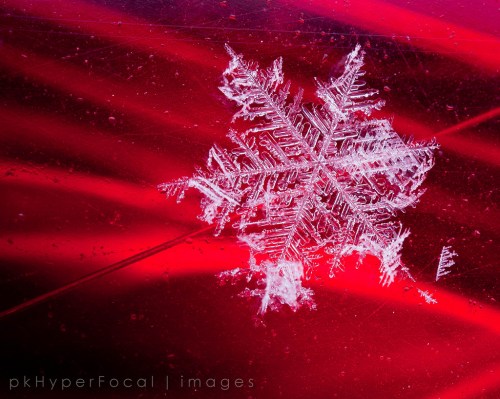
The Beauty of My Nemesis, photo by pkHyperFocal

Waaaay back when I started out on the capital “I” Internet with an online publication called the Northern Michigan Journal. For over five years I edited NMJ, producing around 4 issues a year that featured some interesting work from a wide range of writers & artists.

Two of these were my friends Jerry Dennis and Glenn Wolff, a writer/artist duo who collaborated on several books.  Their first was called It’s Raining Frogs & Fishes: Four Seasons of Natural Phenomena and Oddities of the Sky, a fascinating romp through the oddities and beauties of the natural world through Jerry’s captivating prose and Glenn’s engaging drawings. You can click that link to learn more about the book from Jerry’s website. Trust me, it’s the perfect gift for the nature lover or scientist in your life!

Glenn & Jerry shared a chapter from the book with me that I published to the inaugural issue of NMJ. Here’s the beginning of Nature Baroque: Snowflakes & Crystals:

There is more to the birth of a snowflake than Aristotle’s assertion that “when a cloud freezes there is snow.” Snow is not merely frozen rain. Rain occasionally freezes, falling to the ground as sleet or freezing rain, but snow originates independent of atmospheric drops of water. Individual ice crystals for high in the atmosphere when water vapor freezes around dust or other particulates. Without particles to serve as condensation nuclei, water vapor can be cooled to -40 degrees Fahrenheit before freezing occurs. A supercooled cloud of this sort seeded with a few particles often escalates into a snowstorm. The individual crystals collect additional molecules of water vapor one at a time, building on one another symmetrically in a rapidly growing, widening circle. Temperature, wind, humidity, and even barometric pressure will determine the growth and ultimate form of the crystal. Large and elaborate crystals for at higher temperatures and humidity while, while the small, basic crystals such as those common in polar regions form when temperature and humidity are very low. As the crystals fall they bump against each other, breaking off pieces of ice that in turn serve as nuclei for new crystals. As they pass through warmer layers of air they adhere to one another, congregating into snowflakes that may contain a thousand or more crystals.

Snowflakes, then, are aggregates of snow crystals. When the temperature is near or slightly above freezing, snowflakes become wet, adhere to other flakes, and grow to two or three inches in diameter. On very rare occasions, they can grow larger yet. According to a report in a 1915 issue of Monthly Weather Review, a snowfall on January 28, 1887 dropped flakes “larger than milk pans,” measuring fifteen inches in diameter by eight inches thick across several square miles near Fort Keogh, Montana.

Only when the temperature remains consistently below freezing will complete, individual crystals fall to the ground. If the temperature of the cloud they form in and the air they descend through is warmer than 27 degrees Fahrenheit, the crystals tend to be flat and hexagonal. Between 27 and 23 degrees, they tend to be needle-shaped. Between 23 and 18 they are likely to be hollow and columnar, with prismatic sides. At temperatures below 18 they can be columnar, hexagonal, or fernlike. Virtually all have six sides. That hexagonal tendency is something of a mystery, although some scientists suggest it is produced by electrical charges in the crystals, while others say it is basic to the molecular structure of water molecules. The atoms in a molecule of H20 are arranged, in physicist Hans C. von Baeyer’s graphic description, “with two little hydrogens stuck onto a big oxygen like ears on a Mickey Mouse’s head.” Scientists like von Baeyer believe that the angle at which the hydrogen molecules protrude from the oxygen atom–about 120 degrees–causes snow crystals to grow to a six-pointed symmetry that repeats the molecular structure of water.

Read on for much more including whether or not two snow crystals are alike, heavy snowfalls and snow words & myths.

View this photo background bigtacular and see more in pk’s really, really cool Chromatic Progression slideshow.

More snow, sciencewinter wallpaper on Michigan in Pictures!
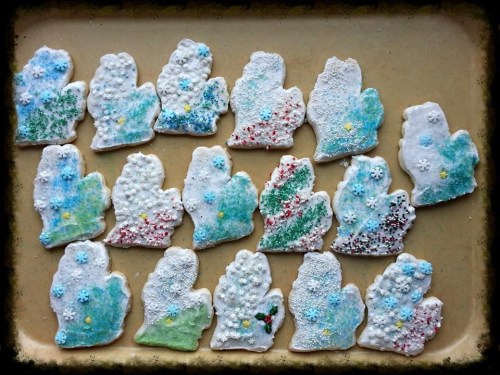
Michigan’s Winter Sprinkles

Michigan's Winter Sprinkles

Michigan’s Winter Sprinkles, photo by LadyDragonflyCC

The weekend outlook is for snow with a chance of sprinkles!

Check Christine’s photo out bigger and see more in her cookie slideshow.

PS: In case you’re wondering, she does have a UP cookie cutter too!

Ice Volcanoes in Michigan

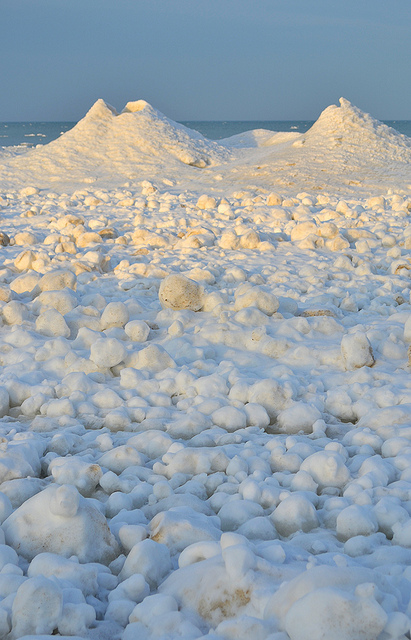
Shore Ice

Shore Ice, photo by timmerschester

The Weather Notebook has this to say about Ice Volcanoes:

Ice volcanoes can form during winter on the Great Lakes. They are not lava-spewing mountains of ice, but water-spouting ice cones.

As winter ice begins to build along the shores of large lakes such as Lake Superior, it is jostled, broken, and shifted by the winds and wave motions on the waters. When winds blow onshore, they can build an ice shelf, a jumble of ice chunks that anchors on the shore but extends some distance back into the water. Amongst the numerous ice blocks comprising a shelf, many open tunnels lead back to the lake waters.

To build a good ice volcano cone, the surface air temperature must be several degrees below freezing and lake waves should be several feet high and breaking onshore. As the waves strike the edge of the ice shelf, pulses of wave energy flow beneath the ice. Upon reaching the open end of a tunnel, the wave forces water to erupt out through the ice. If the hole has been covered with snow, the eruption may spray snow outward like a volcanic gas cloud.

As the ejected water falls back onto the ice, it quickly freezes and begins the formation of an ice cone, a process very similar to the building of a lava cone surrounding a geologic volcanic vent. A study of ice volcanoes on Lake Superior’s southern shore by students from Michigan Tech measured ice cones ranging from three to 25 feet in height.

Like rock volcanoes, ice volcano vents can heal over and become dormant during periods of low wave action. They lie in wait for a strong wave surge to awaken them back to explosive activity.

Also see the Ice Volcanoes page from Michigan Tech and a video of an ice volcano from Great Lakes Echo.

Kathy took this photo on November 29th on Lake Huron in Caseville – pretty early for ice this big! Check it out background bigtacular and see more in her Winter slideshow.

More icy goodness on Michigan in Pictures.

lighthouse snowman

lighthouse snowman

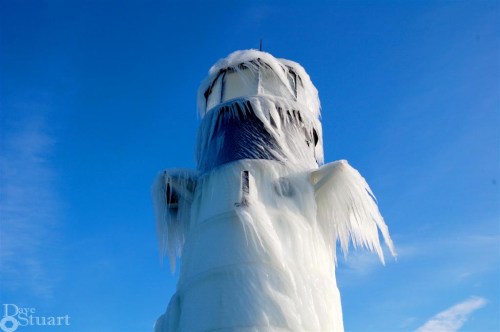
lighthouse snowman, photo by kiwirat

Frosty’s got nothing on the St. Joseph Lighthouse.

View Dave’s photo bigger or in his St. Joseph, MI slideshow.

Get your Polar Express aboard Pere Marquette 1225!

Pere Marquette 1225

Pere Marquette 1225, photo by Mi Bob

Every year, the Steam Train Railroading Institute in Owosso operates an annual North Pole Express that takes you to the North Pole and back. Over on Absolute Michigan, The Polar Express Comes to Michigan from Michigan History Magazine explains that author Chris Van Allsburg his well-known children’s book, The Polar Express, on train experiences he had as a boy in Grand Rapids:

The book’s popularity led to a movie released in November 2004. Michigan railroad buffs recognize the sound of the movie’s train whistle, which comes from one of the nation’s few working steam locomotives.

Built in 1941, the Pere Marquette 1225 is an enormous steam locomotive, measuring one hundred feet long and sixteen feet high. Replaced in 1951 by a more efficient diesel engine, the 1225 was saved from the scrap heap and decades later, ended up in Owosso as the star of the Steam Railroading Institute (SRI). Shortly thereafter, the 1225 was restored to its former glory.

As researchers prepared the movie version of Van Allsburg popular book, they were drawn to Owosso and the 1225. Technicians recorded the sound of the whistle, the clatter of the wheels and the rumble of the four-hundred-ton locomotive rolling down the tracks. The sounds were merged with the animated Polar Express.

Check the photo out bigger and see more in Bob’s slideshow.

More trains on Michigan in Pictures and also check out the Pere Marquette 1225 slideshow in the Absolute Michigan pool!

What Are You So Afraid Of?

What Are You So Afraid Of?

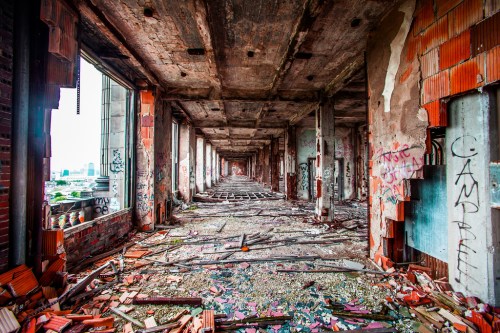
What Are You So Afraid Of?, photo by Thomas Hawk

If there’s a King of Flickr, it’s probably Thomas Hawk. One of his projects is to document the 100 Largest American Cities, and back in June of 2010 he visited Detroit. His massive #11 Detroit, MI slideshow is heavy on the ruin of the Motor City but I think you’ll really appreciate it!

View this photo from Michigan Central Station background bigtacular and see more in the slideshow above and at ThomasHawk.com.