Mother Nature’s Birthday gift

Mother Natures Birthday gift

Mother Natures Birthday gift, photo by Daylily18.

Yesterday Lori wrote:

Today is my birthday and Mother Nature decided to give me my first blooms of the season,. I have a handful of purple and yellow crocuses. Who could ask for more?

Who indeed. Welcome to Michigan, springtime. We’ve missed you!

Be sure to check this out bigger and in her slideshow.

Garage Sale Culture: I’m one of those Americans

david-mcgowan-garage-sale-culture

I’m one of those Americans, photo by David McGowan

David says that in the summer of 2008, he started shooting an essay on the culture of garage sales in Michigan as we moved deeper into recession.

Now his essay is one the fantastic photography site Burn. Burn is curated by notable Magnum and National Geographic photographer, David Alan Harvey, and was established to be a platform for emerging photographers online and in print. Do yourself a favor and check out David McGowan – Garage Sale.

I’m serious – do not miss this one.

I have to also say thanks to David for introducing me to Lux Land,  Michigan songstress and wife of Brian Vander Ark who I had heard of but never really heard. Her song, Touching a Legend is the soundtrack and you can can check her music out at Luxy Land or MySpace.

The Color Green

Untitled, photo by paulh192.

I guess I already did my yearly St. Patrick’s Day post, but Michigan in Pictures can still get in on the wearing of the green (actually referring to a shamrock rather than the color).

Wikipedia’s entry for Green says that the word green comes from the Old English word grene, or, in its older form, groeni. This adjective is closely related to the Old English verb growan meaning “to grow”. Color Psychology – Green says that the color:

  • Symbolizes nature and the natural world
  • Can improve reading speed and comprehension if you lay a transparent green sheet over the page
  • Is often used in decorating for its calming effect as in the “green room”
  • May relieve stress and help heal and those who have a green work environment experience fewer stomachaches
  • Has long been a symbol of fertility and was once the preferred color choice for wedding gowns in the 15th-century … and then there’s that whole green M&Ms thing

Whether you are out celebrating St. Patrick’s Day with green beer or just feeling the earth shrug off her wintry coat, I hope that today brings you the best of luck and health.

Paul took this photo deep in the forest in Northern Michigan. Be sure to check it out bigger and see it and more in his slideshow.

River Raisin Flood in Dundee

Untitled, photo by bohemianrobot.

March means more sun, warmer temps and melting snow. All are pretty welcome, but after a winter with as much snow as we’ve had, they also bring a risk of flood. We do better job of controlling the waters now than we did in March of 1908, but we still see rivers top their banks.

The US Geologic Survey’s Michigan Flood Watch has flood resources for Michigan including this nifty map showing currently flooded rivers and those at risk.

See this photo of the Dundee Mill bigger right here. You can check out more shots of the flooded River Raisin in bohemianrobot’s flood slideshow and in from other Flickr members and see other Michigan flood photos in the Absolute Michigan pool on Flickr.

Stay dry!

Remembering Detroit Pistons owner Bill Davidson

The Real Fab Five

The Real Fab Five, photo by Dave Hogg.

For any successful organization or business, you have to have integrity, and you have to make everything as straightforward as you can make it.
~Detroit Pistons owner William Davidson

Sometimes when I don’t know what I’m going to post on Michigan in Pictures, it’s a happy thing. Other days, like today, it’s not.

Last night we lost a man who has done as much as anyone to bring athletic excellence to the Palace and the state of Michigan. On his photo from December of 2005, Dave wrote “These five guys have brought a lot of joy to the Motor City in the last 18 months.” I think that Detroit Pistons owner William “Bill” Davidson certainly merits consideration as a sixth man.

bill-davidson-detroit-pistons1William Morse Davidson was born on December 5, 1922 in Detroit. He played football in the Navy during World War II and was a member of the track-and-field team at the University of Michigan, where he majored in business, following it up with a law degree from Wayne State in 1949. He eventually transformed the family business, the Guardian Glass Co., into Guardian Industries, one of the world’s largest manufacturers of architectural and automotive glass.

From William Davidson’s Wikipedia entry, I learned that Davidson was only the second owner the Pistons have ever had and that his name is on the Palace floor along with Piston legends who all played during his tenure: Dave Bing, Bob Lanier, Bill Laimbeer, Vinnie Johnson, Chuck Daly, Joe Dumars and Isiah Thomas. The Detroit Pistons web site tells the story of his involvement with the Pistons and the WNBA’s Detroit Shock:

Mr. Davidson owned the Pistons since 1974 and won three NBA Championships (1989, 1990, 2004), three WNBA Championships (2004, 2006, 2008) and one NHL Championship (2004). He became the first owner in sports history to win championships in three different professional sports leagues during the 2003-04 calendar year (NBA – Detroit Pistons, NHL – Tampa Bay Lightning and WNBA – Detroit Shock). In September 2008, Davidson’s contributions to the game of basketball were honored when he was officially enshrined into the Naismith Memorial Basketball Hall of Fame.

In 1988-89, the Pistons began play in The Palace of Auburn Hills, a state-of-the-art arena built with Davidson’s financial support: a privately-financed facility, which when combined with the Pistons, formed the foundation of his entertainment business.

…The Pistons have played in the postseason in 19 of the past 25 years, including 11 of the past 13 seasons. Davidson acquired the Detroit Pistons in 1974 from the late Fred Zollner, the man who founded the team in Fort Wayne, Indiana in the 1940s. With a franchise-record seven straight seasons of recording 50 or more wins, the Pistons have won 384 regular season games (.669 wining percentage) since 2001, including a franchise-record 63 wins in 2005-06. The club has compiled 73 playoff wins in that same span and made six consecutive trips to the Eastern Conference Finals for the first time in franchise history. Detroit has won six Central Division titles in the last seven seasons and nine overall since 1987-88. Only the San Antonio Spurs have won more division titles in the same 20-year span.

The Detroit Shock joined the Washington Mystics as the first two expansion teams in the WNBA in 1998 and the team was an immediate success in the upstart league. The Shock have won three championships since their inception (2004, 2006, 2008) and set a WNBA attendance record (22,076) in Game 3 of the 2004 WNBA Finals while also becoming the first team since 1890 to go from the worst team in a professional sports league to the best team.

The Detroit Free Press has a nice article on Bill Davidson that tells more of how Davidson presided over the transformation of a team that was “basically a laughingstock” into one that has won 3 championships and appeared in the post-season far more often than not. You probably will be happiest, however, with Mitch Albom’s September 2008 interview with Bill Davidson. They also have a nice photo gallery as does the Detroit News (the second photo in the gallery is great!)

Be sure to check the above photo out bigger and see more great work from Dave in his Your Favorites slideshow.

More Detroit Pistons from Michigan in Pictures.

I’ll take the Luck of the Irish over Friday the 13th!

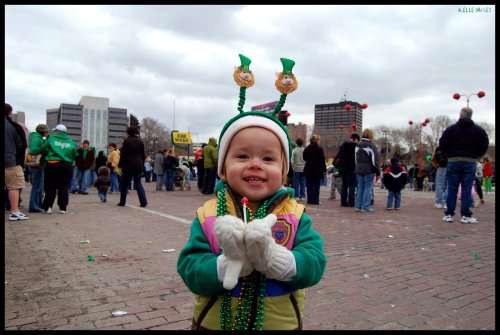
cheese

cheese, photo by n.elle.

I suppose I should have dug out a photo of a black cat or a broken mirror, but I think that I’d rather rely on a little Leprechaunish luck to carry us through the day.

Royal Oak, Michigan

Royal Oak, Michigan

Royal Oak, Michigan, photo by paulhitz.

Be sure to check Paul’s photo out bigger and see more of Royal Oak photos in his slideshow. You can also check out about 400 more Royal Oak photos from the Absolute Michigan pool.

On their History page, the City of Royal Oak explains that:

In 1819, Michigan Gov. Lewis Cass and several companions set out on an exploration of Michigan territory to disprove land surveyors’ claims that the territory was swampy and uninhabitable. The beginning of their journey seemed to support those claims until they reached a desirable area of higher ground near the intersections of Main, Rochester and Crooks Roads. Here they encountered a stately oak tree with a trunk considerably wider than most other oaks. Its large branches reminded Cass of the legend of the royal oak tree, under which King Charles II of England took sanctuary from enemy forces in 1660. Cass and his companions christened the tree, the “Royal Oak.” And so Royal Oak received its name.

As early as 1891, when Royal Oak was a small village, there were only a few hundred residents. In the 10-year span from 1900 to 1910 the population grew to over 1,000. By the time Royal Oak was incorporated as a city in 1921, the population had exploded to over 6,000. This was due in large part to new jobs created by the booming auto industry. The development of the super highway, Woodward Avenue, led to greater population expansion. Woodward Avenue replaced the old Indian road, Saginaw Trail, as the connection between Detroit, Pontiac, Flint and Saginaw, making Royal Oak more accessible. Today, the 28-mile Woodward Avenue (M-1), bridging 10 communities from the Detroit River north to downtown Pontiac, holds the honorary designation of Michigan Heritage Route. The designation was awarded because of the historical and cultural significance of some 350 sites along Woodward Avenue, including 42 historic churches.

You can get tons more great Royal Oak history & historic photos from Historic Royal Oak by Dr. David G. Penney.

Wikipedia’s Royal Oak entry says that as of 2000, the city had a total population of 60,062, making it Michigan’s 18th largest city. Michigan in Pictures has a lot of photos that involve Royal Oak (apparently there’s some sort of Photographic Guild that exhibits there).

Check out Royal Oak on Absolute Michigan’s Michigan Map.

Michigan’s Rattler: the Eastern Massasauga Rattlesnake

Bothered

Bothered, photo by Aaron Fortin.

Aaron writes that he spent an entire summer tracking 18 of these snakes around the park and watching their habits and where they went throughout the season. Lots of fun trekking through swamps, up hills, through shrubbery, etc. You can see more of his rattlesnake photos (slideshow) including a great shot of the rattler’s fangs. You might also enjoy this Michigan rattlesnake slideshow on Flickr!

The Michigan DNR says that the Eastern Massasauga Rattlesnake (Sistrurus catenatus catenatus) is Michigan’s only venomous snake. They say that Massasaugas are found throughout the Lower Peninsula, but not in the Upper Peninsula and that they are becoming rare in many parts of their former range, due to wetland habitat loss and persecution by humans. After reading Wisconsin’s very excellent page on the Massasauga Rattlesnake I’m also thinking that wild pigs are accounting for some of that drop. Remember that they are classed as an Endangered Species so don’t kill them! Here’s a few tidbits:

  • They say that although drop for drop the massasauga’s venom is more toxic than the timber rattler, with a smaller volume of venom, their bite would probably not cause severe harm to an adult human.
  • The adult massasauga is usually two to three feet in length.
  • “Massasauga” means “great river mouth” in Chippewa, so named because it is usually found in river bottom forests and nearby fields. Massasaugas are characteristic of mesic prairies and lowland places, such as along rivers, lakes, and marshes.
  • The infamous rattles are actually modified epidermal scales with a bony core. Each time the snake sheds its skin a new “button” is added to the rattle, therefore these rattles are not an indication of age, but the amount of times the animal has shed its skin. Massasaugas can shed their skin between 3 and 5 times a year, depending on their health and growth rate. The rattles are believed to serve as warning communications to predators. The rattle produces a buzzing sound similar to that of a grasshopper or cricket.
  • It is interesting to note that rattlesnakes can control the injection of venom when biting. Medical experts familiar with snake bites indicate that up to 60% of all snake bites to humans by poisonous snakes are “dry” bites containing no venom.
  • Massasaugas are preyed upon by raccoons, hogs, skunks, foxes, hawks, and eagles. They in turn will eat cold-blooded prey, such as frogs and other snakes, but they usually prefer warm-blooded prey like mice and voles.

You can learn more about this snake at Wikipedia, Sistrurus catenatus and at Sistrurus catenatus (massasauga rattlesnake) from the University of Michigan Department of Zoology Animal Diversity Web.

Hydrant Heaven | Bow-Wow!

Hydrant Heaven | Bow-Wow!

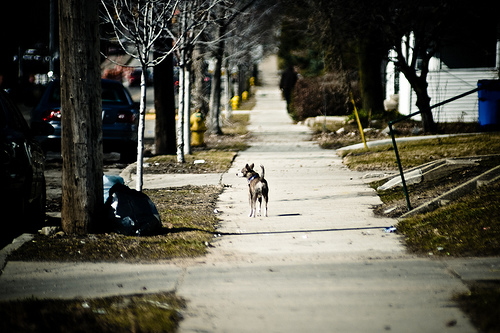
Hydrant Heaven | Bow-Wow!, photo by docksidepress.

Sometimes it’s the little things that make a day special.

Part of Matt’s March 2009 set (slideshow).

Wind, Snow, Light

Wind, Snow, Light

Wind, Snow, Light, photo by dcclark.

David captured blowing snow and light at the Tech Trails at Michigan Tech University. You can see it bigger in his Winter set (slideshow).

Check out David’s blog Cliffs and Ruins for more photos and stories including this cool set of possibly bobcat tracks.