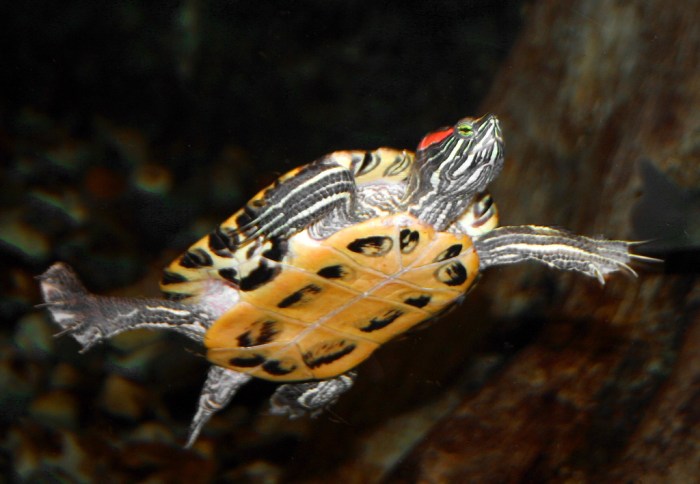
Happy World Turtle Day from the Red-eared slider

Trachemys scripta Red-eared Slider

Trachemys scripta (Red-eared Slider), photo by Nick Scobel

One of the most popular posts on Michigan in Pictures is Know Your Michigan Turtles, and World Turtle Day (May 23rd) is the perfect day to add another turtle to our list!

Jim Harding’s MSU Critter Field Guide entry for the red-eared slider (Trachemys scripta elegans) says that the turtle is named for the broad red or orange stripe behind the eye, which may extend onto the neck. He continues:

Red-eared sliders prefer still-water habitats (lakes, ponds, sloughs) with abundant aquatic plant growth and numerous basking sites in the form of logs or other emergent objects. These turtles are called “sliders” because they quickly slide from their basking spots into the water when disturbed. They feed on aquatic plants, and animals such as crayfish, snails, insects, tadpoles, and carrion. The young turtles are mostly carnivorous but eat increasing amounts of vegetation as they get older.

…This is a common turtle from northwestern Indiana south to Georgia and west to Texas and Oklahoma. Red-eared sliders are probably not native to Michigan, but breeding populations exist locally in the western and southern Lower Peninsula. Many thousands of baby sliders were once imported into this state for the pet trade, so it is likely that released or escaped specimens are responsible for the established colonies. Isolated specimens may turn up almost anywhere in Michigan.

Read on for more in the MSU Critter Guide.

Nick runs the excellent Herping Michigan Blog where you can find lots more of his excellent photos of Michigan’s reptiles and amphibians along with informative writeups. View his photo bigger and see more in his slideshow.
More Michigan turtles right here!

Know Your Michigan Turtles: Eastern Box Turtle

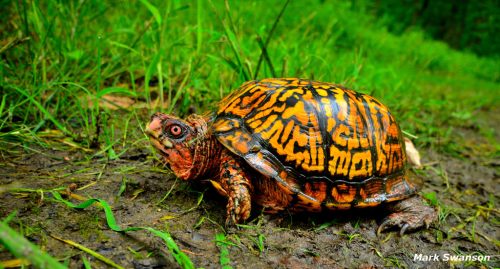
Eastern Box Turtle

Eastern Box Turtle, photo by Mark Swanson

It’s been a while since I posted a turtle pic, and while I have a couple more Michigan turtles left to profile, this photo caught my eye today. The Herping Michigan Blog page on the Eastern Box Turtle says (in part) that:

Of all Michigan turtles, the Eastern Box Turtle is by far the most charismatic. A Species of Special Concern in Michigan, this species has declined drastically from its former distribution in the state. Nest predation, habitat fragmentation, road mortality, and illegal collection are the catalysts for the decline of the Eastern Box Turtle. Today, populations persist in pockets where grassland and mature woodlands still exist without fragmentation. Michigan individuals are often brightly colored with yellow or orange and have much broader carapaces than individuals of the same species which exist farther south in the range. This summer, my internship has allowed me to get direct involvement with the study and management of this species through captive head starting programs and aiding in telemetry studies.

…Farther south in their range, Box Turtles are traditionally known as a woodland species. But in Michigan, they prefer a mosaic of community types. Michigan Turtles often are found along woodland edges in grasslands but they occasionally wander into wetlands such as fens. They are often found in some sort of cover and are rarely out in the open except after summer rainstorms.

Box Turtles have a wide diet which includes worms, insects, plants, berries, and fungi. In the late summer when wildberries fruit out and drop to the ground, Box Turtles can often be found concentrated under or around large berry patches. Sometimes the evidence of Box Turtles is hard to miss.

Click through for lots more from Herping Michigan including a bunch of photos of the Eastern Box Turtle in action!

View Mark’s photo bigger and see more in his Michigan – Color slideshow.

Lots more Michigan turtle goodness on one of Michigan in Pictures most popular posts: Know Your Michigan Turtles, where this post has now become the definitive Eastern Box Turtle entry.

Know your Michigan Turtles: Spiny Soft-shell Turtle

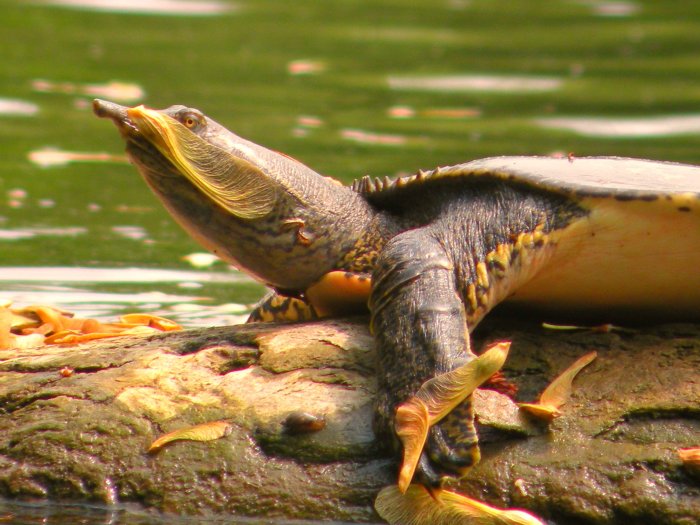
Soft Shell Attracts Seed Pods

Soft Shell Attracts Seed Pods, photo by David Mayer

One of the most popular posts on Michigan in Pictures is Know Your Michigan Turtles where we now have 8 of Michigan’s 10 turtle species profiled. You can click that link for the list of all of them and read on to learn about the soft shell turtle.

The Spiny Soft-shell Turtle (Apalone spinifera spinifera) entry at the University of Michigan Animal Diversity Web says that:

Apalone spinifera inhabits various freshwater systems such as rivers, lakes, marshes, farm ponds as well as bays of the Great Lakes . Apalone spinifera prefers open habitats with a small amount of vegetation and a sandy or muddy bottom and require sandy raised nesting areas close to water.

…Spiny softshell turtles are diurnal animals, spending most of the day basking in the sun and foraging for food. They can be spotted sunning on logs and river banks. If disturbed, they will quickly retreat into the water and bury themselves in sand, leaving only their heads visible. These turtles are also able to breathe underwater for extended periods through their pharyngeal lining, cloacal lining, and skin. Spiny softshell turtles spend October to April in the water buried underneath substrate in a state of dormancy.

Apalone spinifera preys on on various macroinvertebrates such as aquatic insects, crayfish, and occasionally a fish. They find their food underneath objects, along the floor of the lake, and in vegetation. They also hide in the floor substrate and grab prey as they swim by.

Spiny softshell turtle nests are often destroyed by raccoons, skunks, and foxes. Young softshell turtles are eaten by raccoons, herons, and fish. Adults are killed and eaten only by humans, they have few natural predators. When bothered, spiny softshell turtles will extend their long necks and snap viciously at their attacker, inflicting a painful bite. They are wary and can hide themselves quickly.

Read on for a whole lot more including photos.

David says to be sure to check out the seed pod copter on this turtle’s face! View it background big and see more in his Wildlife slideshow.

Spend World Turtle Day with Common Map Turtles

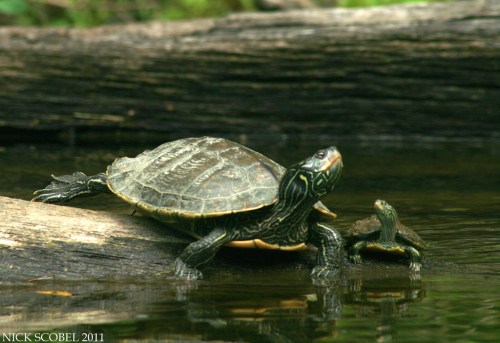
Northern Map Turtles

Northern Map Turtles, photo by Nick Scobel

May 23rd is World Turtle Day and Michigan is home to 10 native turtle species. I’ve now profiled 7 (most with Nick’s awesome photography), and you can get the full list at one of the most popular posts on Michigan in Pictures: Know Your Michigan Turtles.

Graptemys geographica (Common Map Turtle, Northern Map Turtle) from the University of Michigan Animal Diversity web says (in part):

Common map turtles get their name from the markings on the carapace. The light markings resemble waterways on a map or chart. The lines on the carapace are a shade of yellow or orange and are surrounded by dark borders. The rest of the carapace is olive or grayish brown. The markings on the older turtles may be barely visible because of darker pigment. The carapace is broad with moderately low keel. The hind of the carapace is slightly scalloped shaped due to the scutes. The plastron of an adult map turtle tends to be plain yellowish color. The head, neck and limbs are dark olive, brown or black with thin yellow, green or orangish stripes. There is also a oval spot located behind the eye of most specimens. There is sexual dimorphism in size and shape. The females are much larger than the males…

The common map turtle is dormant from November through early April. Most of that time is spent under the water, wedged beneath submerged logs, in the bottom mud of a lake or in a burrow. They have been known to change locations in the middle of the winter. They are avid baskers and they bask in groups. They are diurnal, active both in the day and at night. They are also a very wary animal, at the slightest hint of danger they slip into the water and hide. During courtship the male initiates by tapping his long claws on the front of the female but few details are known.

Common map turtles are omnivores. The feeding always takes place in the water. The adult females, due to their large heads and strong jaws eat larger prey than the males. The females consume snails, clams, and crayfish. The males eat aquatic insects, snails, and smaller crustaceans. Both are also known to eat dead fish and some plant material.

Read on for more and also see the Michigan DNR’s page on Common Map Turtles which includes a distribution map.

View Nick’s photo bigger, see more of his Northern Map Turtle photos or just dive into his huge collection of turtle pics! Nick also runs the Herping Michigan Blog that features all kinds of photo-rich features of Michigan frogs, snakes, salamanders and turtles. Definitely check out his Kayaking for Turtles post to see dozens of turtles from several turtle species that he photographed on one river paddle in Northern Michigan.

American Tortoise Rescue, a nonprofit organization established in 1990 for the protection of all species of tortoise and turtle, is sponsoring its 14th annual World Turtle Day™ on May 23rd. The day was created as an observance to help people celebrate and protect turtles and tortoises and their disappearing habitats around the world. Click the link to learn more about turtles and how you can protect them.

Know Your Michigan Turtles: Blanding’s Turtle

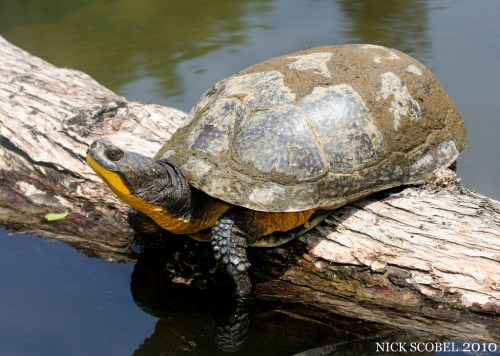
Blanding's Turtle

Blanding’s Turtle, photo by Nick Scobel

One of the most popular posts on Michigan in Pictures is Know Your Michigan Turtles where there’s now 6 of Michigan’s 10 turtle species profiled. For all those folks who come by to hang with our hard-shelled friends, here’s the latest installment in the series! 

The University of Michigan Animal Diversity Web entry for Emydoidea blandingii (Blanding’s Turtle) says that the Great Lakes region is currently a stronghold for this species:

Blanding’s turtles are found in and around shallow weedy ponds, marshes, swamps, and lake inlets and coves most of the year. They prefer slow-moving, shallow water and a muddy bottom with plenty of vegetation.

Blanding’s turtle are medium sized turtles with a carapace length ranging from 15.2 to 27.4 cm. These semi-aquatic turtles have moderately high, domed carapaces. They are elongate and smooth, lacking keels or sculpturing. The carapacial scutes display distinct growth annuli most prominently seen in juveniles. Coloration between individuals is highly variable. The carapace is black or gray with any variation of scattered light yellow or whitish flecks or dots. The light spots and flecks predominate in some individuals while others are almost solid black. The plastron is yellow in color with a dark blotch in the outer corner of each scute, and has a V-shaped notch near the tail.

Blanding’s turtles, like most other turtles, emerge to bask on sunny days. Basking sits include logs, grass clumps, sloping banks, or high perches near the water. Although these turtles are quite tolerant to cold, the summer heat may restrict their activities to early morning and evening or possibly a more nocturnal lifestyle. In the event of their habitat drying up some individuals will opt to migrate to new bodies of water while others simply burrow into the mud and aestivate until conditions improve. Blanding’s turtles generally hibernate from late October until early April, but quite often they can be seen moving slowly below the ice.

Blanding’s turtles are omnivores. Their favorite food items are crustaceans but they also feed on insects, leeches, snails, small fish, frogs, and occasionally some plants. Food is captured with a rapid thrust of this turtle’s long neck, similar to the feeding actions of the snapping turtle (Chelydra). Feeding mostly occurs underwater and food seized on land is generally carried to the water for swallowing. Prey is either swallowed whole or if it is too large it is held by the jaws and shredded into smaller pieces by the front claws.

The Michigan DNR notes that Blanding’s Turtle is protected as a species of special concern in Michigan and also has a map of occurences of Blanding’s Turtle.

View Nick’s photo bigger and see a lot more of his photos of Blanding’s turtles on Flickr including this shot of the turtle’s amazingly long neck. Nick also runs the Herping Michigan Blog, a great resource to see a lot of reptiles and amphibians in the wild!

Know your Michigan Turtles: Spotted Turtle (Clemmys guttata)

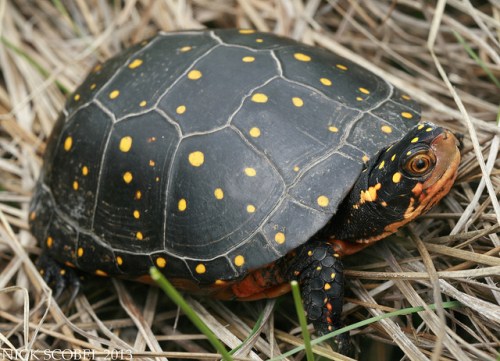
Spotted Turtle

Spotted Turtle, photo by Nick Scobel

One of the most popular posts on Michigan in Pictures is Know Your Michigan Turtles, drawing around 100 people each day. Along with “Yay turtles!”, “Give the people what they want” has always been one of my philosophies so let’s get up close with one of our hard shelled neighbors. 

The UM Animal Diversity Web entry for Spotted Turtle (Clemmys guttata) says (in part):

Spotted Turtles prefer shallow waters with a soft bottom substrate and some submergent and emergent vegetation. These can include sedge meadows, boggy ponds, fens, tamarack swamps, sphagnum seepages, and slow, muddy streams. These turtles also frequently wander on land between wetlands, and may aestivate on land for weeks at a time.

Clemmys guttata is a very small species that rarely exceeds a straight-line carapace length of 11.4 cm (4.5 inches); the maximum recorded carapace length is 13.6 cm (5.4 inches). The adult carapace is smooth, without obvious growth ridges (annuli), and is black or brownish-black with a variable number of round yellow spots. These spots may fade in old adults, and occasional specimens lack carapace spots altogether.

…Spotted Turtles become active very early in the spring, and (as noted above) are often active at relatively cold water temperatures. Activity appears to peak during April and May in the northern part of the range. Spotted Turtles tend to become inactive in the warmest part of the summer (when water temperatures exceed 30°C) and they may aestivate aquatically or terrestrially for long periods of time. During summer dormancy, the turtles may burrow into leaf litter in woodlands or open fields or marsh edges; others remain in muskrat burrows or other aquatic refuge

…Spotted turtles are listed as vulnerable on the IUCN’s Red List, and they are considered threatened in the state of Michigan.

Read on for more and also see the Michigan DNR page on Spotted Turtles.

Check Nick’s photo out and see more in his Clemmys guttata slideshow which includes some pics of adult male spotted turtles. Nick runs the Herping Michigan Blog as well and has an interesting article about the recent division of the Clemmys genus into three genuses. The spotted turtles got to keep theirs with the other two being Wood Turtle (Glyptemys insculpta) & Bog Turtle (Glyptemys muhlenbergii).

More turtles on Michigan in Pictures!

Know your Michigan turtles

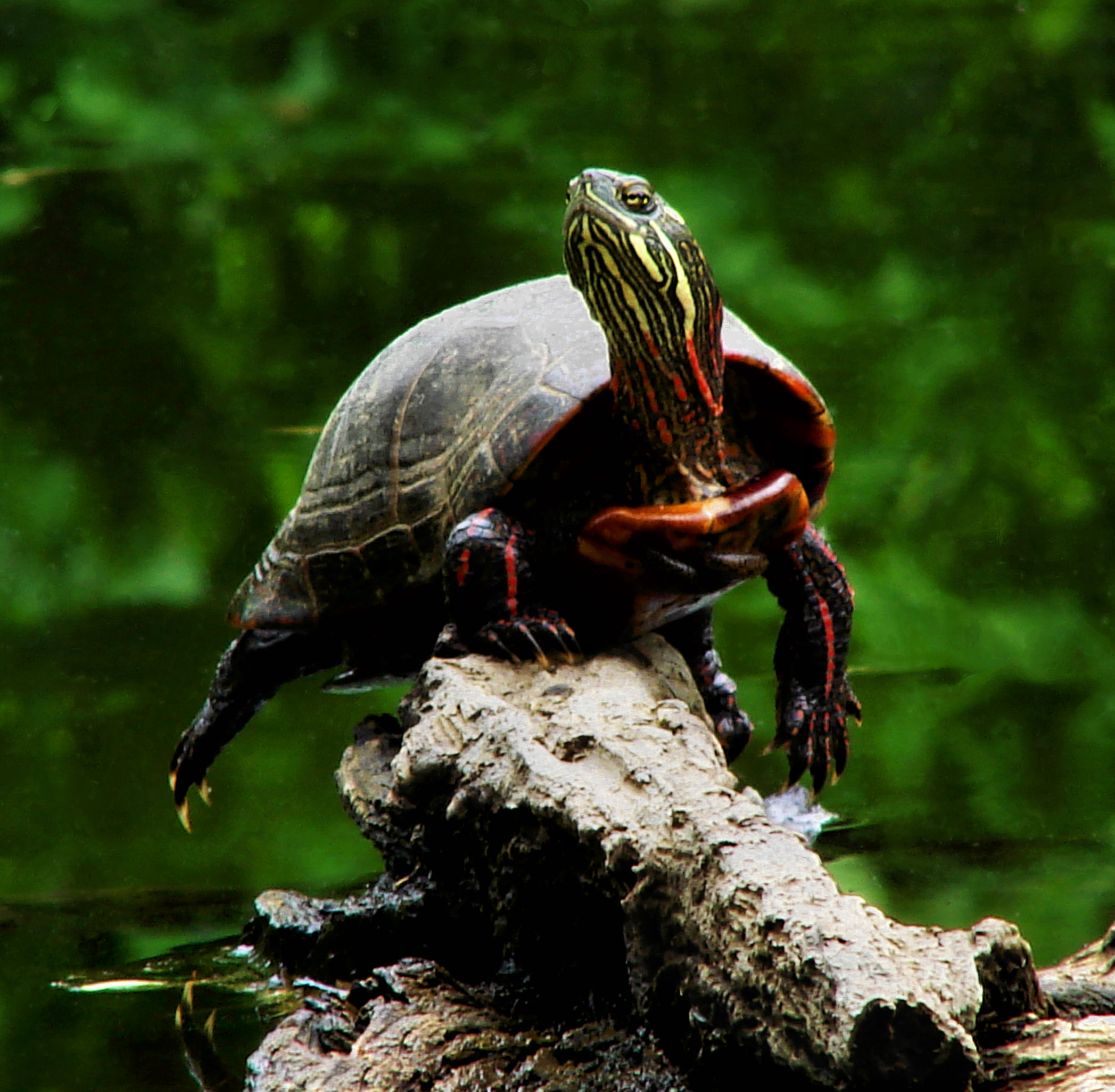
Posing Painted Turtle

I’m Posing for the Camera, photo by capcbd

It appears the turtle above is aware that Michigan’s state reptile is the painted turtle.

I thought it perfect for my day-late post celebrating World Turtle Day (May 23), an annual day of recognition that was started in 2000 by American Tortoise Rescue. They offer some tips to help preserve endangered turtles worldwide including not buying turtles or tortoises from pet shop (it increases demand from the wild), not removing turtles from the wild unless they are injured, and something that we can all do when we’re on the roads: if a turtle is crossing a busy street, pick it up and send it in the same direction it was going – if you try to make it go back, it will turn right around again!

It might surprise you to learn that Michigan is home to 10 native turtle species. Learn about all of them on Michigan in Pictures:

If you’re trying to identify a turtle you’ve found, Check out Nick Scobel’s Herping Michigan Blog and James Harding “The Critter Guy” at the MSU museum has a great Michigan turtle identification guide and loads of turtle lore.

Speaking of Turtle Lore, I always like to shout out a book I read as a kid that did more to foster my love of Michigan than any other: Lore of the Great Turtle. It was filled with Indian tales of Mackinac Island , and one of these was the formation of the island. While this version adapted by Basil Johnston is not quite the same, I think you’ll enjoy it!

Check this photo out background bigtacular and see more in capcbd’s water slideshow.

Also check out more turtles on Michigan in Pictures and definitely have a look at the turtle slideshow from the Absolute Michigan pool on Flickr!

PS: This is one of the most popular posts on Michigan in Pictures. Hooray for turtles!