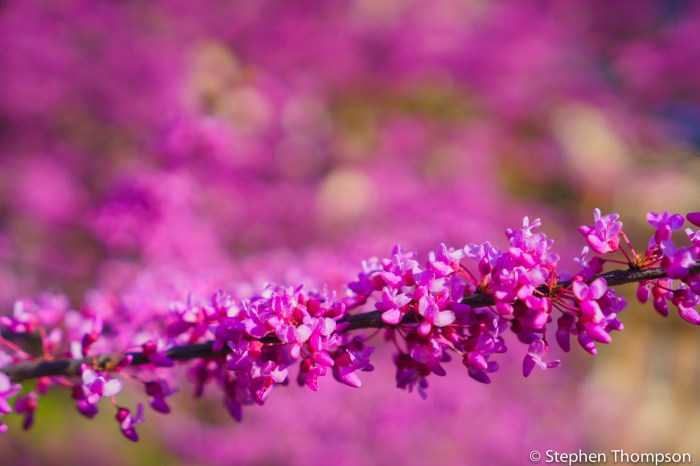
Eastern Redbud (Cercis canadensis)

Redbud

Redbud, photo by Stephen Thompson

The magenta flash of Eastern Redbud (Cercis canadensis) is one of my favorite sights in springtime. I used to think it was an exotic tree, but as Rick Meader of the Ann Arbor News shares, Redbud trees are native to southern Michigan:

…as a member of the Pea family (Fabaceae) it’s a cousin to the previous pod-producers we’ve learned about, Honeylocust (Gleditsia triacanthos) and Kentucky Coffeetree (Gymnocladus dioica). Let’s learn more about this colorful little native.

As mentioned before, Eastern redbud is native to southern Michigan, occurring naturally up to a line across the lower peninsula from Kent County to Genesee County. Nationally, it occurs naturally in an area extending from Maryland and the Carolinas west to eastern Kansas through Texas, including all of the southern states and northern Florida. Of course, because it’s a pretty little thing, it has been planted in areas beyond its native range.

If you want to use it in your landscape, it is fairly flexible in terms of where it will grow. It naturally occurs in rich soil along stream and river banks but is tolerant of a wider range of conditions. It likes sun or partial shade and can do well in most soils except waterlogged soils and dry, sandy soils.

Read on for more.

View Stephen’s photo bigger and jump into his slideshow for more great pics!
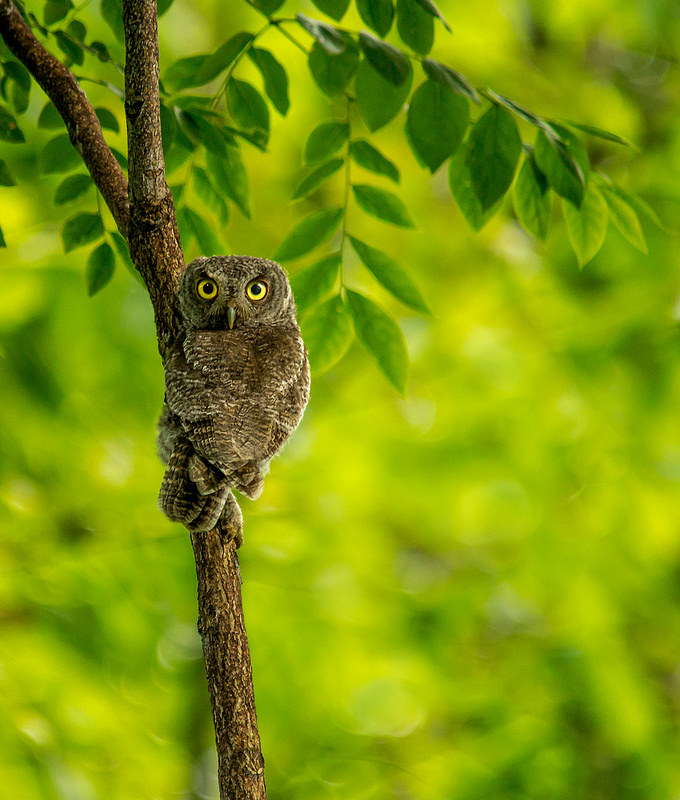
Hanging around with an Eastern Screech Owl

Eastern Screech Owl

Eastern Screech Owl, photo by Kevin Povenz

All About Birds’ entry for the Eastern Screech Owl (Megascops asio) says in part:

If a mysterious trill catches your attention in the night, bear in mind the spooky sound may come from an owl no bigger than a pint glass. Common east of the Rockies in woods, suburbs, and parks, the Eastern Screech-Owl is found wherever trees are, and they’re even willing to nest in backyard nest boxes. These supremely camouflaged birds hide out in nooks and tree crannies through the day, so train your ears and listen for them at night.

The Eastern Screech-Owl is a short, stocky bird, with a large head and almost no neck. Its wings are rounded; its tail is short and square. Pointed ear tufts are often raised, lending its head a distinctive silhouette.

Eastern Screech-Owls can be either mostly gray or mostly reddish-brown (rufous). Whatever the overall color, they are patterned with complex bands and spots that give the bird excellent camouflage against tree bark. Eyes are yellow.

Eastern Screech-Owls are active at night and are far more often heard than seen—most bird watchers know this species only from its trilling or whinnying song. However, this cavity-roosting owl can be attracted to nest boxes or, if you’re sharp-eyed, spotted in daylight at the entrance to its home in a tree cavity.

Read on for more including screech owl calls.

View Kevin’s photo bigger and see more in his massive Birds of Prey slideshow.

More owls on Michigan in Pictures.

A Tree in the Fog

A Tree in the Fog

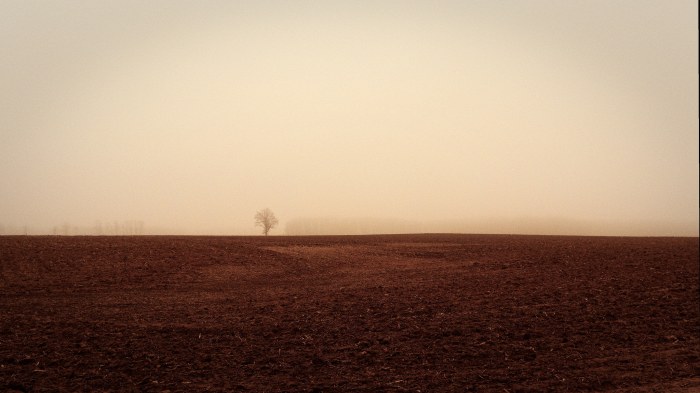
A Tree in the Fog, photo by Joel Dinda

Joel took this photo on April 4, 2014 in Eaton County’s Roxand Township. View it background bigilicious and see more in his The Showcase slideshow.

More spring wallpaper on Michigan in Pictures!

O Tree, Live Forever

Kalamazoo Tree

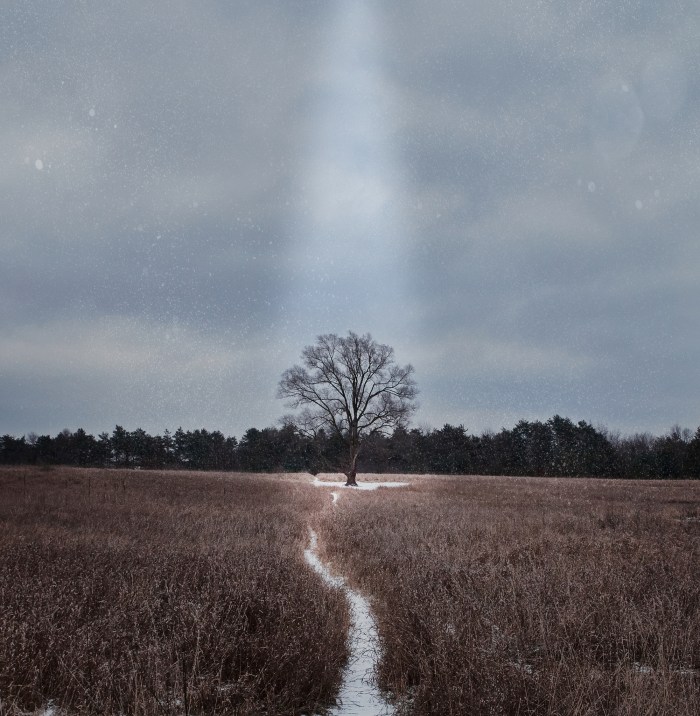
O, tree, live forever, photo by Bill Dolak

Bill writes:

This tree in the Al Sabo Preserve in Kalamazoo County is a frequent subject and accessory for local photographers. I have images of it from the days I was still putting film into my SLR.

Regarding the Al Sabo Preserve, the Texas Charter Township Parks & Rec page says:

The Al Sabo Land Preserve was established in the early 1970’s in order to protect the groundwater supply of the Atwater wellfield. The 741 acres were purchased in the late 1960’s and a master plan was developed for its use as a passive recreation nature preserve. The City of Kalamazoo passed an ordinance that would ensure its protection as a water resource. The wetlands and sandy soils serve as a recharge area for the area’s groundwater.

View Bill’s photo background big and see more in his Al Sabo, Michigan slideshow.

Fiery Fall Foliage at Fenner

Fiery Fall Foliage

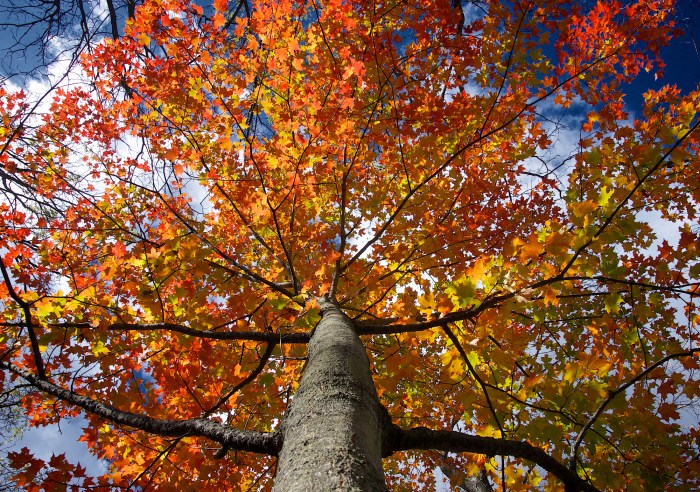
Fiery Fall Foliage, photo by David Marvin

Let’s head out of autumn with a with a bang and this firework of a maple! I hope you get a chance to get out and enjoy what remains of the 2015 fall color touring season in Michigan. mLive updated their color report with some pics from readers:

The colors are fading fast and the leaves are falling, but there are still some Michigan areas with peak color. The inland areas of the Upper Peninsula and the inland areas of northern Lower Michigan are past fall color peak now. The leaves are falling fast.

But the shoreline areas and the peninsulas are warmer. Some of those areas are still at peak, or even just peaking now.

It will still be well worth the trip to the Leelanau Peninsula and the Old Mission Peninsula this week and probably even this weekend.

We took the drive of M-22 along the shore of Leelanau County Sunday, October 18, 2015. Along the shore there was still some green and was a few days away from peak. Old Mission Peninsula was 50 percent green still on Sunday, Oct. 18, 2015. So if you are going north this weekend, take the routes near water and you’ll be pleased.

The southern half of Lower Michigan is peaking now through the next few days. This weekend will still be real nice to take that last fall color drive.

Also have at these aerial photos of fall color from a U.S. Coast Guard MH-65D Dolphin helicopter they shared a week ago.

Check this photo out big as a tree and head over to Dave’s blog for more photos & writing from Fenner Nature Center.

More fall wallpaper on Michigan in Pictures.

Christmas Survivors

Christmas Survivors

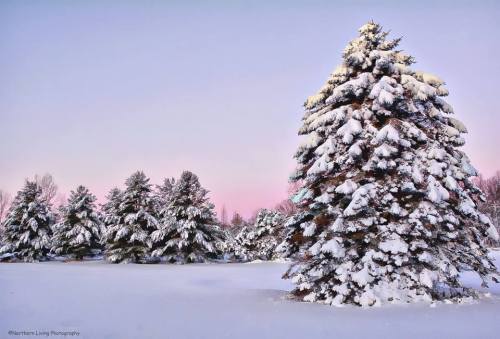
Pink Glow, photo by Northern Living Photography

Dee shared this gorgeous shot from near Greenbush of some trees that managed to live to grow another season!

View her photo bigger on Facebook!

Snowy Topper

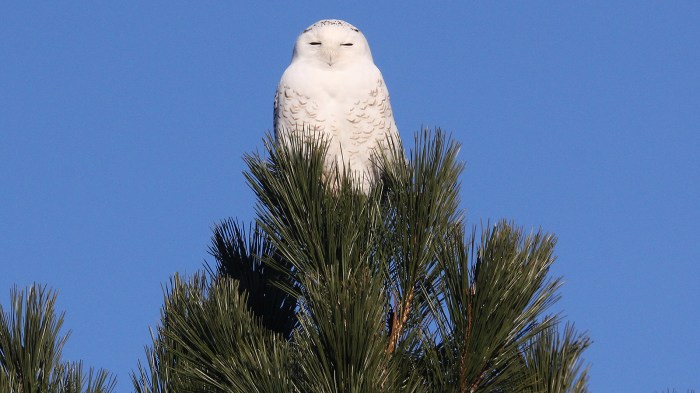
Michigan Snowy Owl Winter

snowy12-28-4, photo by Dan Lockard

What’s on top of your tree this year? Right now in the Absolute Michigan photo group, we’re seeing a ton of snowy owls. While these arctic owls are not found in the summer, we are in their winter range, as the Michigan DNR’s Winter Visitors page shares:

Just because the leaves have fallen from the trees and there is a chill in the air is no reason to put away your binoculars. Winter offers unique viewing opportunities. Many of our summer resident birds migrate to warmer summer climates. Still, there are several species of birds that migrate from Canada and find Michigan the perfect winter temperature. Winter is the only time several of these species can be found in Michigan.

Two of the largest migrants are the snowy owl and the great gray owl. Snowy owls can be found moving into Michigan during winter when the food supply on the arctic tundra is in short supply. Snowy owls have been recorded as far south as Lansing, Michigan. Because they rarely see humans on their northern homes, they are not timid and can be easily viewed for long periods of time.

Friday’s Sault Star reported that about three dozen snowys were sighted during the annual Audubon Christmas Bird count on December 20th. That’s more than average. We’ll know if this is an irruption year after all the bird count numbers are released in January.

View Dan’s photo taken near Muskegon background big and see lots more (including a couple shots of the great gray owl) in his awesome Owls slideshow.

Lots more snowy owl pictures & information (including a couple more by Dan) in the Michigan in Pictures archives!

The Monarch and Hartwick Pines

Logging Era Grayling MI Monster Hartwick Michigan White Pine called the Monarch RPPC 1942 at the Memorial Park prior to Hartwick becoming a State Park

Logging Era Grayling MI Monster Hartwick Michigan White Pine, photo by UpNorth Memories – Donald (Don) Harrison

This Friday, April 26th is Arbor Day, and I thought it would be nice to take a look what is probably the most famous trees in Michigan’s history and the place where it once grew, Hartwick Pines State Park. In 1927, Karen Michelson Hartwick purchased over 8,000 acres of land that included 85 acres of old growth white pine from the Salling-Hanson Company of Grayling. Mrs. Hartwick was a daughter of  a founding partner of the logging company and shortly after the purchase, she donated the land to the State of Michigan as a memorial park named for her husband, the late Major Edward E. Hartwick of Grayling. A nice article from the Toledo Blade about Hartwick Pines explains:

This is Hartwick Pines, the largest stand of “old growth” forest in Michigan’s Lower Peninsula. Here, white pines, red pines and hemlocks ladder their way 160 feet to the sky.

…There are approximately 24,000 trees in the Hartwick Pines old growth grove today, but not all are “old growth” trees. Lightning and wind claim a few of the old trees each year, and they are replaced with a mixture of hardwoods and pines.

A large hemlock near the parking lot was recently damaged by a storm and had to be removed. Its stump showed 365 annual rings. The most famous tree at Hartwick Pines — The Monarch — lost its crown in a 1992 storm and then died four years later. It was 155 feet tall when healthy, with a circumference of 12 feet and an estimated age of 325 years.

Read on and learn more about Hartwick Pines from the State of Michigan.

See this big as the Monarch and jump in to Don’s slideshow of postcards for more vintage scenes from Hartwick Pines!

PS: The Monarch was a white pine, Michigan’s State Tree.

Spring Return: Eastern Redbud

I'll Return With Spring

I’ll Return With Spring, photo by MightyBoyBrian

On AnnArbor.com Rick Meader writes:

When you think about popular, colorful ornamentals, Eastern Redbud (Cercis canadensis) often comes to mind. It’s a real crowd-pleaser, with a graceful, ornamental shape that puts out a “bouquet on a stem” look, with thousands of tiny pink/purple flowers lining its branches in early spring before its leaves emerge.

And, the best thing about it is, it’s native to southern Michigan, as well as most of the eastern half of the United States south of here. Furthermore, as a member of the Pea family (Fabaceae) it’s a cousin to the previous pod-producers we’ve learned about, Honeylocust (Gleditsia triacanthos) and Kentucky Coffeetree (Gymnocladus dioica).

As mentioned before, Eastern redbud is native to southern Michigan, occurring naturally up to a line across the lower peninsula from Kent County to Genesee County.

…If you want to use it in your landscape, it is fairly flexible in terms of where it will grow. It naturally occurs in rich soil along stream and river banks but is tolerant of a wider range of conditions. It likes sun or partial shade and can do well in most soils except waterlogged soils and dry, sandy soils.

Read on for more including Rick’s advice to make sure your tree comes from a northern nursery because trees from southern nurseries often are killed off by Michigan’s cold winters.

Brian’s photo is the first background we selected for the new Absolute Michigan, and  as you can see from past features of his work on Michigan in Pictures, he’s a really talented photographer who uploads big enough for backgrounds. See this shot from April of last year background bigilicious and see more in his Nature slideshow.

More spring wallpaper on Michigan in Pictures!

I Love Ice

I Love Ice_0746

I Love Ice_0746, photo by Mike Hainstock

As long as it’s not under my tires, I love ice too.

Check this photo out on black and see more in Mike’s spectacular ice slideshow which includes some photos from the soon-to-form Eben Ice Caves.

More ice on Michigan in Pictures.