The month of the Pleiades … and legendary aurora borealis

Orion Aurora

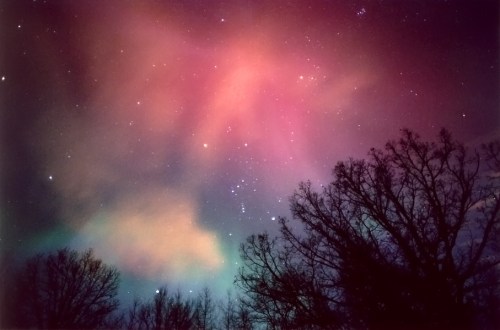
Orion Aurora, photo by Kevin’s Stuff

This EarthSky article on the Pleiades gives some great lore and viewing tips and says that:

In our Northern Hemispheres skies, the Pleiades cluster is associated with the winter season. It’s easy to imagine this misty patch of icy-blue suns as hoarfrost clinging to the dome of night. Frosty November is often called the month of the Pleiades, because it’s at this time that the Pleiades shine from dusk until dawn. But you can see the Pleiades cluster in the evening sky well into April.

You can read much more at EarthSky.org and also might want to check out this story of the Pleiades.

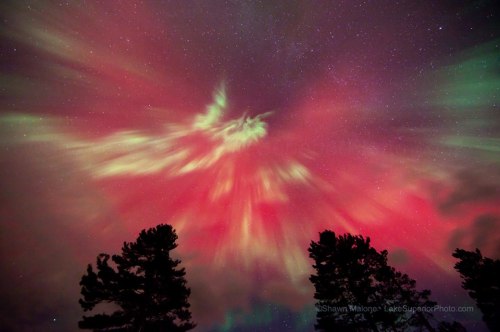
November is also the month of the Aurora, delivering some of the best northern lights action. Kevin took this photo during one of the best solar storms in the last several decades on November 10, 2004. He wrote the following (in part) after viewing these lights:

It was a Dark and (Solar) Stormy Night. Stormy with shafts and rays of light streaming from the heavens.

We all knew there was a chance of another auroral display tonight. We were waiting. And then around 10:30pm or so (from Grand Rapids), the wait was over. This time I went out with my brother, taking back roads and such until we finally found a great spot in northeastern Kent County. We ended up off Old Belding Rd on Lessiter Rd, which is on the way to the Grattan Raceway.

The road faced north, so we were shooting right down the middle of it. There were some clouds around to the north, but nothing too bothersome. Most of the action was to the northeast, with not much seen in the way of color except green, and an occasional red and blue. There were curtains, rays, shafts, and some really good pulsing going on.

I of course used my 35mm film camera, and my brother had his Canon Digital SLR. I was a tad pickier this time, and only shot 3 rolls by the time 1:30 rolled around, and it started to wane. Also, we were getting some clouds coming in, so we bailed.

On the way back to civilization, I noticed it was picking up again … I finally found a place a few miles down the road with a good northern horizon, and set up the camera again.

Oh… My… God. The curtains! The pulsing rays!! The pulsing shafts of light as they flickered up the magnetic lines of force to the corona. I was seeing pulsating shafts from the south!! All of them converging near Orion, forming another spectacular corona. I shot, moved the camera, and shot again. Always looking for the best display, and ever mindful to watch for composition (at least I was keeping my photographers’ hat on during this), I shot frame after frame. At one point I was going to leave, as it was dying again. But as I put my camera in the car, it flared up to the point I HAD to get set up again; another roll of film in the camera. I finally stopped around 3:00, as it was dying down, and also because I knew if I didn’t force myself, I’d shoot until I ran out of film. … In all my years of observing the aurora, I’ve never seen such intense pulsating effects. Also, the coronas (all 5 I counted) had more detail in them than I had ever seen.

Check his photo out bigger with Kevin’s helpful note showing the Pleiades cluster in the top right and see more including a few more from November 2004 in his Aurora slideshow.

More of the night sky on Michigan in Pictures.
Misty Moonrise at Tahquamenon

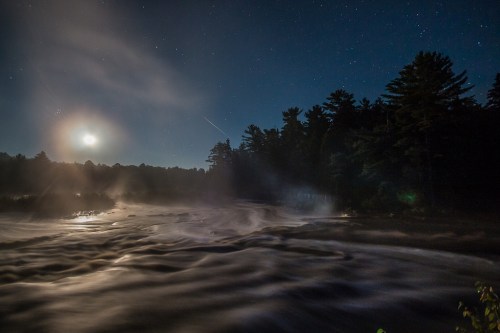
Misty Moonrise

Misty Moonrise, photo by ShaneWyatt

Here’s a gorgeous shot of the moon rising over the mist of Lower Taquamenon Falls – Shane caught a shooting star too!

View his photo bigger and see more including another night shot at the falls in Shane’s stars slideshow.

Northern Lights the next two nights!

Make this the evening of October 2nd & 3rd – I misread the alert!

Aurural Angel

Angel, photo by Shawn Malone/Lake Superior Photo

The latest Space Weather forecast says that S1 (Minor) solar radiation storm conditions are expected tonight and tomorrow night Wednesday & Thursday night due to particle enhancement associated with the 29 Sep coronal mass ejection (CME). They have revised Thursday up from Minor to Moderate too!

That’s good enough reason to check in on Shawn Malone of Lake Superior Photo. Shawn takes amazing pictures of the Northern Lights and all things Upper Peninsula. This summer, her incredible North Country Dreamland video won the Viewers Choice in the 2013 Smithsonian in Motion video contest.

Check this photo out bigger and see more in her Northern Lights Collection on Facebook.

Much (much) more about the aurora borealis on Michigan in Pictures!

Chasing the Perseids at Bond Falls

Chasing the Perseids

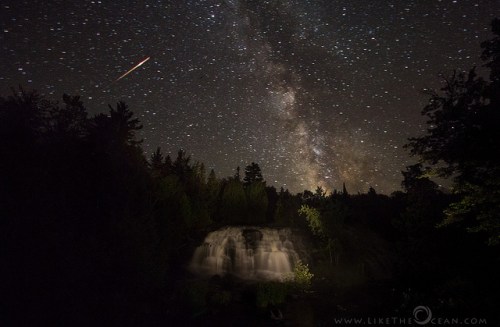
Milky Way over Milky Falls with a dash of Perseids, photo by Like The Ocean

“I am beginning to love the stars too fondly to be fearful of the night.”
~Sathya R.

I hope that you had a chance to catch the annual show that is the Perseid Meteor Shower. In Chasing the Perseids at his blog Like the Ocean, Saytha writes:

45 hours on the road with just few hours of sleep, in search of that one spot to capture the Perseids. The lashing rain, the forecasted aurora that never turned up and the hide and seek with the clouds – it was all fun. Was it all worth it, you bet! The road trip took me to one of the darkest skies of Mid Western US – Bond Falls. Would like to share with you a moment in time from that night. This was one of the two meteor I was able to capture on frame, but loved how everything came together in this shot. I do love when a plan comes together :)

The deafening sound of 500 gallons of water / second from 50 feet
The tranquil silence of the dark night
Milky way adorning the skies
A (Perseids) meteor fireball streaking across the horizon
Definitely a moment of serenity and one I would cherish!

Read on at Like the Ocean Photography, check this photo out bigger and see more in his awesome Nightscape slideshow.

More about Bond Falls at Michigan in Pictures.

2013 Perseid Meteor Shower

Perseids & the Milky Way

Perseids & the Milky Way, photo by gkretovic

EarthSky.org’s Meteor Shower Guide explains:

The Perseid meteor shower is perhaps the most beloved meteor shower of the year for the Northern Hemisphere. The shower builds gradually to a peak, often produces 50 to 100 meteors per hour in a dark sky at the peak, and, for us in the Northern Hemisphere, this shower comes when the weather is warm. The Perseids tend to strengthen in number as late night deepens into midnight, and typically produce the most meteors in the wee hours before dawn. They radiate from a point in the constellation Perseus the Hero, but, as with all meteor shower radiant points, you don’t need to know Perseus to watch the shower; instead, the meteors appear in all parts of the sky. They are typically fast and bright meteors. They frequently leave persistent trains.

Every year, you can look for the Perseids around August 10-13. They combine with the Delta Aquarid shower to produce the year’s most dazzling display of shooting stars. In 2013, the Perseid meteors will streak across the short summer nights – August 10-13 – from late night until dawn, with little to no interference from the waxing crescent moon. Plus the moon will be near the planet Saturn in the evening hours, giving a colorful prelude to late-night Perseid show. Best mornings to look: August 11, 12 and 13.

Check out Everything you need to know about the Perseid Meteor Shower on EarthSky and also don’t  miss Star Trails, the Perseid Meteor Shower and the Tears of St. Lawrence in the Michigan in Pictures archives!

Greg took this shot in the UP – I’m thinking that’s the Nahma Burner on Big Bay de Noc at the right. Check it out bigger and see more in his stunning Upper Peninsula of Michigan slideshow.

More meteors on Michigan in Pictures.

NASA turns 55

Milky Way - Silos

Milky Way – Silos, photo by eddy.matt

“To reach for new heights and reveal the unknown so that what we do and learn will benefit all humankind.”
~NASA’s Vision

On July 29, 1958, President Dwight D Eisenhower signed the  National Aeronautics and Space Act that established the National Aeronautics and Space Administration aka NASA. While I don’t think that we’ve seen quite the advances we expected after making it to the moon in just over a decade, NASA has evolved into a science agency that is engaged in an incredible range of operations from theoretical research (warp drive is my current favorite) to monitoring our planet, solar system and the visible universe (measuring Northern Lights and roving Mars) to a permanent presence in space (I watched NASA TV live from the International Space Station this morning) and plans for a manned Mars mission.

Check Matthew’s photo out bigger and see more in his slideshow. This photo is a still from a gorgeous time-lapse on the Leelanau Peninsula that he did last year in July.

More space on Michigan in Pictures!

Heavy (Space) Weather: Coronal Mass Ejections and the Northern Lights

Northern Lights

Northern Lights, photo by gkretovic

Michigan in Pictures has a whole lot on the Northern Lights.

The aurora borealis are one of the world’s most rare and wonderful sights and Michigan – especially the Upper Peninsula – is blessed with more than a few nights every year when this elusive phenomenon makes an appearance.

The Library of Congress page What Are the Northern Lights? calls on NASA’s Dr. Sten Odenwald, author of The 23rd Cycle, Learning to Live with a Stormy Star, to provide insight to how northern lights are formed:

The origin of the aurora begins on the surface of the sun when solar activity ejects a cloud of gas. Scientists call this a coronal mass ejection (CME). If one of these reaches earth, taking about 2 to 3 days, it collides with the Earth’s magnetic field. This field is invisible, and if you could see its shape, it would make Earth look like a comet with a long magnetic ‘tail’ stretching a million miles behind Earth in the opposite direction of the sun.

When a coronal mass ejection collides with the magnetic field, it causes complex changes to happen to the magnetic tail region. These changes generate currents of charged particles, which then flow along lines of magnetic force into the Polar Regions. These particles are boosted in energy in Earth’s upper atmosphere, and when they collide with oxygen and nitrogen atoms, they produce dazzling auroral light.

We focus on the beauty, but as he explains:

“Aurora are beautiful, but the invisible flows of particles and magnetism that go on at the same time can damage our electrical power grid and satellites operating in space. This is why scientists are so keen to understand the physics of aurora and solar storms, so we can predict when our technologies may be affected.”

Dr. Odenwald’s book is out of print but he has made it available online. There’s some interesting stuff in there, and be sure to check out his Astronomy Cafe site too.

One benefit from the economic & security concerns of predicting space weather is that you can get some great northern light forecasts. My favorite is NOAA’s Space Weather Service. They reported a G1 storm on March 1st – it’s the lowest intensity on the Space Weather Scales but as you can see is still able to produce auroral activity!

Greg took this photo Saturday night just before midnight at Presque Isle in Marquette – check it out on black and in his slideshow. You can see more of Greg’s work on Michigan in Pictures, at michigannaturephotos.com and definitely follow him at Michigan Nature Photos on Facebook.