
Spring Tease: Winter Aconite & Snowdrop

Spring Tease

Spring Tease, photo by MichaelinA2

I was thinking there had been entirely too much ice on Michigan in Pictures this week. Thankfully Michael shared this photo in the Absolute Michigan pool, saying:

NE Ann Arbor ~ At 41F. our first break towards Spring… Winter Aconite (yellow flowers) and Snow Drops (white flowers)

Wikipedia explains that Eranthis (winter aconite) is a genus of eight species of flowering plants in the Buttercup family:

They are herbaceous perennials growing to 10–15 cm (4–6 in) tall. The flowers are yellow (white in E. albiflora and E. pinnatifida), and among the first to appear in spring, as early as January in mild climates, though later where winter snowpack persists; they are frost-tolerant and readily survive fresh snow cover unharmed. The leaves only expand fully when the flowers are nearly finished; they are peltate, 5-8 cm diameter, with several notches, and only last for 2-3 months before dying down during the late spring.
Species in this genus are spring ephemerals, growing on forest floors and using the sunshine available below the canopy of deciduous trees before the leaves come out; the leaves die off when the shade from tree canopies becomes dense, or, in dry areas, when summer drought reduces water availability.

There is (of course) a detailed Wikipedia entry for Galanthus (Snowdrop), but I found Plant Focus: Snowdrops by George Papadelis at The Michigan Gardener to be full of great information. He begins:

The very first bulb to cheerfully announce spring is the snowdrop. As the last winter snow melts, carpets of delicate white flowers emerge through last year’s fallen leaves. Snowdrops will reliably return year after year despite Mother Nature’s most challenging winters. The botanical name, Galanthus, comes from the Greek words Gala meaning “milk” and anthos meaning “flower.” They will thrive in the rich, moist soil usually found in the shade provided by deciduous trees. Few bulbs can tolerate shade, but snowdrops develop in the winter sun well before the leaves of trees and shrubs have expanded. Their flowers last for several weeks beginning in early March and persisting through the cool days of spring in early April. Once planted, Galanthus require no maintenance.

One of the most treasured features of this easy-to-grow perennial is its ability to propagate on its own and develop into large masses. It is this trait that gives snowdrops the label “good naturalizer.” Many other popular bulbs such as tulips, hyacinths, and alliums flower beautifully the first few seasons, but eventually weaken and disappear. Galanthus may be left undisturbed for years to form large, densely packed colonies.

Read on for much more including planting tips for Michigan and a bunch of photos.

Check this out on black and see more in Michael’s slideshow.

More flowers and by gosh more SPRING on Michigan in Pictures.
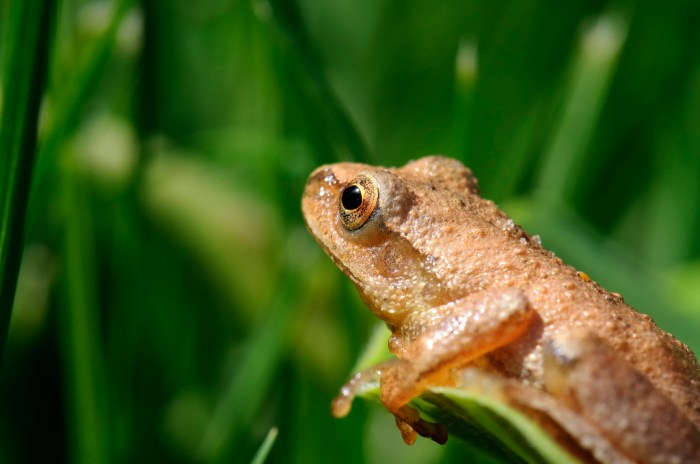
Signs of Spring in Michigan: Spring Peepers (Pseudacris crucifer)

Spring Peeper Pseudacris crucifer

Untitled, photo by Tim Mayo.

The Michigan DNR’s page on Northern Spring Peeper (Pseudacris crucifer) says:

The tinkling of bells is a popular description of the spring peeper’s spring mating call. Spring peepers are one of the earliest callers among the dozen frog species found in Michigan. During the first warm evenings of spring in late March or early April through May, their distinctive single note, high pitched “peep” is considered a harbinger of spring. The intensity of calling increases and can become a deafening chorus during humid evenings or just after a warm spring rain when many males congregate.

Only the male frogs call. They establish territories near the edge of permanent or ephemeral wetlands. They may call from elevated perches of submerged grass or shrubs near the water. The faster and louder a male sings, the more likely he is to attract a mate.

The female will lay between 750-1,200 eggs. The strings or clumps are attached to twigs and aquatic vegetation. Depending on the temperatures, eggs may hatch within four days or may take up to two weeks during cooler periods. After another two to three months, young tadpoles are fully transformed into young frogs and leave the pond.
They resemble their parents with the most distinctive mark being a dark brown “X” (may be irregular or incomplete on some) on their lighter brown or tan back. They begin feeding on small food items like spiders, mites, ticks, pill bugs, ants, and caterpillars. By the end of the summer, they have reached the adult size of about 1 – 1 1/2 inches. As the days cool, the peepers dig into the soft mud near ponds for the winter. Still, during warm spells into the fall they can be confused and emerge to give their spring mating call.

The spring peeper is the most abundant of Michigan’s singing frogs and is common statewide. They prefer damp woodlands, swamps, and marshes. However, they still need protection – local populations around small ponds and wetlands can be highly susceptible to surface water runoff. These waters can carry chemicals, pesticides, or silt that can kill adults, eggs, or tadpoles. Good soil erosion practices and the careful application of pesticides and fertilizers are good for spring peepers.

The most distinctive thing about peepers is their call, which can become deafening in springtime. The Pseudacris crucifer (Spring Peeper) section from UM Animal Diversity Web has a short peeper call from Livingston County, and you can see a peeper peeping in this video.

Some more peeper particulars: Wikipedia’s Spring Peeper entry notes that their calls can be heard from as far as 1 – 2.5 miles depending on the number of peepers in a pond, that peepers generally like to breed when it is closer to dusk and throughout the evening and early morning hours, and that peepers can live up to 3 years in the wild. At Portage Lake in Washtenaw County, Michigan in the 1950s, surveys in March, April, and May found that spring peepers were the most abundant animals. The page on peepers from watersheds.org notes that spring peepers produce glucose (sugar) in their livers that acts as an anti-freeze and is pumped to vital organs including the heart and lungs to allow them to freeze and thaw without developing ice crystals. Our Peeper-pedia on Absolute Michigan has a few more links and a cool video of a Michigan peeper in action.

Check Tim’s photo out bigger and in his PJ Hoffmaster State Park slideshow.

More frogs on Michigan in Pictures.