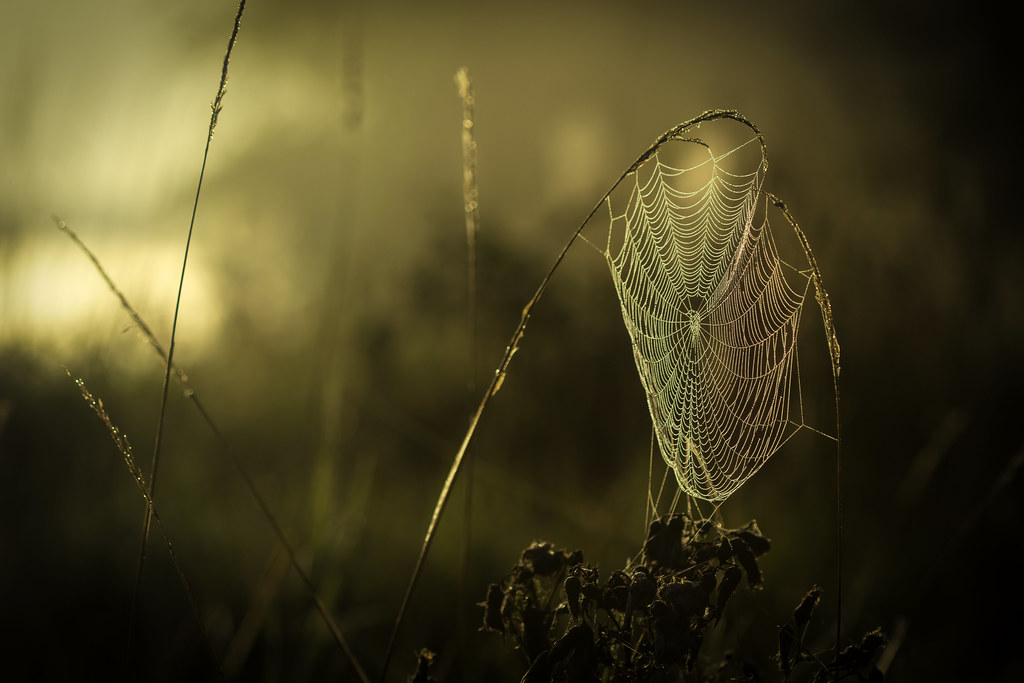
Kevin shares that he took this when he walked along the Grand River on a Sunday morning this August & got to an open field with some great sunlit spider webs. See more in his Butterflies/Insects gallery on Flickr & follow him at Kevin Povenz Photos on Facebook!
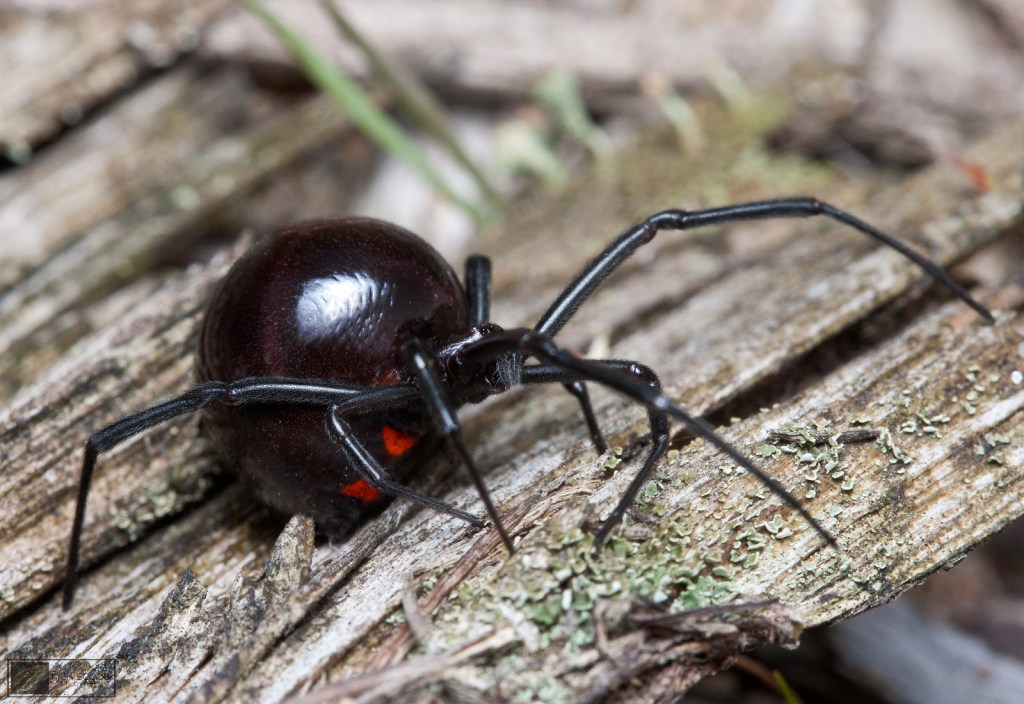
In Michigan, they appear to be more common in the western Lower Peninsula. Outdoors, they are found in old stumps, hollow logs, under fallen fence posts, in abandoned animal burrows or piles of brush, and in the corners of sheds and crawlspaces. In the northern black widow, the distinctive hour glass marking on the underside of the abdomen is incomplete or split in the middle. Northern widows also have a series of red spots along the dorsal midline of the abdomen, and many have a series of lateral white stripes on the abdomen. The web of the black widow is an irregular mesh of strands in which the spider hangs in an inverted position.
Surprisingly, as common as this spider is, black widow bites are infrequent because the spider is actually very timid and prefers fleeing when disturbed. That’s a good thing because the venom of a widow spider is 15 times more toxic than that of rattlesnakes. However, due to the small amount of the venom injected into the bite, widow bites are far less serious.
FRANK CARTER, local resident who had been in Chicago and Grand Rapids during the summer, returned Monday night being ill from the poisonous effects of a spider which walked over his arm, leaving a poisonous track at every step. Last week, while lying on the ground at Grand Rapids, an immense yellow spider jumped on his arm near his elbow and ran down to his wrist. Mr. Carter smashed his poisonous body on his arm and it immediately began to swell from the poison. The arm was inflamed and swollen with white spots. Under the advice of a physician, Mr. Carter went home to care for his arm.
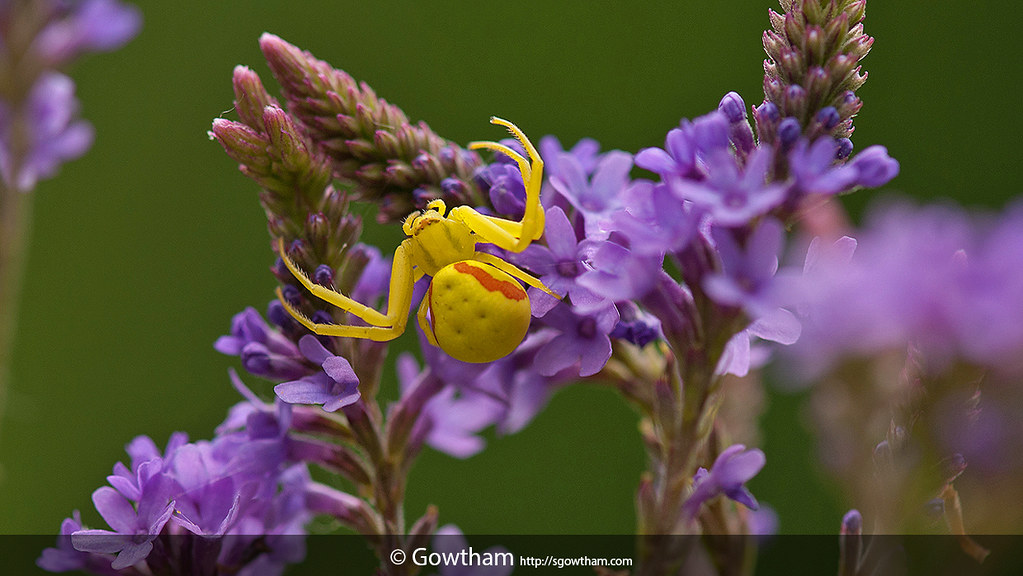
It’s been a minute since I’ve featured a photo from Gowtham. He shares that while driving through the back roads of Huron Mountains from Houghton to Marquette, “I took a few wrong forks in succession and one of those forks had a plethora of Blue Vervains (the flower in the picture). Taking one wrong fork after another, driving slow and paying attention paid off – as one of those blue vervains had an uncommon yellow tinge. I stopped to look carefully and much to my surprise was this tiny little Golden Rod Spider.”
…These spiders may be yellow or white, depending on the flower in which they are hunting. Especially younger females, which may hunt on a variety of flowers such as daisies and sunflowers, may change color “at will”. Older females require large amounts of relatively large prey to produce the best possible clutch of eggs. They are therefore, in North America, most commonly found in goldenrod (Solidago sp.), a bright yellow flower which attracts large numbers of insects, especially in autumn. It is often very hard even for a searching human to recognize one of these spiders on a yellow flower.”
I want to be very clear that this spider is not venomous (and no spider has “venomous tracks”). Only the Northern Black Widow and the Brown Recluse have bites that endanger humans. The rest are out there happily dispatching harmful pests. My guess is that it was a Brown Recluse as their bites have sort of a bullseye pattern with a white center.
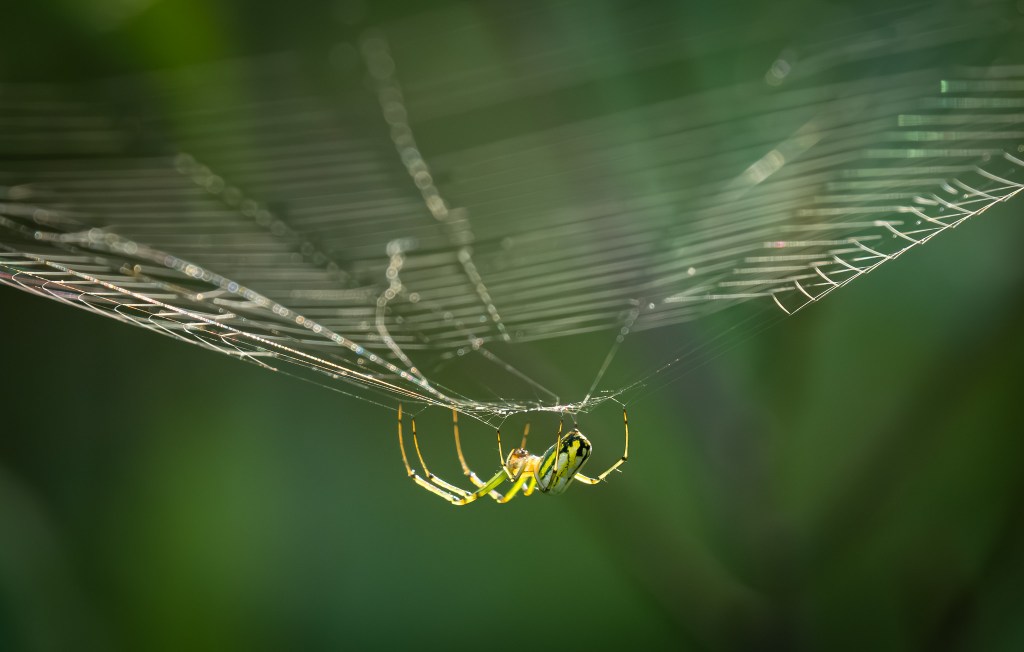
…Most spiders’ breeding seasons coincide with the transition from summer to fall. If you see more spiders than usual around your home during these months, chances are they’re mature males wandering far and wide in search of a mate. In fact, less than 5 percent (yikes) of the spiders you encounter inside your home have set one of their eight feet outside, according to Rod Crawford, Curator of Arachnids at the Burke Museum at the University of Washington.
Unlike humans, spiders are considered cold-blooded creatures since they don’t have a mechanism to regulate body temperature. When it’s cold, some spider species go through a process of cold-hardening to survive the winter. Beyond the chemical transformation in their bodies, many spiders seek shelter in piles of rocks, leaves or wood. Once snuggled up, spiders enter a slowdown state called diapause. In diapause, spiders are not completely inactive. Instead, they may emerge on warmer days to hunt and feed on any insect prey that may be active during this time.


 Michigan in Pictures