mLive shares that although Lake Michigan will still help “warm” lower Michigan this week, it will still be dangerously cold. The coldest air will come around the south end of Lake Michigan and plunge wind chills for southern Michigan into the -25 to -35 degree range Monday into Tuesday morning & it’s not much better for the rest of the state!
Detroit, Ann Arbor and Southeast Michigan: Sub-zero wind chills on Monday and Tuesday, falling as low as -15 degrees.
West Michigan: Monday and Tuesday’s wind chills could hit -20 degrees.
Northern Michigan: Wind chills could fall to -25 by Tuesday morning.
Upper Peninsula: “High confidence (>75%) for wind chills near or below -25F Monday morning and Tuesday morning for most of the U.P.,” the National Weather Service in Marquette said.“ Cold Weather Advisory for northern Houghton and Keweenaw Counties Monday morning.”
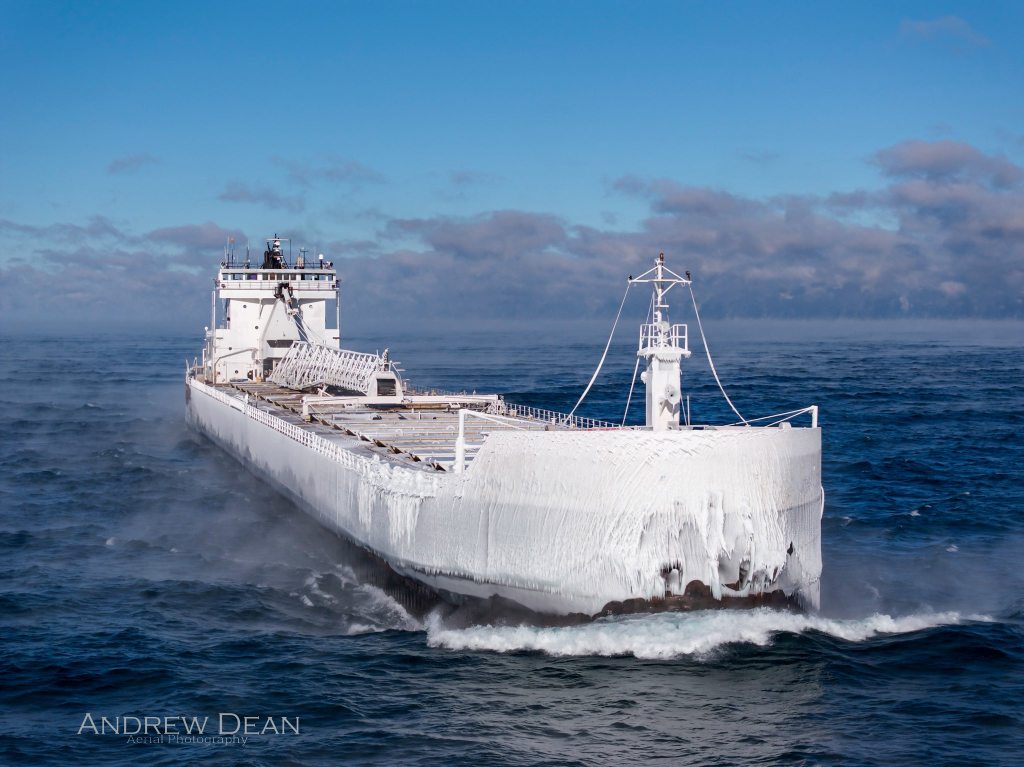
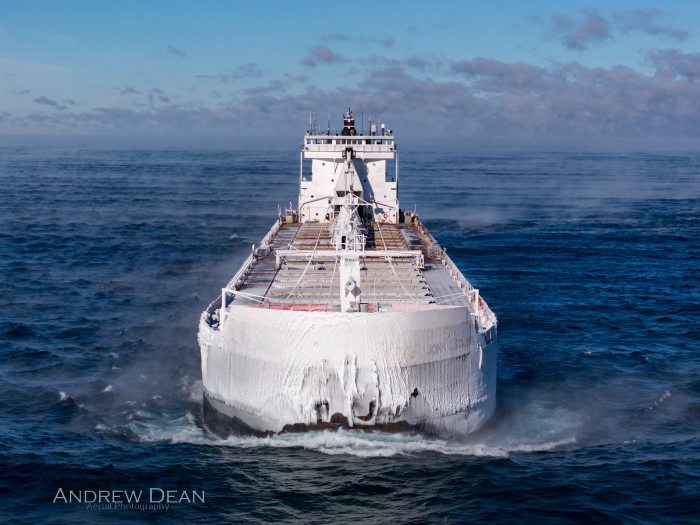
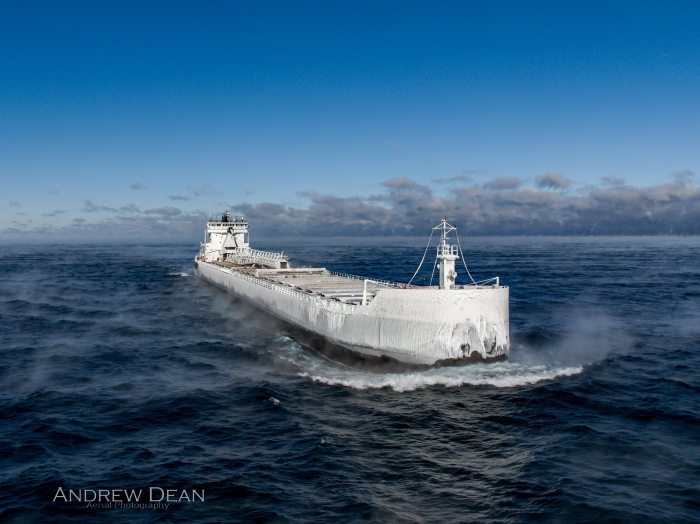
Andrew got these photos of freezing fog & spray turning the M/V John J. Boland into a floating icebox on Lake Michigan as she headed towards Indiana back in December. Follow him on Facebook and for sure visit his website for photos and information about his drone photography services!
The 1868 peak in sail-powered ships on Lake Michigan also marked the year the 123-foot Rouse Simmons was launched from Milwaukee’s shipyards. The ship was built by the firm of Allan, McClelland, and Company, one of Milwaukee’s preeminent shipbuilding firms …In the early 1870s, the Rouse Simmons joined the sizeable shipping fleet of wealthy lumber magnate and philanthropist Charles H. Hackley of Muskegon, hauling loads of lumber for Hackley’s fleet from company mills to the various markets around the lake for roughly 20 years.
By the late 19th and early 20th centuries, the popular German tradition of decorating an evergreen tree in the home was widely practiced, and it was not uncommon for a handful of lake schooners to make late-season runs from northern Michigan and Wisconsin loaded with thousands of Christmas trees for busy Chicago waterfront markets. Estimates of the number of Christmas schooners vary, but perhaps up to two dozen vessels in any season delivered evergreens to markets in Great Lakes states.
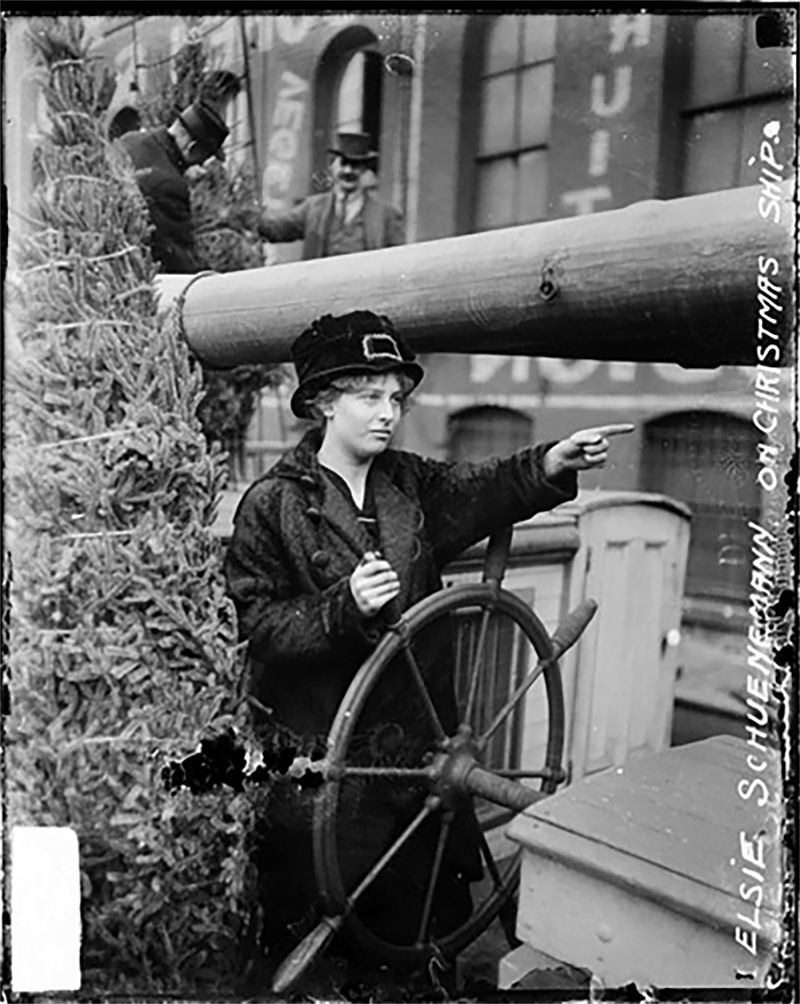
In Chicago, most vessels, including the Rouse Simmons, sold the trees directly from their berths along the Chicago River’s Clark Street docks. Electric lights were strung from the schooner’s bow to stern, and customers were invited to board the ship to choose their trees. In addition to selling Christmas trees, many boat operators, including Schuenemann, made and sold wreaths, garlands, and other holiday decorations. Barbara Schuenemann and her three daughters (Elsie is pictured above) helped make and sell these items as part of the family’s holiday trade.
You can read on for much more about Herman Schuenemann’s long career as “Captain Santa” which tragically came to an end on Friday, November 22, 1912 when the Rouse Simmons, heavily laden with 3,000–5,000 Christmas trees filling its hold & deck, left the dock at Thompson, Michigan looking “like a floating forest.” Sadly, the Rouse Simmons sailed into a powerful winter storm on the lake that sent her and several other ships including the South Shore, Three Sisters, and Two Brothers to the bottom of Lake Michigan.
On November 23, 1912, Back in 2007 Rich Evenhouse shared this video of a dive to the wreck of the Rouse Simmons. The shipwreck lies upright in 165 ft. at the bottom of Lake Michigan & I’ve heard that every year divers place a Christmas tree on the bow.
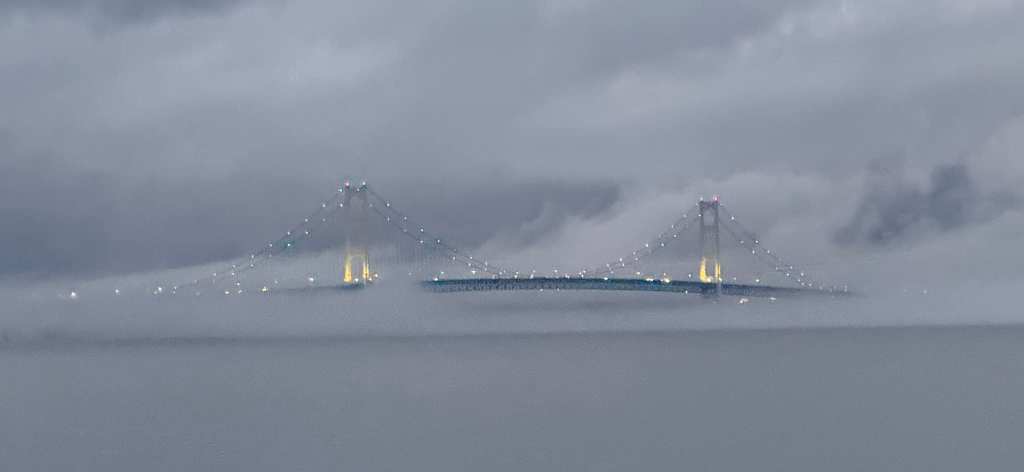
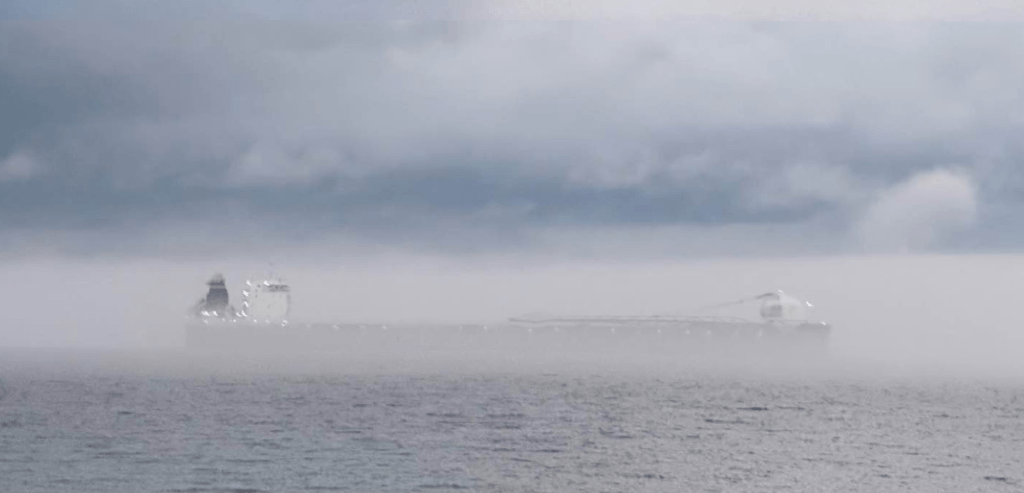
Joe got these great shots on October 31st of the Mackinac Bridge and a freighter & shared them saying “Mackinaw City has a ghost ship for Halloween!” You can see more of his pics & those of others in the Mackinaw City, Michigan group that he manages on Facebook.
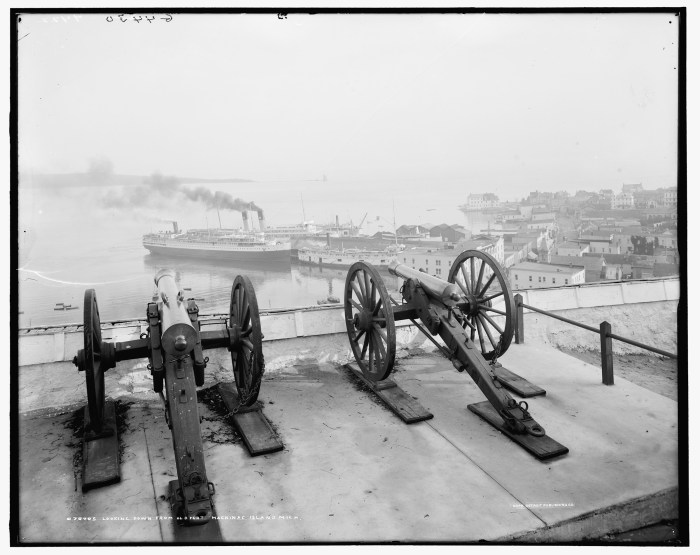
This cool old photo from the Library of Congress shows ships at dock on Mackinac Island, including the black hulled steamer Juniata. Head over to the LOC for a lot more from Mackinac.
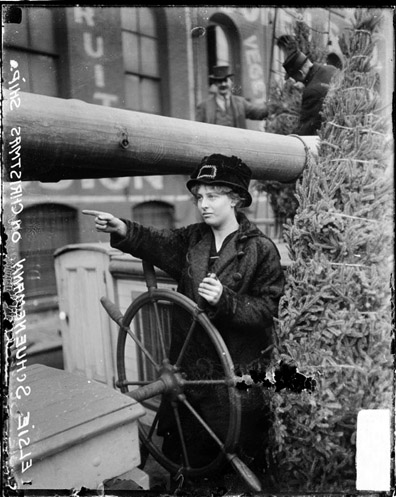
Above is a portrait of Elsie Schuenemann at the wheel of the Christmas Ship, near the Clark Street Bridge on the Chicago River in the Loop community area of Chicago, Illinois. The boat carried Christmas trees to Chicago from Michigan. Her father, Captain H. Schuenemann, died when the Rouse Simmons, a ship carrying Christmas trees, sank in 1912.
The trees behind her likely came from the woods of Escanaba. Though the story of Barbara Schuenemann and her three daughters carrying on the tradition of the Christmas Tree Ships has perhaps been a little over-romanticized, there can be little doubt that the Schuenemann family and the many others who participated in the difficult trade of hauling Christmas trees south as the storms of winter closed in were heroes cut from a cloth that isn’t found too often today.
If you’d like to read more about all the Christmas tree ships (there were many more than just the famous Rouse Simmons) I recommend Christmas Tree Ships from Fred Neuschel. He has also written a book called Lives and Legends of the Christmas Tree Ships (available from UM Press). The National Archive also has The Christmas Tree Ship: Captain Herman E. Schuenemann and the Schooner Rouse Simmons that details the Schuenemann’s story.
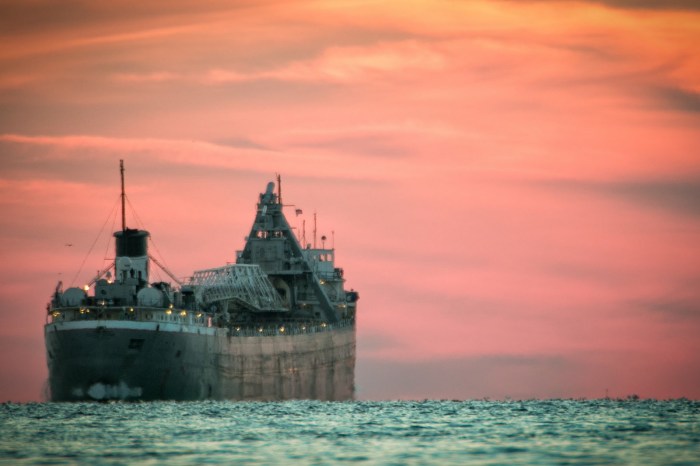
The sun rose on Lake St. Clair at about 6:30 AMthis morning. If you were there, maybe you were lucky enough to see something like Tom’s photo of the Cuyahoga headed into the sunrise. If not, at least we can be happy that there’s folks like him willing to get up and out for incredible shots like this.
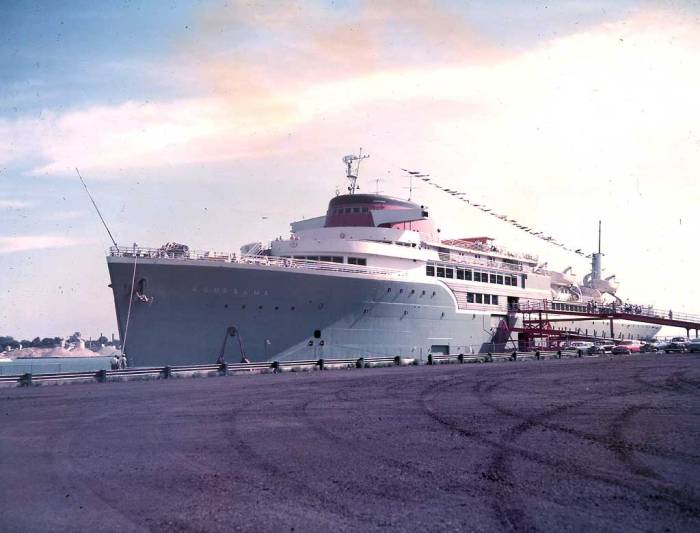
The Aquarama began its life in 1945 as a transoceanic troop carrier called the Marine Star: 520 feet and 12,733 tons. It made only one Atlantic Ocean trip before combat ceased. Eight years later, the ship was purchased by Detroit’s Sand Products Company and taken to Muskegon, Michigan, where it underwent an $8 million, two-year conversion, and was reborn as a nine-deck luxury-class ferry capable of carrying 2,500 passengers and 160 cars. The rechristened Aquarama also touted five bars, four restaurants, two dance floors, a movie theater, a television theater, and a playroom. Special events often were held in conjunction with day or evening cruises. For example, on June 10, 1962, passengers were treated to a style show from Lane Bryant’s Tall Girl Department. The next month, evening cruisers on the Aquarama could watch the Miss World finals. Regular shipboard entertainment included musical performances, dancing, marionette shows, games, and contests.
The cruise portion of the ship’s life actually began in 1955, with tours to various Great Lakes ports and a brief stint as a “floating amusement palace” docked along Chicago’s Navy Pier. Soon after, service began focusing solely on runs between Cleveland and Detroit: six hours “door to door” with Cleveland-based passengers embarking in the morning from (and returning in late evening to) the West 3rd Street pier. For the next six years, the Aquarama was extremely popular but never profitable. Part of the problem may have been frequent “incidents”: One summer, the Aquarama backed into a seawall. A year later, it hit a dock in Cleveland. A week after that, it banged into a Detroit dock, damaging a warehouse. Alcohol issues also were recurrent: Accusations included untaxed booze and liquor sold in Ohio waters on Sunday. Still, the ship’s most likely death knell was simply high operating costs.
The Aquarama made its last trip on September 4, 1962. It then was towed back to where it had been rebuilt–Muskegon, Michigan, ostensibly to continue as cruise vessel. Unfortunately, a prohibitively large dredging investment was needed to accommodate the harbor. The Aquarama thus sat dockside—residing (but not operating) later in Sarnia, Ontario, Windsor, Ontario, and Buffalo, New York, where entrepreneurs hoped in vain to convert it to a floating casino. In 2007 the Aquarama was towed to Aliağa, Turkey, where it was broken up for scrap.
This photo from Boatnerd shows the Aquarama unloading passengers from Cleveland at Detroit’s city park next to the J.W. Westcott Co. dock, 1963. Another view. Hartland Smith, William Hoey collection. More pics at Boatnerd.com.
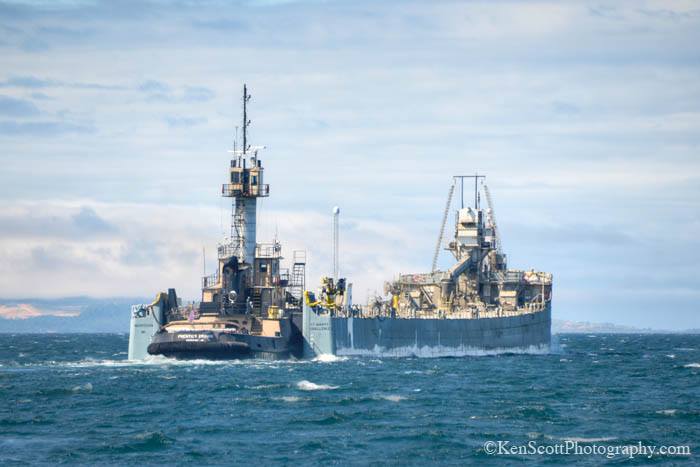
St. Marys Challenger lived up to its name by defying that assertion longer than its counterparts. But after 107 years, the laker was taken out of service in November 2013 to be converted to a barge. Built in 1906, Challenger was the oldest operating freighter on the Great Lakes.
The decision to convert the 551-foot cement carrier followed a series of upgrades spanning several decades, including extensive hull rebuilding, installation of a self-unloading cargo system and a myriad of other structural upgrades. In the end, the owner was left with a Skinner Marine Uniflow four-cylinder reciprocating steam engine burning heavy fuel oil, outdated DC electric and an aged mechanical propulsion system that made operating the boat an ever-increasing expense.
…Port City Marine, based in Muskegon, Mich., considered its alternatives, including retrofitting Challenger with a diesel engine. Not only would that have cost about $20 million — nearly double the barge conversion project — but it would have saddled the company with ongoing expenses. And while a crew of 25 was needed to operate Challenger, the articulated tug-barge (ATB) can operate with 11.
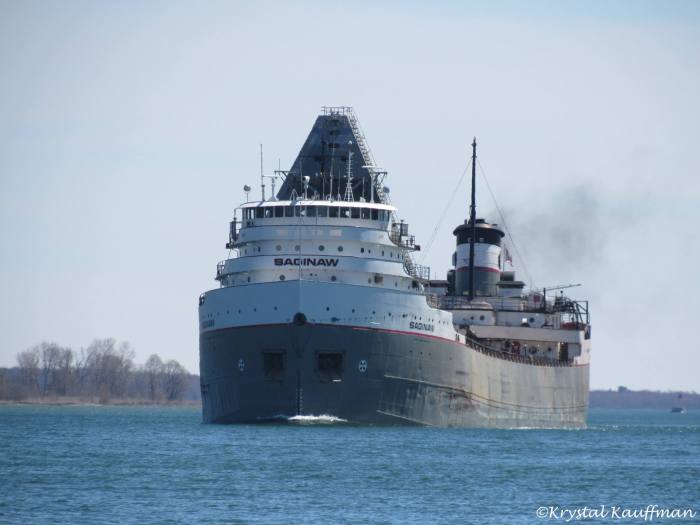
Capistrano has their swallows, but a sure sign of Spring in Michigan is when the freighters return to the Great Lakes. One of the best places for shipwatching is right where Krystal took this photo: Mission Point at the mouth of the North Channel near the Soo Locks.
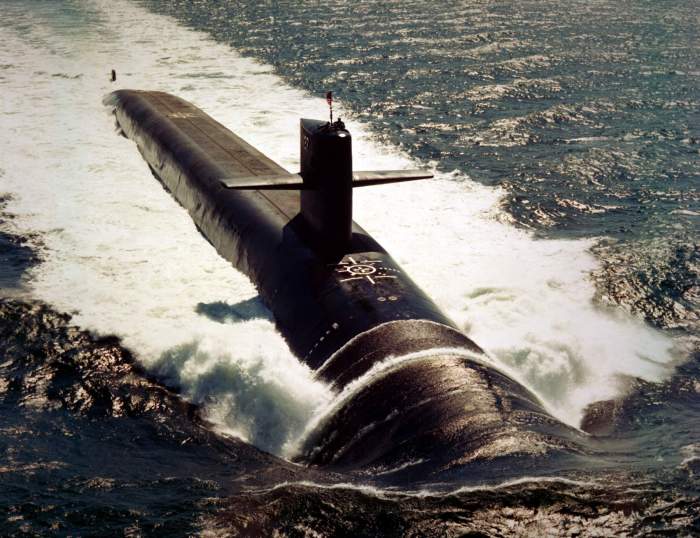
The USS Michigan is more than 560 feet long and weighs more than 18,000 tons when submerged and is regularly deployed throughout the Western Pacific from its home port of Bremerton, Wash.
It was first launched in 1980 and commissioned two years later. It was built to carry the Navy’s third generation submarine-launched ballistic missile, the Trident C-4. The Michigan carried out its primary mission of deterrence for nearly two decades in over 60 missions.
At the end of the Cold War, it was spared from decommission and converted with two other ships to the Ohio-class sea frame. In 2007, it followed the USS Ohio, Florida and Georgia as a guided missile submarine.
The vessel is capable of hitting speeds of over 20 knots while submerged and can drop over 800 feet below sea level. It also contains 22 tubes that carry seven Tomahawks each.
…The Michigan is the third ship to bear the name in the U.S. Navy’s history. The original Michigan was the first iron warship in the U.S. Navy and likely the first iron or steel warship of its size in the world, according to a biography on the Navy’s website.


 Michigan in Pictures

