2025 Chicago to Mackinac Race

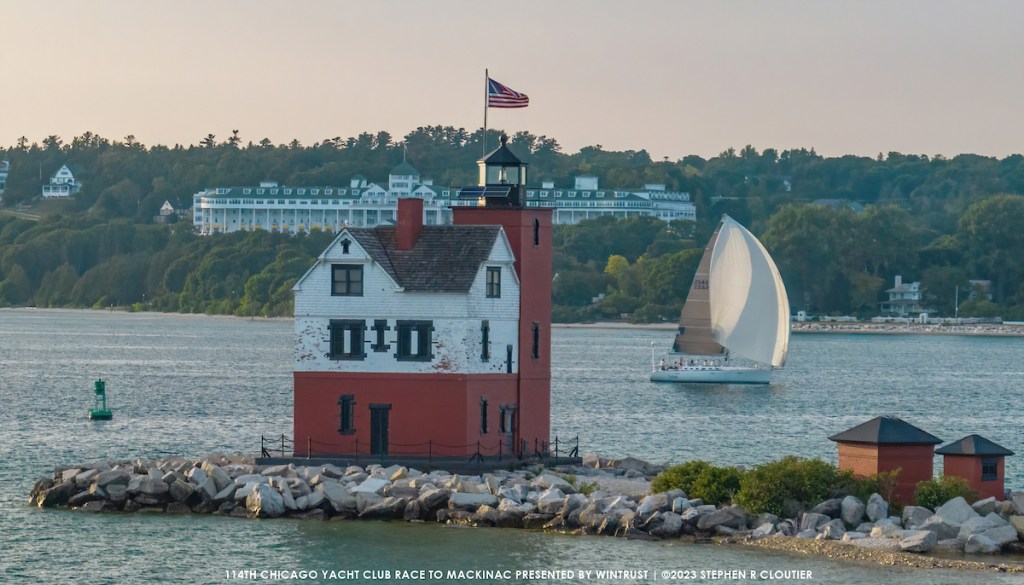
Chicago to Mac Sailing Race at Mackinac Island by Stephen R. Cloutier

Chicago to Mac Sailing Race at Mackinac Island by Stephen R. Cloutier

The Chicago Yacht Club Race To Mackinac starts Friday morning (July 18). The Chicago to Mac is the longest annual freshwater sailing race in the world, spanning 333 statute miles from the start at the Chicago Yacht Club, up the western shore of Lake Michigan, passing under the Mackinac Bridge to finish at Mackinac Island. They explain that:

…the race’s unpredictable weather and shifting winds on Lake Michigan make it a supreme test of sailing skill, rivaling many offshore ocean races. What first began in 1898 with just five boats has now evolved into a world-class sporting event. The origins of the Race to Mackinac date back to 1898, when Joseph Myers designed two fin-keel sloops, Siren and Vanenna. These vessels sparked a competition between their owners, George Peate of Siren and W.R. Crawford of Vanenna, and after three races in June of 1898, Vanenna remained undefeated. This prompted the idea of a unique, challenging race – one that would forever change the history of sailing.

Lots more on the Race to Mackinac website. If you click the pic above, you can see more of Stephen’s photos. For sure follow him on Instagram for his latest! Also more about Round Island lighthouse on Michigan in Pictures!
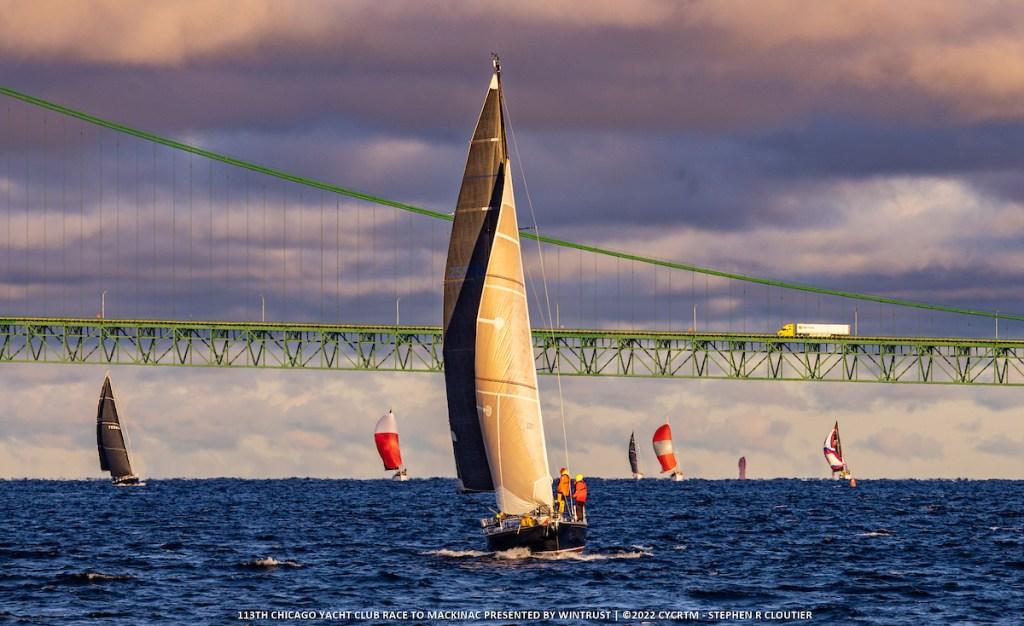
Chicago to Mac at Mackinac Bridge by Stephen R. Cloutier

Chicago to Mac at Mackinac Bridge by Stephen R. Cloutier
Support Michigan in Pictures with Patreon

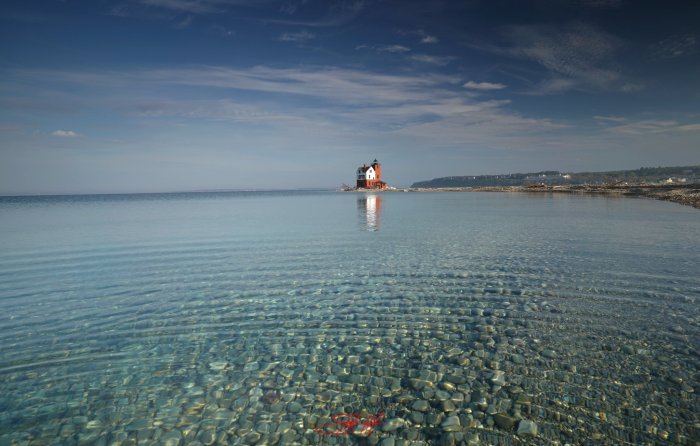
Round Island Ripples

Round Island Light 2022 by S.Hughes Photos

Round Island Light 2022 by S.Hughes Photos

“We are here but for a second, but our impact ripples through time.”
― Neetal Parekh

The Wilderness Connect entry for Round Island says in part:

The United States Congress designated the Round Island Wilderness in 1987 and it now has a total of 375 acres.

All of Round Island has been designated wilderness except one acre on the northern tip, a sand and cobblestone spit where the lighthouse stands. There has been no logging on the island since the turn-of-the-century. There are no docks, roads, or developed hiking trails on the island. Access is by boat in the summer and over ice in the winter. Several historic and prehistoric sites exist on the island.

…The “Michigan rattler”, massausauga has been rumored to reside on the island. You may see whitetail deer, raccoon, red squirrel, fox, rabbit, and an occasional black bear on the island; as well as a variety of songbirds and waterfowl. Trout, pike, salmon, and other freshwater fish are found in the lake waters around the island. While the island is removed from the hustle and bustle of everyday life, it is close enough that you can see busy Mackinac Island and the mainland lights.

More information about the Round Island Wilderness Area from the US Forest Service.

While I’ve shared a number of photos of the Round Island Lighthouse taken from the Mackinac Island Ferry over the years, I’ve never seen a shot from taken from on Round Island! Follow S. Hughes Photos on Facebook for lots more.

Support Michigan in Pictures with Patreon

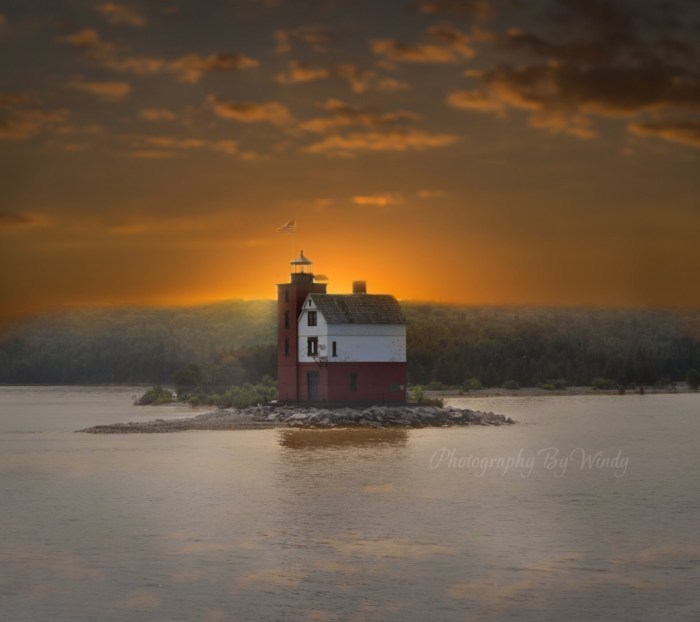
Sunset at Round Island

Lighthouse by Windy

Lighthouse by Windy

The Round Island Lighthouse Preservation Society tells us:

Round Island Lighthouse was constructed in 1895 at a cost of $15,000 by Frank Rounds, a carpenter from Detroit. Rounds had previously worked on Mackinac Island’s Grand Hotel, which was completed in 1887. The lighthouse was first lit on May 15th, 1896. It was commissioned under the U.S. Lighthouse Board, which became the United States Lighthouse Service in 1910. When it was first completed, the lighthouse was brick red. This would remain so until it was painted red and white in 1924. The fog signal at the lighthouse was installed in the fall of 1896. William Marshall was the first keeper of the lighthouse and served until 1906.

The beacon was automated in 1924 and became the responsibility of the United States Coast Guard in 1939, when the Coast Guard took over all of the nation’s lighthouses. To support World War II efforts, most of the original machinery on the first floor was removed for scrap. The structure was whitewashed in 1939.

When an automated light was constructed off the shore of Mackinac Island in 1947, the Coast Guard abandoned and decommissioned Round Island Lighthouse. A few years later, becoming tired of maintenance on the unused structure, the Coast Guard recommended that the lighthouse be demolished. Luckily the lighthouse was transferred to Hiawatha National Forest in 1958 and saved from its fate of destruction. For more information on the Hiawatha National Forest, visit the United States Forest Service website.

Since the lighthouse was abandoned, the lighthouse was a target for vandals. Also, without upkeep, the outside was feeling the effects of the Great Lakes and was starting to deteriorate away. On October 20th, 1972, a fierce storm knocked down part of the southwestern corner of the lighthouse. If it wasn’t for local preservationists, the lighthouse would have met its end.

You can read more of the history and preservation efforts right here.

Windy took this back in 2015. See more in her Other gallery on Flickr.

Support Michigan in Pictures with Patreon

Round Island Run

Ferry & lighthouse

Round Island, MI, photo by Bill Johnson

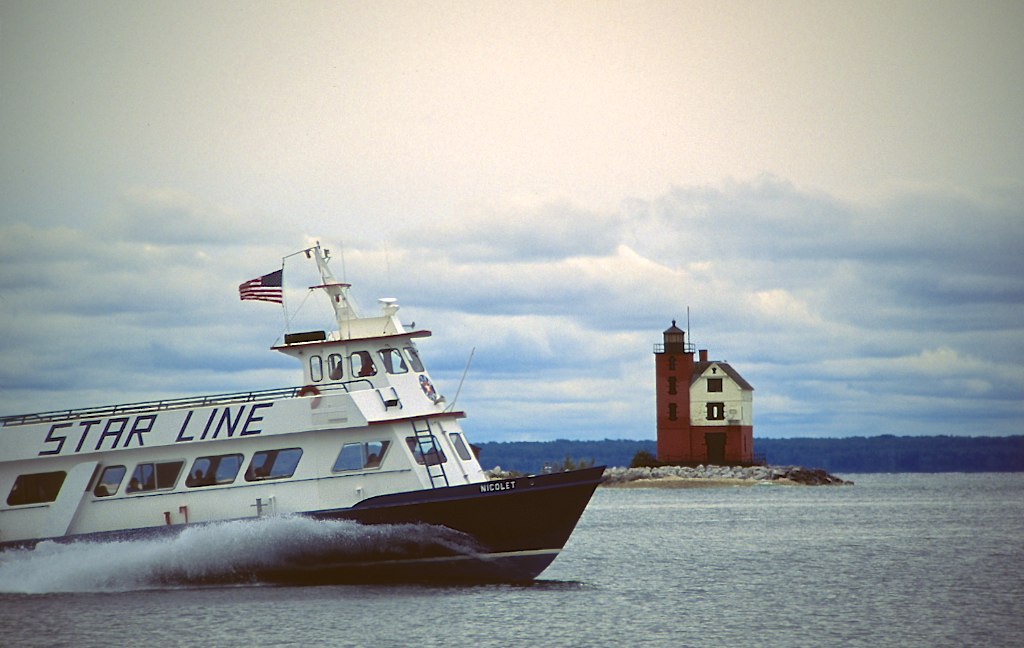
Bill took this photo 21 years ago on September 21, 1995! It shows the Star Line Ferry’s Nicolet speeding past the Round Island Lighthouse. Star Line explains:

Star Line Ferry was started by Tom Pfeiffelmann, Sam McIntire, and others in the late 1970s. They purchased Argosy Boat Line. The company was then renamed Star Line after the 5 original stockholders making up a 5 pointed star. At that time they operated slower ferries including the Nicolet, Treasure Islander and Flamingo.

In 1979 Star Line bought their first fast ferry, Marquette. Over the next few years the old LaSalle and Nicolet were replaced with sisters to the Marquette. In 1987 Star Line decided to take it up a notch with Radisson, an 85-foot fast ferry which was modeled after a luxury yacht.

View Bob’s photo background big and see more in his Lighthouses slideshow.

PS: Check out this cool yesterday and today at Round Island Lighthouse on Michigan in Pictures!

Mackinac’s Round Island Passage Light is for sale

Somewhere in Light

Somewhere in Light, photo by Kristina Austin Scarcelli

mLive reports that the Government Services Administration is taking bids from nonprofit or community groups to take stewardship of the Round Island Passage Light before auctioning it off. Click through for all the details.

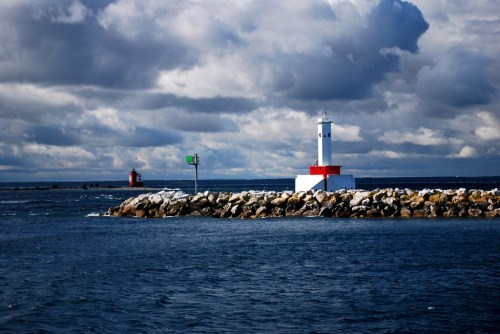
Lighthouse Friends has a page on the Round Island Passage Lighthouse that includes the entry from the 1948 Coast Guard Bulletin on this light that replaced the Round Island Lighthouse (in the background on the left):

The substructure of the new lighthouse, 56 feet square up to the 1 foot line below mean low water, is a timber crib with cells at the perimeter filled with concrete and internal cells filled with 5-inch to 14-inch rock. The superstructure is concrete with a reinforced concrete deck. It has four vertical and four sloping sides, giving the lighthouse a new and unusually trim appearance. The tower is appropriately ornamented on each side with a 4- or 5-foot Indian Head plaque, symbolic of the area.

But the most interesting thing about Round Island Passage Light Station is its main light. Located in the top section of the 41 ½-foot tower, it is indeed a departure from the “single light source” arrangement that has been in use for centuries. This new light apparatus is a solid bank of sealed beam lamps of 3,000 candlepower which produce a characteristic of occulting green every 10 seconds. It is visible 16 miles. (These sealed beam lamps are similar to your present day automobile headlights.)

The fog signal consists of two air operated diaphragm horns, sounding simultaneously with 3 seconds blast and 27 seconds silence. The radiobeacon is class B. Distance finding is also provided.

The passage between Mackinac Island and Round Island has long been regarded as extremely hazardous. It is now adequately guarded by Round Island Passage Light Station. This will result in a saving of time on trips and will relieve the congestion of Poe Reef Channel. This, in turn, will increase Great Lakes’ tonnage.

View Kristina’s photo bigger and see more in her Michigan Lighthouses slideshow.