The Cutting Room Floor

God and Automobiles

God and Automobiles, photo by g. s. george.

Yesterday on Absolute Michigan we featured Generation Y Michigan, a project of Michigan Radio that is probing why young adults leave Michigan (or buck the trend and choose to stay). While poking around, I found an engaging feature by Colleen Hill of Pixelgawker that features the photography of Geoff George (a regular on Michigan in Pictures). It’s titled Editors and Image Makers: On Photographing Detroit, Part 1 and begins:

One of the most important jobs in the media, that of the editor, often goes unseen. A well-edited film is seamless in its delivery. There are no awkward cuts or pauses, and the plot transcends time and distance effortlessly. Recently Detroit has been a prime topic of interest both in the national media and in film. With the copious number of photographs and footage of the city circulating the Internet and television, I can’t help but wonder, what is the edited version of Detroit that resides in the minds of the most of Americans? What are the parts left behind on the cutting room floor?

Read on for a lot more! About the photo above, Geoff writes:

This is the memorable and ironic view that greets every motorist traveling south on I-75 towards downtown. Thousands of these motorists are surely suburban GM workers on their way to work every day, and the irony of this chance alignment is hopefully not lost on them. In the background, the Renaissance Center, Detroit’s tallest building and GM World Headquarters. In the foreground, St. Josaphat, a 105-year old still-functioning relic from Detroit’s heyday. Detroit is the Motor City, but the sins committed here cannot be forgotten or forgiven–from the hundreds of murders every year to the construction of a freeway system that divided and destroyed vibrant and working neighborhoods. Hopefully this image will one day have different associations.

For me, it is a powerful view that is quintessentially Detroit. I’m sure it’s been photographed hundreds of times, but the balance and contrast between Detroit’s largest and most infamous glass skyscraper, a struggling community church, and the freeway that cut a swath across the city and acted as a runway for white flighters provides me with endless fascination. I hope you will find it equally stimulating.

You can see a whole lot more in Geoff’s the city on the strait: detroit set (slideshow).

the city on the strait: detroit

72nd floor / 2008 fireworks

72nd floor / 2008 fireworks, photo by g. s. george.

Geoff took this from the 72nd floor of the Renaissance Center during the Detroit River Days fireworks (formerly Detroit International Freedom Festival). He explains that we’re looking down onto the Detroit River, Hart Plaza and Jefferson Avenue. The entrance to the Detroit-Windsor tunnel is seen at the very bottom. In the distance, the Ambassador Bridge spans the Strait of Detroit. Windsor, Ontario Canada can be seen behind the fireworks at far left.

Geoff is obviously one of the many photographers who have a deep love for Michigan’s largest city. Introducing his the city on the strait: detroit set (slideshow) he writes:

a city without bounds, connected to the world and to its vast country by an aquamarine strait nestled between five of the world’s largest freshwater lakes. its capital, industry, and population developed so rapidly that it imploded under the pressure of social strife, and today Detroit stands as a living urban document of the capabilities–and failures–of the American people. But the city chugs along, and its million-odd residents continue to embrace the city’s many cultural and historical vestiges–those links to the past that may, one day, be used to revitalize and reignite the city’s vibrancy and industrial prowess. already signs of that reemergence have appeared, and its only a matter of time before these majestic structures, occupied and abandoned, end up as a pile of rubble or an icon.

Michigan in Pictures has some more Detroit Freedom Festival fireworks pics (from 2006).

metropolis

Metropolis

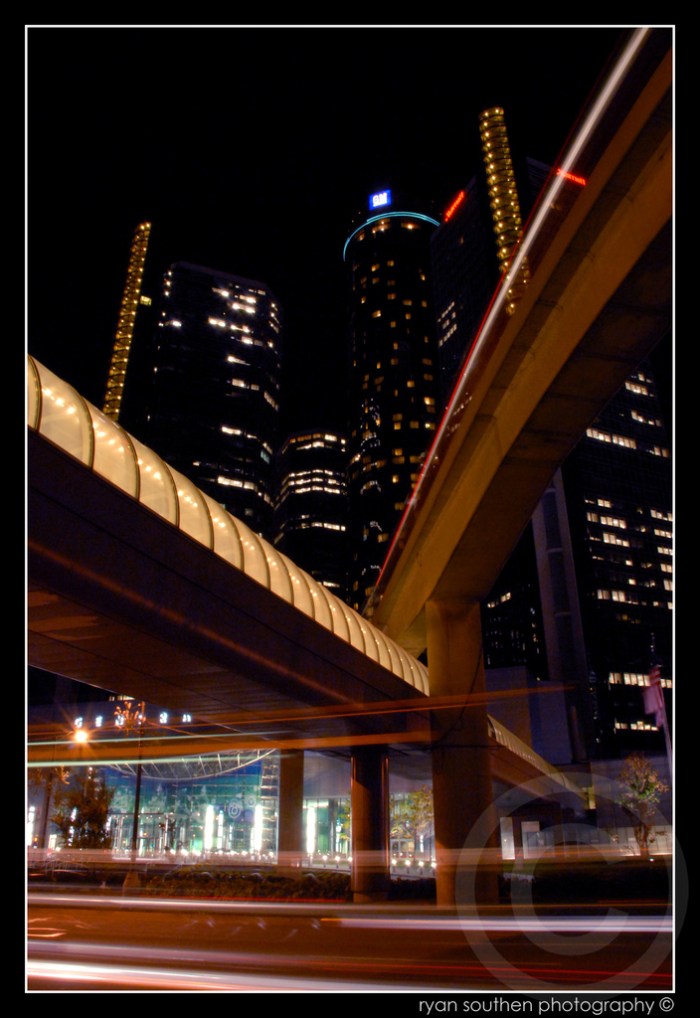
metropolis, photo by SOUTHEN.

Ryan writes:

This is the Renaissance Center in Detroit. The views of this place across Jefferson Avenue often have a futuristic look to them, especially at night. I like the streaks of the cars in the foreground with the streak of the people mover from above on the track.

You can metropolis on black and see other photos from his Nights in DETROIT set (slideshow). He has photos for sale through his Ryan Southen Photography web site.

“Detroit” and “Night” reminds me that there’s something to do with Detroit photography tonight.

Danny Lane’s sculpture ‘Borealis’ at the Renaissance Center

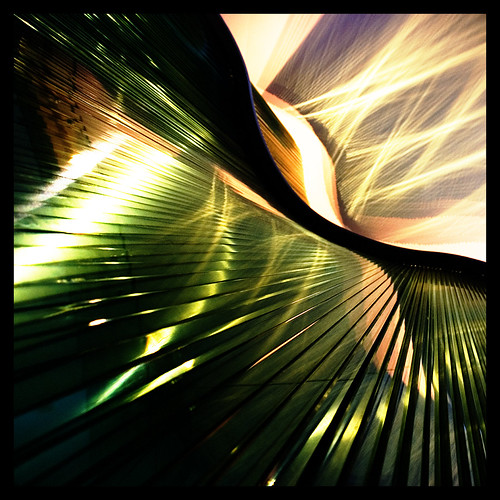
Reflective Distortion

Reflective Distortion, photo by rckrawczykjr.

Ralph writes: Detail of a glass wall within the entrance space of the Renaissance Center with a happy little cross process filter applied for good measure.

The wall is part of the Danny Lane sculpture Borealis. As the Kinetic Curtain in Glass Magazine explains, Borealis is one of the largest glass sculptures in the world:

Borealis comprises two enormous walls of undulating glass that measure 47 and 50 feet long, and weigh nearly 50,000 pounds each. A single wall contains about 1,100 43-pound panels of annealed float glass (auto safety glass of course) 4 inches wide, 11⁄2 inches thick and 221⁄2 feet long. The panels stand on end side-by-side and lean at different angles up to 71⁄2 degrees from center to create a wave effect. If laid end-to-end, the panels would extend 9.4 miles.

The article is pretty interesting and details the engineering challenges in building this amazing work of art. You can also see more from Danny Lane at his web site.

Renaissance

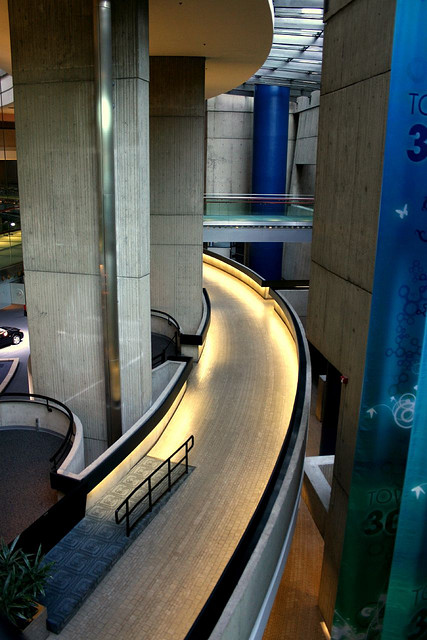
Renaissance, photo by irinuchka.

…in the Renaissance Center, Detroit.

Kind of amazing what can be accomplished when you try to accomplish something amazing. More at Detroit Marriott at the Renaissance Center from SkyscraperPage.com, Renaissance Center from Wikipedia and Flickr’s RenCen slideshow.