Fledge Season & Great Horned Owlets

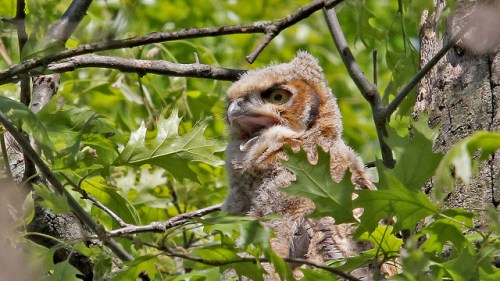
Great Horned Owlets

Great Horned Owlets, photo by Kevin Povenz

April is the season for owls to fledge, or learn to fly. The Raptor Education Group from over in Wisconsin has a page about owlets that includes what to do if you come across one of these cute balls of fluff on the ground:

Great-horned Owls do not build their own nest. Instead, they choose an old nest of a crow, hawk, or even a squirrel to call their own.

When the young owls are 6-8 weeks old, they begin to venture from their nest. This is before they can actually fly. Nature’s method provides owlets opportunities to develop their leg muscles that will very soon be catching their own prey. In a natural setting owlets that appear to have fallen from their nest actually have fledged. In a natural wooded area, bushes and smaller trees provide a ladder of sorts and allow the chicks to climb to a higher perch until they can fly. When owls nest in a city with concrete below them rather than a soft forest floor, problems arise. That is also the case with a well-manicured park or lawn setting that has nothing that can function as a ladder for the tykes.

…If you find a young owl, leave it where it is, unless it is in imminent danger. Give us a call and let us help you decide if the adults are in attendance and the chick is just fledging naturally or if there is something wrong with the little one. Remember, owls are nocturnal for the most part and are not easy to see during daylight hours. Mom and dad could be very close and yet be so well camouflaged they are hard to see.

Michigan in Pictures has a feature on Great Horned Owls with a lot more about these birds!

View this on black, check out more from Kevin on Michigan in Pictures and definitely have a look at his great Birds of Prey slideshow.
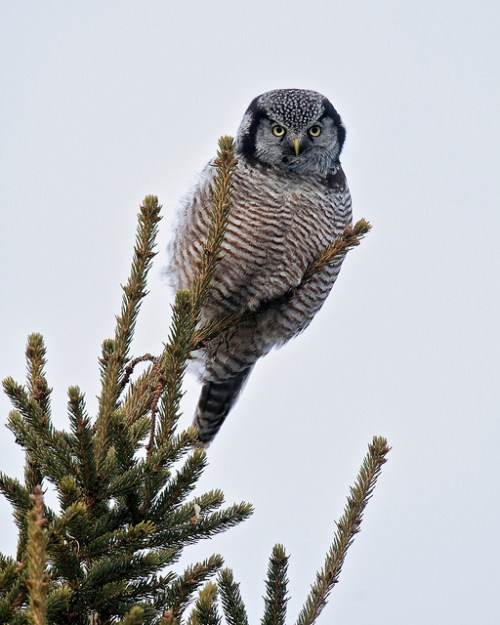
Northern Hawk Owl, and the NMC Hawk Owls

northern hawk owl, chippewa county, michigan

northern hawk owl, chippewa county, michigan, photo by twurdemann

Northwestern Michigan College here in Traverse City has just under 5000 students and is turning from a 2 year to a 4 year college. As part of this, they will be adding athletics again, and that means they need a mascot. So this week they selected a new one – the NMC Hawk Owls.

With a weight of half a pound to a pound, a length of just 14-16″ and a wingspan of just under 2 1/2 feet, the Northern Hawk Owl appears to be the perfect mascot:

Northern Hawk Owl – Surnia ulula at OwlPages.com:

Hunting & Food: Takes mainly small mammals as prey, mostly lemmings and voles. Will also take birds, frogs and occasionally fish. Prey weight is normally below 70g. Hunts by searching from a lookout, then quickly flying to swoop down on prey. Has been observed hovering also.

Breeding: Male advertises potential nest sites, and the female selects one. Nests in Cavities on top of broken trunks, natural tree hollows, abandoned holes of large woodpeckers. Will accept nest boxes, and occasionally use a stick nest of a larger bird. Laying normally occurs in April and the first half of May. Clutch sizes are usually between 5 and 13 eggs, each 36-44mm  x 29-34.4mm. Eggs are laid at 1-2 day intervals, and incubated by the female alone for 25-30 days. During this time, the male feeds the female.

Northern Hawk-Owl at Wikipedia:

The Northern Hawk-Owl has been said to resemble a hawk in appearance and in behavior. In North America, its appearance in flight is often considered similar to a Cooper’s Hawk (Accipiter cooperii). It has been suggested that this may be because the Hawk-Owl may partially fill an important diurnal niche similar to that of day hunters such as hawks.

…Northern Hawk Owls are unevenly distributed and highly variable throughout the boreal forest. They live mostly in open coniferous forests, or coniferous forests mixed with deciduous species such as larchbirchpoplar, and willow. They are found in muskegs, clearings, swamp valleys, meadows, or recently burnt areas, and generally avoid dense spruce-fir forests. Winter habitat is usually the same as breeding habitat. 

Northern Hawk Owl at All About Birds adds that their International conservation status is Least Concern and some cool facts:

  • The Northern Hawk Owl can detect prey by sight at a distance of up to 800 meters (half a mile).
  • Though it is thought to detect prey primarily by sight, the Northern Hawk Owl can find and seize prey under 30 cm (1 foot) of snow.

The Whitefish Point Bird Observatory adds that Northern Hawk Owl were observed yesterday in Trout Lake and Dryburg, Michigan.

Grabbing a mouse through a foot of snow? That’s a seriously scary predator … at least if you’re the prey. Click all those links to explore photos, calls and more about these tiny terrors.

Check this photo from Chippewa County out on black and see more including another shot of this owl in twurdemann’s Birds slideshow.

More owls (and also apparently words that end with owl) on Michigan in Pictures.


Before we were owls

10

10, photo by Sherri & Dan

The Great Horned Owl article on Michigan in Pictures is stocked with all kinds of information about what this little guy will grow up to be (Sherri & Dan also took that photo). Also see Bubo virginianus (great horned owl) on the University of Michigan Animal Diversity Web and check out this video of three little horned owlets.

See this photo background big and and follow this owl’s growth in  Sherri & Dan’s owls slideshow.

Snowy Owl Irruption in Michigan

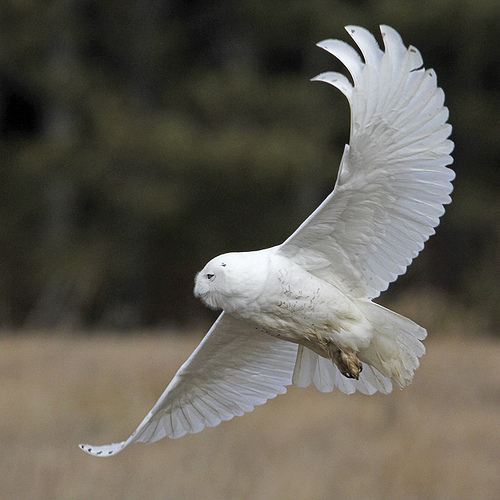
Snowy Owl (Bubo scandiacus)_0314_1

Snowy Owl (Bubo scandiacus)_0314_1, photo by johndykstraphotography.

We’ve been seeing a lot of snowy owls this winter in the Absolute Michigan pool on Flickr. These 2′ birds are native to the Arctic tundra, but they’ve been sighted in large numbers in Michigan this winter. Snowy owls flock to Mich. in unusual numbers in USA Today explains:

Scientists say the likely reason for the explosion is that the owls’ chief food source, small animals called lemmings, was abundant last summer, allowing the adults to raise more young. Now, in search of food, young owls are heading farther south.

Although there are a few snowy owls spotted in Michigan every year, “I can tell you this winter is highly unusual,” said Karen Cleveland, bird biologist with the Michigan Department of Natural Resources.

…The phenomenon is called an irruption, an invasion of birds in unusual places or in high numbers. It usually occurs because of a lack of food in the birds’ home territory.

They even talk with photographer Stacy Niedzwiecki about her snowy owl photos, which we featured on Michigan in Pictures a few months ago!

The Snowy Owl page at All About Birds notes that they are the northernmost, heaviest, and most distinctively marked owl of North America, and that an individual adult Snowy Owl may eat three to five lemmings per day, or up to 1,600 per year! While this irruption means that there are many more owls than usual in Michigan, they are a common wintertime visitor.

John captured this owl in Muskegon County earlier this month. See it bigger and see more in his Snowy Owl slideshow.

More Michigan birds on Michigan in Pictures!

Under the Gaze of an Owl

Gaze 3903-11

Gaze 3903-11, photo by StacyN – MichiganMoments

This month has been pretty owl heavy. More about the Snowy Owl from November 2008 on Michigan in Pictures.

Stacy says that this was her first wild snowy owl sighting. She spent all afternoon watching it and is in LOVE. See it bigger and see all her shots from this encounter in her The Visitor slideshow.

Owls in the Attic

Attic, Clare Michigan.

Attic, Clare Michigan. , photo by matthew_michalek.

I posted this photo to the Michigan in Pictures Facebook yesterday with the comment “It’s not all sunsets and lighthouses. ;)” A reader thought it a little strange and wondered “why not show a live one?”

That’s a good question for which I have a few answers.

One is that Michigan in Pictures has a number of posts about owls including a snowy owl on the roof, Northern Saw Whet Owl (and an owl house you can build for one), the Evening Owl, Marsh Owl, Short-eared owl and a live version of this owl, the Great Horned Owl (Bubo virginianus) aka tiger owl or cat owl.

A second reason is that while I am a huge fan of Pure Michigan and the gorgeous photography they share, I’m also a big fan of the strange and wonderful bits of history you can find all over the state in our quirky little museums, second hand stores, attics, basements and (of course) garage sales. When I see a photo like this I wonder how the owl got there. Was it purchased at the Call of the Wild museum in Gaylord or did it simply die of old age?

The final reason is that the experience of Michigan and Michigan in Pictures is (for me at least) one of discovery. I delight in odd finds like the Big Boy Graveyard, old slumpy in Detroit, Lake Michigan’s “Stonehenge” and the crazy things that I find in the Library of Congress and that people like the folks at FOUND magazine in Ann Arbor and daveraoul find in the corners of reality that we often miss.

What do you think? Let me know in the comments…

Check this out on black and in Matt’s slideshow.

You can build a home for little raptors like the Northern Saw Whet Owl!

saw whet owl

saw whet owl, photo by Sherri & Dan.

My friend Michael told me about Ned the Saw Whet Owl, an avian ambassador that Rebecca Lessard of the nonprofit Wings of Wonder is using to tell folks about nest boxes that you can build for small raptors (pdf). Ned is just 7″ tall and belongs to the smallest species of owl native to Michigan. Click Ned’s link above to see just how tiny he is!

This home will also house a screech owl and another bird recently featured – the American Kestrel (Michigan’s smallest raptor).

The Owl Pages have this to say about the Northern Saw-whet Owl – Aegolius acadicus:

European explorers first discovered this Owl in a North American colony called Acadia (now Nova Scotia). The Latinised word “acadius” refers to this territory. The common name “Saw-whet” comes from these Owls unique calls described below. The Saw-whet Owl is also called Acadian Owl, blind Owl, Kirkland’s Owl, the saw-filer, the sawyer, sparrow Owl, white-fronted Owl, Farmland Owl, Little Nightbird, Queen Charlotte Owl, and even the Whet-saw Owl.

The Northern Saw-whet Owl is a very small, short-bodied, Owl with a relatively short tail. The overly large head has no ear tufts and may appear distorted due to an asymmetrical skull. They look small when perched and tend to shuffle their feet, but in flight appear larger because of their broad wings.

…Northern Saw-whet Owls are strictly Nocturnal, with activity beginning at late dusk. During the day, they depend on plumage for camouflage when roosting in foliage, usually close to the ground.

You can hear their call at the link above and learn more at Wikipedia and All About Birds who explain that their defense upon discovery is to sit still and not fly, leading people to perceive them as “tame.”

Check this out way bigger than a saw whet owl and in Sherri & Dan’s slideshow. They took the shot at Whitefish Point Bird Observatory – read more at that link!

Many more Michigan birds on Michigan in Pictures.