
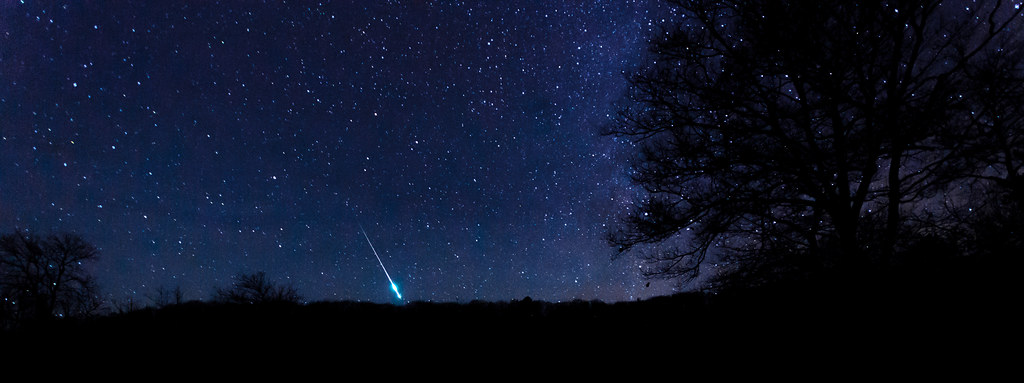
Bolides & Electrophonic Sounds by Aaron Springer
While much of Michigan was shrouded in clouds for the peak of the Orionids, the October meteor shower will still be producing a lot of meteors for the next few days. As you are watching the skies, you may hear sounds that have been reported along with meteors for millenia, and dismissed for the same amount of time by such luminaries as Edmund “The Comet Guy” Halley. This Space.com article says that you might be able to believe your ears that meteors can make hissing sounds:
These faint sounds are probably created when bright pulses of light from the meteors heat up certain objects on the ground below, a new study reports. These objects — for example, leaves or hair — radiate thermal energy into the nearby air, producing pressure waves that generate a variety of sounds.
“I think our answer is pretty solid,” said study co-author William Sweatt, a researcher at Sandia National Laboratories in New Mexico.
The mysterious sounds are associated with very bright fireballs, meteors that blaze up at least as intensely as the full moon shines in the sky. Generally, an incoming object must weigh 1.1 lbs. (0.5 kilograms) or more to make noise audible to humans, Sweatt said.
The faint, whispery sounds have been described in many different ways by people who have heard them; popping, sizzling, rustling and hissing are commonly employed adjectives. And hearing them is a rare treat indeed. “I think a person’s lucky if they get one per lifetime,” Sweatt told Space.com.
You can read more & check out the video below. A very cool twist on the story for me is that a friend shared my experience of hearing the sounds with today’s photographer Aaron Springer when he shared this back in November of 2015. Aaron referenced the American Meteor Society’s theories on the sounds which appear to have been correct!!
Another form of sound frequently reported with bright fireballs is “electrophonic” sound, which occurs coincidentally with the visible fireball. The reported sounds range from hissing static, to sizzling, to popping sounds. Often, the witness of such sounds is located near some metal object when the fireball occurs. Additionally, those with a large amount of hair seem to have a better chance of hearing these sounds. Electrophonic sounds have never been validated scientifically, and their origin is unknown. Currently, the most popular theory is the potential emission of VLF radio waves by the fireball, although this has yet to be verified.
Head over to Aaron’s Flickr for his latest & don’t forget to look up!!


 Michigan in Pictures