Northern Lights: Ancient Aliens Edition

Northern Lights Ancient Aliens Edition

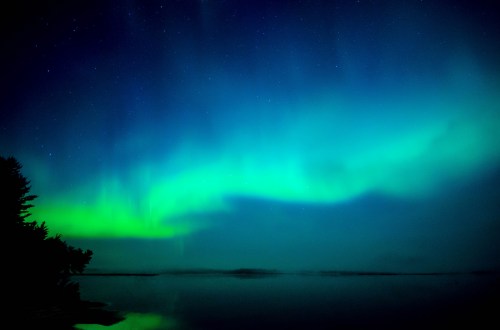
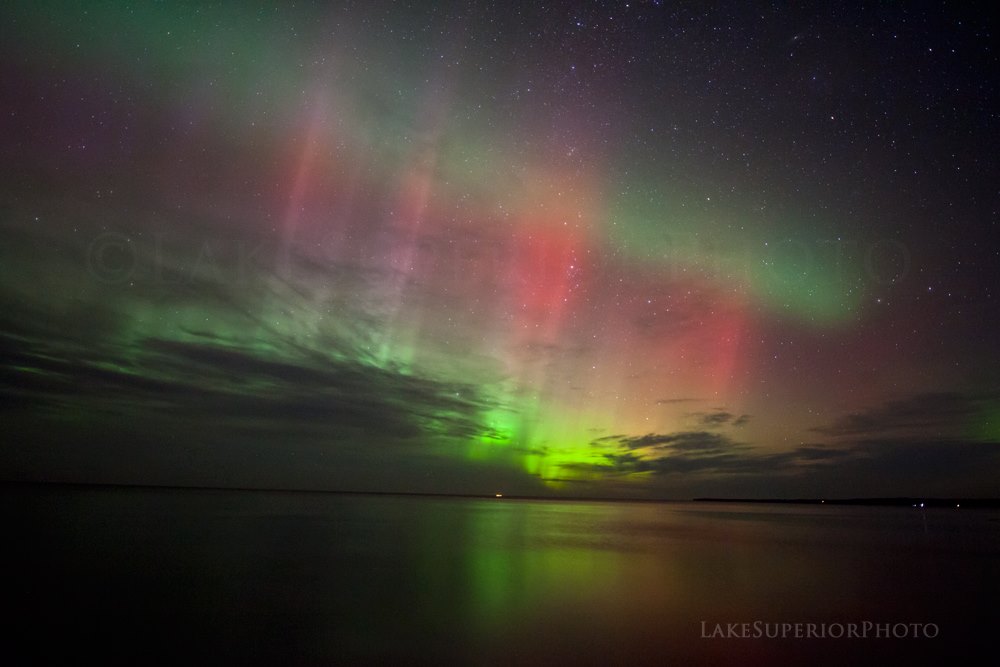
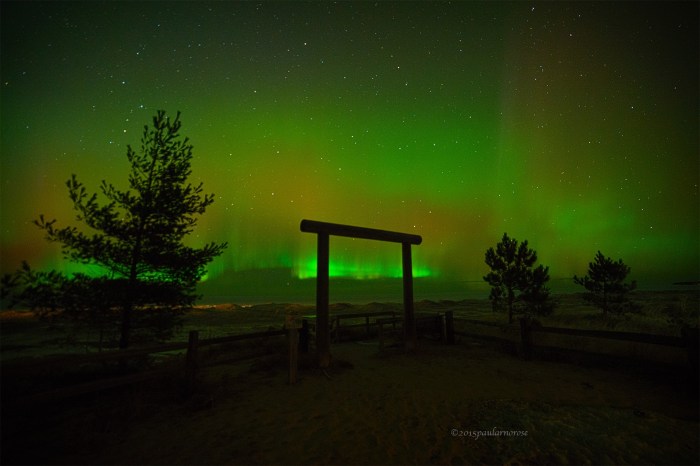
Northern Lights over Lake Lake Superior, photo by Paul Arno Rose

NOAA’s Space Weather Prediction Center is THE place to go for forecasting of likely northern lights activity. Yesterday they held a press conference regarding the G4 storm (on a scale of 1-5) that was caused by two magnetic eruptions on March 15 that combined to form a single wave producing the biggest storm so far of Cycle 24.

Their page on Geomagnetic Storms explains:

A geomagnetic storm is a major disturbance of Earth’s magnetosphere that occurs when there is a very efficient exchange of energy from the solar wind into the space environment surrounding Earth. These storms result from variations in the solar wind that produces major changes in the currents, plasmas, and fields in Earth’s magnetosphere. The solar wind conditions that are effective for creating geomagnetic storms are sustained (for several to many hours) periods of high-speed solar wind, and most importantly, a southward directed solar wind magnetic field (opposite the direction of Earth’s field) at the dayside of the magnetosphere. This condition is effective for transferring energy from the solar wind into Earth’s magnetosphere.

The largest storms that result from these conditions are associated with solar coronal mass ejections (CMEs) where a billion tons or so of plasma from the sun, with its embedded magnetic field, arrives at Earth. CMEs typically take several days to arrive at Earth, but have been observed, for some of the most intense storms, to arrive in as short as 18 hours. Another solar wind disturbance that creates conditions favorable to geomagnetic storms is a high-speed solar wind stream (HSS). HSSs plow into the slower solar wind in front and create co-rotating interaction regions, or CIRs. These regions are often related to geomagnetic storms that while less intense than CME storms, often can deposit more energy in Earth’s magnetosphere over a longer interval.

Storms also result in intense currents in the magnetosphere, changes in the radiation belts, and changes in the ionosphere, including heating the ionosphere and upper atmosphere region called the thermosphere. In space, a ring of westward current around Earth produces magnetic disturbances on the ground. A measure of this current, the disturbance storm time (Dst) index, has been used historically to characterize the size of a geomagnetic storm. In addition, there are currents produced in the magnetosphere that follow the magnetic field, called field-aligned currents, and these connect to intense currents in the auroral ionosphere. These auroral currents, called the auroral electrojets, also produce large magnetic disturbances. Together, all of these currents, and the magnetic deviations they produce on the ground, are used to generate a planetary geomagnetic disturbance index called Kp. This index is the basis for one of the three NOAA Space Weather Scales, the Geomagnetic Storm, or G-Scale, that is used to describe space weather that can disrupt systems on Earth.

During storms, the currents in the ionosphere, as well as the energetic particles that precipitate into the ionosphere add energy in the form of heat that can increase the density and distribution of density in the upper atmosphere, causing extra drag on satellites in low-earth orbit. The local heating also creates strong horizontal variations in the in the ionospheric density that can modify the path of radio signals and create errors in the positioning information provided by GPS. While the storms create beautiful aurora, they also can disrupt navigation systems such as the Global Navigation Satellite System (GNSS) and create harmful geomagnetic induced currents (GICs) in the power grid and pipelines.

Lots more including the ability to sign up for space weather alerts at www.swpc.noaa.gov. Also head over to the NOAA Auroras group on Flickr to share your photos.

View Paul’s photo background bigtacular and check out more of his photography on his Facebook page.

More northern lights photos & info on Michigan in Pictures.
Wearing o’ the Green (Aurora)

Wearing o the Green Aurora

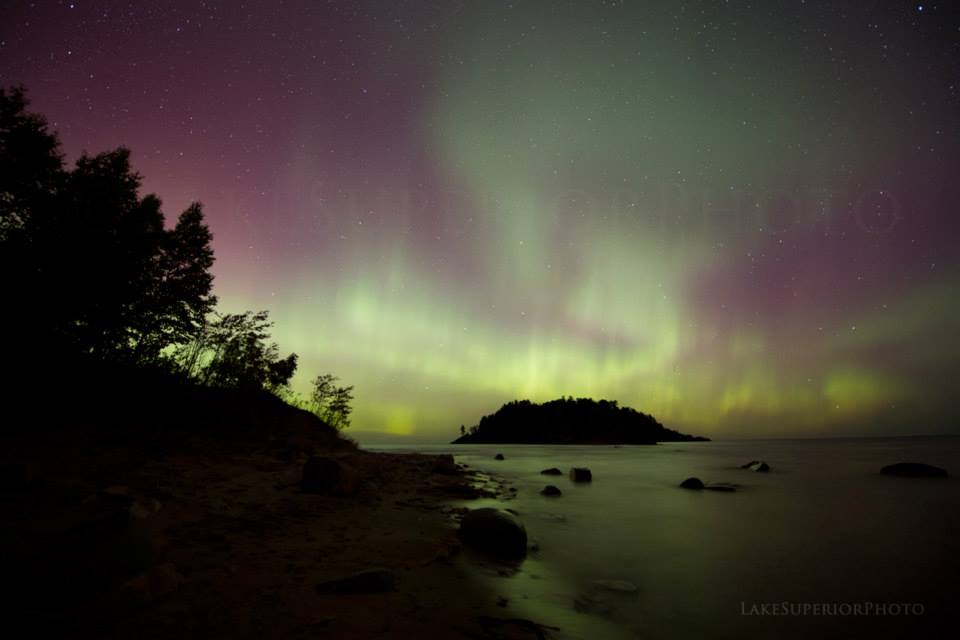
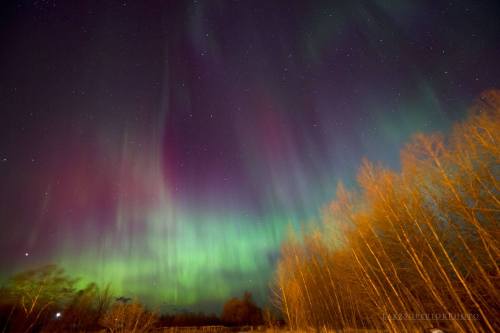
St. Patrick’s Day 2015 Northern Lights, photo by Lake Superior Photo

Shawn of Lake Superior Photo writes:

Some great auroras this morning, but it was very difficult to photograph, brutal wind- it’s still out and still dark, go look north

Click to view the photo background bigtacular after you go out and check!!

Call it the luck of the Irish for early risers! Stay safe and happy St. Patrick’s Day everyone.


A Conflagration of Storms: The March 13, 1989 Solar Storm

Conflagration of Storms

Northern Lights, photo by Stephen Tripp

Intense colors from the rare Great Aurora painted the skies around the world in vivid shapes that moved like legendary dragons. Ghostly celestial armies battled from sunset to midnight. Newspapers that reported this event considered the aurora, itself, to be the most newsworthy aspect of the storm. Seen as far south as Florida and Cuba, the vast majority of people in the Northern Hemisphere had never seen such a spectacle. 
~Dr. Sten Odenwald

I like to revisit this March 13, 1989 incident documented by Dr. Odenwald in A Conflagration of Storms. In addition to being an amazing display of the aurora borealis, this solar storm took down Quebec’s power network and very nearly much more:

In many ways, the Quebec blackout was a sanitized calamity. It was wrapped in a diversion of beautiful colors, and affected a distant population mostly while they slept. There were no houses torn asunder, or streets flooded in the manner of a hurricane or tornado. There was no dramatic footage of waves crashing against the beach. There were no cyclonic whirlwinds cutting a swath of destruction through Kansas trailer parks. The calamity passed without mention in the major metropolitan newspapers, yet six million people were affected as they woke to find no electricity to see them through a cold Quebec wintry night. Engineers from the major North American power companies were not so blasé about what some would later conclude, could easily have escalated into a $6 billion catastrophe affecting most U.S. East Coast cities. All that prevented 50 million more people in the U.S. from joining their Canadian friends in the dark were a dozen or so heroic capacitors on the Allegheny Power Network.

The Media seemed to have missed one of the most human impacts of the beautiful aurora they so meticulously described in article after article. Today the March 1989 ‘Quebec Blackout’ has reached legendary stature, at least among electrical engineers and space scientists, as an example of how solar storms can adversely affect us. It has even begun to appear in science textbooks. Fortunately, storms as powerful as this really are rather rare. It takes quite a solar wallop to cause anything like the conditions leading up to a Quebec-style blackout. When might we expect the next one to happen? About once every ten years or so, but the exact time is largely a game of chance.

Call it the ultimate Friday the 13th! The whole book The 23rd Cycle:Learning to live with a stormy star is available online, and you can read a lot more from Dr. Odenwald at his website, The Astronomy Cafe or at facebook.com/AstronomyCafe.

View Stephen’s photo bigger and see more in his excellent Northern Lights slideshow.

A whole lot more northern lights on Michigan in Pictures!

PS: Keep an eye on solar storminess and get heads up notifications when the northern lights might be visible at NOAA’s Space Weather Prediction Center.

Space Weather and Starbreeze

Isle Royale Star Breeze

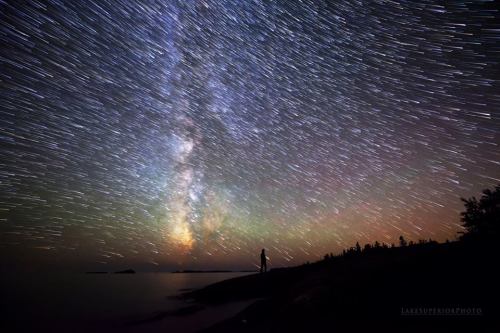
Isle Royale starbreeze, photo by Shawn Malone/Lake Superior Photo

If you’re a watcher of the northern lights or want to be, NOAA’s Space Weather Projection Center at spaceweather.gov is a resource you should be aware of. It’s packed full of all kinds of data on what’s happening on the sun and how that impacts us here on earth.

Yesterday they updated to an all-new site that I encourage you to check out. The coolest things I found so far are the Space Weather Enthusiast Dashboard and the 30 minute aurora forecast, a seriously awesome visualization of aurora potential. Be sure to subscribe to their space weather alerts for tips on when the aurora borealis might be visible!

Shawn says that the stars were screaming that night at Isle Royale National Park. View her photo bigger on the Lake Superior Photo Facebook, and if you like you can purchase the photo right here. And speaking of northern lights, be sure to click for a time-lapse of the aurora over Isle Royale with a very cool soundtrack she recorded of loons on the island.

More northern lights and more Isle Royale on Michigan in Pictures.

Heavy Space Weather Ahead?

Frigid Auroras Over Superior

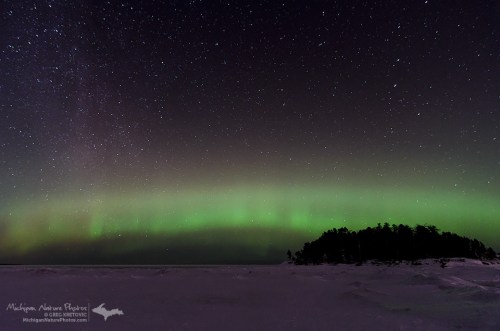
Frigid Auroras Over Superior, photo by Michigan Nature Photog

NOAA’s current space weather forecast reports an M Class (moderate) solar flare from solar region AR2002. Spaceweather.com adds that AR2002 has destabilized its magnetic field, making it more likely to erupt, and that NOAA forecasters are estimating a 60% chance of M-class flares and a 10% chance of X-class flares during the next 24 hours. X-class flares are major solar events that can spawn incredible auroras visible far to the south of us, planet-wide radio blackouts and long-lasting radiation storms. Click to Space Weather for a video of AR2002 development.

While there’s not much chance of a major event, I thought it was interesting that 25 years ago this week,  one of the most significant solar storms in memory created a spectacle in the skies as it demonstrated the power and danger of solar weather to modern society. A Conflagration of Storms begins:

On Thursday, March 9, 1989 astronomers at the Kitt Peak Solar Observatory spotted a major solar flare in progress. Eight minutes later, the Earth’s outer atmosphere was struck by a wave of powerful ultraviolet and X-ray radiation. Then the next day, an even more powerful eruption launched a cloud of gas 36 times the size of the from Active Region 5395 nearly dead center on the Sun. The storm cloud rushed out from the Sun at a million miles an hour, and on the evening of Monday, March 13 it struck the Earth. Alaskan and Scandinavian observers were treated to a spectacular auroral display that night. Intense colors from the rare Great Aurora painted the skies around the world in vivid shapes that moved like legendary dragons. Ghostly celestial armies battled from sunset to midnight. Newspapers that reported this event considered the aurora, itself, to be the most newsworthy aspect of the storm. Seen as far south as Florida and Cuba, the vast majority of people in the Northern Hemisphere had never seen such a spectacle. Some even worried that a nuclear first-strike might be in progress.

…Millions marveled at the beautiful celestial spectacle, and solar physicists delighted in the new data it brought to them, but many more were not so happy about it.

Silently, the storm had impacted the magnetic field of the Earth and caused a powerful jet stream of current to flow 1000 miles above the ground. Like a drunken serpent, its coils gyrated and swooped downwards in latitude, deep into North America. As midnight came and went, invisible electromagnetic forces were staging their own pitched battle in a vast arena bounded by the sky above and the rocky subterranean reaches of the Earth. A river of charged particles and electrons in the ionosphere flowed from west to east, inducing powerful electrical currents in the ground that surged into many natural nooks and crannies. There, beneath the surface, natural rock resistance murdered them quietly in the night. Nature has its own effective defenses for these currents, but human technology was not so fortunate on this particular night. The currents eventually found harbor in the electrical systems of Great Britain, the United States and Canada.

You can read on for more about how the storm spawned a power outage in Quebec and pushed US systems to the brink of collapse. If you want to totally geek out on auroral science, check this article out about how the Earth’s magnetosphere actually extends itself to block solar storms.

Greg took this shot in late February in Marquette in -17 temps! View his photo bigger and see more in his northern lights slideshow. You can purchase Greg’s pics at MichiganNaturePhotos.com.

There’s more science and much (much) more about the Northern Lights and Michigan on Michigan in Pictures.

How to see the Northern Lights in Michigan

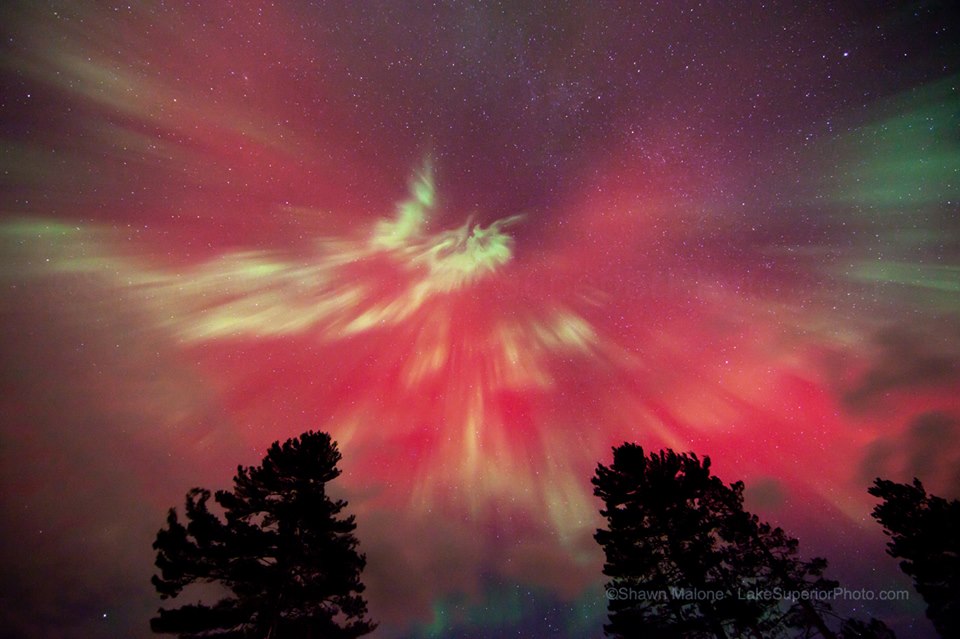
October Auroras by Shawn Malone

October Auroras by Shawn Malone/Lake Superior Photo

Just in! Shawn told me she just got in from shooting the northern lights last night – check her photo out right here and stay tuned to her Facebook for updates!

NOAA’s Space Weather Prediction Center reported this morning:

Earth is currently under the influence of a coronal mass ejection (CME) and G2 (Moderate) geomagnetic storming has been observed. This is likely the result of what was expected to be a near miss from an event originally observed on the 14th. This CME has a fairly well-organized magnetic field structure so continued G1 (Minor) to G2 (Moderate) storming is certainly possible. Stay tuned for updates as this event unfolds.

The Aurora Borealis was out last night, and I thought it a good time to share Shawn Malone’s Insider Secrets for Northern Lights that she wrote for the Pure Michigan Blog a couple of months ago:

Michigan has a lot of things going for it when it comes to northern lights viewing, the most important being 1). latitude  and 2). relatively low light pollution in many areas.  Northern Michigan sits in a great location latitude-wise, as the auroral oval dips further south on nights of stronger auroral activity.  The Upper Peninsula  is blessed with hundreds of miles of shoreline along the south shore of Lake Superior, which provides some of the best northern lights viewing in the lower 48 due to the very dark night skies.  When looking north over Lake Superior, one can see right down to the horizon and take in a 180 degree unobstructed view of the night sky.  Getting to a location without the obstruction of a treeline or hills is important at our latitude, as many times an auroral display will sit very low on the horizon. Having a dark night sky with little light pollution is necessary when looking for the northern lights, as the light of the aurora is equal to the brightness of starlight.

People often ask me how I’ve been able to see so many northern lights displays over the years and a lot of it has to do with what I mentioned above. I live in Marquette, Michigan which sits centered on the south shore of Lake Superior, and when looking north there’s nothing but lake for hundreds of miles. Marquette and locations nearby have many areas along the lakeshore still publicly accessible, allowing for the opportunity to view the aurora right from the shoreline.

If you’ve never seen the northern lights and want to maximize your opportunity to do so, learn and pay attention to sunspot activity, as that’s what drives the northern lights.

Read on for tips on where to catch these lights, some more photos from Shawn and her incredible, Smithsonian award-winning video Radiance.

View Shawn’s photo bigger on Facebook, follow her Lake Superior Photo page and if you get up to Marquette, check out the Lake Superior Photo Gallery on Front St in downtown Marquette!

Michigan in Pictures has a TON of Northern Lights information & photos that includes the science and stories of this incredible phenomenon.

Support Michigan in Pictures with Patreon

The month of the Pleiades … and legendary aurora borealis

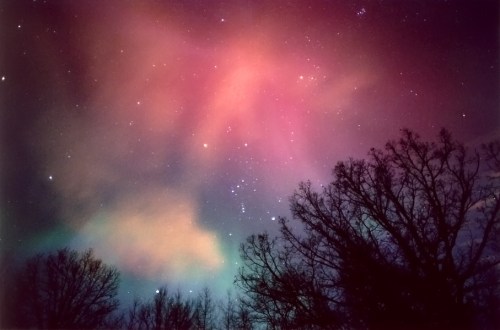
Orion Aurora

Orion Aurora, photo by Kevin’s Stuff

This EarthSky article on the Pleiades gives some great lore and viewing tips and says that:

In our Northern Hemispheres skies, the Pleiades cluster is associated with the winter season. It’s easy to imagine this misty patch of icy-blue suns as hoarfrost clinging to the dome of night. Frosty November is often called the month of the Pleiades, because it’s at this time that the Pleiades shine from dusk until dawn. But you can see the Pleiades cluster in the evening sky well into April.

You can read much more at EarthSky.org and also might want to check out this story of the Pleiades.

November is also the month of the Aurora, delivering some of the best northern lights action. Kevin took this photo during one of the best solar storms in the last several decades on November 10, 2004. He wrote the following (in part) after viewing these lights:

It was a Dark and (Solar) Stormy Night. Stormy with shafts and rays of light streaming from the heavens.

We all knew there was a chance of another auroral display tonight. We were waiting. And then around 10:30pm or so (from Grand Rapids), the wait was over. This time I went out with my brother, taking back roads and such until we finally found a great spot in northeastern Kent County. We ended up off Old Belding Rd on Lessiter Rd, which is on the way to the Grattan Raceway.

The road faced north, so we were shooting right down the middle of it. There were some clouds around to the north, but nothing too bothersome. Most of the action was to the northeast, with not much seen in the way of color except green, and an occasional red and blue. There were curtains, rays, shafts, and some really good pulsing going on.

I of course used my 35mm film camera, and my brother had his Canon Digital SLR. I was a tad pickier this time, and only shot 3 rolls by the time 1:30 rolled around, and it started to wane. Also, we were getting some clouds coming in, so we bailed.

On the way back to civilization, I noticed it was picking up again … I finally found a place a few miles down the road with a good northern horizon, and set up the camera again.

Oh… My… God. The curtains! The pulsing rays!! The pulsing shafts of light as they flickered up the magnetic lines of force to the corona. I was seeing pulsating shafts from the south!! All of them converging near Orion, forming another spectacular corona. I shot, moved the camera, and shot again. Always looking for the best display, and ever mindful to watch for composition (at least I was keeping my photographers’ hat on during this), I shot frame after frame. At one point I was going to leave, as it was dying again. But as I put my camera in the car, it flared up to the point I HAD to get set up again; another roll of film in the camera. I finally stopped around 3:00, as it was dying down, and also because I knew if I didn’t force myself, I’d shoot until I ran out of film. … In all my years of observing the aurora, I’ve never seen such intense pulsating effects. Also, the coronas (all 5 I counted) had more detail in them than I had ever seen.

Check his photo out bigger with Kevin’s helpful note showing the Pleiades cluster in the top right and see more including a few more from November 2004 in his Aurora slideshow.

More of the night sky on Michigan in Pictures.

Radiance

Northern Lights by Shawn Malone

Radiance, photo by Shawn Malone/Lake Superior Photo

Run, don’t walk to watch Shawn’s latest video Radiance. It’s another eye-popping look at the aurora borealis featuring her photos set to “The Opening” from the forthcoming Album: “FOUND” by David Helpling/Jon Jenkins.

Speaking of northern lights, it looks like we have a 25% chance of the aurora over the next 3 days according to NOAA’s Space Weather Prediction Center.

Speaking of Shawn’s video, after you watch it be sure to check out North Country Dreamland, the 2013 Smithsonian In Motion Video Contest Viewer’s Choice award winner!

Northern Lights show better than expected!

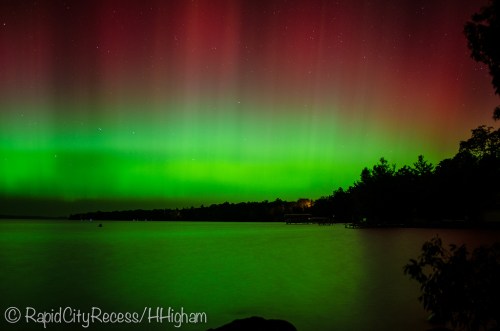
Aurora over Torch Lake

Aurora over Torch Lake, photo by HLHigham

NOAA’s Space Weather Prediction Center posted Geomagnetic Storm Starts Early about 8 hours ago:

The awaited CME passed the ACE spacecraft around 0100 UTC on October 2 (9:00 p.m. EDT October 1), sooner than forecasters had expected. G1 (Minor) Geomagnetic Storming now prevails, with the prospects of G2 (Moderate) levels still to come. The shock had no effect on the current Solar Radiation Storm, still declining through the S1 (Minor) category. Aurora watchers in North America may want to check the skies in the next few hours.

Those who got out were rewarded, and there’s more on tap for tonight. With this strong on an aurora at Torch Lake, the might be visible tonight in Grand Rapids or even further south!

I posted a photo from Heather just a couple of days ago, but sometimes convention needs to take a back seat to beauty! Check this out background bigtacular and in her Night Sky slideshow. 

PS: Shawn Malone simply posted “Oh My” about an hour ago, so definitely take a look at her Lake Superior Photo Facebook later today when she’s had a chance to grab some shut-eye and post them!

Northern Lights the next two nights!

Make this the evening of October 2nd & 3rd – I misread the alert!

Aurural Angel

Angel, photo by Shawn Malone/Lake Superior Photo

The latest Space Weather forecast says that S1 (Minor) solar radiation storm conditions are expected tonight and tomorrow night Wednesday & Thursday night due to particle enhancement associated with the 29 Sep coronal mass ejection (CME). They have revised Thursday up from Minor to Moderate too!

That’s good enough reason to check in on Shawn Malone of Lake Superior Photo. Shawn takes amazing pictures of the Northern Lights and all things Upper Peninsula. This summer, her incredible North Country Dreamland video won the Viewers Choice in the 2013 Smithsonian in Motion video contest.

Check this photo out bigger and see more in her Northern Lights Collection on Facebook.

Much (much) more about the aurora borealis on Michigan in Pictures!