ISS Flyover and Flythrough

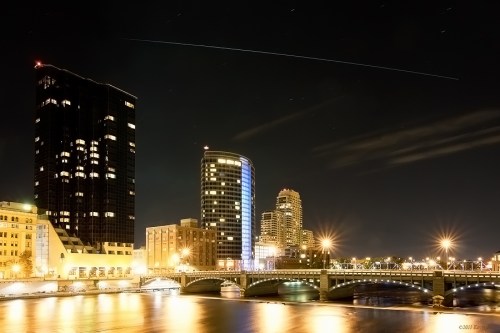
Downtown Flyover

Downtown Flyover, photo by Kevin’s Stuff

The other night I came across an incredible video tour of the International Space Station by Commander Sunita Williams of NASA before she departed for Earth. It’s one of the most amazing things I’ve ever seen and does so much to make the experience of living, working and moving in space a lot more tangible.

Commander Williams is a big part of what makes this video so engaging. She guides you through the corridors of the space station with a skill for explanation that I have seldom (if ever) seen. If she were born a hundred or so miles to the east, she’d be a Michigander. She wasn’t though, so I guess it might not be true what my grandmother told me about Ohio. Read her blog of the mission at NASA. (great photos)

Kudos to Commander Williams, and to everyone who worked across national and other divisions to make the ISS a reality. This video really made my day and I hope it makes yours – click to watch on YouTube!

About the photo, Kevin writes:

The International Space Station flies through the constellation Orion in the skies over downtown Grand Rapids, Michigan on a chilly and windy October evening.

This was a low pass in the southern sky (maximum altitude 34 degrees) so I decided to drive downtown to see if I could get a shot as the spacecraft flew over the buildings. I had done something similar in March of 2010, and figured if I could do it once, a second time wouldn’t be a problem.

Using timings and coordinates from Heavens Above  via their Android app, I was able to determine where the flyover would begin and end. I set up my camera and did a few test shots before the actual time, and was ready by the time ISS was visible over the south-southwestern horizon.

I timed it so the light from the station would already be in the FOV of the lens, and opened the shutter until it disappeared a short time later. Then it was home to the computer to see if I could make anything out of the image. I guess I did.

Who says you can’t do astrophotography from the city? :)

View his photo bigger and see more in his ISS slideshow.

More nighttime photos on Michigan in Pictures.

2014 Meteor Shower Calendar starts tonight with the Quadrantids

meteor and milky way

meteor and milky way, photo by HLHigham

EarthSky’s meteor shower guide for 2014 says that:

Although the Quadrantids can produce over 100 meteors per hour, the sharp peak of this shower tends to last only a few hours, and doesn’t always come at an opportune time. In other words, you have to be in the right spot on Earth to view this meteor shower in all its splendor. The radiant point is in the part of the sky that used to be considered the constellation Quadrans Muralis the Mural Quadrant. You’ll find this radiant near the famous Big Dipper asterism (chart here), in the north-northeastern sky after midnight and highest up before dawn.

Because the radiant is fairly far to the north on the sky’s dome, meteor numbers will be greater in the Northern Hemisphere. In 2014, watch in the wee hours – after midnight and before dawn – on January 3 in North America and January 4 in Asia. Fortunately, the waxing crescent moon sets soon after sunset, providing a dark sky for meteor watching.

Click through for more and a calendar of 2014 meteor showers. The next shower isn’t until the Lyrids on April 22nd so check them out tonight and early AM on the 4th if you can! You can get viewing tips for the Quads from Universe today too!

View Heather’s photo big as the sky and in her Night Sky slideshow.

Misty Moonrise at Tahquamenon

Misty Moonrise

Misty Moonrise, photo by ShaneWyatt

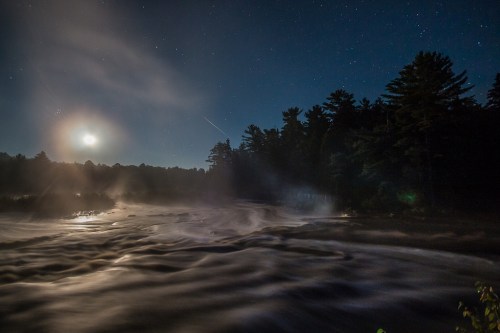
Here’s a gorgeous shot of the moon rising over the mist of Lower Taquamenon Falls – Shane caught a shooting star too!

View his photo bigger and see more including another night shot at the falls in Shane’s stars slideshow.

Northern Lights the next two nights!

Make this the evening of October 2nd & 3rd – I misread the alert!

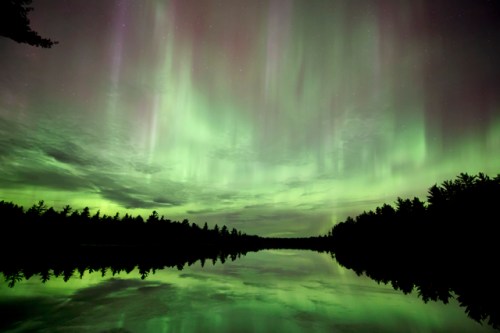
Aurural Angel

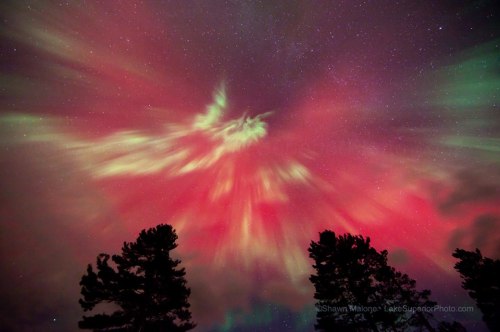
Angel, photo by Shawn Malone/Lake Superior Photo

The latest Space Weather forecast says that S1 (Minor) solar radiation storm conditions are expected tonight and tomorrow night Wednesday & Thursday night due to particle enhancement associated with the 29 Sep coronal mass ejection (CME). They have revised Thursday up from Minor to Moderate too!

That’s good enough reason to check in on Shawn Malone of Lake Superior Photo. Shawn takes amazing pictures of the Northern Lights and all things Upper Peninsula. This summer, her incredible North Country Dreamland video won the Viewers Choice in the 2013 Smithsonian in Motion video contest.

Check this photo out bigger and see more in her Northern Lights Collection on Facebook.

Much (much) more about the aurora borealis on Michigan in Pictures!

Moonflower

Moonflower

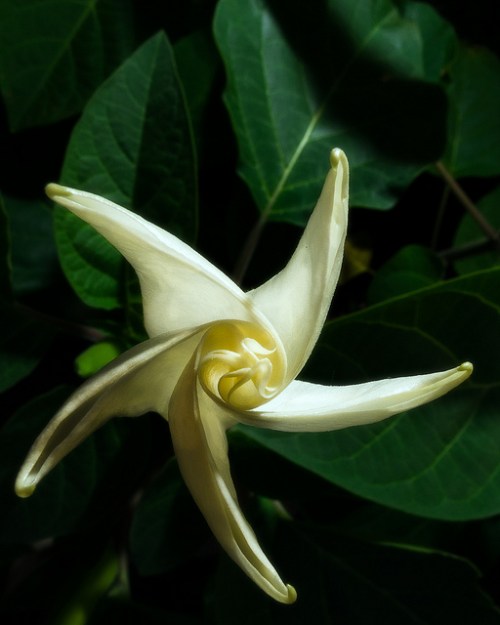
Moonflower, photo by bill.d

WiseGeek’s page on growing moonflowers explains:

For a gardener who doesn’t keep a normal nine-to-five schedule, growing moonflowers may be the perfect hobby. Ipomoea alba, or the common moonflower, is a night-blooming vine from the same family as the morning glory. Growing moonflowers requires very little effort, and the gardener is rewarded with a climbing vine that can reach a height of 10 to 20 feet (3.05 to 6.1 meters) in one season. In its natural habitat of tropical and sub-tropical climates, this vine is considered a perennial, but in colder climates it must be replanted every year.

…As with their daytime cousins, the morning glories, growing moonflowers requires full or partial sun. The plant will begin to bloom in late afternoon and into the early evening hours, and continue to remain open until sunrise. The vines are voracious climbers, and should be planted in a spot where they may spread as needed, such as near a trellis or patio support beam.

Moonflowers produce large white flowers. Some gardeners like to grow them alongside various colors of morning glories, especially the “heavenly blue” strain. This commingling results in an abundance of flowers both day and night in one garden spot, blue in daylight and white by moonlight. The fragrant moonflowers are often considered ornamental, and each flower remains open no longer than one night.

Also see Everything You Wanted to Know About Moonflowers from Local Harvest check out this video of a moonflower opening.

Bill took this shot in his garden and suggests you  check out “moon flower moth” on Flickr. See his photo bigger and see  more great shots of these ephemeral beauties in his Flowers slideshow!

Many (many) more Michigan flowers on Michigan in Pictures!

North Country Dreamland

North-Country-Dreamland-at-Miners-Castle-by-Shawn-Malone


North Country Dreamland at Miners Castle, photo by Shawn Malone / lakesuperiorphoto.com

Last night I got an alert of a moderately strong solar flare with the possibility of generating northern lights. When I went looking to see if anyone had photographed them, I discovered that Michigan in Pictures regular Shawn Malone has just released a truly stunning video featuring a series of time-lapses of the night skies of northern Michigan! She writes:

Rare pairings caught on camera include ribbons of aurora above a full moon fogbow on the horizon of Lake Superior, the aurora and an isolated singular lightning storm cloud over Lake Superior, and the aurora and Milky Way in several scenes including Copper Harbor, Marquette, Isle Royale, Pictured Rocks, and Eagle Harbor Lighthouse.

…All scenes are within 200 miles or so of my home in Marquette, Mi. and I feel very blessed to live where I do and to share the beauty that I see ‘in my own backyard’ with you. I hope it inspires others to take time to find the beauty that is everywhere around us and also to raise an awareness about the importance of preserving our night wondrous starlit skies.

You can read about it and see it on Absolute Michigan or head over to Vimeo to watch it.

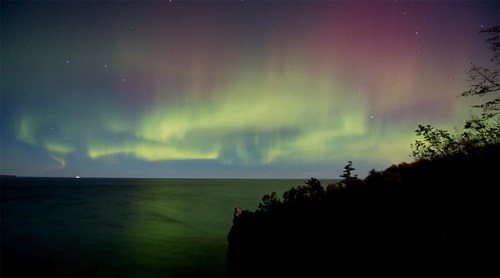
The shot above is one of 33 different scenes in the video and shows Miners Castle in the Pictured Rocks National Lakeshore. See it bigger in the video and see a lot more on the Lake Superior Photo Facebook.

Much more from Shawn on Michigan in Pictures.

Space Weather outlook: Mostly clear with a chance of Northern Lights!

Colorful

Colorful, photo by Xueqian-Vision Photography

Today’s Space Weather Forecast says that there’s chance for R1 – R2 (minor – moderate) solar radio blackouts are possible through 26 April due to solar Region 1726 which will rotate off the visible disk on or about 26 April.

Check this out on black and see more in Xueqian-Vision Photography’s Keweenaw Peninsular – Here We Are slideshow.

Much (much) more about the aurora borealis including how weather on the sun impacts the northern lights on Michigan in Pictures.

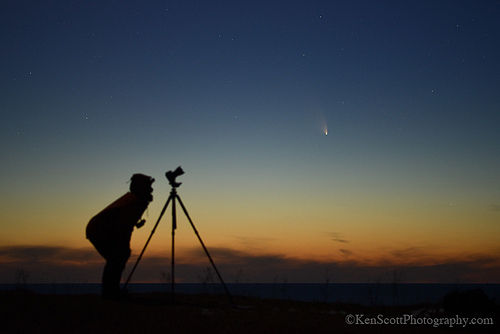
Capturing Comet PANSTARRS

Comet Pan-Starrs ... 3-17-13

Comet Pan-Starrs … 3-17-13, photo by Ken Scott

EarthSky.org is a fantastic site for all things astronomical, and their post detailing everything you need to know about Comet PANSTARRS has great info on the first of 2013 major comets. The comet was discovered by the PANSTARRS telescope in Hawaii and they explain that:

Comet PANSTARRS is still visible through binoculars in the Northern Hemisphere, if you know right where to look. Note where the sun sets in the west. Some 60 to 75 minutes after sundown, seek for the comet about two to three binocular fields to the right, or upper right, of the sunset point on the horizon. Comet PANSTARRS now sets at nightfall or very early evening at mid-northern latitudes. From here on out, the comet will dim a bit day by day, while the waxing moon will brighten daily. So it’s hard to say how much longer Comet PANSTARRS will be readily visible through binoculars. Each day, Comet PANSTARRS goes a few degrees northward (to the right) on the sky’s dome, toward the constellation Cassiopeia the Queen.

…No matter how bright it gets in March, the comet will surely fade as April arrives, as it moves away from the sun and back out into the depths of space. But it will be located far to the north on the sky’s dome and will be circumpolar for northerly latitudes in the Northern Hemisphere. That means it might be visible somewhere in the northern sky throughout the night for northern observers. What’s more, the comet will be near in the sky to another beautiful and fuzzy object in our night sky, the Andromeda Galaxy (M31), the nearest large spiral galaxy to our Milky Way. If the comet truly is bright then, and if it still has a substantial tail, it’ll be an awesome photo opportunity!

Read on for more and also check out the michpics post on Comet ISON which has the possibility of  being so bright that you can see it in the daytime!

Ken shot this last weekend. You can see it on black, check out the sunset he captured before this and see more great work in his Night Sky slideshow. If you’re looking to purchase this or other shots, definitely head over to KenScottPhotography.com!

More nighttime photography on Michigan in Pictures.

The Northern Lights of March 1989

Emerald Radiance by Shawn Malone

Emerald Radiance, photo by by Shawn Malone

Last week on Michigan in Pictures for a post titled Heavy (space) Weather,  I referenced The 23rd Cycle:Learning to live with a stormy star by Dr. Sten Odenwald. This out-of-print book is available online for free and explores the impact of solar storms upon our electromagnetic grid. Chapter 1 is titled A Conflagration of Storms, and it begins with an account of one of the most memorable aurora borealis I’ve ever experienced:

On Thursday, March 9, 1989 astronomers at the Kitt Peak Solar Observatory spotted a major solar flare in progress. Eight minutes later, the Earth’s outer atmosphere was struck by a wave of powerful ultraviolet and X-ray radiation. Then the next day, an even more powerful eruption launched a cloud of gas 36 times the size of the from Active Region 5395 nearly dead center on the Sun. The storm cloud rushed out from the Sun at a million miles an hour, and on the evening of Monday, March 13 it struck the Earth. Alaskan and Scandinavian observers were treated to a spectacular auroral display that night. Intense colors from the rare Great Aurora painted the skies around the world in vivid shapes that moved like legendary dragons. Ghostly celestial armies battled from sunset to midnight. Newspapers that reported this event considered the aurora, itself, to be the most newsworthy aspect of the storm. Seen as far south as Florida and Cuba, the vast majority of people in the Northern Hemisphere had never seen such a spectacle. Some even worried that a nuclear first-strike might be in progress.

Read on for more about the impact of this and other solar storms or check out the whole book.

While I couldn’t find photos from ’89 of these amazing northern lights, I was able to get a really cool photo from one of Michigan’s best aurora photographers, Shawn Malone. About the display above from November 14, 2012 she writes:

I think this photo is my favorite to date. It felt like years of observing and photographing resulted in the reward of being able to catch this image. Beautiful place, right time, right conditions, and a great geomagnetic event materialized!

You can purchase the photo at LakeSuperiorPhoto.com at and see many more in her Northern Lights Gallery.

There’s more from Shawn and LOTS more about the Northern Lights on Michigan in Pictures.

Heavy (Space) Weather: Coronal Mass Ejections and the Northern Lights

Northern Lights

Northern Lights, photo by gkretovic

Michigan in Pictures has a whole lot on the Northern Lights.

The aurora borealis are one of the world’s most rare and wonderful sights and Michigan – especially the Upper Peninsula – is blessed with more than a few nights every year when this elusive phenomenon makes an appearance.

The Library of Congress page What Are the Northern Lights? calls on NASA’s Dr. Sten Odenwald, author of The 23rd Cycle, Learning to Live with a Stormy Star, to provide insight to how northern lights are formed:

The origin of the aurora begins on the surface of the sun when solar activity ejects a cloud of gas. Scientists call this a coronal mass ejection (CME). If one of these reaches earth, taking about 2 to 3 days, it collides with the Earth’s magnetic field. This field is invisible, and if you could see its shape, it would make Earth look like a comet with a long magnetic ‘tail’ stretching a million miles behind Earth in the opposite direction of the sun.

When a coronal mass ejection collides with the magnetic field, it causes complex changes to happen to the magnetic tail region. These changes generate currents of charged particles, which then flow along lines of magnetic force into the Polar Regions. These particles are boosted in energy in Earth’s upper atmosphere, and when they collide with oxygen and nitrogen atoms, they produce dazzling auroral light.

We focus on the beauty, but as he explains:

“Aurora are beautiful, but the invisible flows of particles and magnetism that go on at the same time can damage our electrical power grid and satellites operating in space. This is why scientists are so keen to understand the physics of aurora and solar storms, so we can predict when our technologies may be affected.”

Dr. Odenwald’s book is out of print but he has made it available online. There’s some interesting stuff in there, and be sure to check out his Astronomy Cafe site too.

One benefit from the economic & security concerns of predicting space weather is that you can get some great northern light forecasts. My favorite is NOAA’s Space Weather Service. They reported a G1 storm on March 1st – it’s the lowest intensity on the Space Weather Scales but as you can see is still able to produce auroral activity!

Greg took this photo Saturday night just before midnight at Presque Isle in Marquette – check it out on black and in his slideshow. You can see more of Greg’s work on Michigan in Pictures, at michigannaturephotos.com and definitely follow him at Michigan Nature Photos on Facebook.