
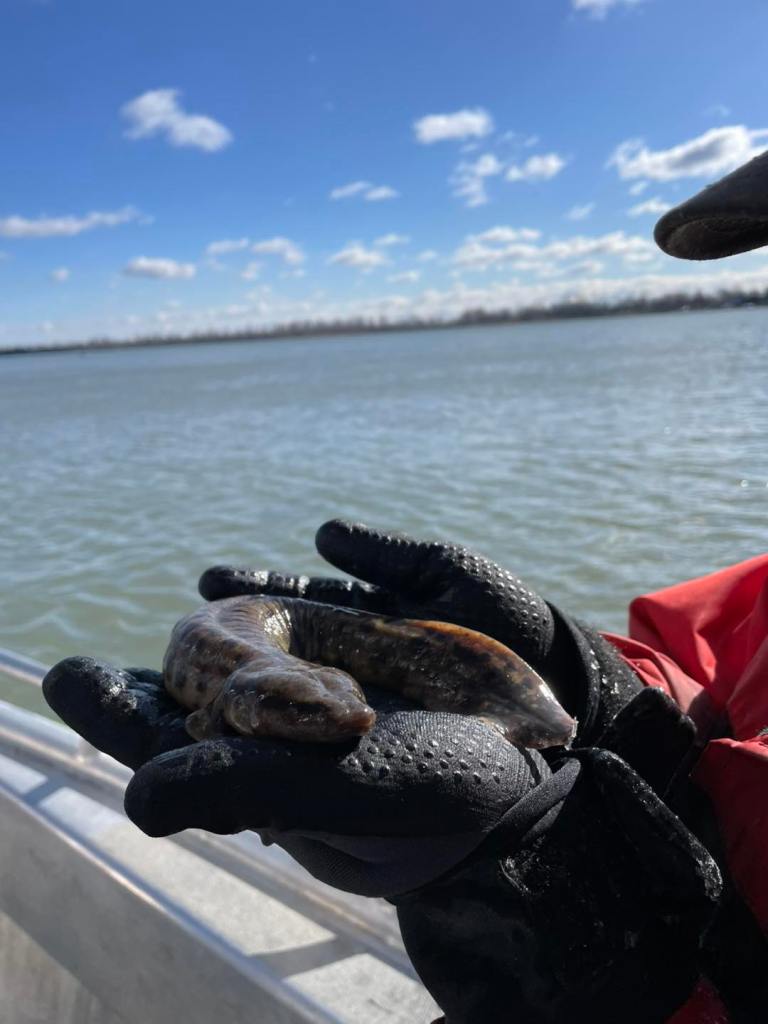
Mudpuppy by Michala Burke/USFWS
The Alpena Fish & Wildlife Conservation Office says that mudpuppies are Michigan’s largest fully aquatic salamander and are often referred to as “bio-indicators” since they are sensitive to pollutants and poor water quality. This mudpuppy was caught during lake sturgeon setline assessments on the Detroit River. Mary of MSU Extension put together a great guide to the misunderstood mudpuppy that includes the facts on some common fictions.
| FICTION | FACT |
|---|---|
| Mudpuppies are a type of fish. | Mudpuppies are actually an amphibian and although they have lungs and can gulp air they rely on their feathery red external gills for oxygen. |
| Mudpuppies that are thrown on the ice by anglers will revive in the spring when the ice melts. | Unfortunately if a mudpuppy freezes it will die. When thrown on the ice mudpuppies will eventually suffocate or freeze to death. |
| Mudpuppies eat so many fish eggs that they decrease sport fish populations. | Their diet is mostly crayfish, insect larvae, snails and small fish (including invasive round gobies). There is no evidence that they impact fish populations, and they more likely benefit them by helping control nonnative species. |
| Mudpuppies are not protected in Michigan and can be collected all year round. | According to MDNR, mudpuppies are a protected species in Michigan. People sometimes accidentally catch them while fishing. If you do catch a mudpuppy, you must put them back. |
| Mudpuppies are blind and are not good hunters. | Mudpuppies are not blind, but their eyesight is limited. They rely on a keen sense of smell to find their prey. |

 Michigan in Pictures