A wink from the Harvest Moon

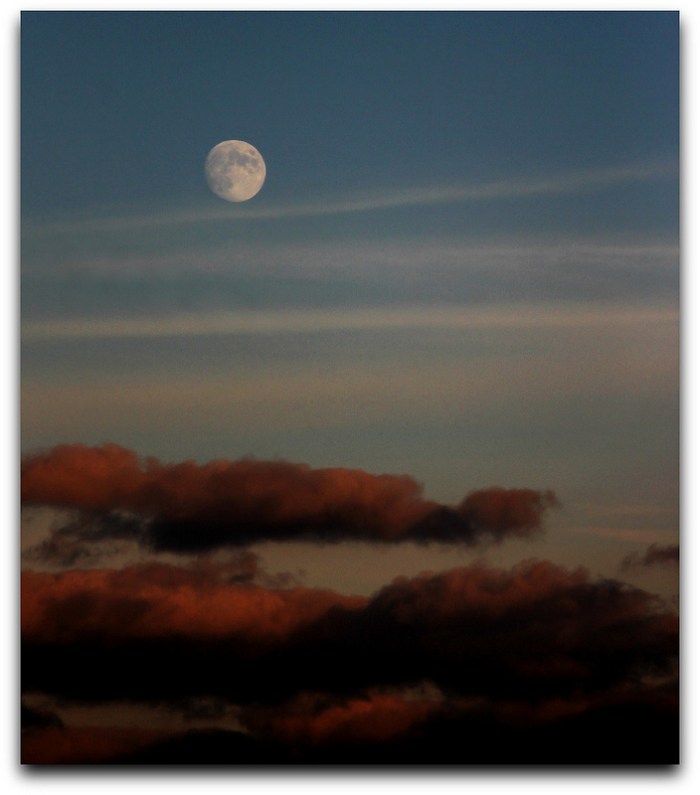
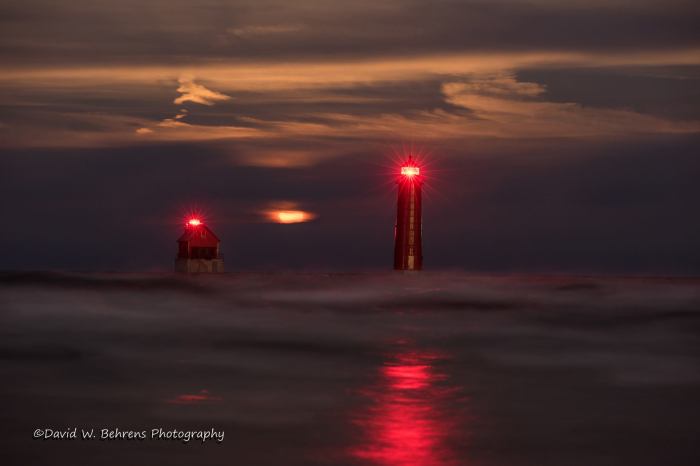
With A Wink The Full Moon Sets Over Grand Haven, photo by David W Behrens

I watched the full harvest moon set this morning over the Leland Harbor among some clouds, and then saw this photo that David of David W. Behrens Photography shared from Grand Haven, Michigan. Click through to see more pics from David!

The full harvest moon rises tonight at 7:21 PM, so I figured that I would share a bit about the Harvest Moon from a past post on Michigan in Pictures:

EarthSky.org has a nice article about the Harvest Moon that explains that for all its mystique, the Harvest Moon is just an ordinary full moon:

Still, you might think the Harvest Moon looks bigger or brighter or more orange. That’s because the Harvest Moon has such a powerful mystique. Many people look for it shortly after sunset around the time of full moon. After sunset around any full moon, the moon will always be near the horizon. It’ll just have risen. It’s the location of the moon near the horizon that causes the Harvest Moon – or any full moon – to look big and orange in color.

The orange color of a moon near the horizon is a true physical effect. It stems from the fact that – when you look toward the horizon – you are looking through a greater thickness of Earth’s atmosphere than when you gaze up and overhead. The atmosphere scatters blue light – that’s why the sky looks blue. The greater thickness of atmosphere in the direction of a horizon scatters blue light most effectively, but it lets red light pass through to your eyes. So a moon near the horizon takes on a yellow or orange or reddish hue.

…The shorter-than-usual time between moonrises around the full Harvest Moon means no long period of darkness between sunset and moonrise for days in succession. In the days before tractor lights, the lamp of the Harvest Moon helped farmers to gather their crops, despite the diminishing daylight hours. As the sun’s light faded in the west, the moon would soon rise in the east to illuminate the fields throughout the night.

You can read on for more.
September’s Corn Moon is full tonight!

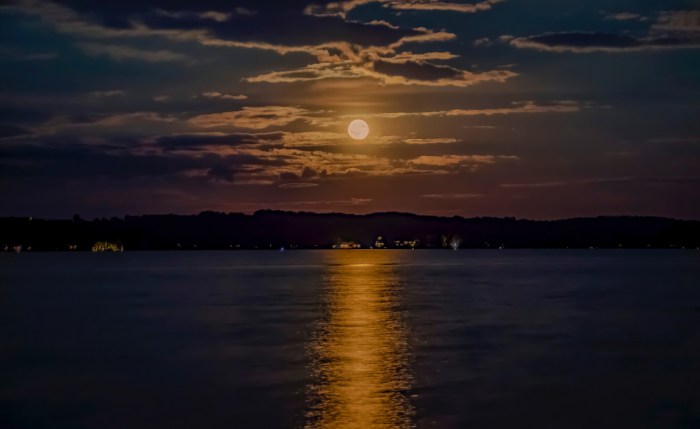
Reflections of the Moon, photo by TP Mann

Space.com’s article on September’s Full Corn Moon says in part:

Look up tonight (Sept. 6) to see the Full Corn Moon glowing in the sky. If you have binoculars or a telescope, you can also see the planet Neptune glowing faintly nearby.

The moon reached its fullest phase early this morning, at 3:02 a.m. EDT (0702 GMT), but it will still appear full to casual observers this evening. Look for it in the southern sky in the constellation of Aquarius, the Water Bearer.

Usually, the full moon in September is known as the Harvest Moon, but this year that name is reserved for October’s full moon. That’s because the Harvest Moon is the full moon that falls closest to the autumnal equinox, which occurs on Sept. 22 this year.

Check out the photo of the full moon over Torch Lake background bigtacular and see more in TP’s Night Shots slideshow.

Lots more about the moon on Michigan in Pictures.

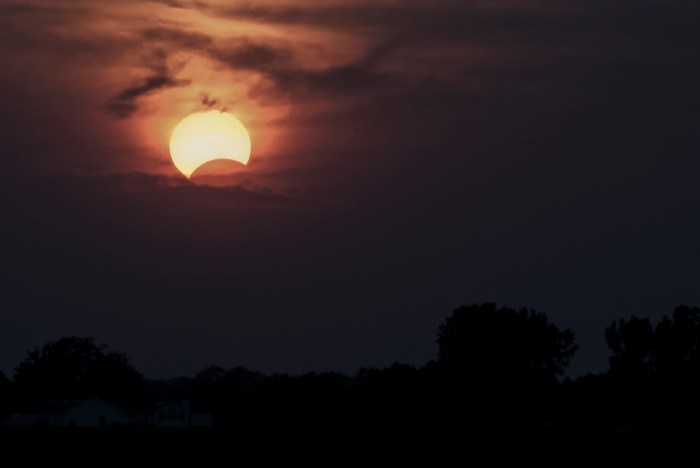
Watching the August 21st solar eclipse in Michigan

The solar eclipse will be visible in Michigan on Monday, Aug 21, 2017 so in the interests of maximal eclipse enjoyment, I’m publishing this special Sunday Michigan in Pictures!

Solar Eclipse May 21st 2012, photo by John Kennedy

The brighter stars and the planets come out. Animals change their behavior. Birds and squirrels nest. Cows return to the barn. Crickets chirp. There is a noticeable drop in both light level and air temperature. It is an eerie feeling. Totality can last for no more than about seven and a half minutes but is usually less than three minutes long.
-National Aeronautics and Space Administration

Tomorrow is the day for the total eclipse, although in Michigan we will see only 70-80% of the sun eclipsed by the moon (less as you move northward) it’s still a rare opportunity. Here’s times for a range of Michigan locations:

NASA’s Eclipse 2017 website is definitely the place to go for all of your eclipse watching & info needs. In addition to the NASA Goddard Instagram feed and an Eclipse 2017 Flickr group where you can share photos from the eclipse with people from all over, there’s…

View the photo background bigtacular and see more in John’s Scenery slideshow.

Moons Big & Small: Perigee & Apogee Moons

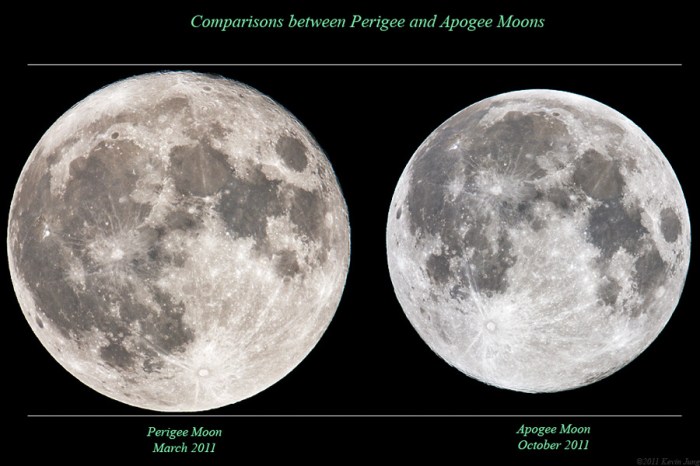
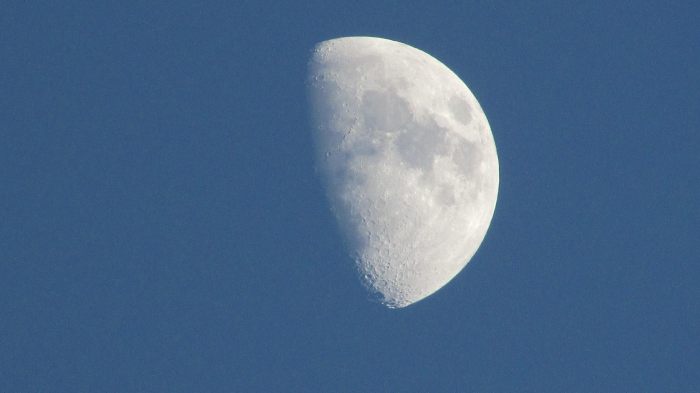
A comparison of the perigee and apogee Moons of 2011.

Moons Big and Small, photo by Kevin

Last night I learned that the full moon was at apogee, and with all the love I’ve given to supermoons, I figured that I should throw a bone to the tiny ones as well. Kevin is a regular on Michigan in Pictures with his stunning photos of the night sky. He made a comparison of the perigee and apogee Moons of 2011 and shared this explanation:

The Full Moon of October 2011 was near apogee, which is the furthest point in the Moon’s orbit of the Earth. Back in March, you may recall, the Moon was at it’s closest point in its orbit to Earth, and the media dubbed it the “Supermoon.”

According to several sources, the difference in size between the March Full Moon and the October Full Moon is 12.3%. Why is there such a difference, you may ask?

Well, the Moon’s orbit around the Earth is elliptical, just as the Earth’s is around the Sun. That means that as the object – the Moon in this case – orbits the “parent” object (the Earth) it will never be the same distance away.

The image I put together shows the difference between the size of the Moon at perigee (March 2011) and apogee (October 2011). This comparison makes the size difference quite clear.

Kevin adds that both images of the Moon were taken with exactly the same equipment. View it bigger and see more in his massive The Moon slideshow.

PS: This full moon is the strawberry moon, and you can click that link for more about that and (unsurprisingly) a photo from Kevin!

Super Moon over the Lift Bridge

supermoon-over-the-lift-bridge

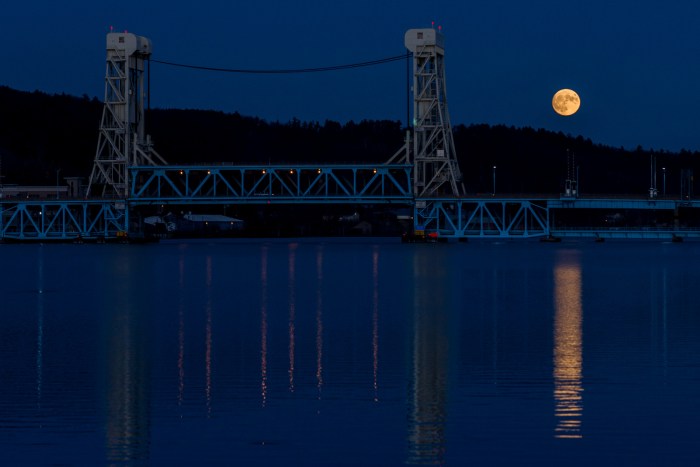
Super Moon over the Lift Bridge, photo by Eric Hackney

Marvelous shot of the nearly full Supermoon over the Portage Lake Lift Bridge that connects the UP cities of Houghton & Hancock.

View Eric’s photo bigger, see more in his 11-13-16: Supermoon Rise slideshow, and definitely follow Eric Hackney Photography on Facebook!

More from Houghton on Michigan in Pictures!

Tonight’s Hunter’s Moon … and November’s Extra Super Moon

hunters-moon-october

Catching the Hunter’s Moon, photo by Brad Worrell

EarthSky notes that 2016 Hunter’s Moon is also a supermoon, explaining:

In some months, the full moon is closer to us in orbit than others. The 2016 Hunter’s Moon does happen to be particularly close. It’s near perigee, the moon’s closest point to Earth in its monthly orbit. Perigee comes on October 16 at 23:36 UTC (translate to your time zone), about 19 hours after the crest of the moon’s full phase at 4:23 UTC on the same date. Nowadays, people call these close full moons supermoons.

Some don’t like the word supermoon … but we like it. Full moons at their closest to Earth do look brighter. They have a larger-than-usual effect on earthly tides. Although most of us can’t detect that a supermoon appears larger to the eye, very careful and experienced observers say it’s possible.

So you won’t likely see a bigger-than-usual moon (unless you see it near the horizon, an effect known as the moon illusion). But you can notice how brightly the moon is shining, especially on the nights of October 15 and 16!

Next month – in November 2016, the full moon and perigee (closest point) come even closer together to stage the largest full moon of the year on November 14. … That November 2016 full moon will feature the closest supermoon since 1948!

Tons more about the Hunter’s Moon on EarthSky!

View Brad’s photo bigger and seem more in his Not More Pictures of the Moon! slideshow (note: more pictures of the moon are there).

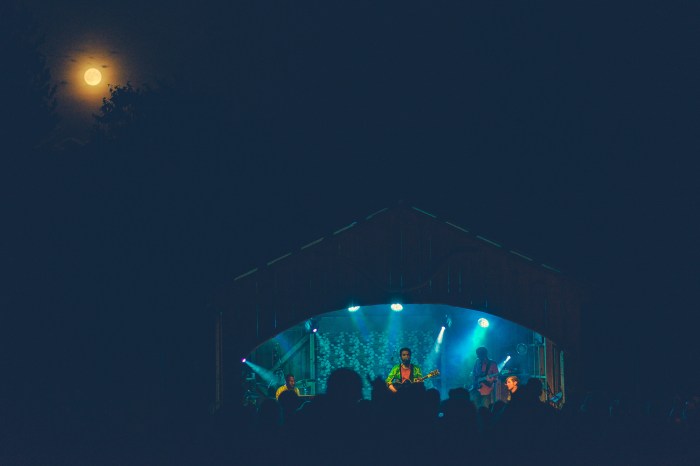
Harvest Moon on Harvest Gathering

harvest-moon-at-harvest-gathering

Harvest Moon on Harvest Gathering, photo by Adam Johnson / Brockit, inc

This weekend I’m where I am this weekend every year, helping out at the Earthwork Harvest Gathering. One of the photographers who’s helping out is Michigan in Pictures contributor Adam Johnson of Brockit, inc.

Follow his work for Harvest on Instagram and also on the Earthwork Harvest Gathering Facebook.

Strawberry Season, Strawberry Moon

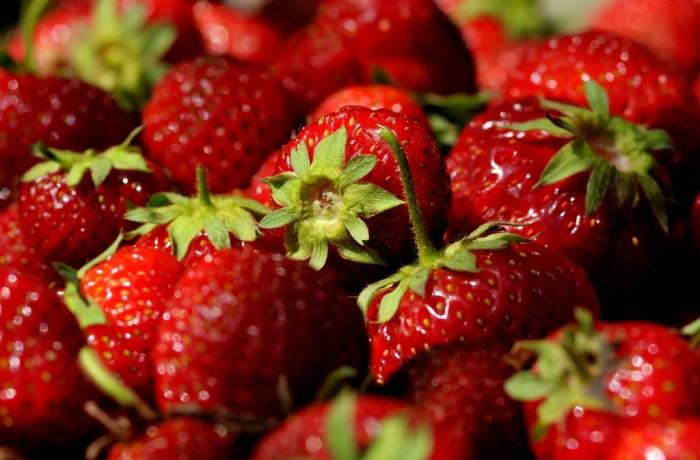
Fresh Picked Strawberries

Fresh Picked Strawberries, photo by Dee

June’s moon is full on full on June 20 at 7:02 AM. It was known as the Strawberry Moon by Algonquin tribes, and it’s looking like Michigan’s strawberry season will be ramping up right on schedule. Here’s a couple of strawberry tidbits via Michigan Strawberries are Ready to Pick on Absolute Michigan:

Strawberries are grown in every county of Michigan and your fun fact of the day is that 53% of seven to nine year olds say strawberries are their favorite fruit. Strawberries are high in iron and Vitamin C – Eight strawberries will provide 14% of the recommended daily intake of Vitamin C for kids – and have less than 60 calories per cup.

Strawberries were a symbol of perfection and righteousness that medieval stone masons carved on altars and around the tops of pillars in churches and cathedrals. In parts of Bavaria, country folk still practice the annual rite each spring of tying small baskets of wild strawberries to the horns of their cattle as an offering to elves. They believe that the elves, who are passionately fond of strawberries, will help to produce healthy calves and abundance of milk in return.

View Dee’s photo bigger and see more in her slideshow.

More strawberry goodness on Michigan in Pictures!

Christmas Full Moon and the Metonic Cycle

Moon December 18 2015

Moon December 18 2015, photo by Dave in Michigan

EarthSky notes that the December full moon will be the first on Christmas since 1977:

This month, the December full moon falls on Friday, December 25, 2015. For Earth’s Western Hemisphere, it’s the first full moon on Christmas Day since 1977.We won’t have another full moon on a Christmas Day until 2034.

A 19-year cycle of the moon is the reason. Amazingly, the moon’s phases recur on (or near) the same calendar dates every 19 years. This cycle – known as the Metonic cycle – happens because 235 returns to full moon almost exactly equal 19 years. So, in other words, the phases of the moon realign (or nearly realign) with the same calendar dates every 19 years. We just missed a full moon on Christmas 19 years ago; instead, the full moon fell on Christmas Eve. It was December 24, 1996 at 20:41 Universal Time, or UT.

…In any year, the phases of the moon take place about 11 days earlier than in the previous year. For instance, the December 2016 full moon will happen on December 14, 2016, and the December 2017 full moon will fall on December 3, 2017.

View Dave’s photo big as the moon and see more in his moon & moon shots slideshow.

More about December’s full moon in Christmas Moon, Snow Moon, Cold Moon, Oak Moon, December Moon on Michigan in Pictures!

Harvest Moon Eclipse Sunday Night

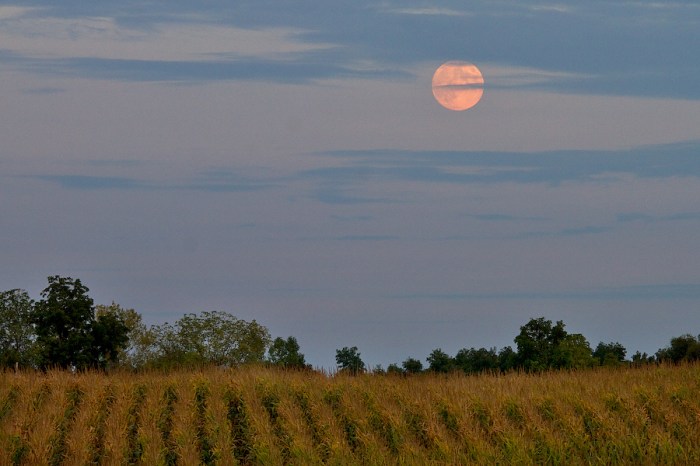
Harvest Moon over Michigan Cornfield

Harvest Moon over Cornfield, photo by Kevin

NASA Science reminds us that this Sunday night (Sep 27) and into the early hours of Monday, the full Harvest Moon will glide through the shadow of Earth, turning the Harvest Moon a golden-red color akin to autumn leaves:

The action begins at 9:07 PM Eastern Time on the evening of Sept 27th when the edge of the Moon first enters the amber core of Earth’s shadow. For the next three hours and 18 minutes, Earth’s shadow will move across the lunar disk.

Totality begins at 10:11 PM Eastern Time. That’s when the Moon is completely enveloped by the shadow of our planet. Totality lasts for an hour and 12 minutes so there is plenty of time to soak up the suddenly-red moonlight.

The reason the Moon turns red may be found on the surface of the Moon itself. Using your imagination, fly to the Moon and stand inside a dusty lunar crater. Look up. Overhead hangs Earth, nightside facing you, completely hiding the sun behind it. The eclipse is underway.

You might suppose that the Earth overhead would be completely dark. After all, you’re looking at the nightside of our planet. Instead, something amazing happens. When the sun is located directly behind Earth, the rim of the planet seems to catch fire! The darkened terrestrial disk is ringed by every sunrise and every sunset in the world, all at once. This light filters into the heart of Earth’s shadow, suffusing it with a coppery glow.

Click through for more including a video Science Cast of how it all works.

Kevin is the go-to moon-and-astronomy guy on Michigan in Pictures, delivering great photos and info. He shares this about the Harvest Moon:

The “Harvest Moon” is the name traditionally given to the full moon that occurs closest to the autumnal (fall) equinox. The Harvest Moon usually comes in September, but (on average) once or twice a decade it will fall in early October. At the peak of the harvest, farmers can work into the night by the light of this moon.

At this time of the year also occurs the “Harvest Moon Effect”. Usually the moon rises an average of 50 minutes later each night, but for the few nights around the Harvest Moon, the moon seems to rise at nearly the same time each night: just 25 to 30 minutes later across the U.S., and only 10 to 20 minutes later for much of Canada and Europe. Corn, pumpkins, squash, beans and wild rice are now ready for gathering.

View his photo bigger and see more of moon photos including this cool one of the harvest moon over Grand Rapids taken a little earlier in his The Moon slideshow.

There’s more about the Harvest moon and more eclipses on Michigan in Pictures!