Memorial Day Weekend is a unique holiday. It’s both a celebration of the beginning of the summer, the weekend to throw off the shackles of cold & gray and embrace sun and sand, and also a somber remembrance of those who have given their lives defending our nation. I hope that light and love touch you in both of these pursuits.
I hope everyone is ready for the launch of summer 2017. Given the tension in the world, I’ve got a feeling it will be memorable. Hopefully not in a bad way but I admit, I worry.
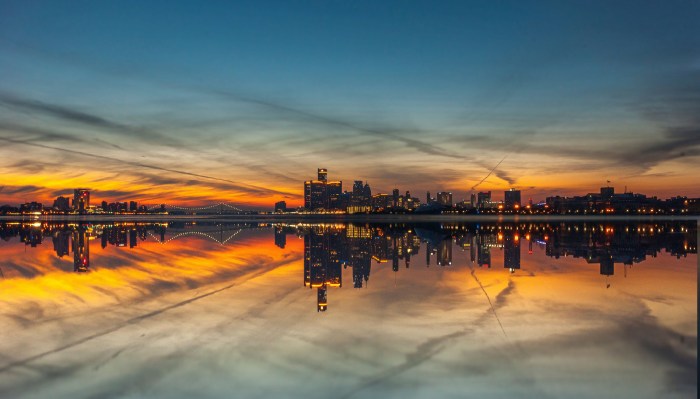
If you’re looking for a new and fun way to kick off the summer, consider the Movement Electronic Music Festival this Saturday – Monday (May 27-29) in downtown Detroit. It takes place every Memorial Day weekend in the birthplace of Techno music with 6 stages and over 100 acts.
As we’re gearing up for summer, it’s a great time to think about Michigan’s many incredible museums. One of the coolest is Greenfield Village at The Henry Ford in Dearborn. They explain that the origins of Greenfield Village were with Henry Ford himself. His obsession to recreate his childhood home was a resounding success and:
…after several other restorations of buildings at their original sites, he began looking to create a village that would represent the early days of America up to the present. Working with Ford Motor Company draftsman and architect Edward L. Cutler, Ford began laying out plans for Greenfield Village.
It wasn’t meant to represent any specific place in the United States, or even serve as a particular town – Ford created Greenfield Village primarily from buildings that he had purchased and moved to the site, organizing them around a village green with a courthouse, a town hall, a church, a store, an inn and a school. He placed homes along a road beyond the green. He brought industrial buildings, such as carding mills, sawmills and gristmills to the village and made them operate.
Today, Greenfield Village is organized into seven historic districts, with real working farms, a glassblowing shop, a pottery shop and more…so that, just like Henry Ford when he surveyed his preserved birthplace, you, too, can be transported to another place and time to learn about the ordinary and extraordinary people who shaped America.
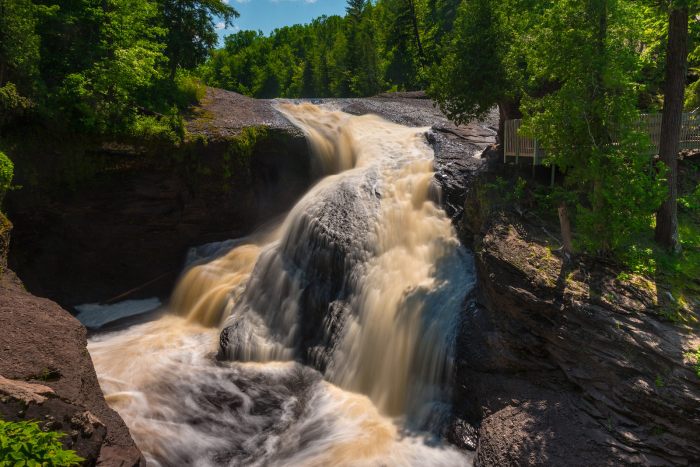
I’ve profiled Rainbow Falls and the other waterfalls of the Black River Scenic Byway on Michigan in Pictures, but my friend Gary shared a super-cool video that I want to share with all of you! GoWaterfalling’s says that Rainbow Falls is:
…the last of the main falls on the Black River before it enters Lake Superior. This is an interesting waterfall. Unfortunately the best views are from the east side of the river and the observation deck is on the west side of the river. The hike from the west side trailhead is 1/2 mile. In my opinion the smarter thing to do is to drive down to end of the Black River Scenic Byway, cross the river and hike back up to the falls. A supsension bridge takes you across the river and a mile long, scenic, and mostly level trail, takes you back to the falls. The views are far superior. In low water you can wade across the river above the falls.
The waterfall has carved out a large pothole. Most of the river falls into the pothole, but some of the water, depending on how high the river is, goes around or jumps clear over this hole.
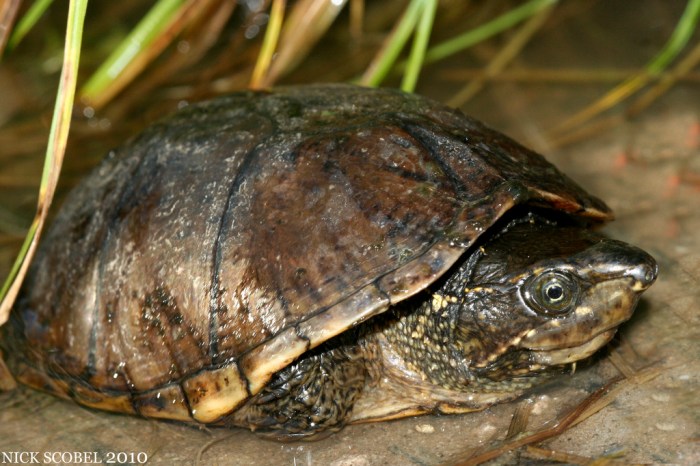
World Turtle Day (May 23rd) was started in 2000 by American Tortoise Rescue to bring awareness about dangers to turtles worldwide. It’s also the perfect day to add the 10th and final turtle to one of the most popular posts on Michigan in Pictures, Know Your Michigan Turtles!
The UM Animal Diversity Web entry for the common musk turtle (Sternotherus odoratus), a relatively small turtle with an average length of about 3 to 5 inches, says in part:
The habitat of the common musk turtle includes any kind of permanent body of water, like shallow streams, ponds, rivers, or clear water lakes, and it is rare to find the turtle elsewhere. While in the water, this musk turtle stays mainly in shallow areas. Sometimes it can be found basking on nearby fallen tree trunks or in the branches of trees overhanging the water
…The most prominent behavior of the common musk turtle is its defensive tactic. When disturbed, this turtle will quickly release a foul-smelling liquid from its musk glands. This kind of defense earned the musk turtle the nickname of “stinkpot”. Also, the male is particularly aggressive and will not think twice about biting. Another unique behavior the nocturnal common musk turtle exhibits while foraging is that they walk on the bottom of the stream or pond instead of swimming like other turtles.
Sternotherus oderatus is somewhat of a food generalist, as it is known to eat small amounts of plants, mollusks, small fish, insects, and even carrion. Foraging on the muddy bottom of streams or ponds is the chief way of collecting food.
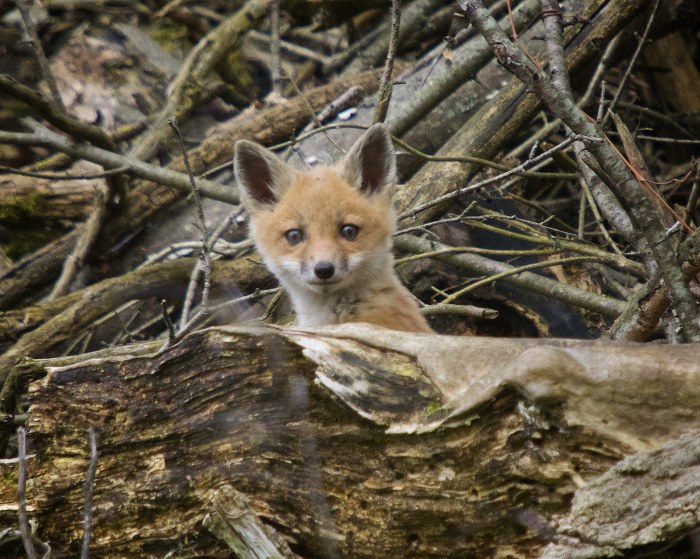
There are two species of fox in Michigan, the Red and the Gray. The Red prefer meadow areas and the Gray favor woods.
As with most wildlife, the kits are born in early spring. The vixen (female fox) chooses a hollow log, an empty woodchuck hole or a roadside culvert for the nursery. This nest site provides her young protection from predators, especially coyotes. The male fox helps with the rearing by bringing the vixen food while she nurses their young and keeps the kits warm. Then later in the kits development both parents teach them how to forage for food.
The foxes diet consists mainly of small rodents, moles and bugs. The benefits that foxes afford farmland, orchards and the general public is their consumption of these invasive pests. It is an absolute miss conception that fox eat cats, dogs or small children.They are very curious creatures but avoid contact with domestic animals and humans.
When fox kits are first born, their eyes and ears are closed, they remain secluded in their den with their mother. As they develop, at about one month, they start venturing out to play, attacking twigs, leaves and their siblings, but never far from the protection of the den.
If you do find an infant fox, please contact them for further instructions and see their website for information about other species!
PS: David has a video too. He writes: “Please note that the video was taken from quiet a distance away with a high power lens so as to avoid as much human contact with the kits.”
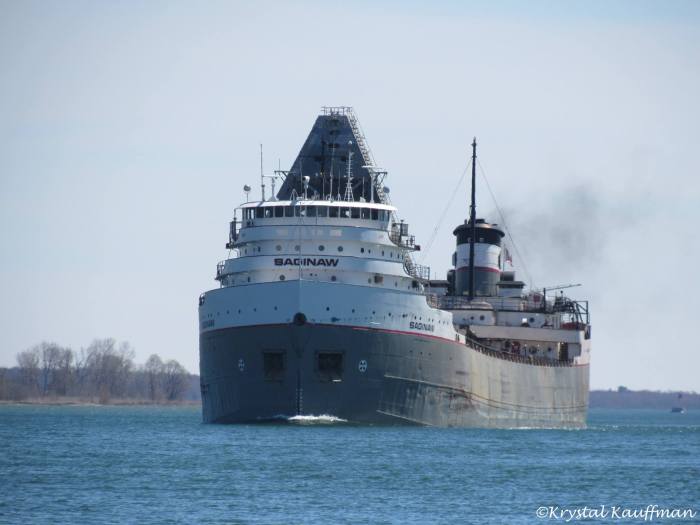
Capistrano has their swallows, but a sure sign of Spring in Michigan is when the freighters return to the Great Lakes. One of the best places for shipwatching is right where Krystal took this photo: Mission Point at the mouth of the North Channel near the Soo Locks.
The bridge will be closed from 6:30 a.m. to noon to all traffic, leaving an estimated 4,000 drivers stranded on either side of the bridge on one of the busiest traffic days of the year.
The action was taken at the request of the Michigan State Police and the U.S. Department of Homeland Security, which are responding to threats posed by terrorists using vehicles to plow into crowds to inflict the most possible damage.
…Between 30,000 and 60,000 people participate in the annual 5-mile walk across the Mackinac Bridge that connects the state’s Upper and Lower Peninsula. Typically, the northbound lanes remain open during the bridge walk and an estimated 9,000 vehicles use the bridge during that time, Baker said.
Regular readers are aware that World Turtle Day is a big favorite of mine. It takes place a week from today on Tuesday, May 23rd, and I’m extra excited for this year as I will post the 10th and final turtle on my list of the ten turtles native to Michigan! Be sure to tune in and definitely consider supporting American Tortoise Rescue and their World Turtle Day!
I tried to find a definitive answer as to why turtles “stack” like this. It appears to be a way for littler turtles to get more sun, but I’m curious if anyone has a definitive answer.
About the photo Dale writes:
I took an old section of dock and made a ramp up to it just above the waterline, and the turtles have voiced their approval! I have no idea why we have so many turtles here, but it must mean the lake is healthy!





 Michigan in Pictures