Mackinac Harbor Sunset

Mackinac-Island-Sunset

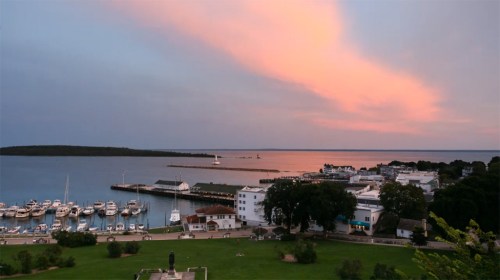
Sunset over Mackinac Island Harbor, photo by Stephanie Stevens Photography

Today’s photo is actually one frame of one of the coolest time-lapses I’ve seen, a time-lapse of Mackinac Island Harbor at the end of the day taken from Fort Mackinac that shows the end of the day boat traffic, the clouds playing across the harbor and even a little glow in the dark frisbee at Marquette Park! Click that link to check it out in HD glory on Flickr!

View more from Stephanie on her Flickr and at Stephanie Stevens Photography.

More Mackinac on Michigan in Pictures!

Fort Mackinac

fort-mackinac-mackinac-island-mi-by-bill-johnson

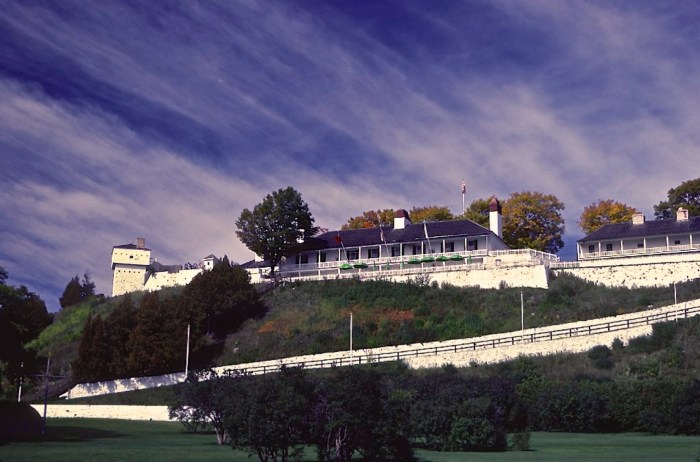
Fort Mackinac, Mackinac Island, MI, photo by Wrong Main

Every once and a while I come across something about Michigan that I can’t believe I haven’t featured. Here’s the latest…

Wikipedia’s comprehensive entry on Fort Mackinac explains that the first fort on the Straits of Mackinac was Fort Du Buade. Built by the French around 1690 near the St. Ignace Mission, Du Bade was closed in 1697. In 1715 the French constructed Fort Michilimackinac on the south side of the Straits where Mackinaw City is today. Michilimackinac became the hub of the upper Great Lakes fur trade and a French outpost until 1761 when British soldiers took control after the French and Indian War.

The Mackinac State Historic Parks history of Fort Mackinac continues:

By 1776 the American Revolution was underway. With the successes of George Rogers Clark in capturing British posts in the south, and American forces moving northward, the British grew anxious that Fort Michilimackinac , a wooden fort built on the beach, was vulnerable. Consequently, British Commandant Patrick Sinclair chose to relocate the fort to Mackinac Island where the high limestone cliffs and good harbor provided a more defensible location. Between 1779 and 1781 many buildings were taken apart on the mainland and reassembled on the island. What was not moved was burned. The civilian community was built around the bay below the fort. One of the first new buildings to be built on the island was the Officers’ Stone Quarters, the oldest building in the State of Michigan today.

The fort and island became United States territory as a result of the American victory in the Revolution. However, it took thirteen years for American troops to arrive and finally take control of the fort from the British. The latter were reluctant to leave the island, as British merchants continued to dominate fur trading, even in American territory. After leaving Fort Mackinac in 1796, the British went to St. Joseph’s Island, at the mouth of the St. Mary’s River and established Fort St. Joseph .

War broke out between the United States and Great Britain in the summer of 1812. Under the cover of darkness, a 300-man force of British soldiers and Native American allies embarked from Fort St. Joseph and landed on the north shore of Mackinac Island . They dragged their cannon to the high ground behind the fort, took positions in the woods and prepared to attack. American soldiers, about 30, were completely surprised and outnumbered by the British invasion. They quickly surrendered without a fight following a single warning shot by the British. This was the first land engagement of the War of 1812 in the United States .

You can read on to learn how the Americans ultimately got the fort back and how became a center of the Great Lakes fishing industry, its time as a Civil War prison, and the hub of the second national park in the U.S., Mackinac National Park. If you want to visit – bear in mind they close for the season October 13th!

Bill took this shot October 1, 1982 on Plustek OpticFilm 7600. Check it out background big, see more in his slideshow and definitely click to view his photo of the Mackinac Bridge taken on the same day.

More Mackinac on Michigan in Pictures, and get a little bit more about Michigan’s role in the War of 1812 in The Battle of Lake Erie.

Sugar Loaf Rock on Mackinac Island

Untitled

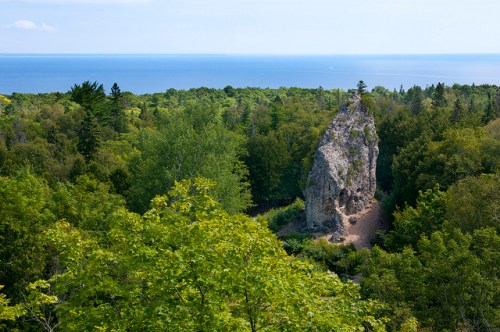
Untitled, photo by *Alysa*

I was surprised to learn that I haven’t posted anything about Sugar Loaf on Mackinac Island. Here’s a summary with help from Wikipedia’s entry for Sugar Loaf Rock, the Mackinac State Historic Parks geology page and some other sources I’ve linked to.

Located not far from the shoreline on the east side of Mackinac Island, Sugar Loaf is a 75′ breccia limestone stack. Thousands of years ago Lake Algonquin covered all but the center of Mackinac Island. When it receded, this tower of rock remained. The people of the region packed maple sugar into cone-shaped baskets of birchbark, and Sugar Loaf Rock was named for its resemblance to one of these cones.

Sugar Loaf was said by some to be the home of Gitchi Manitou, while another tale explains that the rock was the final form taken by a man who asked for immortality and received it, albiet not as he expected. A distinct profile remains in the limestone face of Sugar Loaf Rock. The rock was also used as a site of ritual burials. In 1831, Alexis de Tocqueville and his friend Gustave de Beaumont visited Mackinac Island. De Beaumont reported that the rock was filled with “crevices and faults where the Indians sometimes deposed the bones of the dead.” A natural cave passes through Sugar Loaf from side to side, but it’s too small for any but children.

Check out Anna Lysa’s photo out bigger and see more in her Mackinac Island slideshow.

More from Mackinac on Michigan in Pictures!

A birthday card from the Grand Hotel

View from West Bluff of The Grand Hotel

View from West Bluff of The Grand Hotel, photo by MI photographer

126 years ago today on July 10, 1887, The Grand Hotel opened for business on Mackinac Island. In honor of Michigan’s most famous hotel, here’s a seldom seen view.

Check it out bigger and see more in MI photographer’s Mackinac Island slideshow.

PS: The lighthouse you can see in the distance is Round Island Lighthouse – click the link to get closer with Michigan in Pictures.

Mackinac Island in Winter

Mackinac Island in the winter

Mackinac Island in the winter by SuzyQ0763, photo by SuzyQ0763

Mackinac Island is one of Michigan’s coolest places, drawing over 10,000 visitors a day for much of the summer. Winter on Mackinac is different though, and something that many of us never get to see.

The Arnold Line says that they keep boats running across until early January. After that, islanders use a six-seater plane operated by Great Lakes Air. Once the straits freeze (usually by February) folks can cross on snowmobiles, following the “bridge” marked by Christmas trees in the snow and ice between the Island and St. Ignace (click for a video).

If you’re interested in checking out the island in winter, the Mackinac Island Winter Festival takes place next weekend (February 1-3) at Great Turtle Park. The fun includes a bonfire cook out, sledding, snow golf, archery, snow volleyball, and broom hockey.

Check Suzy’s photo out background big or view all her photos from a winter’s day on Mackinac Island.

July 10, 1887 was a Grand day

Grand Hotel Pano (3 photo pano)

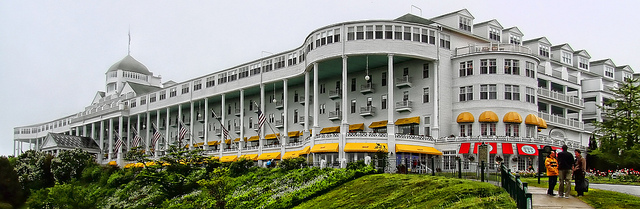
Grand Hotel Pano (3 photo pano), photo by raddad!

Today is the 125th birthday of the Grand Hotel on Mackinac Island which opened on July 10, 1887. Wikipedia’s Grand Hotel (Mackinac Island) entry explains:

In 1886, the Michigan Central Railroad, Grand Rapids and Indiana Railroad, and Detroit and Cleveland Steamship Navigation Company formed the Mackinac Island Hotel Company. The group purchased the land on which the hotel was built and construction began, based upon the design by Detroit architects Mason and Rice. When it opened the following year, the hotel was advertised to Chicago, Erie, Montreal and Detroit residents as a summer retreat for vacationers who arrived by lake steamer and by rail from across the continent. At its opening, nightly rates at the hotel ranged from US$3 to US$5 a night.

Grand Hotel’s front porch is purportedly the longest in the world at some 660 feet (200 m) in length, overlooking a vast Tea Garden and the resort-scale Esther Williams swimming pool.

Also see the History photo gallery from The Grand Hotel and a cool old travelogue on Mackinac Island.

Be sure to check Randy’s great panorama out bigger and in his Mackinac Island slideshow.

Fancy a stay at the Grand Hotel?

Privileged

Privileged, photo by cmu chem prof.

mLive reports:

Mackinac Island’s grande dame of lodging, recently named among the top 50 hotels in North America, is hosting its fourth wildly popular Celebrate Michigan promotion, during which residents of the state can stay for half the hotel’s usual rate.

The package costs $95 per person, per night (taxes and fees are extra), and is offered Sept. 11, Sept. 20-22, Oct. 3 and Oct 23. It includes one night’s lodging, a full breakfast and five-course dinner, Michigan-themed reception and complimentary golf green fees.

I feel like I have to mention a particular movie that was shot here so let me say that if you’re interested, you probably better act fast so you can be somewhere in time for this offer which usually sells out. ;)

Seriously, while there’s no doubt that the Grand Hotel can be a little hoity, but the Mackinac Island landmark is also one of the coolest properties in Michigan. This morning I sorted through photos of the Grand Hotel from the water, the Grand Hotel’s signature front porch (including a very interesting composition on the porch), a panorama of the Grand Hotel and even a sight I’d never seen in quite this way, the Grand Hotel at night. Next year the hotel turns 125, so I’ll return then for some of the history and such.

Check it out big as the Grand and in Phil’s massive Northern Michigan slideshow.