
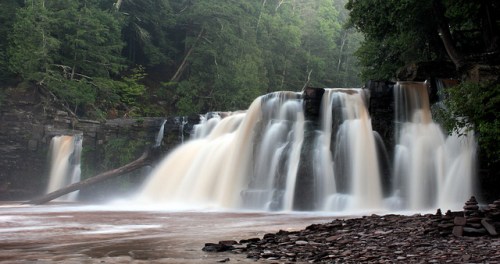
Manabozho and His Toe … and his waterfall

Manabezo Falls.

Manabezo Falls., photo by one lost backpacker

The stories of the people native to Michigan are among my favorite. One reason is for the pervasive humor that enriches them. Manabozho was definitely a trickster, one of four divine brothers in Algonquin tales. Via the Literature Network, here’s Manabozho and His Toe:

Manabozho was so powerful that he began to think there was nothing he could not do. Very wonderful were many of his feats, and he grew more conceited day by day. Now it chanced that one day he was walking about amusing himself by exercising his extraordinary powers, and at length he came to an encampment where one of the first things he noticed was a child lying in the sunshine, curled up with its toe in its mouth.

Manabozho looked at the child for some time, and wondered at its extraordinary posture.

“I have never seen a child before lie like that,” said he to himself, “but I could lie like it.”

So saying, he put himself down beside the child, and, taking his right foot in his hand, drew it towards his mouth. When he had brought it as near as he could it was yet a considerable distance away from his lips.

“I will try the left foot,” said Manabozho. He did so and found that he was no better off, neither of his feet could he get to his mouth. He curled and twisted, and bent his large limbs, and gnashed his teeth in rage to find that he could not get his toe to his mouth. All, however, was vain.

At length he rose, worn out with his exertions and passion, and walked slowly away in a very ill humour, which was not lessened by the sound of the child’s laughter, for Manabozho’s efforts had awakened it.

“Ah, ah!” said Manabozho, “shall I be mocked by a child?”

He did not, however, revenge himself on his victor, but on his way homeward, meeting a boy who did not treat him with proper respect, he transformed him into a cedar-tree.

“At least,” said Manabozho, “I can do something.”

If you’d like more of Manabohzo, check out Manabohzo and the Ultimate Fish Story which might make you a bit more kindly disposed to seagulls.

Check out Randy’s photo background bigtacular and see more in his amazing Michigan Upepr Peninsula 2013 slideshow.

More about Manabezho Falls on Michigan in Pictures.
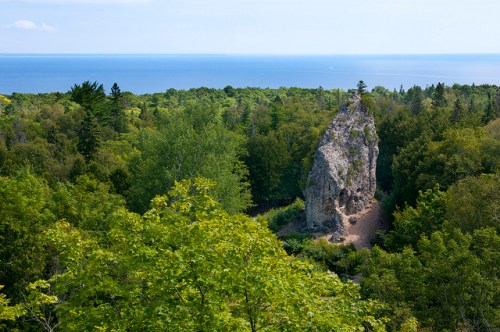
Sugar Loaf Rock on Mackinac Island

Untitled

Untitled, photo by *Alysa*

I was surprised to learn that I haven’t posted anything about Sugar Loaf on Mackinac Island. Here’s a summary with help from Wikipedia’s entry for Sugar Loaf Rock, the Mackinac State Historic Parks geology page and some other sources I’ve linked to.

Located not far from the shoreline on the east side of Mackinac Island, Sugar Loaf is a 75′ breccia limestone stack. Thousands of years ago Lake Algonquin covered all but the center of Mackinac Island. When it receded, this tower of rock remained. The people of the region packed maple sugar into cone-shaped baskets of birchbark, and Sugar Loaf Rock was named for its resemblance to one of these cones.

Sugar Loaf was said by some to be the home of Gitchi Manitou, while another tale explains that the rock was the final form taken by a man who asked for immortality and received it, albiet not as he expected. A distinct profile remains in the limestone face of Sugar Loaf Rock. The rock was also used as a site of ritual burials. In 1831, Alexis de Tocqueville and his friend Gustave de Beaumont visited Mackinac Island. De Beaumont reported that the rock was filled with “crevices and faults where the Indians sometimes deposed the bones of the dead.” A natural cave passes through Sugar Loaf from side to side, but it’s too small for any but children.

Check out Anna Lysa’s photo out bigger and see more in her Mackinac Island slideshow.

More from Mackinac on Michigan in Pictures!

Over the Moon with a Sandhill Crane

Over the moon

Over the moon, photo by TBPICKS

The 1896 book Myths and Legends of our Own Land by Charles M. Skinner relates a rather gruesome version of the tale of the origin of Whitefish, which this photo reminded me of.

An Indian who lived far in the north was so devoted to the chase that he was never at home for the whole of a day, to the sorrow of his two boys, who liked nothing so much as to sport with him and to be allowed to practise with his weapons. Their mother told them that on no account were they to speak to him of the young man who visited the lodge while their father was away, and it was not until they were well grown and knew what the duty of wives should be that they resolved to disobey her. The hunter struck the woman dead when he learned of her perfidy. So greatly did her spirit trouble them, however, that they could no longer abide in their old home in peace and comfort, and they left the country and journeyed southward until they came to the Sault Sainte Marie.

As they stood beside the falls a head came rolling toward them on the earth—the head of the dead woman. At that moment, too, a crane was seen riding on the surface of the water, whirling about in its strongest eddies, and when one of the boys called to it, “O Grandfather, we are persecuted by a spirit; take us across the falls,” the crane flew to them. “Cling to my back and do not touch my head,” it said to them, and landed them safely on the farther shore.

But now the head screamed, “Come, grandfather, and carry me over, for I have lost my children and am sorely distressed,” and the bird flew to her likewise. “Be careful not to touch my head,” it said. The head promised obedience, but succumbed to curiosity when half-way over and touched the bird’s head to see what was the matter with him. With a lurch the crane flung off his burden and it fell into the rapids. As it swept down, bumping against the rocks, the brains were pounded out and strewn over the water. “You were useless in life,” cried the crane. “You shall not be so in death. Become fish!” And the bits of brain changed to roe that presently hatched to a delicate white fish, the flesh whereof is esteemed by Indians of the lakes, and white men, likewise. The family pitched a lodge near the spot and took the crane as their totem or name-mark. Many of their descendants bear it to this day.

The version I read in one of my all-time favorite books, Lore of the Great Turtle : Indian Legends of Mackinac Retold by Dirk Gringhuis is pretty dark as well. Michigan in Pictures has a post with all the information about Sandhill Cranes in Michigan, and you can also check out Sandhill Crane (Grus canadensis) from the Michigan DNR.

View this out on black and see more in Todd’s slideshow.

More birds on Michigan in Pictures.

The Red Dwarf of Detroit and Other Ghostly Tales

2011 March Du Nain Rouge, Detroit, MI

2011 March Du Nain Rouge, Detroit, MI, photo by vanessamiller.

The last Wednesday of every month is a Weird Wednesday on Absolute Michigan, a time for stories of the spooky and strange. Definitely click that link to get your Halloween on, Michigan style, with stories from the Rowdy Ghosts of the Fenton Hotel to The Ghost of Minnie Quay.

Today’s tale is one of our favorites, the story of the Imp of Detroit, the Nain Rouge who some say has plagued the city since its founding over 300 years ago. It begins:

Among all the impish offspring of the Stone God, wizards and witches, that made Detroit feared by the early settlers, none were more dreaded than the Nain Rouge (Red Dwarf), or Demon of the Strait, for it appeared only when there was to be trouble. In that it delighted. It was a shambling, red-faced creature, with a cold, glittering eye and teeth protruding from a grinning mouth. Cadillac, founder of Detroit, having struck at it, presently lost his seigniory and his fortunes. It was seen scampering along the shore on the night before the attack on Bloody Run, when the brook that afterward bore this name turned red with the blood of soldiers. People saw it in the smoky streets when the city was burned in 1805, and on the morning of Hull’s surrender it was found grinning in the fog. It rubbed its bony knuckles expectantly when David Fisher paddled across the strait to see his love, Soulange Gaudet, in the only boat he could find, a wheel-barrow…

Read on for more, including more recent tales like the 1976 sighting by two employees of Detroit Edison of a small “child” climbing a utility pole on March 1st who then leaped from the top of the twenty-foot pole and scurried away. The next day Detroit was buried in one of the worst ice/snowstorms in its history.

Every March, the people of Detroit conduct the Marche Du Nain Rouge, a celebration to drive the Red Dwarf from the city. Vanessa got this shot there – see it bigger and in her 2011 March du nain rouge slideshow.