Space Weather and Starbreeze

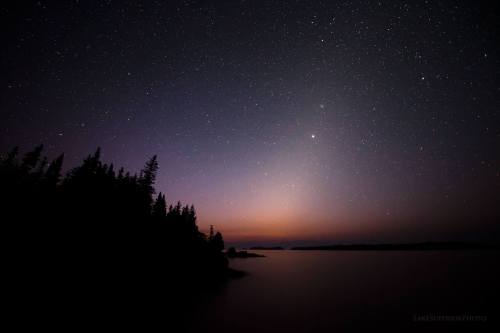
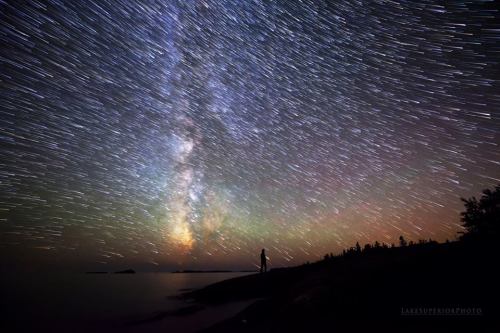
Isle Royale Star Breeze

Isle Royale starbreeze, photo by Shawn Malone/Lake Superior Photo

If you’re a watcher of the northern lights or want to be, NOAA’s Space Weather Projection Center at spaceweather.gov is a resource you should be aware of. It’s packed full of all kinds of data on what’s happening on the sun and how that impacts us here on earth.

Yesterday they updated to an all-new site that I encourage you to check out. The coolest things I found so far are the Space Weather Enthusiast Dashboard and the 30 minute aurora forecast, a seriously awesome visualization of aurora potential. Be sure to subscribe to their space weather alerts for tips on when the aurora borealis might be visible!

Shawn says that the stars were screaming that night at Isle Royale National Park. View her photo bigger on the Lake Superior Photo Facebook, and if you like you can purchase the photo right here. And speaking of northern lights, be sure to click for a time-lapse of the aurora over Isle Royale with a very cool soundtrack she recorded of loons on the island.

More northern lights and more Isle Royale on Michigan in Pictures.

Zodiacal Light on Isle Royale

Zodiacal Light by Shawn Malone

Zodiacal Light on Isle Royale, photo by Shawn Stockman Lightseeker/Lake Superior Photo

The Earth Science Picture of the Day is pretty much my favorite photo blog. Regarding the Zodiacal Light, Rudi Dobesberger and blog curator Jim Foster wrote:

Zodiacal light is now thought to be caused by dust particles scattering sunlight in the orbits of comets. In both hemispheres it’s best observed in late winter/early spring after sunset and late summer/early fall before sunrise. However, it can be detected before astronomical twilight (morning) or after astronomical twilight (evening) at other times of the year as well, providing that the sky is quite dark.

Head over to the EPOD for more and definitely subscribe!

The photo above is from Shawn’s recent journey to Isle Royale. Follow her at Lake Superior Photo on Facebook and view and purchase many more photos – including a gallery of Isle Royale pictures –  on her website.

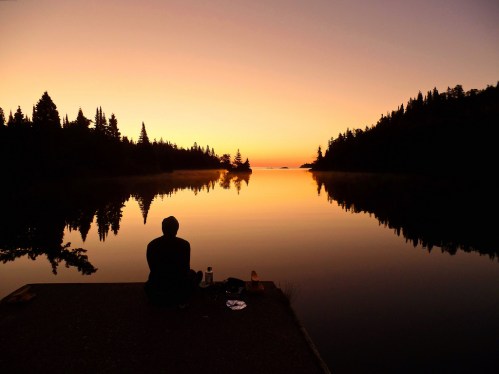
Morning coffee at Chippewa Harbor

Chippewa Harbor Isle Royale

Morning coffee at Chippewa Harbor, photo by Brent West

Hard to imagine a more beautiful spot to enjoy your morning joe than Chippewa Harbor at Isle Royale National Park.

You can view Brent’s photo bigger and click for a couple more of his Isle Royale shots.

Lots more from Isle Royale on Michigan in Pictures.

Rock of Ages Lighthouse is Michigan’s tallest

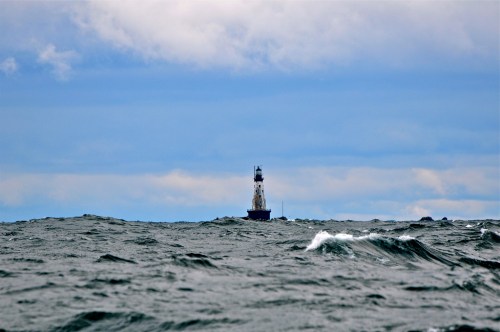
Rock of Ages Lighthouse

Rock of Ages Lighthouse, photo by Dave

I was looking for something on Michigan in Pictures and came across a series of “Michigan’s Tallest” posts that I did a couple of years ago. I thought it made sense to add to that list, so – according to Wikipedia’s list of the tallest lighthouse towers in the United States – measuring in at 130′ tall, Rock of Ages is Michigan’s tallest lighthouse.

It’s also the tallest lighthouse on the Great Lakes and on his Rock of Ages Light page at Seeing the Light, Terry Pepper writes (in part):

Consisting of a strip of exposed rock 50 feet wide and 210 feet long, with it highest point some sixteen feet above the water, Rock of Ages lies two and a half miles off the western end of Isle Royale. While the 205-foot wooden sidewheel steamer CUMBERLAND had been the rock’s only victim in over a half century of Superior navigation, changing navigation patterns in the final decade of the nineteenth century suddenly made Rock of Ages a critical impediment to safe navigation on the big lake.

As Duluth grew to preeminence as the lake’s major shipping port, a growing number of mariners were choosing to set a course along the northern shore during Superior’s violent storms in order to avoid the uncertain and changeable conditions of open water. With Rock of Ages lurking directly in the path of vessels choosing this course, a cry arose in the maritime community for the establishment of a Light on Rock of Ages.

…On completion, the tower stood eight stories in height, and offered relatively large and comfortable quarters for the complement of four keepers assigned to the station. A steam heating plant located in the upper cellar provided heat to cast iron radiators in all rooms, and the first deck was home to the fog signal plant and hoisting engines for the pillar crane located at the edge of the pier level. This crane was used both for raising supplies delivered by the lighthouse tenders at the wharf and for raising the keeper’s boat for storage on the safety of the pier deck. An office and common room made up the second deck, and a mess room and kitchen the third. The Keeper and First Assistant’s quarters were located on the fourth deck, with the Second and Third Assistants quarters immediately above on the Fifth deck. A service room and watch room comprised the sixth and seventh decks, leaving the huge lantern capping the structure above.

Much more at Seeing the Light including an aerial photo of this lonely location. Terry has a listing of verified tower heights for anyone who’s interested too.

About the photo, Dave writes: Photo taken from the back of Voyageur II heading into Windigo with 7 foot waves at 300mm. Yeah I almost got sea sick from taking these.

View his photo bigger and see more in his Lighthouses of Michigan slideshow.

More lighthouses on Michigan in Pictures.

Winter Study: Observing Wolves & Moose on Isle Royale

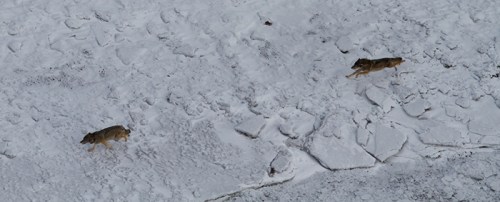
Isabelle being chased by her assailant

Isabelle being chased by her assailant, photo by isleroyalewolf.org

A couple of weeks ago a reader sent me a link isleroyalewolf.org. The website documents the interactions of the island’s wolf & moose population as their decades long dance unfolds on this remote, wilderness island. Their overview explains:

Isle Royale has offered many discoveries… how wolves affect populations of their prey, how population health is affected by inbreeding and genetics, what moose teeth can tell us about long-term trends in air pollution, how ravens give wolves a reason to live in packs, why wolves don’t always eat all the food that they kill, and more. The wolves and moose of Isle Royale also frequently reveal intimate details of their daily life experiences and they have inspired numerous artistic expressions. If we pay attention, they all tell us something important about our relationship with nature. These insights and discoveries are all presented here for you.

Building on the graph above and to develop a deeper understanding, here is more on the history of wolves and moose on Isle Royale. Moose first came to Isle Royale in the early 20th century, and for fifty years, their numbers fluctuated with weather conditions and food abundance. Wolves first arrived in the late 1940s by crossing an ice bridge from Canada. The lives of Isle Royale moose would never be the same.

Every winter since 1958, a team of researchers has spent numerous weeks at Isle Royale observing the lives of these wolves and moose and reporting back. Now they offer a website with photos and detailed reports, a fascinating tale that I encourage you to follow. Today’s photo is from the edition I began with – It’s Complicated. A snapshot:

Isabelle’s signal was surprisingly close. By the time we saw her, she was running for her life, north along the beach of Rainbow Cove. She was being chased by Pip’s two companions. Pip was nowhere in sight. While those two wolves have been eating regularly, Isabelle may not have had a decent meal in weeks, perhaps longer. Isabelle’s half-mile lead was reduced to nothing in just a few minutes.

Definitely read on for photos and a gripping account of these wolves battling and follow the whole 2013 Winter Study as it unfolds (sign up for their email).

More wolves on Michigan in Pictures.

The Michigan Moose Lift

Like posts like this? Please consider supporting Michigan in Pictures through Patreon!

Michigan Moose Reflections

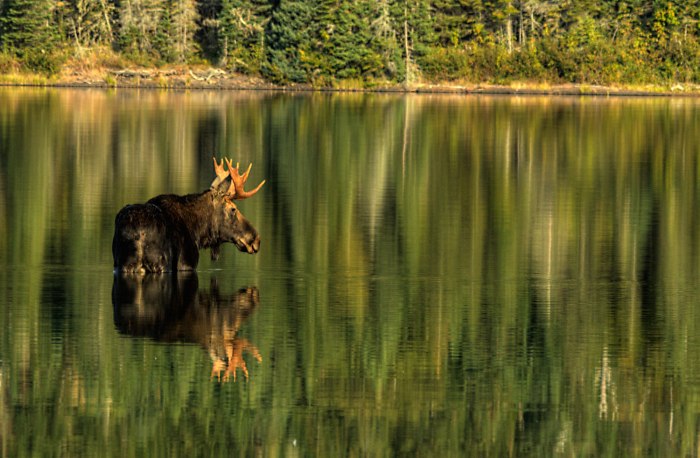
Moose Reflections, photo by yooper1949

NOTE: I’ve edited this post because the State of Michigan removed it from the internet. Thank you archive.org for saving it via The Wayback Machine so I could share it in its entirely!

Remembering Michigan’s Historic Moose Lift from the Michigan DNR says:

On Jan. 20, 1985, separate convoys carrying men and equipment set out from Michigan on a mission to reach the 3,000-square-mile Algonquin Provincial Park in Ontario, Canada.

Over the next two weeks, this team of wildlife biologists and veterinarians from the Michigan Department of Natural Resources, working with a team of Canadian specialists from the Ontario Ministry of Natural Resources, would locate, capture, transport and release a number of wild moose to form the nucleus of a new population in Michigan’s Upper Peninsula.

It was an unprecedented, historic operation. The wind chill at times approached 100 degrees below zero. Utilizing helicopters, tranquilizing dart guns and slings, some moose were air-lifted as far as 14 miles from the capture area to base camp.

At base camp, each animal was subjected to thorough medical testing and was fitted with a sophisticated radio collar, before being lifted into a shipping crate and placed onto a transport truck for the non-stop 600-mile overnight journey back to Michigan.

The remarkable effort was called “moose lift.” A total of 29 moose (10 bulls, 19 cows), ranging in size from 750 to 1,250 pounds, survived the arduous journey.

Crowds assembled each day at the release site north of Lake Michigamme in Marquette County. Despite temperatures well below zero, a welcoming committee of U.P. residents always showed up to greet the new “American” citizens.

As we mark the 20th anniversary of the first moose lift, the most common question that arises is, “How are the moose doing now?”.

“The department’s goal was to produce a self-sustaining population of free-ranging moose, and we have that,” said Dean Beyer, wildlife research biologist for the Michigan Department of Natural Resources.

Since the first moose lift in 1985, and a similar effort two years later when another 30 moose were released in the same area, the DNR has closely monitored the reintroduced moose population.

“At first, the size and growth of the herd was determined through a simple process–similar to balancing a checkbook,” Beyer said. “Because all moose were radio-collared, biologists could monitor each animal and tell when it died, and they could follow cows to record any births. The population could be tracked simply by adding the number of calves born and subtracting the number of animals that died.”

As the population grew, the new animals in the herd did not have radio collars.

“Over time, maintaining an adequate sample of radio-collared animals for the population would not be feasible,” Beyer said.

So in 1996 and 1997, the DNR conducted aerial surveys, which are the most common method of estimating moose numbers. Unfortunately, the population estimates from the aerial surveys were lower than estimates from the population model.

“At that point we knew we needed to conduct a more intensive study of the reintroduced population,” Beyer said. “And we also wanted to determine a more accurate picture of what’s reasonable growth for this population.”

With the help of the Michigan Involvement Committee of Safari Club International, which also provided the single largest financial contribution to the first moose lift, the DNR began a more intensive study of the reintroduced population in 1999, in cooperation with Michigan State University.

“Our research team is developing a technique to estimate the size of the population by estimating the probability of seeing moose from an airplane given the group size; behavior, whether the animal is standing or bedded; and the amount of canopy cover,” Beyer said.

When the moose were reintroduced into the western Upper Peninsula, biologists hoped the population would grow to 1,000 animals by the year 2000. Although that objective was not reached, results of the current study indicate the population is growing, on average, between five and ten percent each year. The research also has shown that poaching, moose/car accidents, brainworm and wolves are not major factors influencing the moose population at this time.

According to Beyer, the herd ranges over approximately 1,800 square miles in Marquette, Baraga and Iron counties. Moose also are found in several parts of the eastern U.P., most notably around the Tahquamenon River.

“Moose in this region have not been studied in detail,” he said.

Although records from the early explorers show that moose were common throughout Michigan, by the late 1800s moose numbers were very low. Moose soon disappeared from the Lower Peninsula and only a small number survived in the U.P., perhaps supplemented by animals coming in from Minnesota and Canada.

Thanks to the vision and hard work of many DNR biologists a generation ago, moose are once again establishing themselves as a premiere Michigan mammal.

Several U.P. communities, in fact, now vie over the self-proclaimed title, “Moose Capital of Michigan.” Mascots, motels, restaurants, candy and even ice cream are named after the mighty moose. Its image is common on billboards, television, artwork and printed materials. But most importantly, moose are alive and well, and rambling about in the wilds of Michigan’s Upper Peninsula once more.

Here’s a great video about the Moose Lift – highly recommended!

The last DNR moose survey pegs the UP’s moose population at about 500 with another 750 on Isle Royale.

Carl took this shot on Isle Royale in September. Check it out big as a moose and see much more (including some more moose shots) from one of Michigan’s coolest parks in his Isle Royale slideshow.

More moose on Michigan in Pictures!

Hiking Isle Royale: Trails, Wolves and Minong Mine

Minong Mine

Minong Mine, photo by nasunto.

Nina went to Isle Royale in September and has been posting accounts on her awesome blog Black Coffee at Sunrise. This photo of Minong Mine appears in Day Five, which features a detailed description of their encounter with a pack of wolves:

Since the vegetation along the narrow trail was dripping with dew and leaning inward, it wasn’t long before we were both soaking wet from hip to ankle. Ten minutes after leaving our campsite, the ground became marshy and we found ourselves walking a long stretch of protective plank bridge. Just before reaching the stream crossing, the trail curved to the right and Craig suddenly stopped in front of me, turned around and said very calmly, “Uh…a whole pack of wolves…”

His voice trailed off as he turned back around to face forward again. I thought he was trying to be funny since I couldn’t yet see what was around the corner. After inching forward another foot or so, he turned to me again and the look on his face was priceless. “I’m not kidding,” he said. “There are at least five wolves on the trail ahead of us.” The next few moments were the most surreal and exciting I’ve ever experienced.

Read on at her blog for the rest of the account or see them all in her Isle Royale section.

Be sure to check this out bigger or in her Isle Royale set (slideshow).

You can learn a little bit about Minong Mine and see a picture of a 6000 pound copper nugget right here.

Check out many more Isle Royale photos on Michigan in Pictures.