

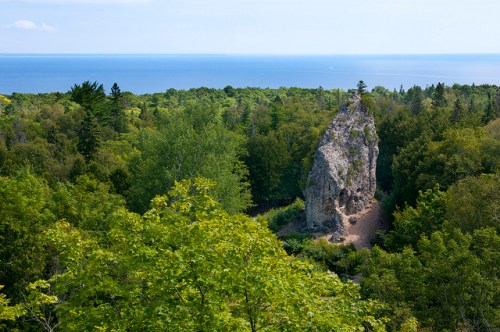
Grand Mere Dunes, photo by mswan777
Grand Mere State Park is located on the southwestern shore of Lake Michigan near Stevensville. The Environmental Protection Agency’s Sand Mine Restoration Plan explains that Grand Mere:
…contains some of the most unique sand dune features in the world. The park also contains three lakes, called North, Middle, and South Lake, and has over one mile of Lake Michigan frontage. The sand dunes within the park are part of the largest freshwater dune system in the world, lining the shores of the Great Lakes. These dunes historically supported a wide array of natural communities, including dry-mesic southern (oak-hickory) forest, rich conifer (cedar) swamp, southern (mixed hardwood) swamp, wetpanne and interdunal wetland (shrub swamp/emergent marsh), open dunes, and a wooded dune and swale complex.
The dunes at Grand Mere fall within a state-designated “Critical Dune Area.” The area containing the present-day park was also designated a National Natural Landmark in 1968. The park was first created on 393 acres of land in 1973, and more than doubled in size with the acquisition of 490 additional acres in 1986. The master plan for Grand Mere State Park, approved in 1986, cited “sand dune preservation” as the primary management objective for the park. A highly diverse flora exists at Grand Mere, with over 550 species of plants documented within the park. Furthermore, Grand Mere lies in a unique place on the southern shore of Lake Michigan where plants typical of both northern and southern temperate latitudes grow together in the same community. Because of the unique flora, fauna, and geology of the dune and wetland features at Grand Mere, the park has long been used as an “outdoor laboratory” for natural resource teaching and research.
…Within the park, the dominant landforms are the sand dunes along the shore of Lake Michigan. A large bay of the glacial Great Lakes was present where Grand Mere State Park is today. During Algonquin Great Lakes time (roughly 12,000 years ago), a large spit formed from the south along the west side of the bay, nearly cutting it off from the glacial lake (Tague 1947). Most of the dunes at Grand Mere formed on this Algonquin sand spit during the later Nipissing Great Lakes period, approximately 4,500 years ago. During the more recent post-Algoma period (3,000 years ago until present), a smaller spit from the north merged with the larger, dune covered southern spit, closing off the bay. As water levels fell, five lakes formed in this bay. The two southern lakes have subsequently filled in and have become the present-day tamarack swamp south of South Lake. While the lakes were forming in the bay as water levels fell, some smaller foredunes were formed along the shoreline of Lake Michigan. The topography and sandy soils of the park can be attributed to this glacial history.
Read on for more about the history & geology of this unique park, and check out Grand Mere State Park on the Absolute Michigan Map.
View Mark’s photo background big and see more in his Michigan – Color slideshow.
More dunes on Michigan in Pictures.

 Michigan in Pictures