Frog Sex: It’s Complicated

Frog Sex Its Complicated

BACKYARD NATURE, photo by John E Heintz Jr

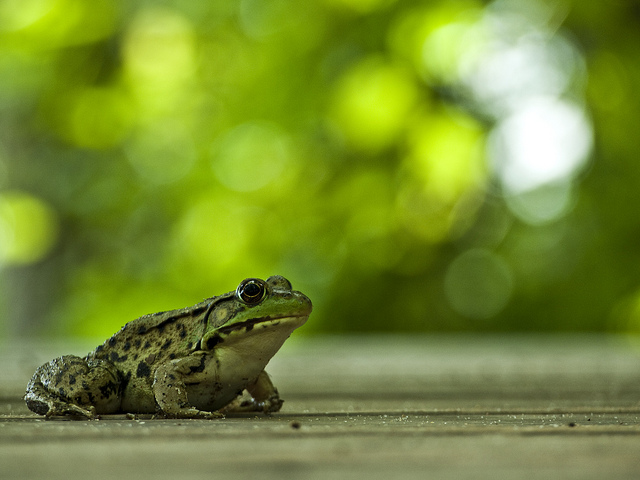
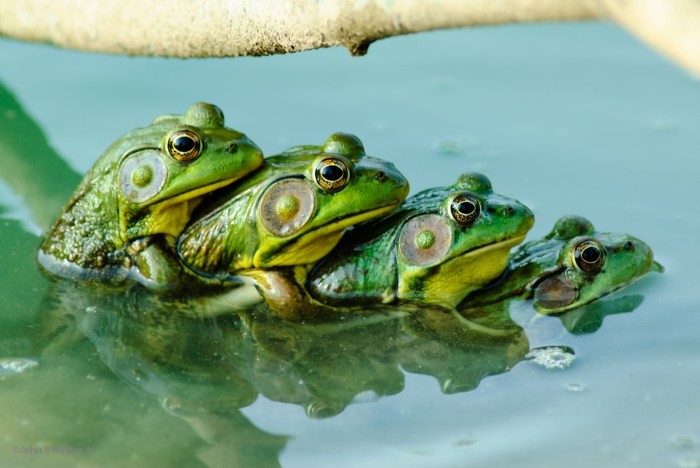
April is the time when we start to hear some of Michigan’s 13 species of frogs and toads making noise. While the green frogs pictured above were confusing their Frogbook friends in July, most of the distinctive spring frog calls are males advertising that they’re looking for love. The Michigan frog & toad page from the DNR explains:

As temperatures rise in early spring, frogs begin to move to their breeding sites. The actual timing depends on the warmth of the air and water, and the humidity, but there is noticeable order in which the various Michigan species become active and begin voicing their breeding calls. For example, in southern Michigan the raspy voice of the Western Chorus Frog is usually heard first, often in late March, followed quickly by the highpitched peeps of the Spring Peeper. In a few days the woodland swamps are filled with the quack like calls of the male Wood Frogs, while in another week in open marshes the low snores of the Leopard Frog are barely heard over the squeaky songs of newly arrived Red Winged Blackbirds.

The first warm rains of April bring American Toads out of the woods to the breeding ponds, where the air is soon filled with their melodious trills. Several of our frogs postpone their breeding activities until later in spring, when air and water temperatures are higher. Included in this late group are the Gray Tree Frog, Blanchard’s Cricket Frog, and Green and Bull Frogs.

Frogs are far more often heard than seen. Most frog sounds are the advertisement calls of the males, intended to attract the females for breeding. Frog voices may carry for long distances, especially the higher pitched calls of the smaller species. The males increase the loudness of their calls by ballooning out their throats or special sacs at the sides of their throats, creating a kind of resonating chamber. Only males produce advertisement calls, but both sexes may give shorter warning calls or screams when danger threatens. Males can also produce distinct calls that warn away rival males that approach their calling or breeding sites.

Female frogs and toads may lay hundreds or even thousands of eggs. These are usually attached to underwater vegetation or left floating in large masses at the surface. During egg laying, the male clings to the female’s back and fertilizes the eggs. The small, dark eggs are protected by layers of a jelly like substance. They may be in rounded masses (as in Wood and Leopard Frogs), loose clusters (Gray Tree Frogs), long necklace like strings (Toads), thin surface films (Bull and Green Frogs), or deposited singly or in small clusters (Spring Peeper). Many frog eggs are eaten by predators such as fish, turtles, and aquatic insects, or are lost to drying or destruction by micro organisms.

Read on for more and also read more about the frog life cycle from All About Frogs.

Check this out on black and see more in John’s BACKYARD NATURE slideshow.

More frogs & toads and more of our “Best Friends in Nature” series on Michigan in Pictures!
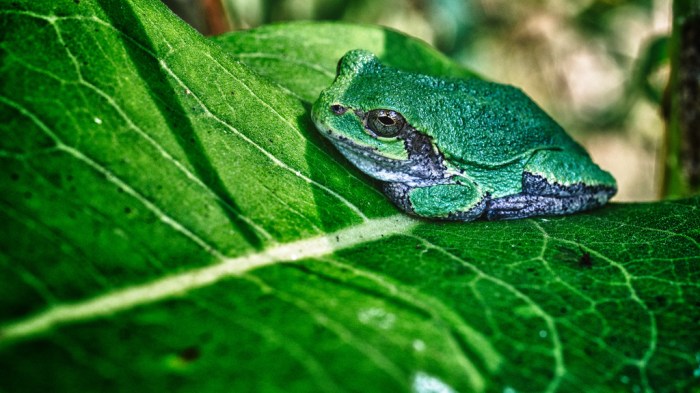
The Gray Treefrog doesn’t care if you’re confused

Gray Tree Frog

You Can’t See Me, photo by MacDonald_Photo (Formerly Sl33stak)

Michigan has two species of Gray Treefrog – the Eastern (Hyla versicolor) and Cope’s (H. chrysoscelis) that are hard to distinguish, sometimes even sharing the same ponds. Check out the Hyla versicolor page at the UM Animal Diversity Web for a bit about that. Their color spans a range of gray, green or brown according to environment or activity. See a collection of photos showing their wide range of color at the UM Animal Diversity Web.

They can be found in woods, swamps and your own backyard. Their ability to climb vertically & horizontally is due to their specially adapted toe pads, and you’ll sometimes find them on your screen windows at night. You’ll hear their short musical trill on warm spring & summer nights.

Jamie writes that he walked 20′ into the woods off a heavily used path and ran into this little guy – small as his thumb and sitting on a milkweed. Check this out background bigtacular and see more in his Fauna slideshow.

More Michigan frogs on Michigan in Pictures. Or, for something different, here’s what we have for green!

Omagakii: Frog in Anishinaabemowin

Ribbit Tell'em

Ribbit Tell’em, photo by EEKaWILL

Spring is frog season, and today’s Anishinaabemowin word of the day is Omagakii which means frog. Omagakiins means little frog and Omagakiinsag means little frogs.

Anishinaabemow.in is a very cool (though no longer updated) website that used short videos to teach words and short phrases in Anishinaabemowin. They explain that:

Anishinaabemowin is the traditional language of the Anishinaabe people. It is sometimes referred to as Ojibwe, Ojibway, Saulteaux or Indian by people in the community. Outsiders sometimes refer to it as Ojibwa or Chippewa. On this site we refer to it by the proper name in the language Anishinaabemowin.

Some facts about Anishinaabemowin

  • During the Fur Trade era Anishinaabemowin was referred to as the ‘Lingua Franca’ or trade language of what is now called Canada, meaning at one time if you wanted to conduct business here you had to speak Anishinaabemowin
  • At one time Guiness Book of World Records listed Anishinaabemowin as having the most complex verb structure of any language in the world, a testament to the intellectual capacity of our ancestors
  • A number of English words are adopted from Anishinaabemowing including Totem (used in Freudian studies and to refer to West Coast art) which is adapted from Dodem or clan, Mocassin (leather slipper) which is adapted from Makasin or shoe and countless place names.
  • Anishinaabemowin is spoken in communities from Quebec to British Columbia, From Northern Ontario to the Midwestern United States. The diffusion of speakers means that it is now spoken in places where there never were Anishinaabeg before.
  • Old Anishinaabeg don’t die, they just Maazhiwe.

Check Will’s photo out bigger and also see the Frog slideshow from the Absolute Michigan pool!

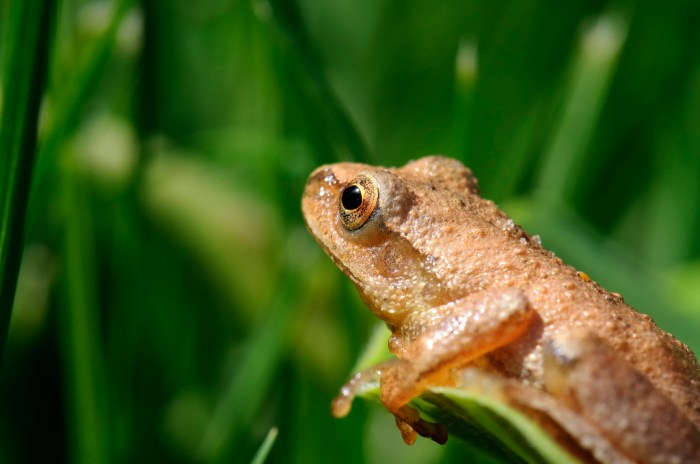
Signs of Spring in Michigan: Spring Peepers (Pseudacris crucifer)

Spring Peeper Pseudacris crucifer

Untitled, photo by Tim Mayo.

The Michigan DNR’s page on Northern Spring Peeper (Pseudacris crucifer) says:

The tinkling of bells is a popular description of the spring peeper’s spring mating call. Spring peepers are one of the earliest callers among the dozen frog species found in Michigan. During the first warm evenings of spring in late March or early April through May, their distinctive single note, high pitched “peep” is considered a harbinger of spring. The intensity of calling increases and can become a deafening chorus during humid evenings or just after a warm spring rain when many males congregate.

Only the male frogs call. They establish territories near the edge of permanent or ephemeral wetlands. They may call from elevated perches of submerged grass or shrubs near the water. The faster and louder a male sings, the more likely he is to attract a mate.

The female will lay between 750-1,200 eggs. The strings or clumps are attached to twigs and aquatic vegetation. Depending on the temperatures, eggs may hatch within four days or may take up to two weeks during cooler periods. After another two to three months, young tadpoles are fully transformed into young frogs and leave the pond.
They resemble their parents with the most distinctive mark being a dark brown “X” (may be irregular or incomplete on some) on their lighter brown or tan back. They begin feeding on small food items like spiders, mites, ticks, pill bugs, ants, and caterpillars. By the end of the summer, they have reached the adult size of about 1 – 1 1/2 inches. As the days cool, the peepers dig into the soft mud near ponds for the winter. Still, during warm spells into the fall they can be confused and emerge to give their spring mating call.

The spring peeper is the most abundant of Michigan’s singing frogs and is common statewide. They prefer damp woodlands, swamps, and marshes. However, they still need protection – local populations around small ponds and wetlands can be highly susceptible to surface water runoff. These waters can carry chemicals, pesticides, or silt that can kill adults, eggs, or tadpoles. Good soil erosion practices and the careful application of pesticides and fertilizers are good for spring peepers.

The most distinctive thing about peepers is their call, which can become deafening in springtime. The Pseudacris crucifer (Spring Peeper) section from UM Animal Diversity Web has a short peeper call from Livingston County, and you can see a peeper peeping in this video.

Some more peeper particulars: Wikipedia’s Spring Peeper entry notes that their calls can be heard from as far as 1 – 2.5 miles depending on the number of peepers in a pond, that peepers generally like to breed when it is closer to dusk and throughout the evening and early morning hours, and that peepers can live up to 3 years in the wild. At Portage Lake in Washtenaw County, Michigan in the 1950s, surveys in March, April, and May found that spring peepers were the most abundant animals. The page on peepers from watersheds.org notes that spring peepers produce glucose (sugar) in their livers that acts as an anti-freeze and is pumped to vital organs including the heart and lungs to allow them to freeze and thaw without developing ice crystals. Our Peeper-pedia on Absolute Michigan has a few more links and a cool video of a Michigan peeper in action.

Check Tim’s photo out bigger and in his PJ Hoffmaster State Park slideshow.

More frogs on Michigan in Pictures.

It ain’t easy being a frog…

It ain't easy...

It ain’t easy…, photo by stevedontsurf.

Steven writes that: Actually, on this day, it seemed pretty easy being green. This guy was eating fly after fly as I snapped away. Must’ve had 5-6 flies in about as many minutes. He looked like lack of food was not an issue. Check it out background big and in his slideshow.

Coincidentally, I came across an article this morning about a nasty fungus called chytrid that has been the culprit of 94 out of 122 frog extinctions since 1980 and that can also affect some toads and salamanders. Brian Gratwicke of the Smithsonian’s National Zoo says:

“There’s frogs all around the world being affected. There’s amphibians that have gone extinct in Australia, in the Caribbean, in North America, in South America, in Central America.”

…There is also a real cost to humans from the frog extinctions. Frogs’ skins are anti-microbial factories. They’ve produced compounds that kill superbugs in hospitals.

“There’s a species of frog in Australia that produces a chemical called caerin, which blocks HIV transmission to T-cells,” Gratwicke says. “The untapped resources of our amphibian biodiversity are virtually unknown.”

Click through to read much more and also check out the Gray Tree Frog (Hyla versicolor) on Michigan in Pictures.

Know Your Michigan Frogs: Northern Leopard Frog

Northern Leopard Frog

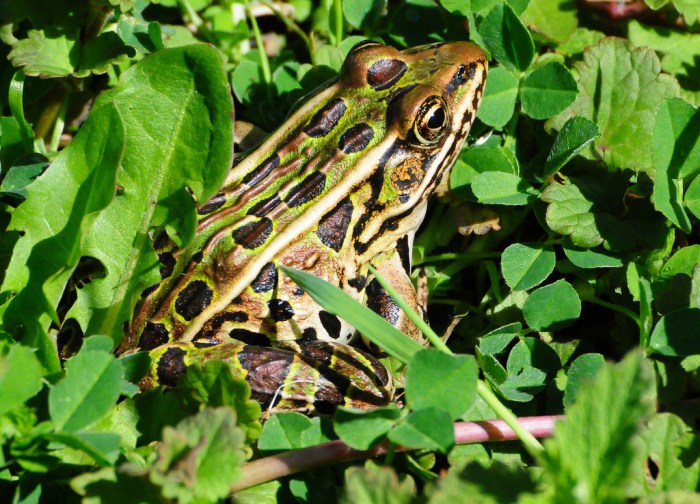
Northern Leopard Frog, photo by Adore707.

National Geographic’s Northern Leopard Frog page says that the range of the species:

…is most of northern North America, except on the Pacific Coast. They generally live near ponds and marshes, but will often venture into well-covered grasslands as well, earning them their other common name, the meadow frog.

Leopard frogs will eat just about anything they can fit in their mouths. They sit still and wait for prey to happen by, then pounce with their powerful legs. They eat beetles, ants, flies, worms, smaller frogs, including their own species, and even birds, and garter snakes.

They also note leopard frogs were once the most abundant and widespread frog species in North America, but that declines beginning in the 1970s have significantly reduced their numbers. The Michigan DNR’s Northern Leopard Frog (Rana pipiens) page says that the frogs have had a similar and equally mysterious decline in Michigan, making a sighting of them rare in may parts of the state where they were once common. For more pictures & information, see Rana pipiens at the UM Animal Diversity Web and Northern Leopard Frog on Wikipedia.

See this bigger in Eli’s Nature slideshow.

More Michigan frogs on Michigan in Pictures!

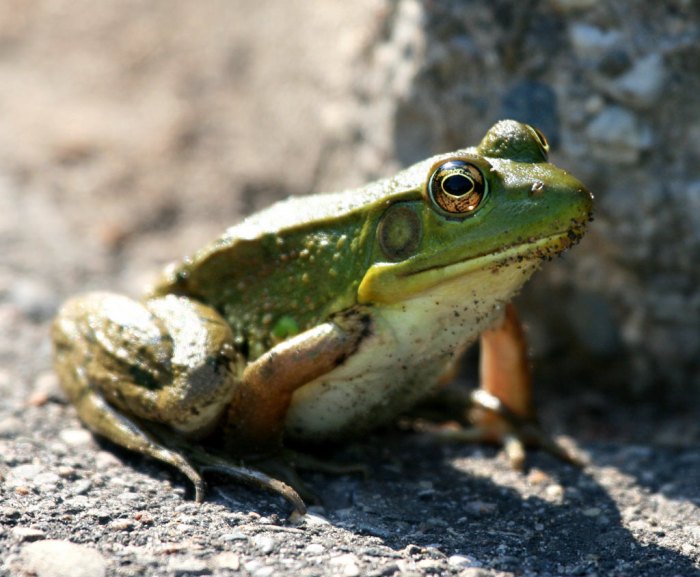
Northern Green Frog

Northern Green Frog

Frog!, photo by StormchaserMike Photography.

I nearly misidentified this guy as an American Bullfrog, likely confusing a whole new generation of readers just as they were recovering from Turtlegate.

The Michigan Herps page on Michigan’s Frogs & Toads says that misidentification is common – the trick is the fold of skin running from their eardrum to their back. The UM Animal Diversity Web entry for Lithobates clamitans (green frog) says you can find them all over the eastern US and that:

Green frogs are found in a wide variety of habitats that surround most inland waters, such as: swamps, wooded swamps, ponds, lakes, marshes, bogs, banks of slow moving rivers and streams, oxbow lakes, sloughs, and impoundments. Juveniles may disperse into wooded areas or meadows during times of rain. Green frogs overwinter in the water usually buried in the substrate.

Green frogs produce as many as six different calls. Males attracting a mate give an advertisement call and a high-intensity advertisement call. Their advertisement call has been compared to the pluck of a loose banjo string. Male frogs defending a territory from an intruding male usually give aggressive calls and growls. The release call is given by non-receptive females and by males accidentally grabbed by another male. Finally, the alert call is given by males and females when startled or attacked by a predator.

Green frogs have an excellent sense of vision and use this to detect and capture prey.

You can hear one of their calls at the link above and also read about them at Wikipedia and the MIchigan DNR’s page on the Green Frog.

Check this out bigger and see it in context in Mike’s Cass Lake set (slideshow).

More about Michigan’s animals from Michigan in Pictures.

When Frog stole the Waters

When Frog Stole the Waters

When Frog stole the Waters, photo by Apocaplops.

I don’t know what the story is here, but I like it. You can see it in full-size glory in Erich’s slideshow.

Gray Tree Frog (Hyla versicolor)

Gray Tree Frog (Hyla versicolor), photo by Wrobel Photographic Arts

Paul Wrobel writes

These little guys change colors depending on their surroundings and the temperature. Here he is just starting to change from gray to green. This is a full grown adult about two inches in length. With legs extended he is about 5-6 inches long.

Our good friends at the UM Animal Diversity Web have more information about the Gray Treefrog (including pictures and sounds).