Sign of spring #77: Trillium in the Woods!

Trillium

Trillium, photo by karstenphoto

One of the many signs of spring in Michigan is the appearance of the endangered trillium flower in the woods. In Plant Focus: Trillium, George Papadelis of the Michigan Gardener writes that for hundreds of years, this plant and its name have been used to symbolize purity, simplicity, elegance, and beauty.

In Ohio, where all 88 counties have masses of wild trillium, it was selected as the state’s official wildflower. Its flowers have twice graced a U.S. postage stamp. Even our Canadian friends across the bridge have declared white trillium (Trillium grandiflorum) the official provincial flower of Ontario. Other parts of the world share our passionate admiration for this plant. In Europe, where trilliums are not found in nature, gardeners dedicate vast amounts of time and money acquiring them, especially rare species. In Japan, a cult-like interest has developed towards trillium.

The most readily available species is Trillium grandiflorum or white wake-robin. This has large, pure white flowers up to 5 inches across. These develop in great abundance throughout the northeastern U.S. Its flowers usually fade to a dull pink and sometimes red. Trillium erectum is a much more diverse species with flowers ranging from red to purple to yellow-green and beige. It also grows wild in the Northeast and Michigan. Trillium luteum is the most common yellow species. It originates from areas around eastern Tennessee. One of its most notable features is the beautiful dark green leaves decorated with pale green markings. The flowers are relatively small. Trillium recurvatum bears maroon-purple to clear yellow flowers with strongly curved petals.

Read on for information about how to legally grow trillium.

Check this out background bigtacular, check out his Spring slideshow and see more from Steve on Michigan in Pictures.

More spring wallpaper

Tulip Time in Holland

Yellow Tulips
Yellow Tulips, photo by srab44_2000

Holland’s annual celebration of Dutch heritage and culture, the Tulip Time Festival, starts Friday May 4th and runs through May 11th. While last year’s crazy March heatwave had tulips blooming in mid-April, tulips have been in the slow lane in 2013 due to a cool spring. The good news according to meteorologist Bill Steffen is that a well-timed warmup should have tulips in near perfect bloom this year.

Check this photo out background bigtacular and see more in E. Benson’s Tulip Time Festival 05/2009 slideshow.

More tulips and more Holland on Michigan in Pictures.

Spring Bokeh

Untitled

Untitled, photo by Brooke Pennington

I refuse to give the ice storm that’s outside my door any power.

Brooke takes some great shots of flowers – check this out on black, see more in his slideshow or here on Michigan in Pictures.

More about bokeh.

Crocus kind of mood

DSC08382

DSC08382, photo by ansonredford

Crocuses have to be one of my favorite flowers. In addition to being beautiful, they are also one of the leading harbingers of spring in Michigan!

Check this out background bigtacular, get yourself in a springtime mood with Donald’s Flowers slideshow and see more of his photos on Michigan in Pictures.

More flowers on Michigan in Pictures, and if you want to be particular, here’s just the crocuses!

Spring Return: Eastern Redbud

I'll Return With Spring

I’ll Return With Spring, photo by MightyBoyBrian

On AnnArbor.com Rick Meader writes:

When you think about popular, colorful ornamentals, Eastern Redbud (Cercis canadensis) often comes to mind. It’s a real crowd-pleaser, with a graceful, ornamental shape that puts out a “bouquet on a stem” look, with thousands of tiny pink/purple flowers lining its branches in early spring before its leaves emerge.

And, the best thing about it is, it’s native to southern Michigan, as well as most of the eastern half of the United States south of here. Furthermore, as a member of the Pea family (Fabaceae) it’s a cousin to the previous pod-producers we’ve learned about, Honeylocust (Gleditsia triacanthos) and Kentucky Coffeetree (Gymnocladus dioica).

As mentioned before, Eastern redbud is native to southern Michigan, occurring naturally up to a line across the lower peninsula from Kent County to Genesee County.

…If you want to use it in your landscape, it is fairly flexible in terms of where it will grow. It naturally occurs in rich soil along stream and river banks but is tolerant of a wider range of conditions. It likes sun or partial shade and can do well in most soils except waterlogged soils and dry, sandy soils.

Read on for more including Rick’s advice to make sure your tree comes from a northern nursery because trees from southern nurseries often are killed off by Michigan’s cold winters.

Brian’s photo is the first background we selected for the new Absolute Michigan, and  as you can see from past features of his work on Michigan in Pictures, he’s a really talented photographer who uploads big enough for backgrounds. See this shot from April of last year background bigilicious and see more in his Nature slideshow.

More spring wallpaper on Michigan in Pictures!

The crocuses are coming, the crocuses are coming!

The crocuses are coming, the crocuses are coming!

The crocuses are coming, the crocuses are coming!, photo by Alissa Holland

Felt a little bad for failing to post anything about the spring equinox this year. As we are still under a blanket of snow up here in Traverse City and since I shared this hopeful sign, maybe I get a pass?

Alissa took this last Saturday, and she cautions you not to mistake the background for sky – it’s snow! See it on black and get your garden on in her how my  garden grows slideshow.

More Michigan spring on Michigan in Pictures.

Spring Tease: Winter Aconite & Snowdrop

Spring Tease

Spring Tease, photo by MichaelinA2

I was thinking there had been entirely too much ice on Michigan in Pictures this week. Thankfully Michael shared this photo in the Absolute Michigan pool, saying:

NE Ann Arbor ~ At 41F. our first break towards Spring… Winter Aconite (yellow flowers) and Snow Drops (white flowers)

Wikipedia explains that Eranthis (winter aconite) is a genus of eight species of flowering plants in the Buttercup family:

They are herbaceous perennials growing to 10–15 cm (4–6 in) tall. The flowers are yellow (white in E. albiflora and E. pinnatifida), and among the first to appear in spring, as early as January in mild climates, though later where winter snowpack persists; they are frost-tolerant and readily survive fresh snow cover unharmed. The leaves only expand fully when the flowers are nearly finished; they are peltate, 5-8 cm diameter, with several notches, and only last for 2-3 months before dying down during the late spring.
Species in this genus are spring ephemerals, growing on forest floors and using the sunshine available below the canopy of deciduous trees before the leaves come out; the leaves die off when the shade from tree canopies becomes dense, or, in dry areas, when summer drought reduces water availability.

There is (of course) a detailed Wikipedia entry for Galanthus (Snowdrop), but I found Plant Focus: Snowdrops by George Papadelis at The Michigan Gardener to be full of great information. He begins:

The very first bulb to cheerfully announce spring is the snowdrop. As the last winter snow melts, carpets of delicate white flowers emerge through last year’s fallen leaves. Snowdrops will reliably return year after year despite Mother Nature’s most challenging winters. The botanical name, Galanthus, comes from the Greek words Gala meaning “milk” and anthos meaning “flower.” They will thrive in the rich, moist soil usually found in the shade provided by deciduous trees. Few bulbs can tolerate shade, but snowdrops develop in the winter sun well before the leaves of trees and shrubs have expanded. Their flowers last for several weeks beginning in early March and persisting through the cool days of spring in early April. Once planted, Galanthus require no maintenance.

One of the most treasured features of this easy-to-grow perennial is its ability to propagate on its own and develop into large masses. It is this trait that gives snowdrops the label “good naturalizer.” Many other popular bulbs such as tulips, hyacinths, and alliums flower beautifully the first few seasons, but eventually weaken and disappear. Galanthus may be left undisturbed for years to form large, densely packed colonies.

Read on for much more including planting tips for Michigan and a bunch of photos.

Check this out on black and see more in Michael’s slideshow.

More flowers and by gosh more SPRING on Michigan in Pictures.

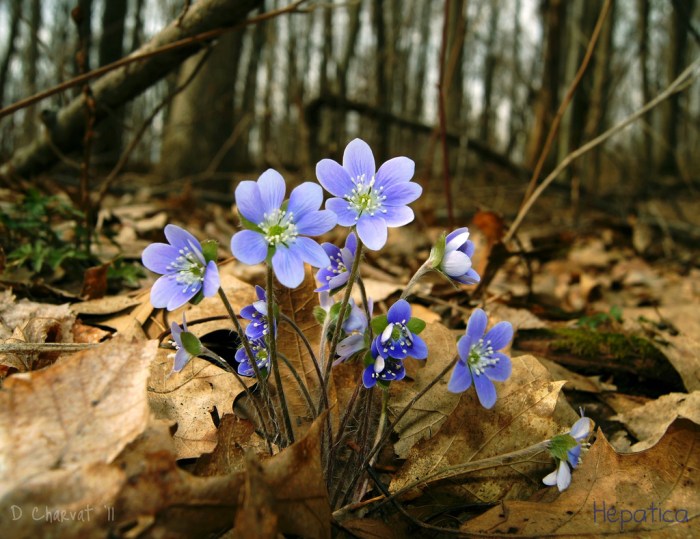
Hepatica … and other Michigan Wildflowers

Hepatica by Diane Charvat

Hepatica, photo by d charvat.

Wikipedia says that Hepatica was named for its leaves, which, like the human liver (Greek hepar), have three lobes. It was once used as a medicinal herb. Owing to the doctrine of signatures, the plant was thought an effective treatment for liver disorders. Although poisonous in large doses, the leaves and flowers may be used as an astringent, demulcent for slow-healing injuries and as a diuretic.

Check this out background bigalicious and in d charvat’s Michigan wildflowers slideshow.

More spring wallpaper on Michigan in Pictures!

First Bloom of Spring, 2010

First Bloom of Spring
First Bloom of Spring, photo by Kevin’s Stuff

While Northern Michigan still has lots of snow, Kevin says that with the over 40 degree temperatures of the past few days, the snow has been melting pretty steadily in West Michigan and the crocus have been coming up, presenting actual flowers yesterday afternoon!

Check it out bigger in his slideshow.

See more crocus on Michigan in Pictures and if you want to go all spring on your desktop, we have that too!