Dinner with the Ospreys

Dinner with the Ospreys

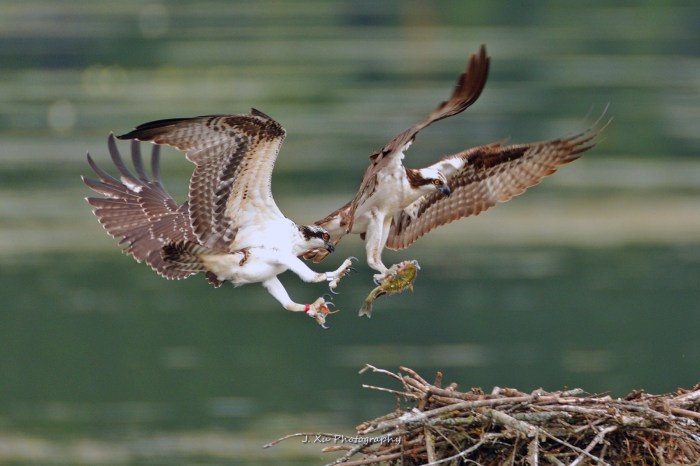
Can’t Wait, photo by Jiafan(John) Xu

Osprey Watch of Southeast Michigan shares some information about Michigan Osprey:

An Osprey is a large bird with a length of 22-25 inches, a wingspan of 4.5-6 feet, and a weight of approximately four pounds. The Osprey has a dark brown back and a white belly, as well as a white head, which features a dark stripe running from its yellow eyes to the back of its head. Female Ospreys are slightly larger than males and may sport a dark speckled necklace

..The Osprey dines almost exclusively on live fish, often catching its meals by hovering over the water at an altitude of 50 to 200 feet, then diving feet first into the water to catch its prey. The Osprey’s feet are uniquely adapted to “air fishing.” Each Osprey foot has a reversible front toe, as well as barbs, called spicules, which help it hold onto a slippery fish in flight. Normally, an Osprey will aerodynamically position a fish headfirst in its talons before it returns to the nest.

These talons definitely look like fish hooks – read on for more!

View Jiafan’s photo bigger and see more in his slideshow where you can also see shots from a trip out west.

More Michigan birds on Michigan in Pictures.
Know Your Michigan Fish: Northern Pike (Esox lucius)

Michigan Northern Pike Esox lucius

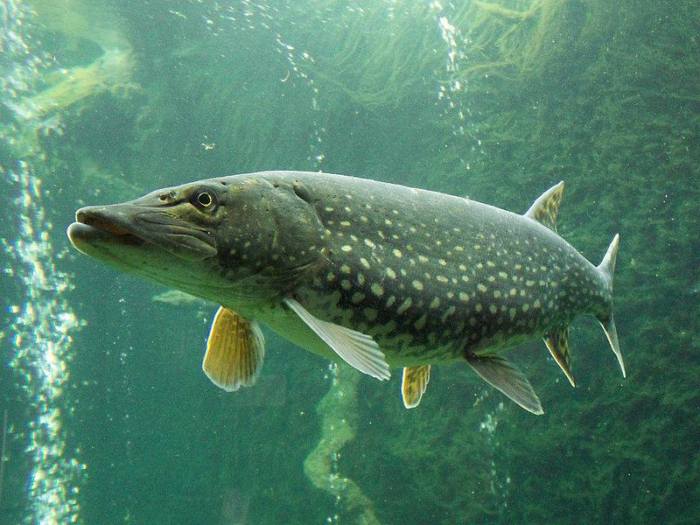
Northern Pike (Esox lucius), photo by Isle Royale National Park

The Michigan DNR’s Northern Pike page has this to say about this apex predator of the Great Lakes and Michigan’s inland lakes:

As predators, northern pike can have significant impact on their prey species. As with muskies, pike lurk in the cover of vegetation in the lake’s clear, shallow, warm waters near shore, although they retreat somewhat deeper in midsummer. Pike consume large numbers of smaller fish – about 90 percent of their diet – but seem willing to supplement their diet with any living creature their huge jaws can surround, including frogs, crayfish, waterfowl, rodents, and other small mammals. Their preferred food size is approximately one third to one half the size of the pike itself.

Great Lakes pike spawn in the shallows in April or May, right after the ice leaves, and before muskies reproduce. As a result of their eating habits, young pike grow rapidly in both length and weight. Females become sexually mature at age three or four years, and males at two to three years. Beyond sexual maturity, pike continue to gain weight, although more slowly. Great Lakes pike have an average life span of 10 to 12 years.

Pike eggs and new hatchlings (which stay inactive, attached to vegetation for their first few days of life) fall prey in large numbers to larger pike, perch, minnows, waterfowl, water mammals, and even some insects. Larger pike have two primary enemies – lampreys, and man. Spawning adult northern pike, exposing themselves recklessly in the shallows, are vulnerable to bears, dogs, and other large carnivores.

Northern pike flesh excels in flavor, thus making them a doubly rewarding game fish. Since their skin has heavy pigmentation and an unappetizing mucous coating, most people skin them or scale them carefully.

This photo was one of Isle Royale National Park’s “Wildlife Wonders of the Week.” They noted that a five pound female pike will lay about 60,000 eggs. Two weeks later fertilized eggs hatch, hungry for microscopic morsels. Once to the fingerling stage, food scarcity may force them to eat their own siblings for nourishment.

View it bigger on Facebook and definitely follow their page for the latest from one of Michigan’s coolest parks!

More Michigan fish on Michigan in Pictures.

Return of the Grayling to Michigan?

michigan-grayling

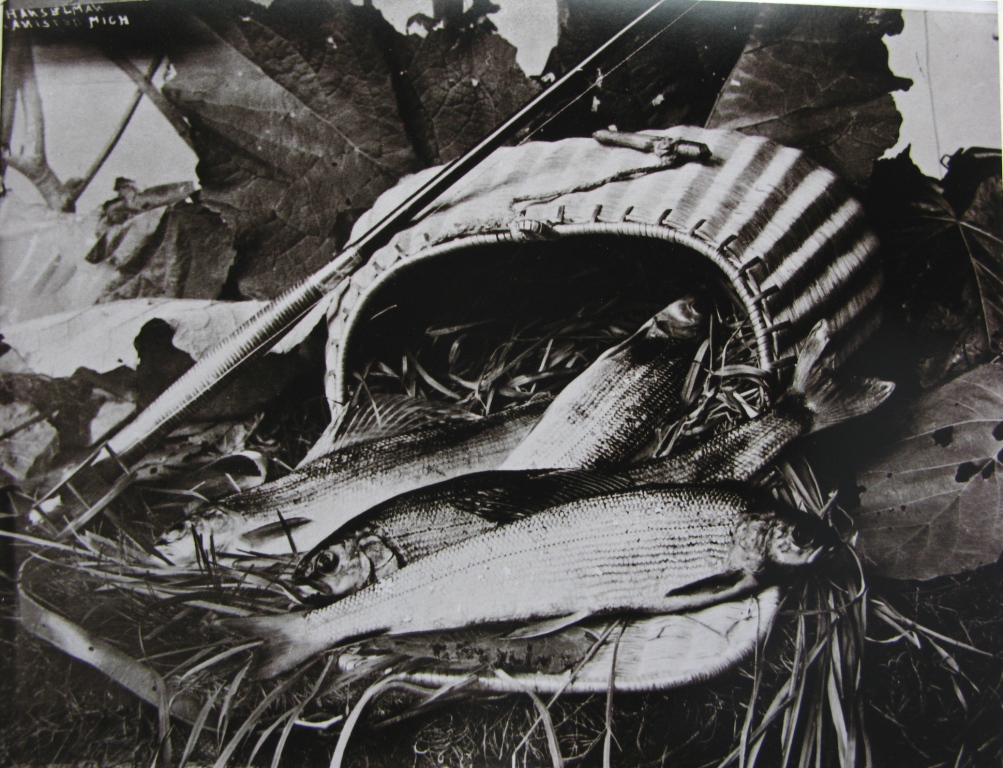
Michigan Grayling, photo courtesy Old Au Sable Fly Shop

The Michigan Department of Natural Resources is partnering with the Little River Band of Ottawa Indians to bring back the Arctic grayling. Grayling were native to Michigan but are long vanished from our waters. Slate blue in color with a sail-like dorsal fin, they are of the salmon family and efforts will begin in the Manistee River watershed.

Regarding the grayling, the Old Au Sable Fly shop says in part:

According to William J. Mantague, “One spring the Grayling were running up the Hersey. We noted they had some difficulty passing an obstruction in the stream, so we placed a canoe crosswise at that point and caught over seven hundred one afternoon.”

The Grayling were eaten. They were packed in ice, loaded onto railway cars, and shipped by the thousands of tons per year to the larger metropolitan areas. In some instances, they were tossed on the banks and buried in mounds.

At the same time, the lumbermen came and cut down centuries-old growth of virgin white pine. The land leading to the rivers was stripped as well, slashed and burned, and the logs floated downstream to the large mills and cities during the spring run-off. The rivers were cleared of logs and debris, places were the Grayling flourished. Shallow riffles were trenched out and deepened, and dams were built so that the flow of the river could be better controlled. Vegetation on the banks of the rivers was cleared as well, and the river slowly filled with sand. The sand filled the deepest pools and covered the Grayling’s spawning beds. By 1885, the Grayling had disappeared from the AuSable River. And in a period of ten to twenty years, a land unrivaled for its fishing and beauty, became a barren wasteland of stumps and empty pools.

More about graylings at the Old Au Sable Fly Shop where you can pick up gear and learn about fish & fishing on Michigan’s most storied fishing river.

More fish & fishing on Michigan in Pictures!

Support Michigan in Pictures with Patreon

This salmon is going up. The salmon population in Lake Michigan is headed the other way!

EDITOR’S NOTE: It looked for a minute that we had another Turtlegate brewing and that this might not be a Chinook but a brown trout. Read more in the comments on Facebook.

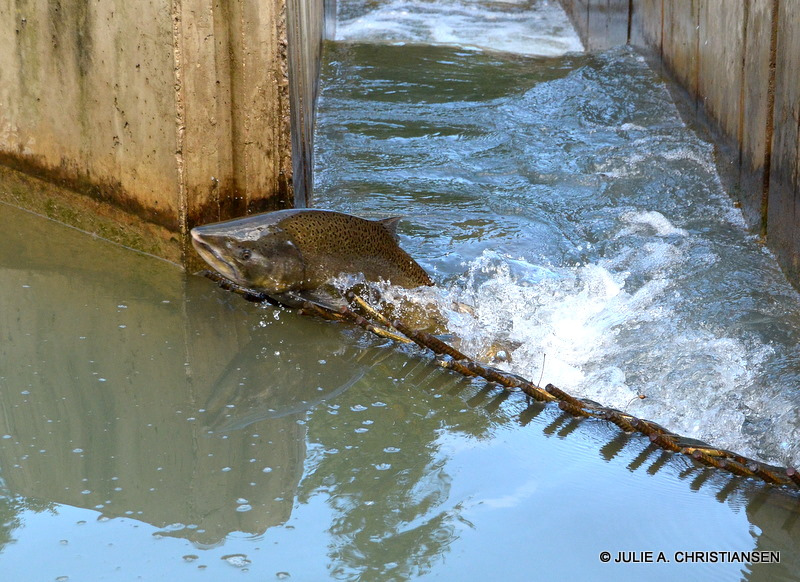
Salmon up and over the dam

Up & Over……….., photo by Julie

The Detroit Free Press reports that the salmon population is plummeting in Lake Michigan. The article begins:

They are the king of the Great Lakes sport fish, luring thousands of anglers to Michigan waters every year for a chance to try to land them — and helping fuel a multibillion-dollar fishing and boating tourism industry.

But the Chinook salmon’s numbers are plummeting in Lake Michigan due to a combination of natural forces, unnatural invasive species, and the state Department of Natural Resources’ own efforts to dial back the population and prevent a more permanent population crash as happened in Lake Huron about a decade ago.

The salmon population on Lake Michigan is down 75% from its 2012 peak, said Randy Claramunt, a DNR Great Lakes fishery biologist based in Charlevoix.

A leading cause is a reduction in alewives, a silvery fish up to 10 inches long that is the salmon’s primary prey on the Great Lakes. The alewife population has been decimated by invasive zebra and quagga mussels that have changed the nutrient dynamics of the lakes.

Read on for more at the Freep.

View Julie’s photo of a salmon jumping up into the weir at Charlevoix bigger and see more in her Wildlife slideshow.

More about Chinook salmon and more fish on Michigan in Pictures.

Testament of a Fisherman

Testament of a Fisherman by Aaron Peterson

Testament of a Fisherman, photo by Aaron Peterson Photography

My friend Aaron Peterson shared this on Facebook last night. It’s built around the words of one my very favorite writers, Michigander John Voelker (aka Robert Traver). I hope you enjoy it – Aaron writes:

Please enjoy this new video I did for Travel Marquette.

In 1964 Ishpeming native John Voelker published his essay “Testament of a Fisherman” summarizing in just 200 words the power of rivers and the solace one finds in trout fishing. When I came to Marquette in 2001 I didn’t have much, but I had a fly rod and a library card. In the library I found the words of John Voelker, and on the rivers of the Upper Peninsula I found a purpose. To be able to do this project and adapt Voelker’s words, with permission from his family, was very important to me on many different levels.

A lot has changed in the 50 years since he wrote this, but the health of our water, wild fish and time spent away from phones and crowds is more important than ever. Enjoy, share, then get the hell off your computer and get in the woods. Maybe to Marquette, because they paid the bill for this inspiration smile emoticon Thanks to Fly Fishing Michigan’s U.P. Nick from Ore Dock Brewing Company and all those who fight for the sanctity of our water. –AP

(the video is beautiful – view it full screen if you can!)

View Aaron’s photo bigger on Facebook and follow his page for the latest. Definitely check out his website too. He has some crazy photos of the U.P.’s incredible adventure offerings!

Smallmouth bass eating round gobys

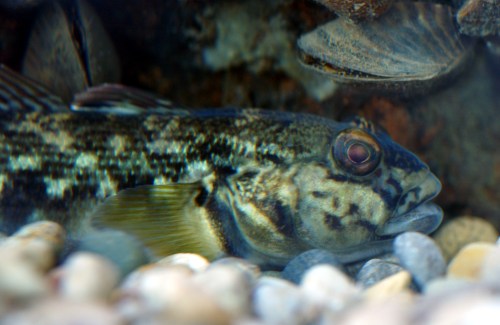
Round Goby

Round Goby, photo by Dave Brenner, Michigan Sea Grant

The Great Lakes Echo reports that although a study has found that invasive round goby are “one of the most successful aquatic invaders” ever in the Great Lakes, smallmouth bass appear to be feasting on gobies:

25 years after their discovery in the Great Lakes, “we’re not documenting specific harms from gobies,” Popoff said, referring to feared environmental, economic and human health concerns.

In fact, there are indications of possible benefits from their presence, he said. For example, “we are seeing amazing smallmouth bass,” as well as some “amazing walleye,” while lake trout have modified their diets from sculpin to round gobies.

One possible exception, according to Popoff, is a decline in sculpin population as documented in Lake Michigan’s Grand Traverse Bay because they compete with round gobies for space and food. However, scientists haven’t determined whether the lake’s overall sculpin population is down or whether they’ve merely moved to deeper areas with fewer round gobies.

…However, the study found the round goby is now a widely available food source for many native fish because of its “extreme abundance, tolerance to a variety of habitat conditions and relatively small size.”

In lakes Erie and Ontario, round gobies accounted for 75 percent of the smallmouth bass diet, Crane said. If all other species have maintained stable populations, that means the bass are putting less pressure on other food sources.

Nice to see the Great Lakes winning a battle – read on for lots more.

View the photo background big and see more in Michigan Sea Grant’s Aquatic Invasive Species (AIS) slideshow.

ArtPrize 2014, now with Fish on Rocks!

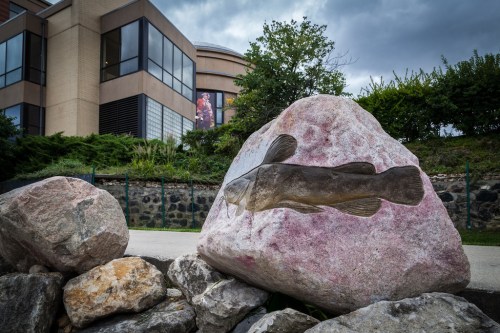
Catfish

Catfish, photo by Robert Bradley

ArtPrize returns to Grand Rapids for its 5th year next Wednesday and runs September 24 – October 12th. The 19 day event turns downtown Grand Rapids into a free & open art competition for hundreds of thousands of dollars in prizes. While you can certainly debate the merits of ArtPrize and the art displayed, there’s no question that this is one of the most engaging and immersive art events in the country.

You can check out the 2014 entries right here, look back through the years on their History page, and also see a video from 2013 that captures some on the flavor and fun. The only way to really experience it is to go, something that I heartily recommend!!

This is part of Kevin Sudeith’s Contemporary Petroglyphs installation along the Grand River.

View Robert’s photo background bigtacular and see more in his ArtPrize 2014 slideshow (which I expect will grow in the weeks to come).

Lots more ArtPrize on Michigan in Pictures!

Gone fishin’ with a Green Heron

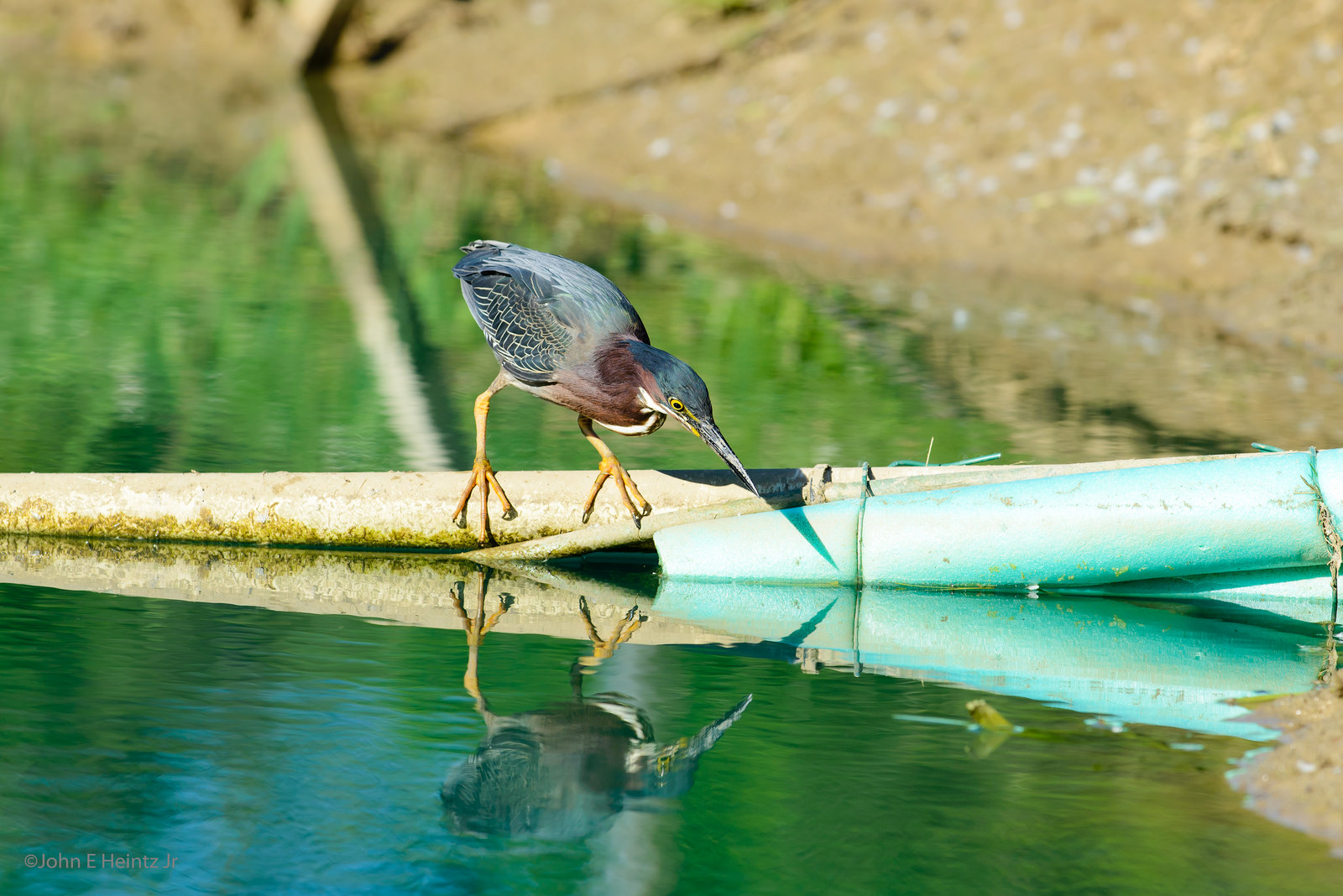
Green Heron and Frog by John Heintz

GREEN HERON by John Heintz, Jr.

The entry for Green Heron (Butorides virescens) at All About Birds says (in part):

From a distance, the Green Heron is a dark, stocky bird hunched on slender yellow legs at the water’s edge, often hidden behind a tangle of leaves. Seen up close, it is a striking bird with a velvet-green back, rich chestnut body, and a dark cap often raised into a short crest. These small herons crouch patiently to surprise fish with a snatch of their daggerlike bill. They sometimes lure in fish using small items such as twigs or insects as bait.

Some Fun Facts…

  • The Green Heron is one of the world’s few tool-using bird species. It creates fishing lures with bread crusts, insects, earthworms, twigs, feathers, and other objects, dropping them on the surface of the water to entice small fish.
  • Like many herons, the Green Heron tends to wander outside of its breeding range after the nesting season is over. Most of the wanderers stay nearby as they search for good feeding habitat, but some travel long distances. Individuals have turned up as far away as England and France.
  • Green Herons usually hunt by wading in shallow water, but occasionally they dive for deep-water prey and need to swim back to shore—probably with help from the webs between their middle and outer toes. One juvenile heron was seen swimming gracefully for more than 60 feet, sitting upright “like a little swan,” according to one observer.
  • The oldest Green Heron on record was 7 years, 11 months old.

Read on for more, with various Green Heron calls including the attack call. The Michigan Bird Atlas shows Green Heron distribution in the state.

FYI John is no longer on Flickr, but he has some awesome pics on Michigan in Pictures!

Many more Michigan birds on Michigan in Pictures.
Equinox to Equinox, 2014

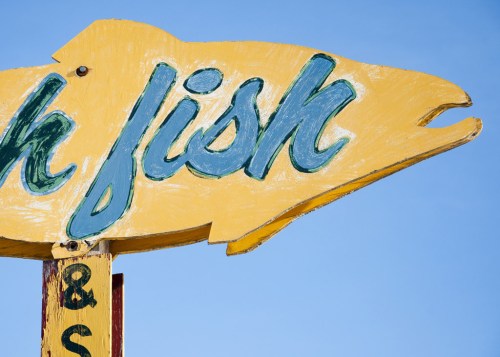
Thill's-Fish-Market-by-Jorie-Obrien

 Day Two, photo by Jorie O’Brien

Jorie started her Equinox to Equinox series on March 20th – click the link to follow along until, I imagine, September 23rd.

There’s more from Jorie on Michigan in Pictures including a multi-day profile that’s really worth your time.

PS: This is Thill’s Fish House in Marquette, and excellent place to buy fresh, Lake Superior fish in the Marquette harbor.


Mr. Brownie, Brown Trout, Salmo trutta

Mr. Brownie

Mr. Brownie, photo by heronwheels

The Michigan Department of Natural Resources page on Brown Trout, Salmo trutta says that Brown trout is something of a misnomer as many Great Lakes brown trout are mainly silver in color. Michigan Sea Grant has excellent information about Great Lakes fish, and their Brown Trout entry says that the they were first stocked in the Great Lakes in the 1880s and:

The brown trout’s scientific name translates to “trout-salmon.” The Atlantic salmon and brown trout both belong to the genus Salmo. Rainbow trout, coho salmon, and Chinook salmon belong to a different genus – Oncorhynchus.

Great Lakes brown trout typically enter tributaries to spawn during late fall. Reef spawning also has been documented in Lake Superior and Lake Michigan. Although naturally reproducing populations of brown trout exist in Michigan waters, most are maintained through stocking. Unlike Chinook and coho salmon, brown trout do not necessarily die after spawning and can live for up to 13 years in Lake Michigan.

Browns can tolerate warmer water than other trout species, which adds to their popularity as a gamefish in rivers that are not suitable for native brook trout. In the Great Lakes, brown trout stay near shore in waters less than 50 feet deep, which makes them an ideal gamefish for shallow bays such as Lake Huron’s Thunder Bay.

The diet of brown trout varies greatly depending on its environment and available food sources. In the Great Lakes, brown trout prey mostly on forage fish such as alewife, rainbow smelt, and round goby. In rivers, small browns eat a variety of aquatic invertebrates. Larger fish transition to a diet of small fish, large insects, and even small rodents. Big browns are notorious for their wariness and nocturnal feeding habits.

Read on for more from Michigan Sea Grant and connect with them on Facebook. For more information on how and where to catch brown trout see the DNR’s Michigan Fish and How to Catch Them and Better Fishing Waters.

Stacey caught this beauty on the Pere Marquette River near Baldwin. Check this out bigger and see more in her Pure Michigan slideshow.

More fish on Michigan in Pictures, and be sure to check out this brown trout with a happy fisherman from the 1930s courtesy Seeking Michigan!