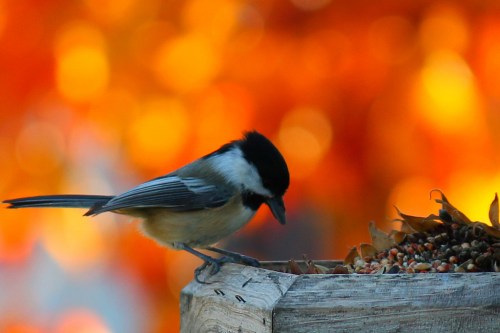
Black-capped chickadees prefer deciduous woodlands, open woods and parks, cottonwood groves, and willow thickets. They are most commonly seen near edges of wooded areas. They are a frequent visitor to backyard feeders. Black-capped chickadees nest in cavities, usually in dead trees or stumps, and are attracted to habitats with suitable nesting locations. During the winter, small flocks of black-capped chickadees can be found in dense conifer forests.
…Black-capped chickadees hop on trees (occasionally on the ground), rather than “walking.” These birds are very active during the day, and can often be seen foraging upside-down. Black-capped chickadees form monogamous pairs which usually stay together for several years. The black-capped chickadee social system has two extremes, one shown by territorial pairs during the breeding season, and the other consisting of non-breeding flocks. These are often mixed species flocks including nuthatches, woodpeckers, kinglets, brown creepers, warblers, and vireos. Black-capped chickadees perform short-distance migrations, but remain in the same general region throughout the year.
Read on for lots more including photos and chickadee calls.
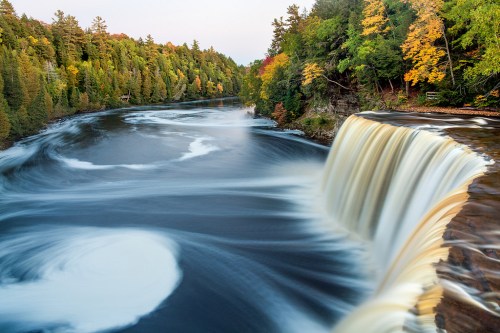
If you’re wondering what fall color looks like in the northeastern Upper Peninsula, wonder no more! Ashley took this shot at Michigan’s largest waterfall, the Tahquamenon Falls last week. As you can see, it’s shaping up nicely.
The autumnal equinox happened last night at 10:29 PM, so today will our the first full day of fall. Here’s hoping this will be a warm & wonderful autumn for Michigan!
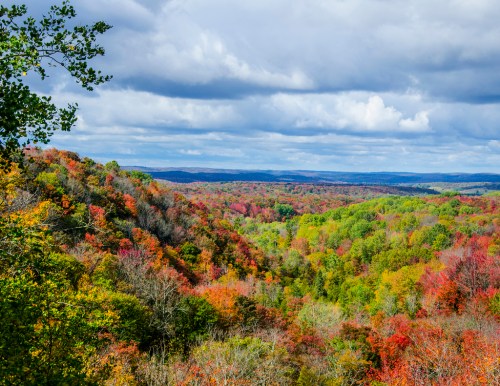
Fall is a time for exploration and seeing new sights. In precisely that spirit of adventure, Linda writes:
Just by looking at the map I said ‘lets take this dirt road and see what color we find.’ I didn’t know it was a seasonal road until we turned onto it and then saw a sign that said Landslide Overlook. So we followed this dirt road, which was rather narrow in spots, until we came to a parking area. It was just a short 1/4 mile walk to this wonderful view of the Jordan River Valley.
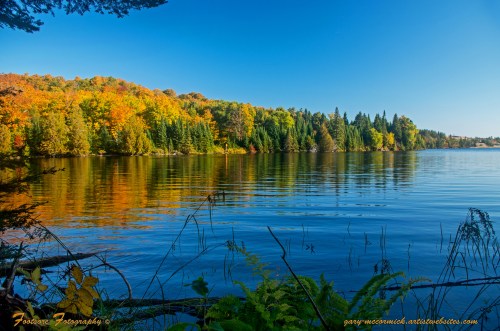
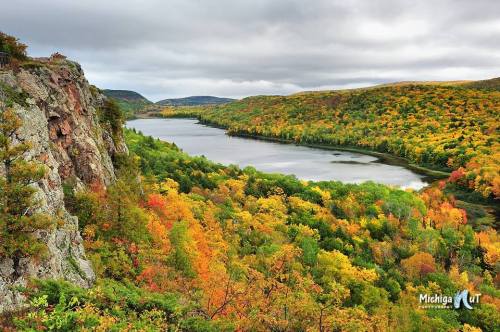
John McCormick comments that it won’t be long and we will be seeing scenes like this one again. With a north wind blowing and highs not expected to reach 60 today in Michigan’s northern half, it’s pretty clear that fall and fall color is right around the corner! I hope you get the time to plan a color tour or two to enjoy places like the Lake of the Clouds. Michigan is especially amazing when the hardwoods catch fire, and the show only comes once a year
John is one of my favorite photographers, and his Michigan Nut Facebook page is on fire right now with new photos every day!
One of the greatest treats Michigan offers is the annual fall color show, and I find it’s nice to have a little deeper appreciation about what’s going on inside sugar maples and other trees whose leaves change color in the fall. The Science of Color in Autumn Leaves from the US Arboretum explains that:
During the growing season, chlorophyll is replaced constantly in the leaves. Chlorophyll breaks down with exposure to light in the same way that colored paper fades in sunlight. The leaves must manufacture new chlorophyll to replace chlorophyll that is lost in this way. In autumn, when the connection between the leaf and the rest of the plant begins to be blocked off, the production of chlorophyll slows and then stops. In a relatively short time period, the chlorophyll disappears completely.
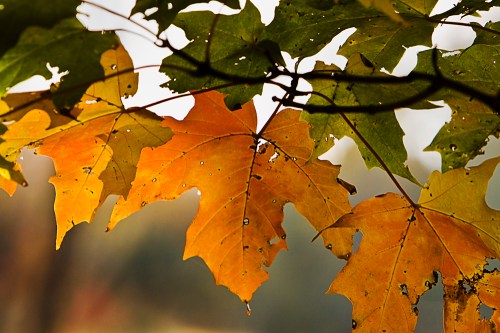
This is when autumn colors are revealed. Chlorophyll normally masks the yellow pigments known as xanthophylls and the orange pigments called carotenoids — both then become visible when the green chlorophyll is gone. These colors are present in the leaf throughout the growing season. Red and purple pigments come from anthocyanins. In the fall anthocyanins are manufactured from the sugars that are trapped in the leaf. In most plants anthocyanins are typically not present during the growing season.
After 70s and 80s for weeks & weeks, there’s a snap in the air as the north wind is rustling the leaves and it’s still dark at 6:30 in the morning. Those longer nights are key to the Science of Fall Color, and you can read all about what makes leaves change color and see another cool fall photo at that link!
Starting to lay plans as to how to enjoy Michigan’s fall color? While a helicopter color tour is probably out of reach for most of us, the fall color tours on Pure Michigan offer some solid ideas for experiencing Michigan at its colorful best. One note: while they invite you to see the dynamic colors of a trillion trees, the actual number (according to Michigan Forests Forever) is about 11.3 billion. That’s still quite a lot – here’s hoping you get to see at least a few hundred thousand!
Color touring and fall fun isn’t only for Northern Michigan – check out the Detroit Fall Color Tour on Pure Michigan, which begins:
The home of the Motown Sound is the starting point for a 195-mile fall color route that skirts three waterways to the maritime city of Port Huron, and rolls through historic Southeast Michigan towns with connections to three pop music stars. The month of October is prime for viewing autumn hues at a variety of parks, and stopping to taste seasonal treats at cider mills along the way
There’s no doubt that the annual fall show that Michigan puts on is one of the best, but did you ever stop to think about the process that causes deciduous trees to change color? Well, here’s your chance…
The Science of Color in Autumn Leaves from the United States National Arboretum explains that process that starts the cascade of events that result in fall color is a growth process that starts in late summer or early autumn. When the nights get long enough, a layer of cells called the abscission layer forms that begins to block transport of materials from the leaf to the branch.
During the growing season, chlorophyll is replaced constantly in the leaves. Chlorophyll breaks down with exposure to light in the same way that colored paper fades in sunlight. The leaves must manufacture new chlorophyll to replace chlorophyll that is lost in this way. In autumn, when the connection between the leaf and the rest of the plant begins to be blocked off, the production of chlorophyll slows and then stops. In a relatively short time period, the chlorophyll disappears completely.
This is when autumn colors are revealed. Chlorophyll normally masks the yellow pigments known as xanthophylls and the orange pigments called carotenoids — both then become visible when the green chlorophyll is gone. These colors are present in the leaf throughout the growing season. Red and purple pigments come from anthocyanins. In the fall anthocyanins are manufactured from the sugars that are trapped in the leaf. In most plants anthocyanins are typically not present during the growing season.
As autumn progresses, the cells in the abscission layer become more dry and corky. The connections between cells become weakened, and the leaves break off with time. Many trees and shrubs lose their leaves when they are still very colorful. Some plants retain a great deal of their foliage through much of the winter, but the leaves do not retain their color for long. Like chlorophyll, the other pigments eventually break down in light or when they are frozen. The only pigments that remain are tannins, which are brown.
The explain that because the starting time of the whole process is dependent on night length, fall colors appear at more or less the same time every year and are not overly dependent on temperature, rainfall or other factors, other than the fact that weather can shorten or prolong the show by stripping leaves from trees.



 Michigan in Pictures