
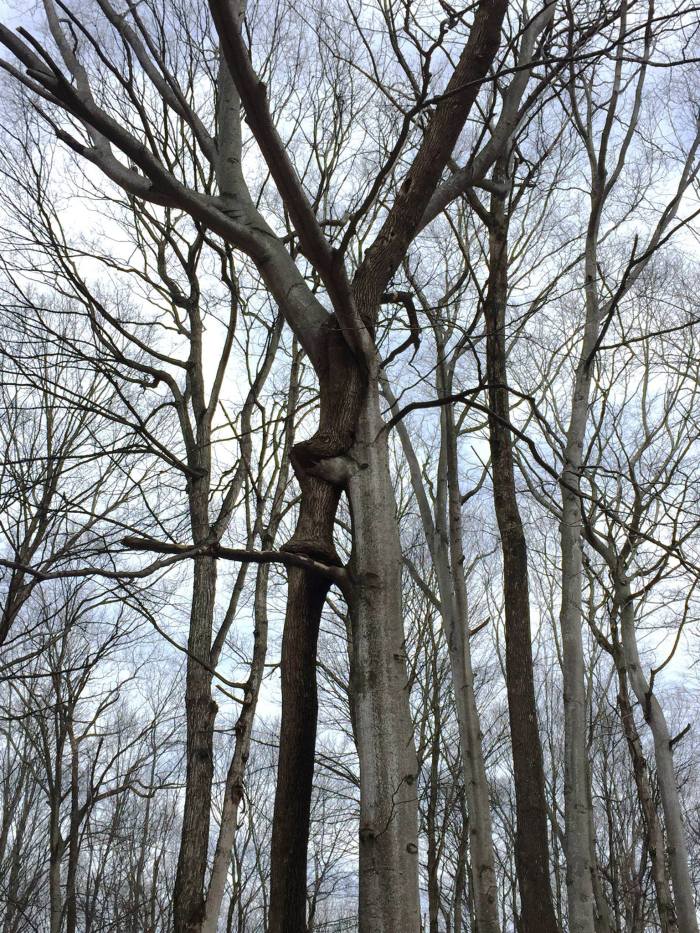
Twined Trees at Treat Farm, photo by Sleeping Bear Dunes National Lakeshore
“A glooming peace this morning with it brings;
The sun, for sorrow, will not show his head:
Go hence, to have more talk of these sad things;
Some shall be pardon’d, and some punished:
For never was a story of more woe
Than this of Juliet and her Romeo.”
~William Shakespeare
The Sleeping Bear Dunes National Lakeshore shared this photo from their Tweddle/Treat Farm property saying:
The two hugging trees on the trail to Treat Farm share a similar fate to the star crossed lovers, Romeo and Juliet. The beech scale brings a fungus that is deadly like a poison, and kills off the American beech trees. The Emerald Ash Borers pierce the hearts of the ash trees to take the nutrients.
Invasive species have made their way to the fair Lakeshore of Sleeping Bear Dunes. You can help prevent the spread by purchasing local firewood, and burning it within the local area.
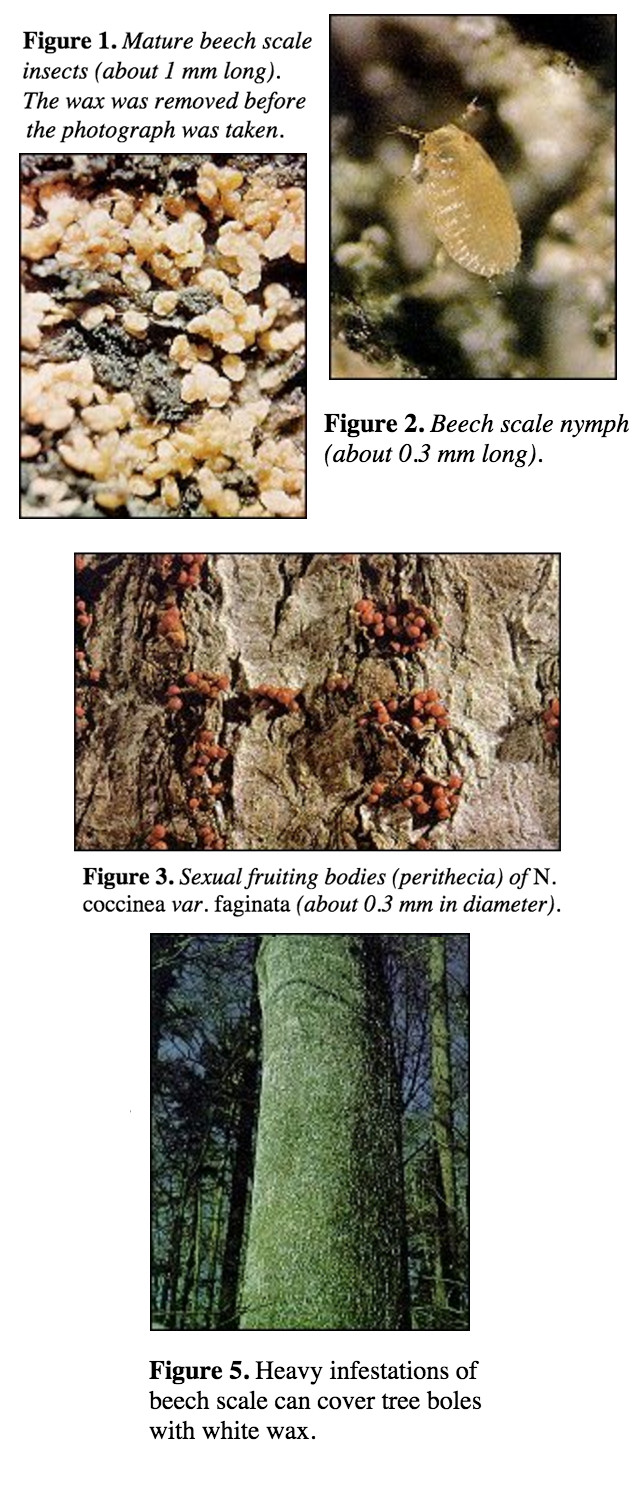 I’ve written about the Emerald Ash Borer on Michigan in Pictures, so here’s a bit about beech scale & beech bark disease from MSU:
Beech bark disease is one of the latest exotic pest problems to plague Michigan forests. Beech bark disease refers to a complex that consists of a sap-feeding scale insect and at least two species of Nectria fungi. Beech bark disease begins when American beech (Fagus grandifolia) becomes infested with beech scale (Cryptococcus fagisuga Lind) (=Cryptococcus fagi Baer.). The tiny scale insects, found on the tree trunk and branches, feed on sap in the inner bark. White wax covers the bodies of the scales.
When trees are heavily infested, they appear to be covered by white wool. Minute wounds and injuries caused by the scale insects eventually enable the Nectria fungus to enter the tree. Nectria kills areas of woody tissue, sometimes creating cankers on the tree stem and large branches. If enough tissue is killed, the tree will be girdled and die. Other trees may linger for several years, eventually succumbing to Nectria or other pathogens. Some infected trees will break off in heavy winds — a condition called “beech snap.” Dense thickets of root sprouts are common after trees die or break.
Read on for lots and also see Beech Bark Disease from the National Forest Service where I got these photos.
View the photo bigger on their Facebook page and learn all about the Lakeshore from their website.
 Michigan in Pictures