Birds of Michigan: Osprey

Osprey Building a Nest

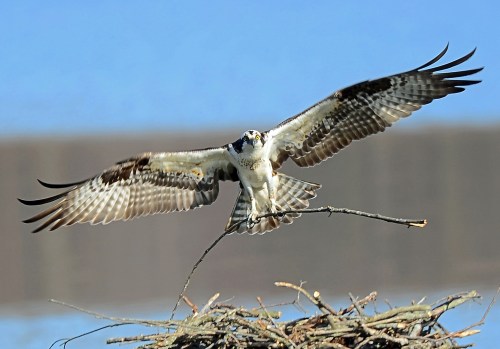
Osprey Building a Nest, photo by Rodney Campbell

All About Birds from the Cornell Lab of Ornithology is the internet’s best resource for bird information. Their entry for Osprey (Pandion haliaetus) says that osprey are one of the largest birds of prey in North America and one of the most widespread birds in the world, found on all continents except Antarctica. More about osprey at Wikipedia and at Pandion haliaetus (Osprey) from the UM Animal Diversity web.

The Michigan DNR’s Osprey page begins:

The “fish hawk” is brown above and white below, and files with a distinct bend in its wing at the “wrist.” Their feet are equipped with spiny scales and long talons that give them a firm grip on slippery fish, their only prey. Ospreys usually select tall trees in marshes along streams, lakes or man made floodings. They will adapt to artificial nesting platforms. This “help” from humans, along with the restriction of certain harmful pesticides, has helped ospreys recover from the drastic population reductions seen in the 1950s and ’60s. The Nongame Wildlife Fund located 166 pairs in 1988, up from the 81 counted in 1975.

They ask for help in reporting osprey sightings in southern Michigan. Also check out Osprey Watch of Southeast Michigan.

Rodney took this photo of an osprey building its nest in Milford.

MichiganOsprey.com is a great local resource and adds:

Like Bald Eagles, Ospreys often reuse old nests, adding new material to them each season. Ospreys prefer nests near water, especially in large trees, but will also nest on artificial platforms. Ospreys three years or older usually mate for life, and their spring courtship begins a five-month period when they raise their young.

View it background bigtacular and see more in his Birds slideshow.

Michigan in Pictures has lots more Michigan Bird photos!!
Perils of Michigan: Quicksand Edition

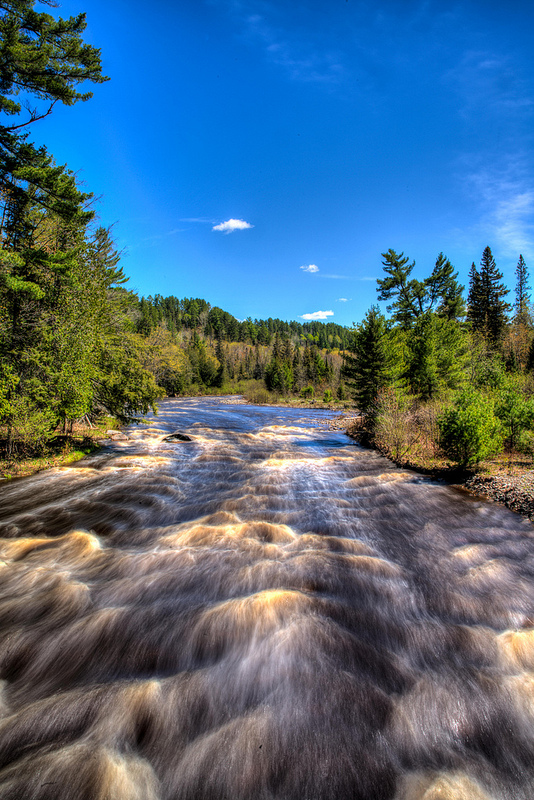
Sturgeon River by Sven

Sturgeon River, photo by Sven

While the ice has melted, leaving the shorelines temporarily free of peril – at least until until bodysurfing season starts – we can take a moment to worry about quicksand. Quicksand in Michigan Streams from Fichigan says:

Everything I know about quicksand I learned from Tarzan movies. The main thing to know is: bad guys don’t make it out, but good guys and gals always do. If you’re a bad guy, please stop reading. Quicksand on a trout stream is a little different than sand bogs in Africa, but there’s some similarity. They are both camouflaged so you don’t see it until it’s too late and if you make it out alive you’ll have an interesting story to tell even if no one believes you.

Quicksand on a trout stream is harder to see since it’s underwater. The stream bottom appears normal except there is no visible hole (sand covers it) so you don’t know it’s here until you start sinking. In waders it’s pretty scary since swimming doesn’t feel like an option.

I’ve found quicksand on the Pine River in Lake County and the Sturgeon River in the Pigeon River State Game Area. On the Pine, the particular spot I know of is a few bends downstream from Raymond Road. The first time I ran into it I was alone. I scrambled to get out and it was like running in place up a sand dune. It was easy to see the exact spot afterwards because a cloud of light gray silt poured out like smoke. An hour later, walking the bank downstream, the silt was still pouring out.

Read on for lots more including his encounter on the Sturgeon River.

I can find photos of almost anything View Sven’s photo bigger on Flickr and see more in his UP Michigan slideshow.

The Sturgeon River is one of Michigan’s Wild & Scenic Rivers – more Sturgeon River on Michigan in Pictures.

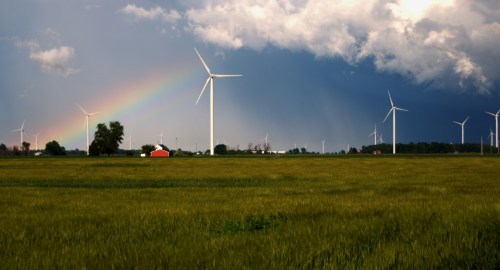
Follow the Rainbow

Follow the Rainbow

Follow the Rainbow, photo by Matt

View Matt’s photo background bigtacular and see more in his slideshow.

#TBT Offseason at the Pontiac Silverdome

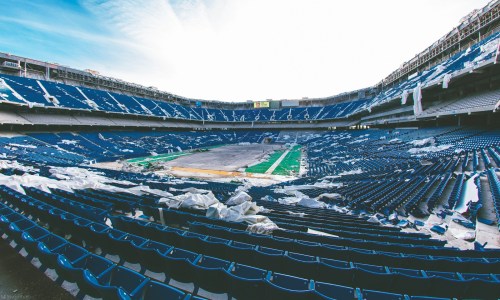
Pontiac Silverdome

Pontiac Silverdome, photo by Mathew Davey

With the departure of some key players including Ndamukong Suh, Nick Fairley and Reggie Bush and addition of new faces including Ravens stalwart Haloti Ngata, the Lions have had a fairly eventful offseason. One place that not much is happening is the Lions’ former home, the massive and now domeless Pontiac Silverdome.

Stadiums of Pro Football’s page on the Pontiac Silverdome says that this modern-day ruin was designed by O’Dell/Hewlett & Luckenbach and built at a cost of $55 million:

Home of the Detroit Lions for more than 25 years, the Silverdome was one of the largest stadiums in the NFL. Prior to moving into the Silverdome, the Detroit Lions had played at Tiger Stadium since 1938, that was also the home of the Detroit Tigers (MLB). Tiger Stadium was primarily a baseball stadium, but served as the home to the Lions for more than 30 years. In the late 1960s, the team wanted a new football only stadium. After several bonds were passed allowing the team to build a stadium, the Lions bought land in nearby Pontiac, MI. Because of the area’s cold winter weather, the team decided to build a domed stadium. Construction on the stadium, named the Pontiac Silverdome, began on September 19, 1973 and was completed in 23 months.

Opening day for the Lions at the Silverdome was on October 6, 1975. The Silverdome became the largest stadium in the NFL with a capacity of 80,311. Three tiers of blue seats circled the entire Astroturf playing field. The roof at the Silverdome consisted of Teflon-coated fiberglass panels. In 1985 after a heavy snowstorm the roof was structurally damaged. However over the next several months a new canvas and steel-girder reinforced roof was added to prevent the problem from occurring again. The Silverdome had several amenities that included 93 executive suites and a club restaurant. Other than hosting football games, the Silverdome hosted many other events including tractor pulls, soccer and basketball games, and concerts. The first Super Bowl played in a northern city, Super Bowl XVI between the Cincinnati Bengals and San Francisco 49ers, was played at the Silverdome. In the mid 1990s, the Lions became dissatisfied with the Silverdome. By 1997, bonds were passed allowing construction of a new domed stadium in downtown Detroit. The Lions played their final game at the Silverdome on January 6, 2002. The team moved into Ford Field in August 2002.

The Oakland Press has 89 historical photos of the Silverdome including a couple with Barry Sanders. If you want to go get all depressed instead, head over to Curbed Detroit for the saga of the godawful mess the Silverdome has become.

Matthew took this photo in December of 2014. Click to view it big as the Silverdome!

More Detroit Lions on Michigan in Pictures.

Kingfisher Friday: The Belted Kingfisher

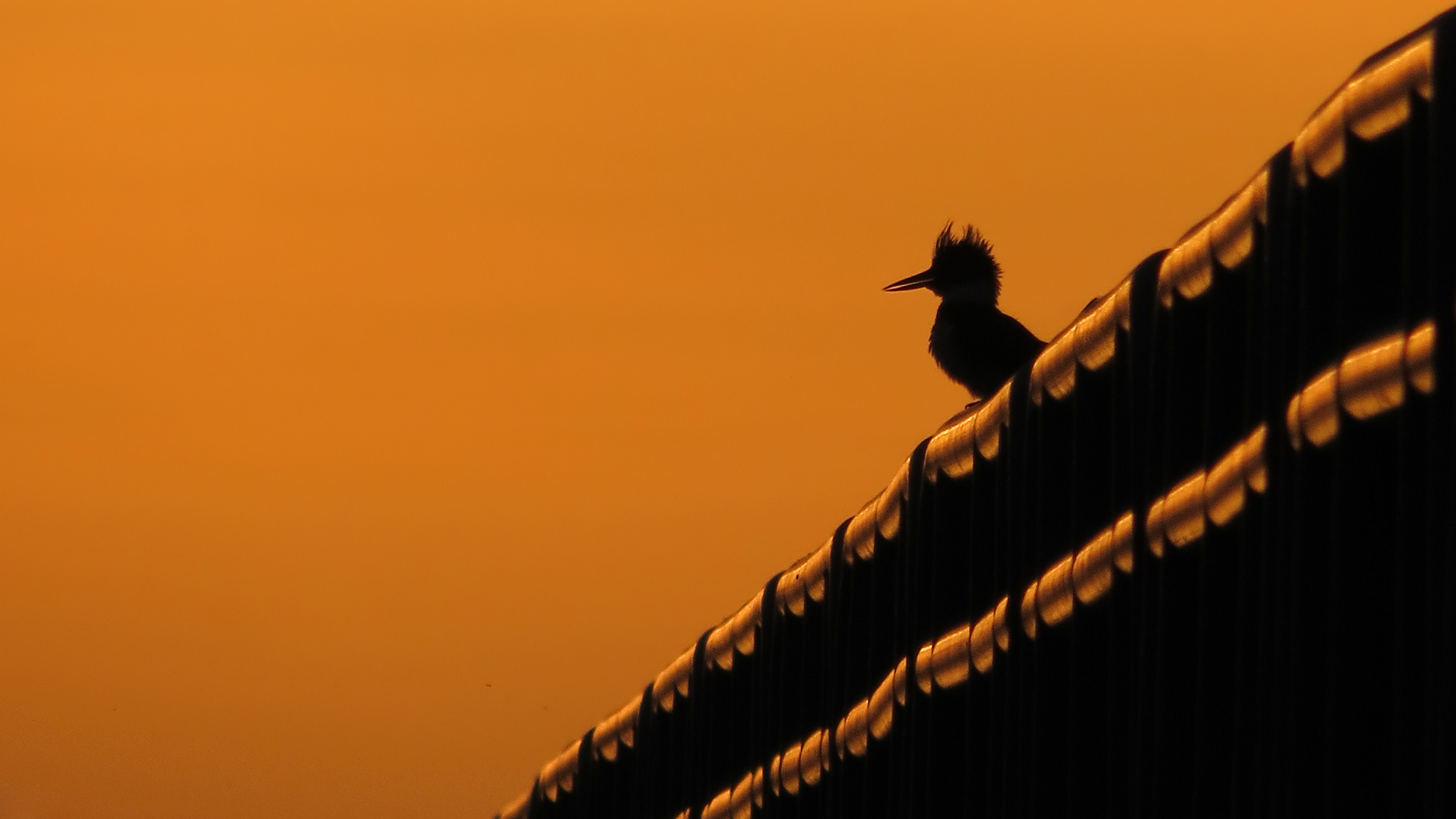
Kingfisher HD Friday

Kingfisher Silhouette HD Wallpaper, photo by John Britt

All about Birds says that the Belted Kingfisher is:

A common waterside resident throughout North America, the Belted Kingfisher is often seen hovering before it plunges headfirst into water to catch a fish. It frequently announces its presence by its loud rattling cry.

It breeds along streams, rivers, lakes, and estuaries with banks for nest holes. The breeding distribution of the Belted Kingfisher is limited in some areas by the availability of suitable nesting sites. Human activity, such as road building and digging gravel pits, has created banks where kingfishers can nest and allowed the expansion of the breeding range.

View John’s photo background big and see more in his Northern Michigan – Seasons, Sunrises, Beaches, Waterfalls, Mountains slideshow.

More Michigan Birds from Michigan in Pictures.

Standing Iceboater

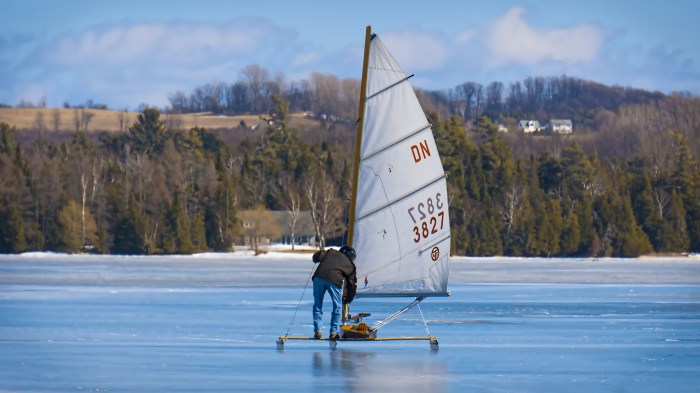
Ice Boating in Leelanau County Michigan

Standing Iceboater, photo by Mark Smith

It’s 8 degrees right now in Traverse City, and while the weeklong run of wintry weather hasn’t been good for such popular pursuits as getting the garden ready, boxing up winter clothes and keeping your house from being declared a Cabin Fever Disaster Area, it has left the ice in many parts of the state just perfect for the sport of ice boating.

Northern Michigan AP News photographer John Russell is a Michigan in Pictures contributor and wrote Ice Boating: An Ancient Sport in a Modern World a few years ago. It begins:

Sailing on frozen surfaces is believed to have its roots in Northern Europe, where goods and people moved around the region on frozen rivers and canals, using simple sails and handmade boats.

The Dutch and others brought iceboating to the Hudson River valley and other places along the East Coast, where miles of frozen rivers made for great sailing during the winter months. Freight and people were commonly moved up and down the Hudson River in huge, slooped-rigged boats.

Ranging in length from 30 – 50 feet, the stern-steering boats are still raced today by the Northwest Ice Yacht Association, having recently celebrated its 100th anniversary.

The ancient sport of sailing on frozen lakes and rivers is alive and well in our state, which has a long and involved history in the sport. Innovations developed in Michigan have enhanced and improved iceboating.

During the winter of 1936-1937, in the hobby shop at the Detroit News, boat builder Archie Arroll, along with Norm Jarrait and Joe Lodge, designed an ice boat they called the Blue Streak 60. Designed to be small enough to build in a garage, and easy enough to be built by anyone, the 12-foot hull design became known as the DN 60, for Detroit News and the 60-square-foot sail.

It is now the largest one-design boat class in the world, with over 8,000 registered boats around the world.

Read on for more including our state’s role in international ice boat racing, some state clubs, safety tips and a couple of photos from John.

Mark took this shot earlier in the week on Lake Leelanau. View it background bigtacular and see more photos (and a couple videos) in his Ice Boats slideshow.

More Michigan iceboating on Michigan in Pictures!

Signs of Spring #56: Chevrons

Chevrons

Chevrons, photo by MichaelinA2.PortrayingLife.com

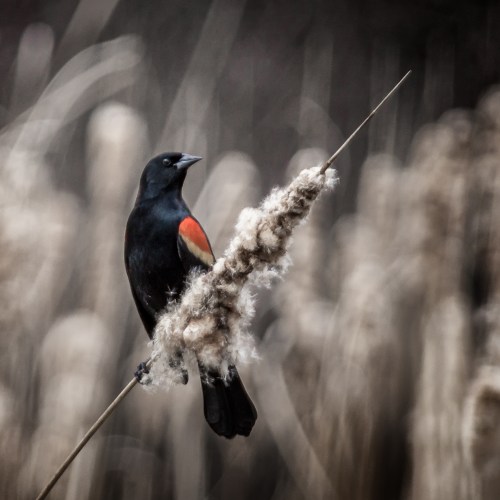
Spring officially arrives today at 6:45 PM, and we are starting to see signs that winter is running out of steam. One of them is the return of Red-winged blackbirds Agelaius phoeniceus about which University of Michigan BioKids says (in part):

These birds are some of the first springtime birds to return from their wintering sites. Once males arrive, they devote their time to defending their territory. The most successful defenders are not necessarily the most aggressive birds. Males that spend more time in, as well as foraging on, their territory are more likely to retain ownership of that territory.

Males with darker colored shoulders do not tend to keep their territories. Typically in the spring, male red-winged blackbirds display in a “song spread.” They fluff their plumage, raise their shoulders, and spread their tail as they sing. As the display becomes more intense, the wings are more arched with the shoulders showing more prominently. Males use this same body display as a threat to other male birds that enter into the male’s territory.

Females will also engage in a “song spread” display directed at each other early in the breeding season. One possibility is that a female will defend a sub-territory within the male’s territory. The female will engage in a “wing flip” display when a disturbance prevents her from returning to her nest full of young.

Red-winged blackbirds are active during the day and migrate between their summer breeding grounds and winter feeding areas. During the winter, red-winged blackbirds aggregate in huge flocks and tend to stay in or near areas where grains and seeds are available to eat.

Read on for more including their ability to help control insect pests.

View Michael’s photo background big and see more in his soon to grow Birds 2015 slideshow.

Many more Michigan birds on Michigan in Pictures.

Fire & Ice

_DSC4701 Fire & Ice

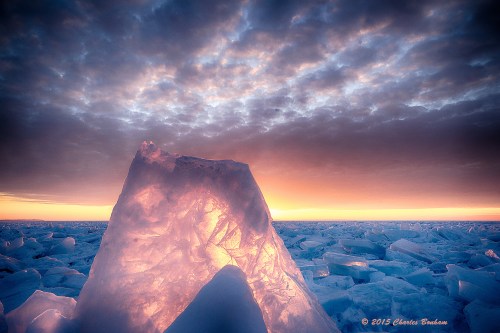
Fire & Ice, photo by Charles Bonham

I keep thinking to myself just one more winter photo … and then there’s one more.

Charles shot this at Gills Pier on the Leelanau Lake Peninsula last week. View it background bigtacular (for real – the detail on the ice in the foreground is staggering) and see lots more Lake Michigan ice and beauty in his awesome slideshow.

More winter wallpaper, more Lake Michigan and more sunsets on Michigan in Pictures.

MLK Say!

MLK Say by Rudy Malmquist

MLK Say !, photo by Rudy Malmquist

“And so we must say, now is the time to make real the promises of democracy. Now is the time to transform this pending national elegy into a creative psalm of brotherhood. Now is the time to lift our nation.

…this social revolution taking place can be summarized in three little words. They are not big words. One does not need an extensive vocabulary to understand them. They are the words “all,” “here,” and “now.” We want all of our rights, we want them here, and we want them now.

…With this faith, we will be able to achieve this new day when all of God’s children, black men and white men, Jews and Gentiles, Protestants and Catholics, will be able to join hands and sing with the Negroes in the spiritual of old: Free at last! Free at last! Thank God almighty, we are free at last!”

~ Dr. Martin Luther King in Detroit, June 23, 1963.

The words above are from Dr. Martin Luther King’s speech at Cobo Hall at the Great March on Detroit. The speech is regarded as the dress rehearsal for his famous I Have a Dream speech in Washington DC. Click to listen and read the text of the speech.

View Rudy’s photo background big and click for more of his graffiti photos.

More Martin Luther King on Michigan in Pictures.

I really encourage you to click through and listen. Dr. King was an incredible orator, and this was one of his very best speeches.

Sunset over the Keweenaw

Sunset over the Keweenaw

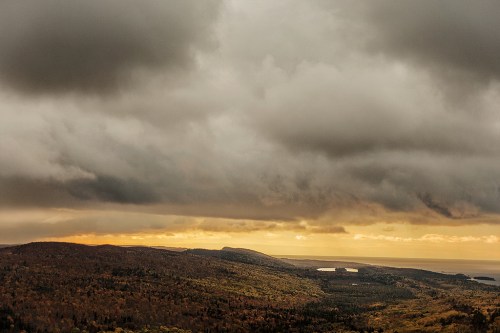
Sunset over the Keweenaw, photo by Ashley Williams

Here’s a beautiful shot from late October last year on the Keweenaw Peninsula in the U.P. With temps this cold, it won’t be long until the color returns! Hope you get a chance to get out and enjoy the outdoors this weekend.

View Ashley’s photo background bigtacular and see more in her slideshow. You can also follow her on Facebook or Instagram and visit her photography website.

More from the Keweenaw and more fall wallpaper on Michigan in Pictures.