Comet of Unknown Origin

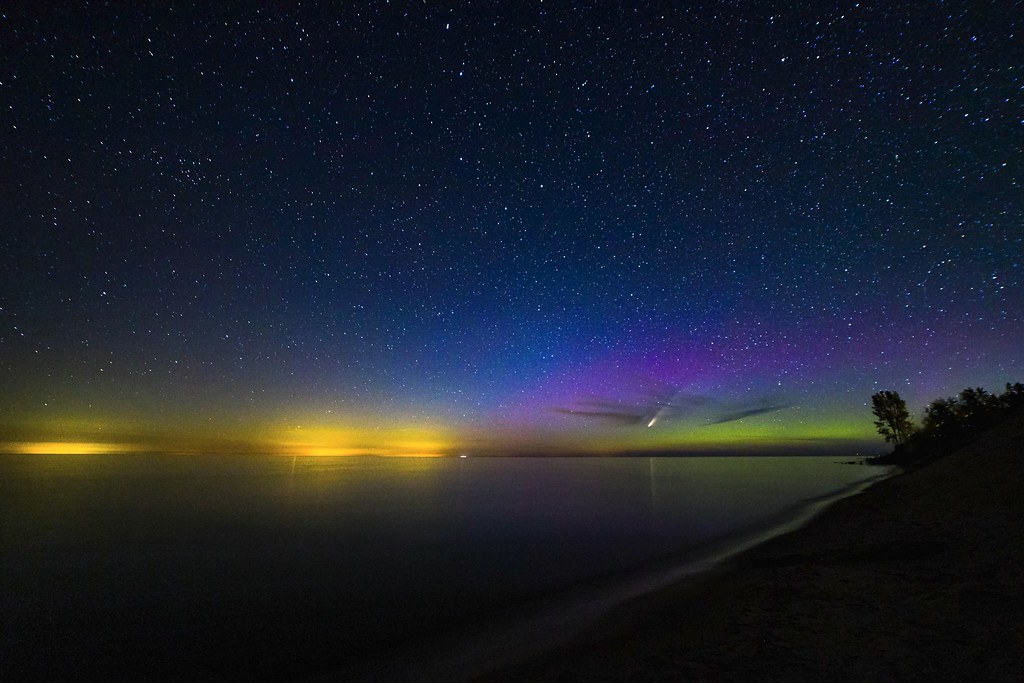
Northern Lights and Comet Neowise by Gary Syrba

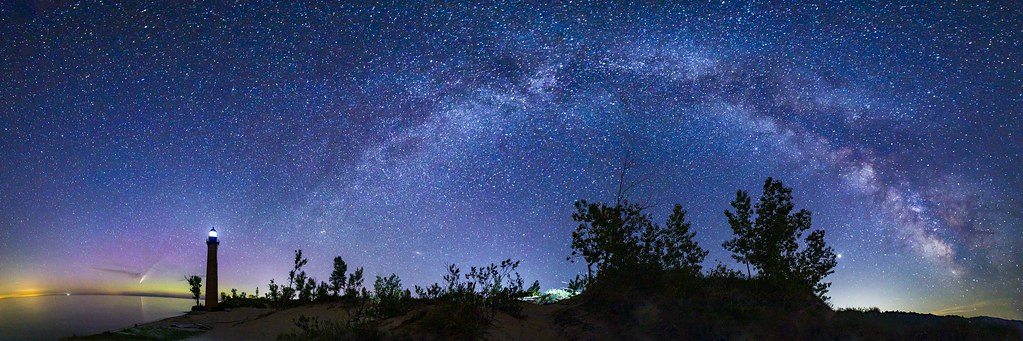
Northern Lights and Comet Neowise by Gary Syrba

Our friends at EarthSky share that the latest observations of Comet 3I/ATLAS show it brightening more quickly than predicted:

Up until now, the interstellar comet had been brightening as expected. But now, the observations from mid-September 2025 are beginning to rise above the upward-sloping line of brightening that would have been typical for a comet nearing the sun.

(There has been a lot of talk that 3I/ATLAS might be an interstellar probe due to its great speed & a trajectory that takes it close to Jupiter, Mars & Earth before it slingshots away using the Sun’s gravitation.)

A team of scientists, led by Xabier Pérez-Couto of the University of A Coruña in Spain, has traced the path of interstellar object 3I/ATLAS back 10 million years. Indeed, this is only the 3rd-known object found traveling in our solar system that didn’t originate with our sun and its planets. Its trajectory tells us it must have come from another star system, but which one?

They traced the path back over 100 million astronomical units (9.3 quadrillion miles) but couldn’t find where it started towards Sol. You can read on for lots more!

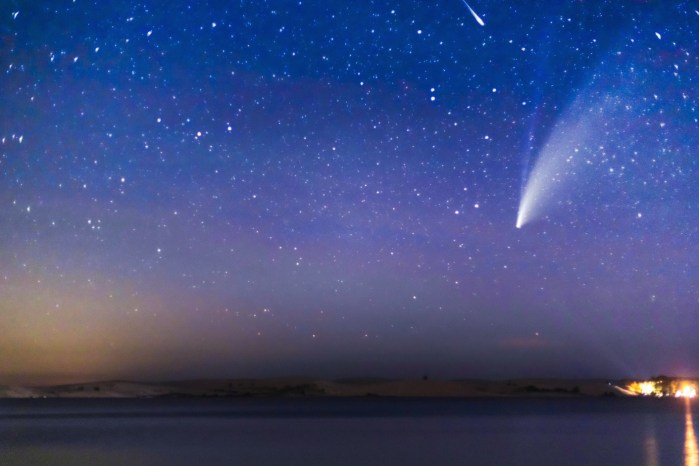
Gary took these photos of the Northern Lights & Comet Neowise over Lake Michigan back in 2020. See more in his Night Skies gallery on Flickr and view & purchase Gary’s work on his website.

Support Michigan in Pictures with Patreon

How to see Comet A3

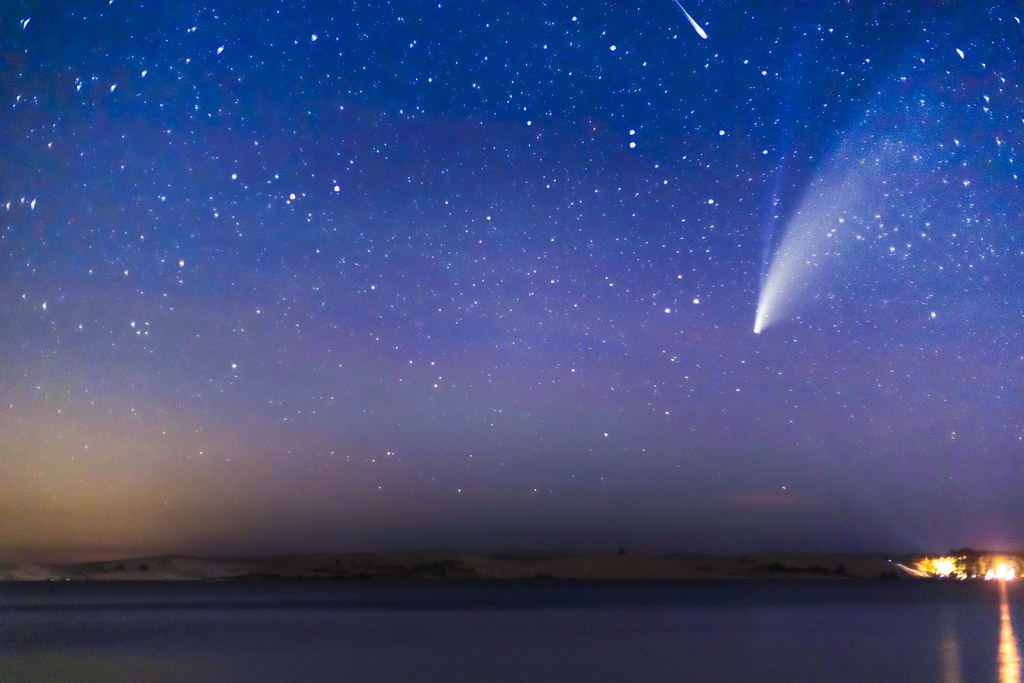
Neowise and meteor by Gary Syrba

There were hopes that Comet C/2023 A3 Tsuchinshan–ATLAS aka Comet A3 would be the comet of the century. While it is not quite that, it does appear that it will be visible for the next couple of weeks just after sunset, even to the naked eye! The good folks at EarthSky offer a helpful checklist to spot Comet A3:

  1. Be sure you’re looking at the correct direction and time. Comet A3 will be visible low in the west after sunset beginning around October 14.
  2. You need a dark, unobstructed sky. Start looking when the sky is dark, but close to sunrise or sunset. Make sure there aren’t hills, trees or buildings blocking your view.
  3. If you can’t see the comet with your eye, try your phone. Most cell phone cameras provide a night or low-light mode. But capturing an image of the comet will require that you hold the camera firmly – or lean against a fixed object like a tree – to avoid shaky or blurred image.
  4. AFTER you’ve located the comet, use binoculars or your eyes to sweep in that area in the sky.

Gary took this shot of Comet Neowise back in July of 2020. See more in his Night Skies gallery on Flickr and view & purchase his work on his website.

Support Michigan in Pictures with Patreon

Get ready for Comet Tsuchinshan-ATLAS!

via Leelanau.com

Comet C2023 А3 Tsuchinshan-ATLAS by Captures by Ethan

The Planetary Society shares that some astronomers are referring to the newly discovered Comet Tsuchinshan-Atlas as:

… “the comet of the century.” They say it will outshine everything but the Moon in the night sky and that it will stretch its tail over a huge portion of the sky. In that case, people around the world would be able to see the comet without trying at all. On the other hand, some people, like astronomer Dr. Zdeněk Sekanina, have predicted that the comet will break apart around the closest point in its orbit to the Sun, or “perihelion.” Comet Tsuchinshan-Atlas shows no clear signs of fragmenting right now, but that could always change.

…During late September and the first few days of October, you can find Comet Tsuchinshan-Atlas in the constellation Sextans. Look to the east, where the comet will rise about an hour before the Sun if you’re in the Northern Hemisphere. If you’re in a Southern Hemisphere, the comet will rise a bit earlier and be easier to see.

For most of early October, Tsuchinshan-Atlas will be too close to the Sun to be easily visible. Then, starting around Oct. 10 — if all goes well — the comet should be visible after sunset near the horizon in the west. With every passing day, Tsuchinshan-Atlas will start the evening higher in the sky and be easier to spot, unless it gets too dim.

…or breaks up, but if not it could be legendary! Head over to Planetary.org for more!

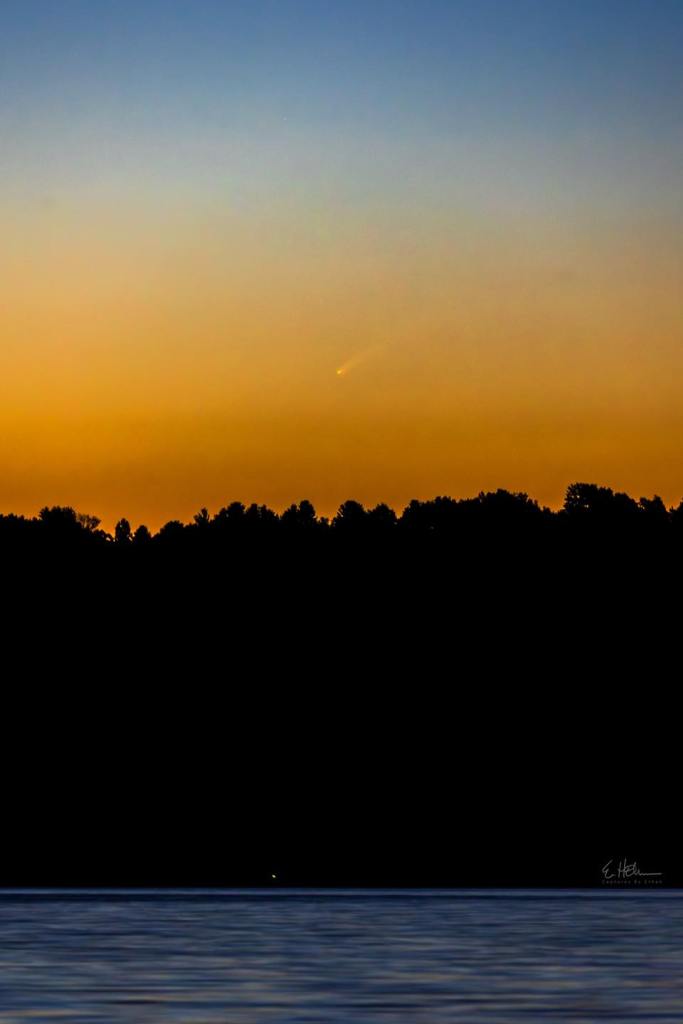
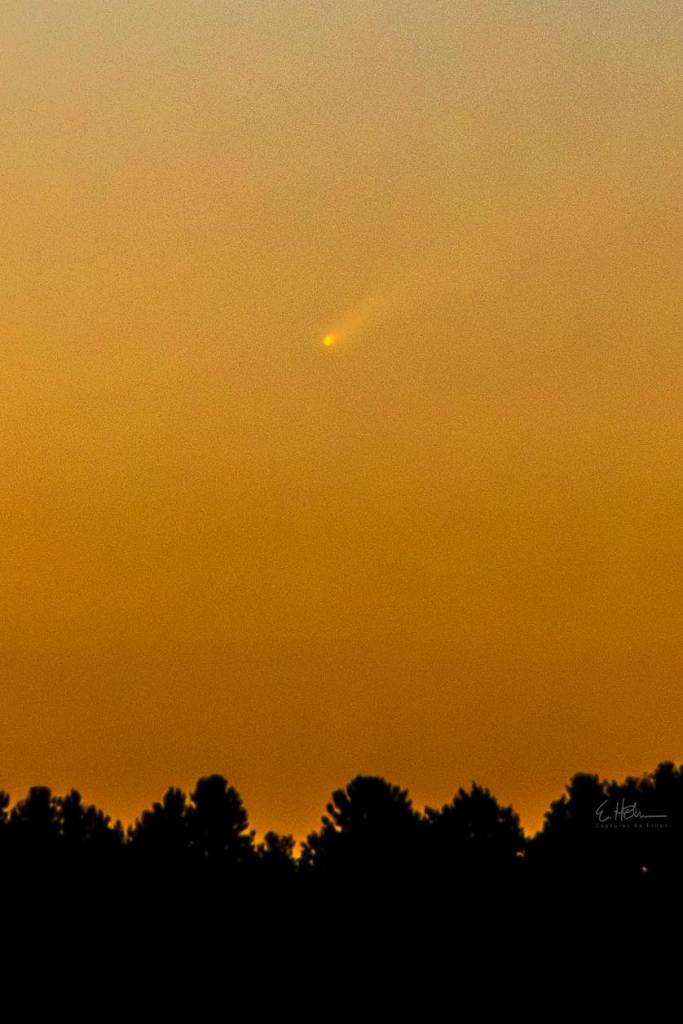
Ethan shares that he captures this sweet shot of Comet Tsuchinshan-ATLAS rising over Lake Leelanau early morning on Sunday. For more follow him on Facebook. View & purchase his work at capturesbyethan.com.

Support Michigan in Pictures with Patreon

Comet P12 Pons-Brooks Visits Eagle Harbor!

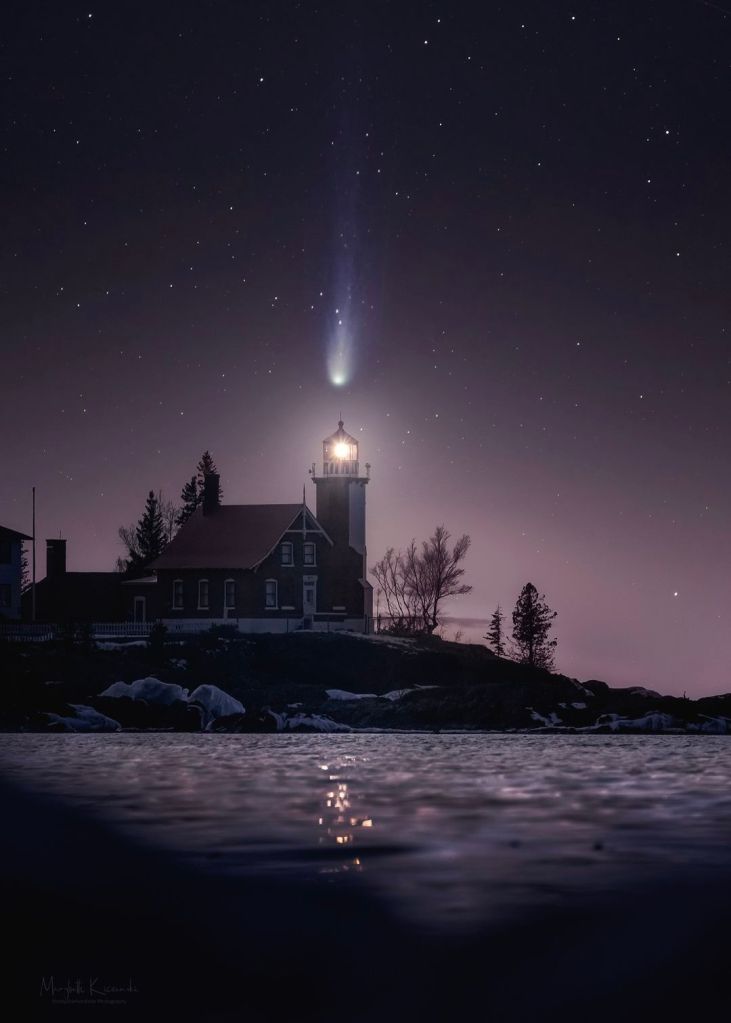
Comet P12 Pons-Brooks Visits Eagle Harbor by Shelby Diamondstar Photography

Comet P12 Pons-Brooks Visits Eagle Harbor by Shelby Diamondstar Photography

Let’s head WAY north for another exciting celestial phenomenon, Comet P12 Pons-Brooks aka the Devil’s Comet. Space.com explains that the comet is named after French astronomer Jean-Louis Pons (1761-1831) who went on to become the greatest visual comet discoverer of all time:

In today’s world, comets are routinely found when they are far out in space, beyond the ability of being picked up by human eyes, but are caught using robotic cameras attached to large telescopes either here on Earth or from satellites out in space.

In contrast, Pons made most of his discoveries using telescopes and lenses of his own design; his “Grand Chercheur” (“Great Seeker”) was an instrument with a large aperture and short focal length, similar to telescopes that our modern-day amateurs would refer to as a “comet seeker.” Pons is noted today for visually discovering 37 comets (still a record) from 1801 to 1827.

…On Sept. 2, 1883, British-born American comet observer William R. Brooks (1844-1921) accidently found it. Like Pons, Brooks was a prolific discoverer of comets. In fact, his total of 27 visual discoveries is second only to Pons. Not until the first orbital calculations of Brooks’ discovery was made, was it realized that this comet and the comet found by Pons of 1812 were one of the same. So, this comet now bears the surnames of both observers.

With an orbital period of roughly 71 years, comet Pons-Brooks is considered to be a “Halley-type” comet, that is, a comet with an orbital period between 20 and 200 years, often appearing only once or twice within one’s lifetime. Other comets with a similar orbital period include 13P/Olbers, 23P/Brosen-Metcalf and the most famous of all, 1P/Halley. Because it was the twelfth comet to have a definitive orbital period calculated, it is cataloged today as 12P/Pons-Brooks.

You can look for the comet just after sunset, but you will probably need binoculars given the afterglow of the sunset.

MaryBeth took this way up on the Keweenaw Peninsula at Eagle Harbor Lighthouse. Click the photo above to share a comment with her on Facebook and for sure view & purchase her work at shelbydiamondstar.com!

PS: In my best Arnold voice, “I’ll be back” (because she has an amazeballs photo for us!)

Falling Skies in October: Draconid & Orionid meteor showers

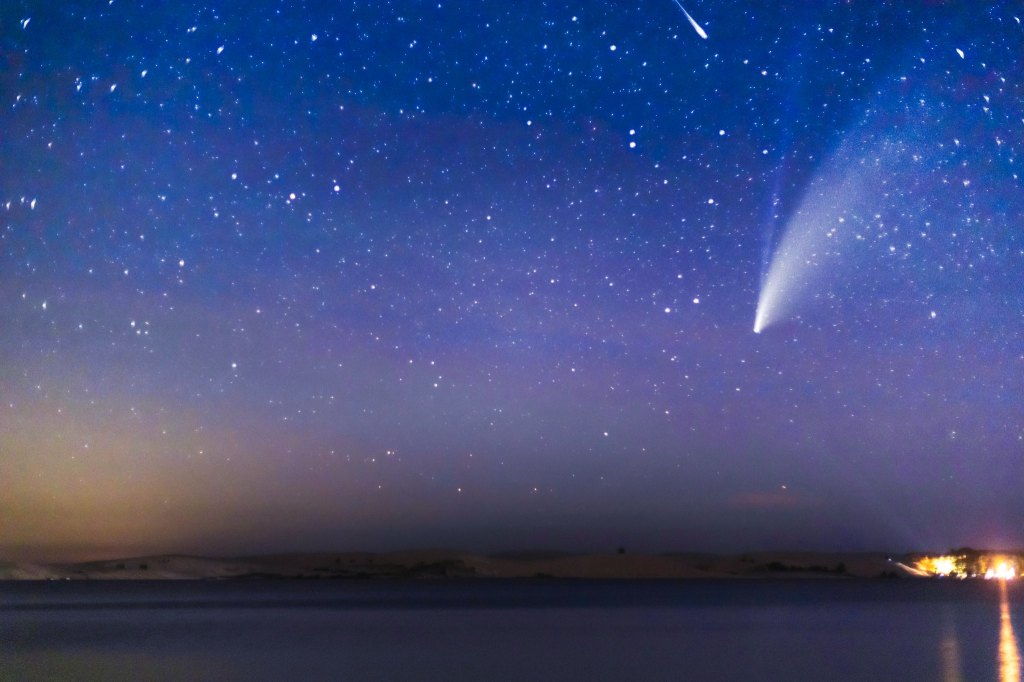
Neowise and meteor by Gary Syrba

Neowise and meteor by Gary Syrba

In addition to being the season of cider, changing leaves, and Halloween, October also brings a pair of meteor showers. Our friends at EarthSky give you all you need to know to see the Draconid & Orionid meteor showers:

The Draconids, October 8th

In 2021, watch the Draconid meteors at nightfall and early evening on October 8. You might catch some on the nights before and after, as well. Fortunately, the thin waxing crescent moon sets before nightfall. It won’t hinder this year’s Draconid shower … This shower is usually a sleeper, producing only a handful of languid meteors per hour in most years. But watch out if the Dragon awakes! In rare instances, fiery Draco has been known to spew forth many hundreds of meteors in a single hour.

The Orionids, October 21st

Unfortunately a full moon accompanies 2021’s Orionid shower. Try watching for these meteors in the wee hours before dawn on October 21. You won’t escape the moon, though. On a dark, moonless night, the Orionids exhibit a maximum of about 10 to 20 meteors per hour. More meteors tend to fly after midnight, and the Orionids are typically at their best in the wee hours before dawn. The Orionids sometimes produce bright fireballs, which might be able to overcome a moonlit glare. If you trace these meteors backward, they seem to radiate from the Club of the famous constellation Orion the Hunter.

Gary took this shot last summer. Head over to his Flickr for the latest!

Support Michigan in Pictures with Patreon

Comet Neowise gets better & better!

Lake Michigan … trifecta! by Ken Scott Photography

Space.com says that those who have gotten up before sunrise to gaze into the twilight skies to see Comet Neowise have been greeted by the best comet performance for Northern Hemisphere observers since the 1997 appearance of Comet Hale-Bopp, emphatically ending nearly a quarter-century of lack of spectacular comets, and it’s only going to get better:

The first good opportunity for evening viewing begins on July 12, when the head of the comet will stand 5 degrees above the north-northwest horizon, 80 minutes after sunset (the end of nautical twilight). By July 14 its altitude will have already doubled to 10 degrees, and by July 19 it will have doubled yet again to 20 degrees up by the end of nautical twilight. By then it will have moved to above the northwest horizon.

So, we at Space.com feel that the best time to view the comet during the evening will come during the July 14-19 time frame.

We also strongly recommend that observers should seek the most favorable conditions possible. Even a bright comet, like this one, can be obliterated by thin horizon clouds, haze, humid air, smoke, twilight glow and especially city lights. We especially emphasize that last factor: the farther away you get from a metropolitan area, the darker your sky and the better your view of NEOWISE. Binoculars will enhance your view.

And more good news: No moonlight will brighten the sky, as the moon will be a waning crescent and visible only in the morning sky through July 20. On successive July evenings the comet will grow fainter, but it will be farther from the sun, setting later and visible in a darker sky. As we move into August, the comet will be very well placed for observers with small telescopes.

Read on for more tips & happy comet hunting to you all!

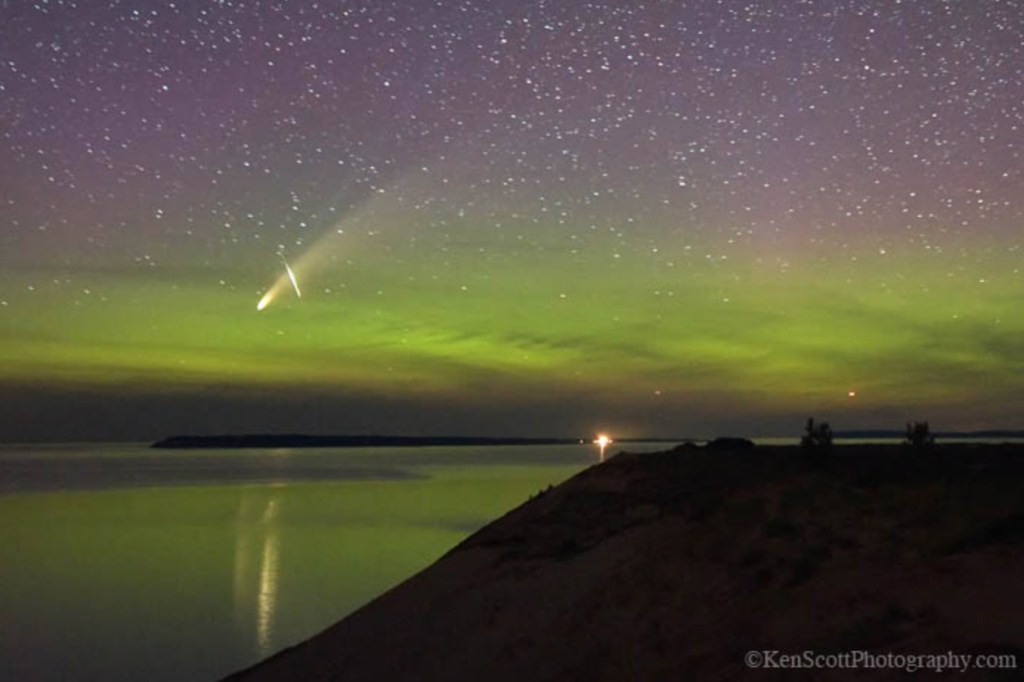
Ken was in the Sleeping Bear Dunes National Lakeshore looking towards the Manitou Islands & writes that he captured Comet Neowise, the Northern Lights and an Iridium Flare plus the bonus reflection on Lake Michigan!! The bright light to right of center horizon is the South Manitou Island Lighthouse. See it bigger on Facebook.

Be sure to follow Ken Scott Photography & view & purchase prints at kenscottphotography.com!

Support Michigan in Pictures with Patreon

See Comet Neowise in Michigan this month!

Comet Neowise by Lake Superior Photo

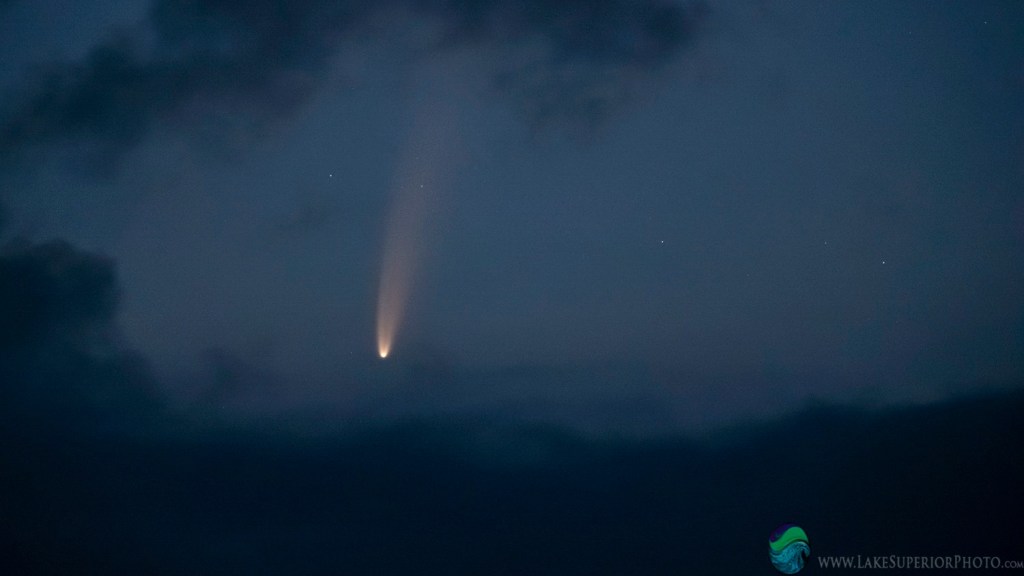
Shawn of Lake Superior Photo took this photo of Comet Neowise peeking through the clouds and fog yesterday morning. She shares that it’s visible to the naked eye & you can catch it the next few days in the northeast before sunrise!! EarthSky explains how to see Comet Neowise:

We still have to wait for another very bright comet, what astronomers call a great comet. There’s no strict definition for great comet, but most agree that Hale-Bopp – widely seen by people in 1997 – was one. Lesser comets are moderately frequent, though, and, right now, there’s a nice binocular comet in the dawn sky. Some skilled observers have reported that – once you spot it with binoculars – you can remove them and see the comet with the unaided eye. Using binoculars or other optical aid is a must, though, if you want to see this comet’s split tail. The comet is called C/2020 F3 (NEOWISE).

Comet C/2020 F3 (NEOWISE) is up at dawn now; it will be highest in the dawn sky around July 11. Then it will gradually approach the horizon each day. By mid July (around July 12-15), the comet will become visible at dusk (just after sunset), low in the northwest horizon.

If the comet remains relatively bright, it might be easier to see in the second half of July during evening dusk, because, at that time, it will appear somewhat higher in the sky.

You can view the photo on the Lake Superior Photo Facebook and view & purchase work at LakeSuperiorPhoto.com.

Support Michigan in Pictures with Patreon

#TBT: Comet Biela and the Great Michigan Fire of 1871

House fire

House fire, photo by Ogedn

“The proponents of the cometary explanation cite many fascinating details confirmed by eye witness reports: the descent of fire from the heavens, a great ‘tornado’ of fire rushing across the landscape and tearing buildings from their foundations, descending balls of fire, a rain of red dust, great explosions of wind accompanied by blasts of thunder, buildings exploding into flame where no fire was burning, and a good deal more.”
~thunderbolts.info

We all probably know of Mrs. O’Leary’s cow and the Chicago Fire that burned over three miles of the city to the ground, but perhaps you’d care to take “Fires beginning October 8, 1871” for $500? Four fires began 144 years ago on this day in 1871: the Great Chicago Fire, the Great Michigan Fire, the Peshtigo (Wisconsin) Fire and the Port Huron Fire.

I’m going to let the crew of thunderbolts take it away with an excerpt from their fascinating feature The Comet and the Chicago Fire:

Contrary to popular folklore, the Chicago fire is not the worst in U.S. history. It was not even the worst to occur on October 8 that year. The same evening—in fact, at the same time, about 9:30—a fierce wildfire struck in Peshtigo, Wisconsin, over 200 miles to the north of Chicago, destroying the town and a dozen other villages. Estimates of those killed range upward from 1200 to 2500 in a single night. It was not the Chicago fire but the simultaneous “Peshtigo Fire” that was the deadliest in U.S. history.

And there is more. On the same evening, across Lake Michigan, another fire also wreaked havoc. Though smaller fires had been burning for some time—not unusual under the reported conditions—the most intense outburst appears to have erupted simultaneously with the Chicago and Peshtigo fires. The blaze is said to have then burned for over a month, consuming over 2,000,000 acres and killing at least 200.

Concerning the Michigan outburst, it is reported that numerous fires endangered towns across the state. The city of Holland was destroyed by fire and in Lansing flames threatened the agricultural college. In Thumb, farmers fled an inferno that some newspapers dubbed, “The Fiery Fiend.” Reports say that fires threatened Muskegon, South Haven, Grand Rapids, Wayland, reaching the outskirts of Big Rapids. A steamship passing the Manitou Islands reported they were on fire.

There can be no doubt that weather conditions at the time favored wildfires. But never before, and never since, has the U.S. seen such wildly destructive simultaneous conflagrations. This “coincidence”, combined with many unusual phenomena reported by eyewitnesses, has led some to conclude that an extraordinary force, one not of the earth, was a more likely “arson” than either a misbehaving cow or a regional drought.

In 1883, Ignatius Donnelly, author of Ragnarok: the Rain of Fire and Gravel, suggested that in early historic times our Earth suffered great catastrophes from cometary intruders. To this claim he added: “There is reason to believe that the present generation has passed through the gaseous prolongation of a comet’s tail, and that hundreds of human beings lost their lives”. He was referring to the conflagration of 1871.

Definitely read on for much more about the possibility of a comet’s tail, perhaps Comet Biela, fueling the fires.

Ogedn took this photo of a controlled burn by the local fire department, who practiced on this house before letting it burn. View the photo background big and see this and lots more in their slideshow.

Tons more Michigan history on Michigan in Pictures.

PS: I definitely did more research on this than I should have on this, and while the cometary theory and Comet Biela was observed to be broken apart on its pass in 1846, it may be that Biela’s Comet returned in September of 1872. In any case check the article out and also their Picture of the Day for a lot more than you’ve probably thought about.

Into the cold clear night with Shawn Malone … and NASA

Shawns Comet

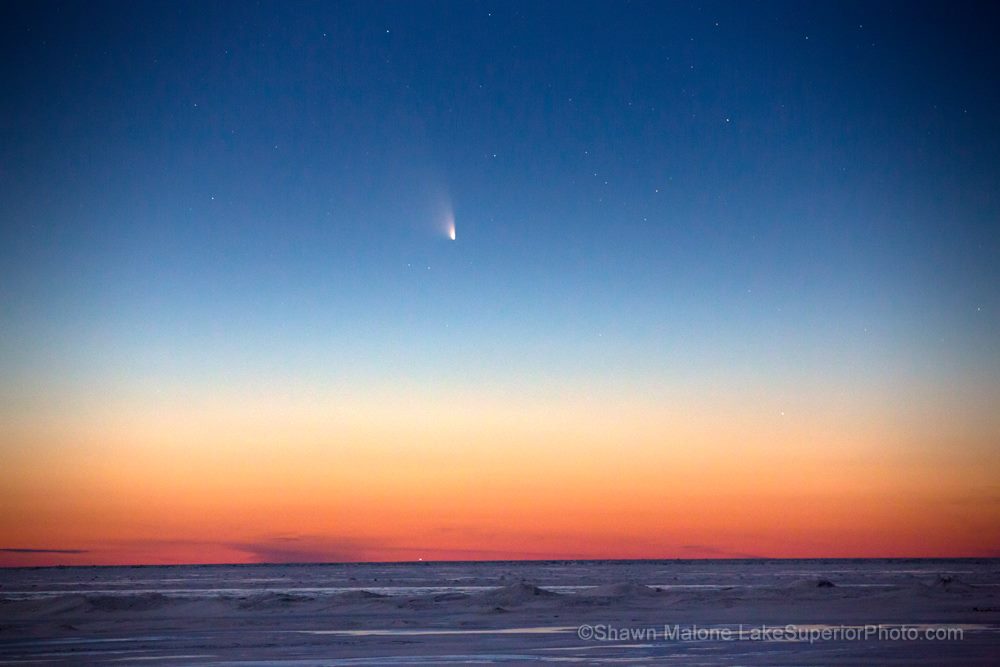
Comet Pan-Starrs over Headlands International Dark Sky Park, photo by Shawn Malone/Lake Superior Photo

Michigan in Pictures regular Shawn Malone of Lake Superior Photo is one of the best photographers of the Michigan night sky around, and on the evening of November 22nd , you have a chance to learn from her at a Night Sky Workshop. She writes:

The Upper Peninsula of Michigan is a wonderful place to discover the magic of night sky photography, due to the abundance of easily accessible dark sky locations. These night sky workshops are designed for those looking for a basic understanding of the equipment and technique necessary for capturing the night sky.

Photography workshops will take place at LakeSuperiorPhoto- gallery/studio on 211 S. Front, Marquette Mi. 49855. There will be an hour class at the studio where I will cover techniques for capturing night sky photos, from basic camera set up and settings, to a brief discussion of post processing to helpful websites and software to help you come away with great night sky photos.

During this workshop we will concentrate on the techniques necessary to capture low light and night sky photos. Hopefully the weather cooperates and we have a chance to photograph the stars or maybe even possibly the northern lights. No matter what weather conditon – we will conduct the workshop and you will come away with everything you need to know about capturing great night sky images.

She has 4 spaces left – click here to register!

You can purchase this photo of Comet Panstars at Lake Superior Photo. Be sure to follow her at Lake Superior Photo on Facebook and see more of Shawn’s photos on Michigan in Pictures.

Speaking of comets, NASA’s Rosetta Mission is going to go all Bruce Willis on a comet THIS MORNING! EarthSky reports:

The Philae (fee-LAY) lander is scheduled to touch down on Comet 67P/Churyumov-Gerasimenko on November 12, 2014 at 10:35 a.m. EST (15:35 UTC). We on Earth – 300 million miles (500 million km) away – won’t know the lander has set down successfully until a signal is received back at about 11:02 a.m. EST (16:02 UTC). Both NASA and ESA will provide live online coverage of this first-ever attempted landing on a comet.

Rosetta spacecraft will do the equivalent of transferring an object from one speeding bullet to another, when it tries to place its Philae lander on its comet. Read more about the mission’s dramatic attempt to land on a comet here.

After landing, Philae will obtain the first images ever taken from a comet’s surface. It also will drill into the surface to study the composition and witness close up how a comet changes as its exposure to the sun varies.

Philae can remain active on the surface for approximately two-and-a-half days. Its “mothership” – the Rosetta spacecraft – will remain in orbit around the comet through 2015. The orbiter will continue detailed studies of the comet as it approaches the sun for its July 2015 perihelion (closest point), and then moves away.

Click through for more and follow it live from NASA right here!

Capturing Comet PANSTARRS

Comet Pan-Starrs ... 3-17-13

Comet Pan-Starrs … 3-17-13, photo by Ken Scott

EarthSky.org is a fantastic site for all things astronomical, and their post detailing everything you need to know about Comet PANSTARRS has great info on the first of 2013 major comets. The comet was discovered by the PANSTARRS telescope in Hawaii and they explain that:

Comet PANSTARRS is still visible through binoculars in the Northern Hemisphere, if you know right where to look. Note where the sun sets in the west. Some 60 to 75 minutes after sundown, seek for the comet about two to three binocular fields to the right, or upper right, of the sunset point on the horizon. Comet PANSTARRS now sets at nightfall or very early evening at mid-northern latitudes. From here on out, the comet will dim a bit day by day, while the waxing moon will brighten daily. So it’s hard to say how much longer Comet PANSTARRS will be readily visible through binoculars. Each day, Comet PANSTARRS goes a few degrees northward (to the right) on the sky’s dome, toward the constellation Cassiopeia the Queen.

…No matter how bright it gets in March, the comet will surely fade as April arrives, as it moves away from the sun and back out into the depths of space. But it will be located far to the north on the sky’s dome and will be circumpolar for northerly latitudes in the Northern Hemisphere. That means it might be visible somewhere in the northern sky throughout the night for northern observers. What’s more, the comet will be near in the sky to another beautiful and fuzzy object in our night sky, the Andromeda Galaxy (M31), the nearest large spiral galaxy to our Milky Way. If the comet truly is bright then, and if it still has a substantial tail, it’ll be an awesome photo opportunity!

Read on for more and also check out the michpics post on Comet ISON which has the possibility of  being so bright that you can see it in the daytime!

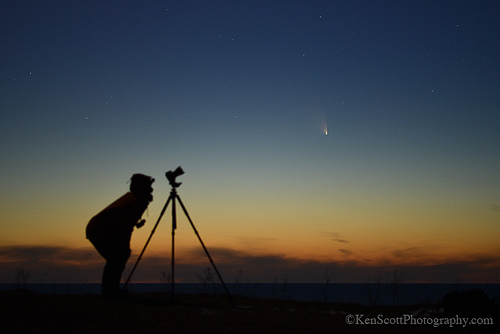
Ken shot this last weekend. You can see it on black, check out the sunset he captured before this and see more great work in his Night Sky slideshow. If you’re looking to purchase this or other shots, definitely head over to KenScottPhotography.com!

More nighttime photography on Michigan in Pictures.