The Making of the Mackinac Bridge

Bridge_HDR2.jpg

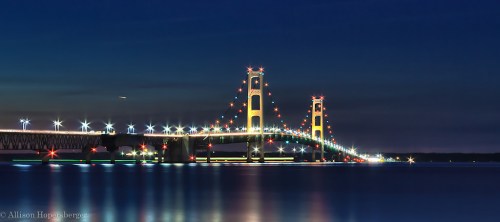
Bridge HDR 2, photo by Allison Hopersberger

A calm night on the Straits of Mackinac, and Michigan’s signature bridge was looking fine!

I’ve posted a ton about the Mighty Mackinac Bridge here on Michigan in Pictures, but had never seen this excellent summary of how it came to be courtesy the Michigan Dept. of Transportation’s page on I-75 and the Straits of Mackinac:

The five-mile stretch of water separating Michigan’s two peninsulas, the result of glacial action some twelve thousand years ago, has long served as a major barrier to the movement of people and goods. The three railroads that reached the Straits of Mackinac in the early 1880s, the Michigan Central and the Grand Rapids & Indiana Railway from the south, and the Detroit, Mackinac and Marquette from the north, jointly established the Mackinac Transportation Company in 1881 to operate a railroad car ferry service across the straits. The railroads and their shipping lines developed Mackinac Island into a major vacation destination in the 1880s.

Improved highways along the eastern shores of Michigan’s lower peninsula brought increased automobile traffic to the straits region starting in the 1910s. The state of Michigan initiated an automobile ferry service between St. Ignace and Mackinaw City in 1923 and eventually operated eight ferry boats. In peak travel periods, particularly during deer season, five mile backups and delays of four hours or longer became common at the state docks at Mackinaw City and St. Ignace.

With increased public pressure to break this bottleneck, the Michigan legislature established a Mackinac Straits Bridge Authority in 1934, with the power to issue bonds for bridge construction. The bridge authority supported a proposal first developed in 1921 by Charles Evan Fowler, the bridge engineer who had previously promoted a Detroit-Windsor bridge. Fowler’s plans called for an island-hopping route from the city of Cheboygan to Bois Blanc, Round, and Mackinac islands, thence to St. Ignace, along a twenty-four-mile route. The Public Works Administration flatly rejected a request for loans and grants to implement this project.

A plan was then drawn up for a direct crossing from Mackinaw City to St. Ignace, but they were again denied funds. In 1940, a plan was submitted for a suspension bridge with a main span of 4600 feet. This design was a larger version of the ill-fated Tacoma Narrows Bridge in Washington State, a structure destroyed by high winds on November 7, 1940. Although the disaster delayed any further action, the activities of 1938-1940 nevertheless produced some important results. The bridge authority conducted a series of soundings and borings across the straits and built a causeway extending out 4200 feet from the St. Ignace shore. The Second World War ended any additional work, and the Legislature abolished the bridge authority in 1947.

William Stewart Woodfill, president of the Grand Hotel on Mackinac Island, almost singlehandedly resuscitated the dream of a bridge across the Straits of Mackinac. Woodfill formed the statewide Mackinac Bridge Citizens Committee in 1949 to lobby for a new bridge authority, which the legislature created in 1950. A panel of three prominent engineers conducted a feasibility study and made recommendations to the bridge authority on the location, structure, and design of the bridge.

The State Highway Department, which had just placed a $4.5 million ferryboat, Vacationland, into service at the straits in January 1952, remained hostile to the bridge plan. In April 1952, the Michigan legislature authorized the bridge authority to issue bonds for the project, choose an engineer, and proceed with construction. The authority selected David B. Steinman as the chief engineer in January 1953 and tried unsuccessfully to sell the bridge bonds in April 1953, but by the end of the year, the authority had sold the $99.8 million in revenue bonds needed to begin construction.

View Allison’s photo bigger and see LOTS more in her Mackinac Island slideshow!
Michigan Nut’s 2015 Calendar

Moonlit-on-the-Mighty-Mac

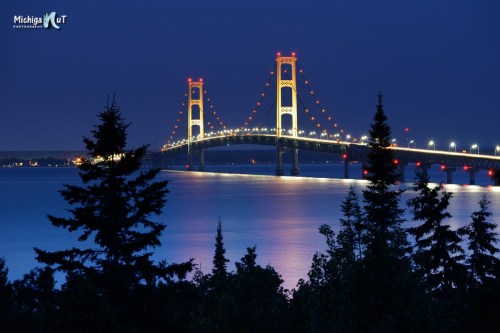
Moonlit on the Mighty Mac, photo by John McCormick/Michigan Nut Photography

If you’ve been following Michigan in Pictures for any length of time, you’re probably familiar with the work of John McCormick aka Michigan Nut.

John has just released his 2015 Michigan Wild & Scenic Wall Calendar, and you can get it for just $15. As an added bonus, if you head over to like his post about it on Facebook, you have a chance to win a free one!

The photo above of the Mackinac Bridge is not only the cover of the calendar, it’s also the photo for June. View (and purchase) John’s photo bigger at MichiganNutPhotography.com, see more in his Michigan Bridges Gallery and definitely follow Michigan Nut Photography on Facebook for a regular dose of photographic awesome from the Great Lakes State!

There’s lots more from John on Michigan in Pictures too!!


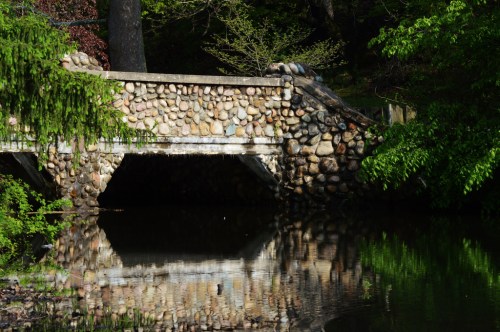
Stone Bridge

DSC_3754

Untitled, photo by erin naylor

One of the fun things about Michigan in Pictures for me is that I get to see interesting and out-of-the-way places like this!

View Erin’s photo background bigtacular and see more in her slideshow.

More bridges on Michigan in Pictures.

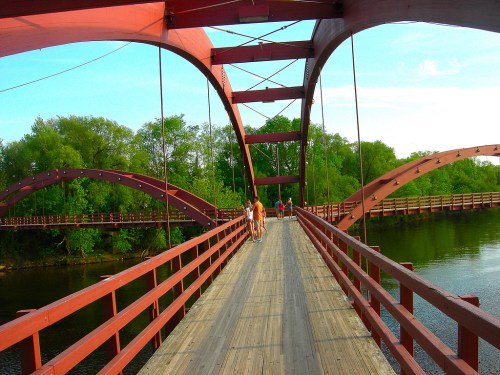
The Tridge in Midland

The "Tridge" - Midland, Mi

The “Tridge” – Midland, Mi, phto by Bluejacket

Wikipedia explains that the The Tridge is a three-way wooden footbridge spanning the junction of the Chippewa and Tittabawassee Rivers near downtown Midland that opened in 1981. It consists of one 31′ tall central pillar supporting three 180′ long by 8′ wide spokes. This apparently globally unique structure was built by Gerace Construction of Midland who add:

The walkways are eight feet, three inches wide, and the triangular observation area in the center measures 35 feet per side. The wooden decking and beams filled six train cars. Although the majority of the Tridge is wood, there are 20 tons of steel in the structure in the form of bolts and connectors. A cofferdam – an enclosed circular cell formed from steel sheet piling – was driven into the river bed and then pumped dry to keep water out while the central concrete pier was built. A causeway – essentially a road in the middle of the river – was built from concrete rubble to allow a crane to approach the center construction area.

The Kuriositas has a nice aerial view of the Tridge too!

Check the photo out bigger and see more in Bluejacket’s The “Tridge” in Midland, Michigan slideshow.

More bridges and more Midland on Michigan in Pictures!

Keepsake: Pennsylvania Truss Bridge

keepsake

keepsake, photo by Marty Hogan

Marty shared this photo and also some information about the CR510 Pennsylvania Truss Bridge in Marquette County from historicbridges.org:

This is one of the largest, most beautiful, and most significant truss spans in Michigan. Not only does this truss bridge display the Pennsylvania truss configuration, it appears that it may have actually come from the state of Pennsylvania. In 1919, the Michigan State Highway Department purchased the bridge which originally crossed the Allegheny River. Relocating and reusing truss bridges was not unusual in this period of history. An example notice indicating bridges for sale from 1921 is shown to the right. At this time, CR-510 was a state trunk line route and purchasing and relocating this bridge would have been an inexpensive alternative to building a new bridge from scratch. It was erected on the CR-510 location in 1921. The Michigan State Highway Department’s Biennial Report stated that the bridge was one of two toll bridges crossing the Allegheny River within 500 feet of each other and was being removed due to the redundancy. Unfortunately, the report did not state exactly where on the river this bridge came from. Since most of the Allegheny River is in Pennsylvania, it is assumed the bridge came from Pennsylvania, although the Allegheny River does dip into New York State for a short time. Depending on where on the Allegheny River it was originally located, it may have been part of a multi-span bridge.

Pennsylvania truss bridges are an uncommon truss type, and the nature of their design means that they are reserved for longer truss spans. However, even among pin-connected highway Pennsylvania truss spans, this bridge’s span still stands out as fairly long. It is the longest pin-connected highway truss span in Michigan. The truss type is extremely rare in Michigan, and so the bridge has additional significance in the context of Michigan. The bridge also retains excellent historic integrity with minimal alterations despite its long service and being located in two different states over its service life. The bridge has decorative details on its portal bracing, another feature that is rare among Michigan truss bridges.

Read on for more.

View Marty’s photo background bigtacular and see more including a long view of the bridge in his 2013 Winter Photo Trip slideshow.

More bridges on Michigan in Pictures.

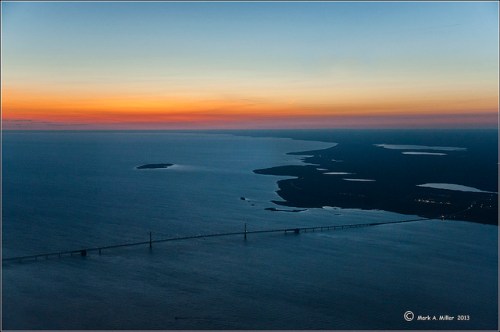
Sunset over the Straits of Mackinac

Straits of Mackinac

Straits of Mackinac, photo by GLASman1

A gorgeous view of a beautiful bridge. Definitely check it out bigger and see more in Mark’s slideshow.

Much more about the Mackinac Bridge on Michigan in Pictures!

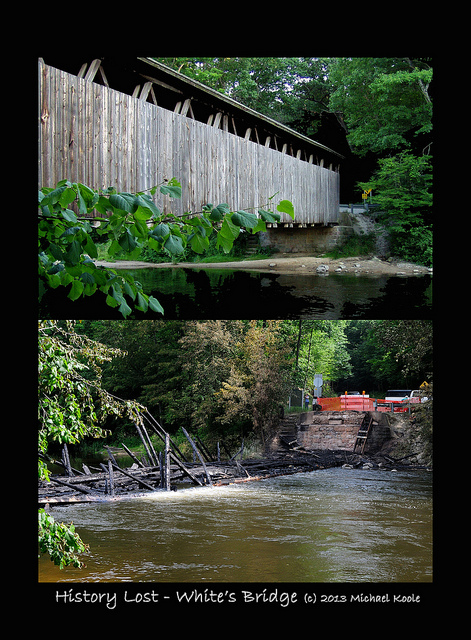
History Lost at White’s Covered Bridge

History Lost

History Lost. photo by Michael Koole – Vision Three Images

Today’s photographer, Michael Koole wrote to let me know that last Sunday (July 7, 2013) the oldest continuously operating covered bridge in Michigan burned and collapsed into the Flat River. Arson is suspected, and you can also see mLive’s coverage and history of the bridge. Michael noted that it was one of less than a dozen in Michigan (see also this page) and the oldest covered bridge still in use in Michigan.

The West Michigan Tourism Association says White’s Covered Bridge:

…was the third bridge built across Flat River at or near the same site, originally called White’s Crossing in honor of a prominent pioneer family. The first was a primitive log-corduroy bridge built in 1840. A second bridge, built around 1856 for a mere $250, was demolished by an ice jam in the spring of 1869. Residents of nearby Smyrna decided they must erect a more substantial structure, despite having no means of immediate payment. The current White’s Covered Bridge was built in 1869.

Jared N. Bresee, who built the covered bridge at Fallasburg, along with Joseph H. Walker, were contracted to build the 120- foot long bridge for a deferred payment of $1000 due in 1870, plus $700 due in 1871. They planked the floor with second-hand lumber in an effort to finish the job quickly. When the townspeople discovered auger holes in the planks, they deducted $25 from the first payment. The bridge was built in just 84 days with only man, ox and horse power.

White’s Bridge is a frame structure with a gable roof. Its construction is of the through-truss type, and the trusses are completely sheeted over with rough pine boards. The floor is 14 feet wide and 116.5 feet long. All of the truss members and dimension lumber are hand hewn and secured with wooden pegs. The sheeting and roof boards are fastened to the rafters with hand cut nails. The abutments are made of local fieldstone. After repair of the abutments in the fall of 1955, White’s Bridge was reopened to automobile traffic.

Except for occasional siding replacement and a new cedar shingle roof, White’s Bridge is much the same today as it was a century ago. It is built with the Brown truss, a type of construction which enjoyed a brief popularity, only in Michigan.

Invented and patented in 1857 by Josiah Brown of Buffalo, New York, the Brown truss resembles the Howe arrangement of “X” bracing and counter bracing, but uses lighter and less timber. It contains no upright members and no iron except for bolt connectors at the timber intersections. Bresee and Walker used the Brown truss successfully in at least four covered bridges in Michigan, three of which are still in existence.

White’s Covered Bridge was listed with the Michigan State Register on February 17, 1965 and awarded a Michigan Historical Marker on July 2, 1965.

See this photo bigger and see more in Michael’s Bridges slideshow.

Michigan in Pictures has profiled a few of Michigan’s remaining covered bridges – they are filed (predictably) under bridge.

Sault Ste. Marie International Railroad Bridge

international railroad bridge, sault ste. marie, ontario / michigan

international railroad bridge, sault ste. marie, ontario / michigan, photo by twurdemann

The Library of Congress page on the Sault Ste. Marie International Railroad Bridge that spans the Soo Locks from Michigan to Canada at St. Marys Falls explains that:

The Sault Ste. Marie International Railroad Bridge has nine camelback truss spans crossing the St. Marys River with bascule and vertical lift bridge components crossing the American Locks at the St. Marys Falls Canal. It is the only bridge in the United States known to include these three types of spans in a single structure to use an interlocking mechanism to connect the leaves of the double-leaf bascule span.

It is Michigan’s most significant railroad bridge from an engineering history standpoint and is eligible for listing in the National Register of Historic Places.

Click through for some great old photos of the bridge and explore the various sections through Historic Bridges.

Check this photo out on black and see more great shots in twurdemann’s Sault Ste. Marie 2012-2013 slideshow.

More Michigan bridges on Michigan in Pictures.

Snow covers the Loon Song Covered Bridge

"Loon Song Covered Bridge" ~ Joshua's Crossing

“Loon Song Covered Bridge” ~ Joshua’s Crossing, photo by Michigan Nut

A couple of years ago, this bridge was for sale. An old listing has a map and summertime photo, and another I found says that this 90 foot private, covered bridge leads across a deep ravine to a heavily wooded parcel on Herendeen Lake near Lake Ann.

John adds that it’s not far from his son’s new home! See it bigger and see more in John’s awesome Bridges/Covered Bridges slideshow.

More bridges on Michigan in Pictures (and also more of John’s photography).