Lady ducks, take notice (of the Mallard)

Lady ducks take notice

Lady ducks take notice, photo by R.J.E.

It’s been too long since I’ve added to the Michigan in Pictures Duckie Gallery. The All about Birds entry for Mallard Anas platyrhynchos explains:

Mallards are large ducks with hefty bodies, rounded heads, and wide, flat bills. Like many “dabbling ducks” the body is long and the tail rides high out of the water, giving a blunt shape. In flight their wings are broad and set back toward the rear.

Male Mallards have a dark, iridescent-green head and bright yellow bill. The gray body is sandwiched between a brown breast and black rear. Females and juveniles are mottled brown with orange-and-brown bills. Both sexes have a white-bordered, blue “speculum” patch in the wing.

Mallards are “dabbling ducks”—they feed in the water by tipping forward and grazing on underwater plants. They almost never dive. They can be very tame ducks especially in city ponds, and often group together with other Mallards and other species of dabbling ducks.

Read on for more including photos and some fun facts:

  • The Mallard is the ancestor of nearly all domestic duck breeds (everything except the Muscovy Duck).
  • Mallard pairs are generally monogamous, but paired males pursue females other than their mates. So-called “extra-pair copulations” are common among birds and in many species are consensual, but male Mallards often force these copulations, with several males chasing a single female and then mating with her.
  • Mallard pairs form long before the spring breeding season. Pairing takes place in the fall, but courtship can be seen all winter. Only the female incubates the eggs and takes care of the ducklings.
  • The standard duck’s quack is the sound of a female Mallard. Males don’t quack; they make a quieter, rasping sound.
  • Mallards, like other ducks, shed all their flight feathers at the end of the breeding season and are flightless for 3–4 weeks. They are secretive during this vulnerable time, and their body feathers molt into a concealing “eclipse” plumage that can make them hard to identify.
  • The oldest known Mallard lived to be at least 27 years 7 months old.

Check this photo out bigger and in R.J.E.’s slideshow.

Over the Moon with a Sandhill Crane

Over the moon

Over the moon, photo by TBPICKS

The 1896 book Myths and Legends of our Own Land by Charles M. Skinner relates a rather gruesome version of the tale of the origin of Whitefish, which this photo reminded me of.

An Indian who lived far in the north was so devoted to the chase that he was never at home for the whole of a day, to the sorrow of his two boys, who liked nothing so much as to sport with him and to be allowed to practise with his weapons. Their mother told them that on no account were they to speak to him of the young man who visited the lodge while their father was away, and it was not until they were well grown and knew what the duty of wives should be that they resolved to disobey her. The hunter struck the woman dead when he learned of her perfidy. So greatly did her spirit trouble them, however, that they could no longer abide in their old home in peace and comfort, and they left the country and journeyed southward until they came to the Sault Sainte Marie.

As they stood beside the falls a head came rolling toward them on the earth—the head of the dead woman. At that moment, too, a crane was seen riding on the surface of the water, whirling about in its strongest eddies, and when one of the boys called to it, “O Grandfather, we are persecuted by a spirit; take us across the falls,” the crane flew to them. “Cling to my back and do not touch my head,” it said to them, and landed them safely on the farther shore.

But now the head screamed, “Come, grandfather, and carry me over, for I have lost my children and am sorely distressed,” and the bird flew to her likewise. “Be careful not to touch my head,” it said. The head promised obedience, but succumbed to curiosity when half-way over and touched the bird’s head to see what was the matter with him. With a lurch the crane flung off his burden and it fell into the rapids. As it swept down, bumping against the rocks, the brains were pounded out and strewn over the water. “You were useless in life,” cried the crane. “You shall not be so in death. Become fish!” And the bits of brain changed to roe that presently hatched to a delicate white fish, the flesh whereof is esteemed by Indians of the lakes, and white men, likewise. The family pitched a lodge near the spot and took the crane as their totem or name-mark. Many of their descendants bear it to this day.

The version I read in one of my all-time favorite books, Lore of the Great Turtle : Indian Legends of Mackinac Retold by Dirk Gringhuis is pretty dark as well. Michigan in Pictures has a post with all the information about Sandhill Cranes in Michigan, and you can also check out Sandhill Crane (Grus canadensis) from the Michigan DNR.

View this out on black and see more in Todd’s slideshow.

More birds on Michigan in Pictures.

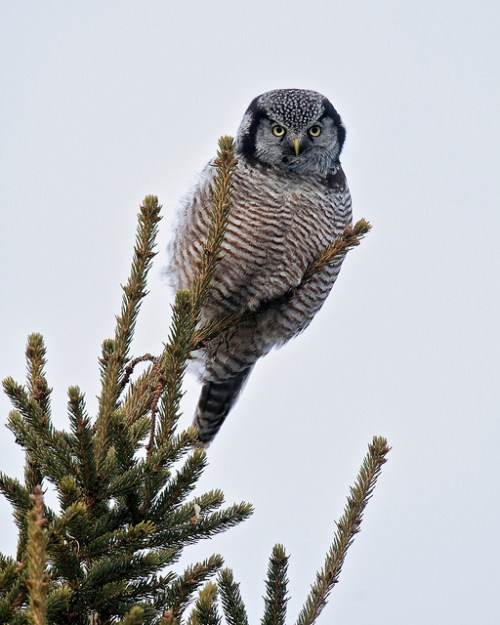
Northern Hawk Owl, and the NMC Hawk Owls

northern hawk owl, chippewa county, michigan

northern hawk owl, chippewa county, michigan, photo by twurdemann

Northwestern Michigan College here in Traverse City has just under 5000 students and is turning from a 2 year to a 4 year college. As part of this, they will be adding athletics again, and that means they need a mascot. So this week they selected a new one – the NMC Hawk Owls.

With a weight of half a pound to a pound, a length of just 14-16″ and a wingspan of just under 2 1/2 feet, the Northern Hawk Owl appears to be the perfect mascot:

Northern Hawk Owl – Surnia ulula at OwlPages.com:

Hunting & Food: Takes mainly small mammals as prey, mostly lemmings and voles. Will also take birds, frogs and occasionally fish. Prey weight is normally below 70g. Hunts by searching from a lookout, then quickly flying to swoop down on prey. Has been observed hovering also.

Breeding: Male advertises potential nest sites, and the female selects one. Nests in Cavities on top of broken trunks, natural tree hollows, abandoned holes of large woodpeckers. Will accept nest boxes, and occasionally use a stick nest of a larger bird. Laying normally occurs in April and the first half of May. Clutch sizes are usually between 5 and 13 eggs, each 36-44mm  x 29-34.4mm. Eggs are laid at 1-2 day intervals, and incubated by the female alone for 25-30 days. During this time, the male feeds the female.

Northern Hawk-Owl at Wikipedia:

The Northern Hawk-Owl has been said to resemble a hawk in appearance and in behavior. In North America, its appearance in flight is often considered similar to a Cooper’s Hawk (Accipiter cooperii). It has been suggested that this may be because the Hawk-Owl may partially fill an important diurnal niche similar to that of day hunters such as hawks.

…Northern Hawk Owls are unevenly distributed and highly variable throughout the boreal forest. They live mostly in open coniferous forests, or coniferous forests mixed with deciduous species such as larchbirchpoplar, and willow. They are found in muskegs, clearings, swamp valleys, meadows, or recently burnt areas, and generally avoid dense spruce-fir forests. Winter habitat is usually the same as breeding habitat. 

Northern Hawk Owl at All About Birds adds that their International conservation status is Least Concern and some cool facts:

  • The Northern Hawk Owl can detect prey by sight at a distance of up to 800 meters (half a mile).
  • Though it is thought to detect prey primarily by sight, the Northern Hawk Owl can find and seize prey under 30 cm (1 foot) of snow.

The Whitefish Point Bird Observatory adds that Northern Hawk Owl were observed yesterday in Trout Lake and Dryburg, Michigan.

Grabbing a mouse through a foot of snow? That’s a seriously scary predator … at least if you’re the prey. Click all those links to explore photos, calls and more about these tiny terrors.

Check this photo from Chippewa County out on black and see more including another shot of this owl in twurdemann’s Birds slideshow.

More owls (and also apparently words that end with owl) on Michigan in Pictures.


Cyanocitta cristata, the Blue Jay

Blue Jay in Winter

Blue Jay in Winter, photo by AcrylicArtist

The UM Animal Diversity Web entry for Cyanocitta cristata blue jay says (in part):

Blue jays are bright blue on top and whitish gray on the belly and chin. They have a gray-blue, feather crested head, which they can raise and lower. The feathers on their wings and tails are bright blue with white and black bands. Blue jays also have a collar of black feathers across the throat and continuing around the head. Their bills, legs, feet, and eyes are black. Males are just a little larger, on average, than females.

…Blue jays are very aggressive and noisy birds,driving other birds away from food sources and their territories. In the winter, Blue jays hide far more food than they can eat, perhaps to remove food from their territories to discourage intruders. They are also partially migratory, and in the fall they can be seen traveling in flocks of more than a hundred birds.

…Blue jays are omnivorous. They feed on fruits, nuts, seeds, insects, mice, frogs, and will rob other nests for small songbirds and bird eggs. To eat nuts, blue jays hold them with their feet and then crack the shell with their bill. Blue jays in captivity have been known to fashion tools in order to get at foods. Blue jays will also steal foods from other birds by frightening them into dropping what they have. They cache foods, such as seeds, for later use.

Read on for much more (including photos)  and don’t miss a previous feature, Things you may not know about Blue Jays.

Check this out background bigtacular and see more in Rodney’s Animals slideshow.

Many more Michigan birds on Michigan in Pictures.

Pairs Skating, Swan Edition

pairskating

pairskating, photo by mozy54

Lynn writes that she didn’t see this pair in the national ice skating finals. Check it out on black and see a couple more shots of these swans in her slideshow.

More birds on Michigan in Pictures!

Fish Dinner: Blue Heron Style

Fish Dinner

Fish Dinner, photo by Mario.Q.

Mario took this great shot of a blue heron fishing on the Red Cedar River.

Check it out bigger in his Great Outdoors slideshow.

Much more about blue herons on Michigan in Pictures.

Know Your Michigan Birds: Great Blue Heron


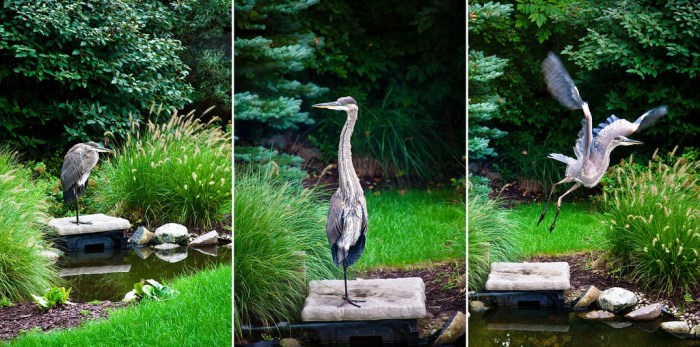
Great Blue Heron Tryptich

backyard-heron-triptych, photo by numstead.

Great Blue Heron (Ardea herodias) on Animal Diversity Web at UM – where you can get complete information, pictures & sounds – says that these birds are the largest and most common herons in North America. The Michigan DNR’s Blue Heron page explains that:

This is the familiar, large grayish-blue heron seen wading in shallow water in marshes, ponds and along lakeshores and stream edges. They are sometimes confused with the sandhill crane; the heron is smaller and flies with its neck folded back, while cranes fly with their neck extended. Great blue herons are commonly seen in small suburban wetlands (cranes are generally less tolerant of close presence). Herons feed on fish, frogs, and other small animals, captured by a quick jab of the beak. They nest in colonies, usually building their stick platform nests in trees in lowland hardwood swamps. In recent years many rookeries have been displaced by shoreline development or timber cutting. Every attempt must be made to preserve known nesting sites if these beautiful birds are to remain common in Michigan’s wetlands.

Wikipedia has more about the Great Blue Heron and you can get more info (and typical calls) from All About Birds. There’s even a short video of a Michigan blue heron on the Kalamazoo River on YouTube.

Nathan says he looked out the window, saw this guy chillin’ by the frog pond and couldn’t believe his eyes when he stretched his neck. Be sure to check this out bigger or in his Great Outdoors set (slideshow).

Holy Spring, Batman!

Holy Spring, Batman!

Holy Spring, Batman!, photo by Rudy Malmquist.

Na, na, na, na, na, na, na, na, na, na, na, na, na, na, na, na, na, na, na, na, na, na, na, na, Bokeh!

Be sure to and get yourself a Bokehlicious Background from Michigan’s Perspicacious Prince of Pictoral Presentment.

Biff!, POW!!

More spring wallpaper on Michigan in Pictures