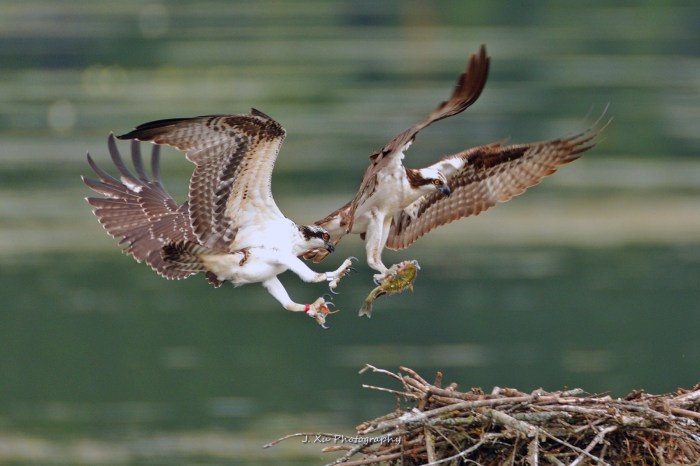
Dinner with the Ospreys

Dinner with the Ospreys

Can’t Wait, photo by Jiafan(John) Xu

Osprey Watch of Southeast Michigan shares some information about Michigan Osprey:

An Osprey is a large bird with a length of 22-25 inches, a wingspan of 4.5-6 feet, and a weight of approximately four pounds. The Osprey has a dark brown back and a white belly, as well as a white head, which features a dark stripe running from its yellow eyes to the back of its head. Female Ospreys are slightly larger than males and may sport a dark speckled necklace

..The Osprey dines almost exclusively on live fish, often catching its meals by hovering over the water at an altitude of 50 to 200 feet, then diving feet first into the water to catch its prey. The Osprey’s feet are uniquely adapted to “air fishing.” Each Osprey foot has a reversible front toe, as well as barbs, called spicules, which help it hold onto a slippery fish in flight. Normally, an Osprey will aerodynamically position a fish headfirst in its talons before it returns to the nest.

These talons definitely look like fish hooks – read on for more!

View Jiafan’s photo bigger and see more in his slideshow where you can also see shots from a trip out west.

More Michigan birds on Michigan in Pictures.

Dancing in the Air: Birding Trails & Bird Sanctuaries in Michigan

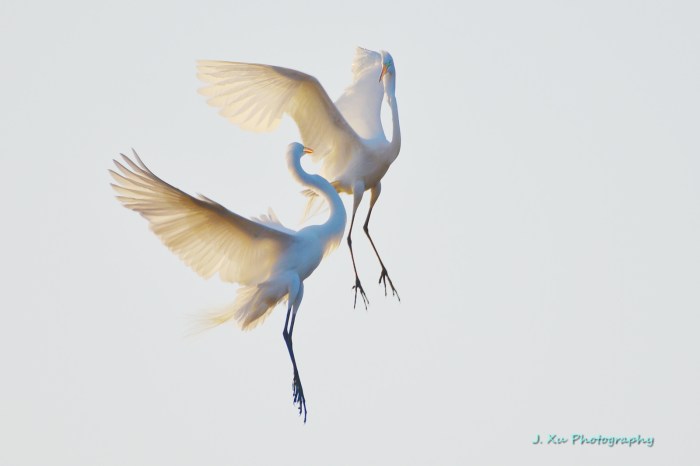
Egrets Dancing in the Air

Dancing in the Air, photo by Jiafan(John) Xu

I’m pretty sure that these are Great Egrets (Ardea alba) but would appreciate confirmation from any birders in the audience.

On the Pure Michigan blog, Mallory King of the Michigan Audubon Society writes that birding is currently the second fastest growing hobby in the United States after gardening with over 47 million people identifying as birdwatchers. She shares some great Michigan birding trails and sanctuaries to help you get going with birding:

The Superior Birding Trail: This trail covers 150 miles in the Upper Peninsula from the Seney National Wildlife Refuge to Whitefish Point; you can observe over 300 bird species here.

The Sleeping Bear Birding Trail: The SBBT West which the trial is commonly referred too, includes 123 miles from Manistee to Traverse City along the scenic M-22 highway and Lake Michigan shoreline; here over 250 bird species can be observed.

The Beaver Island Birding Trail: Located entirely on Lake Michigan’s largest island, encompasses over 100 miles of road and 12,000 acres of natural habitat; over 250 bird species can be spotted on this adventurous trail.

The Saginaw Bay Birding Trail: Also known as SBBT East, takes travelers 142 miles along the Lake Huron shoreline from Port Crescent State Park to Tawas Point State Park, the trail is home to over 200 bird species and an abundance of quaint Michigan towns.

Read on for a list of the sanctuaries and more at Pure Michigan.

John took this last month, presumably in the Keweenaw area. View his photo bigger and see more in his slideshow.

Lots more Michigan birds on Michigan in Pictures!

Michigan’s Bird of Fire: Saving the Kirtland’s Warbler

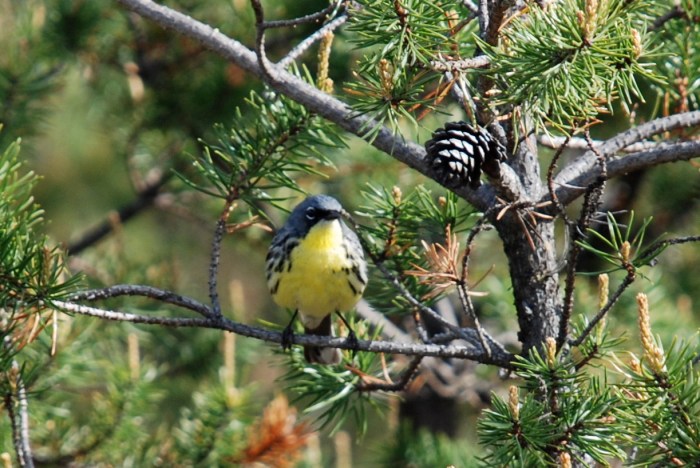
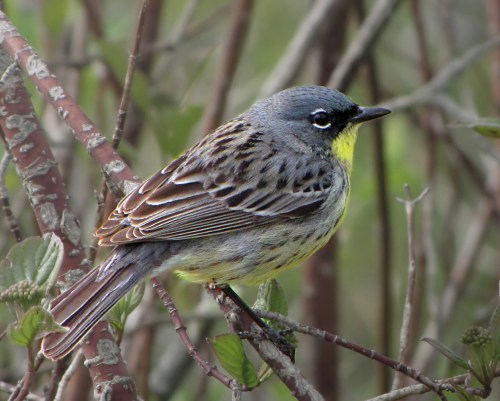
Michigan Bird of Fire Kirtlands Warbler

Kirtland’s Warbler, photo by James Fox

On June 3-4, northeast Michigan will celebrate a Michigan conservation success story with the annual Kirtland’s Warbler Weekend that includes an Au Sable River Kayak Tour. You can also lend a hand this Saturday with the annual jack pine planting day through the Kirtland’s Warbler Initiative!

The Detroit News has a nice editorial by Michael Bean, Principal Deputy Assistant Secretary for Fish and Wildlife and Parks at the U.S. Department of the Interior about how determination saved Michigan’s “Bird of Fire”, the Kirtland’s Warbler:

More than 60 years ago, scientists realized that the Kirtland’s warbler was in trouble. A 1951 census found fewer than 500 breeding pairs. The bird was among the first species ever listed as endangered and was the first species to ever have a “recovery team.”

Kirtland’s warblers will only nest in young jack pine forest. Jack pine requires fire to open its cones and spread its seeds — hence the nickname, “bird of fire.” Fire suppression policies last century led to the decline of the Kirtland’s warbler, as did parasitism from brown-headed cowbirds. The recovery team had to figure out a way to overcome these challenges to save the species.

Since 1974, the Kirtland’s Warbler Recovery Team has worked to save the species, even when the outlook for recovery was bleak. The recovery team brought together federal, state, academic, nonprofit, and even international partners.

Today, scientists estimate there are more than 4,000 Kirtland’s warblers in Michigan. The population has more than doubled its recovery goal, so the recovery team is no longer needed. Through years of hard work the partners figured out how to provide the conditions necessary for the warblers to survive, and the birds have flourished.

View James’ photo background big and see more in his Grayling 2009 slideshow.

Hanging around with an Eastern Screech Owl

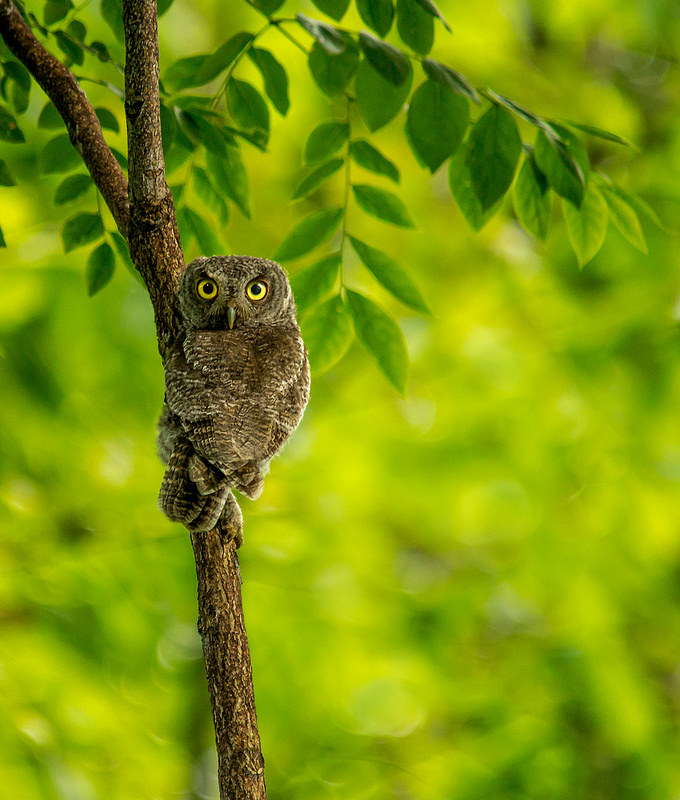
Eastern Screech Owl

Eastern Screech Owl, photo by Kevin Povenz

All About Birds’ entry for the Eastern Screech Owl (Megascops asio) says in part:

If a mysterious trill catches your attention in the night, bear in mind the spooky sound may come from an owl no bigger than a pint glass. Common east of the Rockies in woods, suburbs, and parks, the Eastern Screech-Owl is found wherever trees are, and they’re even willing to nest in backyard nest boxes. These supremely camouflaged birds hide out in nooks and tree crannies through the day, so train your ears and listen for them at night.

The Eastern Screech-Owl is a short, stocky bird, with a large head and almost no neck. Its wings are rounded; its tail is short and square. Pointed ear tufts are often raised, lending its head a distinctive silhouette.

Eastern Screech-Owls can be either mostly gray or mostly reddish-brown (rufous). Whatever the overall color, they are patterned with complex bands and spots that give the bird excellent camouflage against tree bark. Eyes are yellow.

Eastern Screech-Owls are active at night and are far more often heard than seen—most bird watchers know this species only from its trilling or whinnying song. However, this cavity-roosting owl can be attracted to nest boxes or, if you’re sharp-eyed, spotted in daylight at the entrance to its home in a tree cavity.

Read on for more including screech owl calls.

View Kevin’s photo bigger and see more in his massive Birds of Prey slideshow.

More owls on Michigan in Pictures.

Must be a Monday: Be Yourself Blue Heron Edition

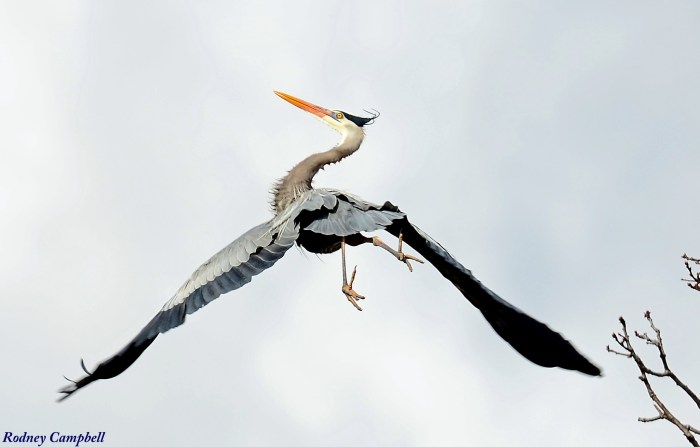
Great Blue Heron Leaving Roost

Great Blue Heron Leaving its Roost, photo by Rodney Campbell

Hope you have a wonderful week, even if you look a little goofy at times. ;)

The Michigan Natural Features Inventory entry for Great Blue Heron Rookeries explains:

The great blue herons in Michigan are largely migratory, with almost all leaving the state during the winter months. Most leave by end of October and return in early to mid-March.

The great blue heron is mostly a colonial nester, occasionally they nest in single pairs. Colonies are typically found in lowland swamps, islands, upland hardwoods and forests adjacent to lakes, ponds and rivers. Nests are usually in trees and may be as high as 98 ft. (30 m) or more from the ground. The platform like nests are constructed out of medium-sized sticks and materials may be added throughout the nesting cycle. Nests are usually lined with finer twigs, leaves, grass, pine needles, moss, reeds, or dry gras. The same nests are refurbished and used year after year.

Most great blue herons return to southern Michigan heronries in mid-March although a few may remain through the winter if there are areas of open water. Courtship and nest building commences from early April in southern Michigan to early May in the extreme northern portions of the state. Both sexes are involved in the nest building process with males primarily gathering sticks from the ground, nearby trees, or ungarded nearby nests.

More about Great Blue Herons on Michigan in Pictures.

View Rodney’s photo background bigtacular and see more in his Birds slideshow.


Groundhog Warning!

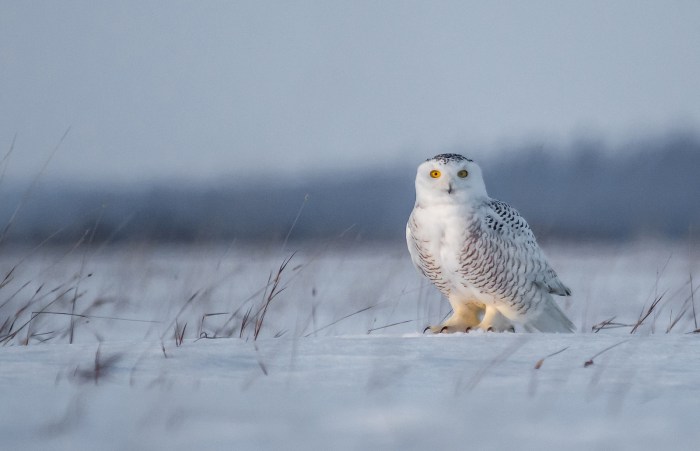
Snowy Owl

Snowy Owl, photo by Kevin Povenz

Any Michigan groundhogs out there probably better just stay inside and check to see what Woody the Woodchuck from the Howell Nature Center predicts. Word is already in from Punxsutawney Phil that we’re in for an early Spring!

You can learn all about Michigan groundhogs/woodchucks and Woody, Michigan’s official groundhog and snowy owls on Michigan in Pictures. One thing about snowy owls that you may not know is that due to their remote existence, they typically don’t have the same fear of humans that other owls exhibit.

Kevin took this gorgeous photo on Saturday near Sault Ste Marie and writes:

Yes I was laying down on my belly in the snow to get this shot. Not the sharpest of shots as there were weeds between me and this snowy and was hard to focus. Should of used manual focus, but I loved the moment. He just kept looking at me probably thinking “what the…?”

View his photo bigger and see more in his Birds of Prey slideshow.

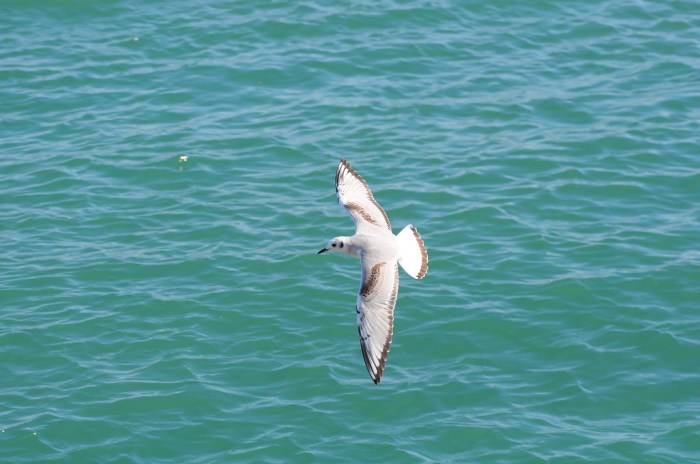
Bonaparte’s Gull (Chroicocephalus philadelphia)

Bonapartes Gull

Bonaparte’s Gull, photo by James Salinas

All About Birds has this to say about Bonaparte’s Gull (Chroicocephalus philadelphia):

A small, graceful gull with bright white patches in its wings, the Bonaparte’s Gull winters near people, but breeds in the isolated taiga and boreal forest.

  • The Bonaparte’s Gull is the only gull that regularly nests in trees.
  • The English name of the Bonaparte’s Gull honors Charles Lucien Bonaparte, who made important contributions to American ornithology while an active member of the Academy of Natural Sciences of Philadelphia during the 1820s. The scientific name philadelphia was given in 1815 by the describer of the species, George Ord of Philadelphia, presumably because he collected his specimen there.
  • During the breeding season, the Bonaparte’s Gull feeds mainly on insects, often catching them on the wing.
  • Breeds around lakes and marshes in boreal forest. Winters along lakes, rivers, marshes, bays, and beaches along coasts.
  • Eats small fish and large invertebrates, including insects. Does not eat garbage or carrion.

Read on for more and some photos and the gull’s distinctive call.

James took this photo in Port Huron. View it bigger and see more in his slideshow.

Lots more Michigan birds on Michigan in Pictures!


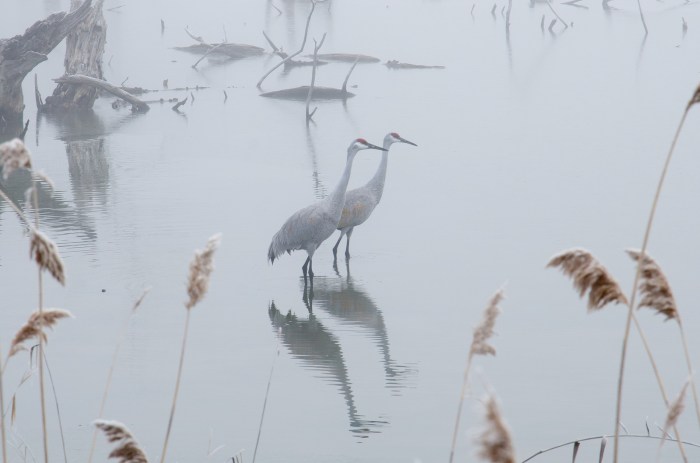
Sandhills in the Mist

Sandhills in the Mist

Sandhills in the mist, photo by Bill VanderMolen

Perhaps they’re waiting for the gorillas?

Here’s a shot from earlier in December, but Michigan is still just as misty and non-snowy as then.

View Bill’s photo bigger and see more in his slideshow.

More birds and more about sandhill cranes on Michigan in Pictures.

Kirtland’s Warbler on the Rebound

Kirtland Warbler at Tawas Point, 5-15-2010

Kirtland Warbler at Tawas Point, 5-15-2010, photo by John Britt

The Michigan Department of Natural Resources completed their annual June survey of Kirtland’s warbler, one of the rarest members of the wood warbler family that nests almost exclusively in Michigan’s northern Lower and Upper peninsulas, with a few locations in Wisconsin and the province of Ontario. They explain:

“We have a great group of DNR, U.S. Forest Service and U.S. Fish and Wildlife Service staff members, as well as volunteers, who are trudging through young, thick jack pine in the early morning hours,” said Department of Natural Resources wildlife supervisor Keith Kintigh. “The reward is getting to hear that singing male Kirtland’s warbler, which is the way we actually census the population.”

The Kirtland’s warbler census is a tool managers use to compare population numbers relative to recovery goals by listening for the male’s song. Kirtland’s warbler numbers had been very low, under 200 nesting pairs, in the mid-1980s. Michigan became the focus for habitat management, since it has been a primary location for the birds’ reproduction.

Kirtland’s warblers spend eight months wintering in the Bahamas. The males arrive back in Michigan between May 3 and May 20, a few days ahead of the females. The males establish and defend territories and then court the females when they arrive. The males’ song is loud, yet low-pitched, ending with an upward inflection – easily recognized to identify the presence of a Kirtland’s warbler.

Additionally, the presence or absence of Kirtland’s warblers determines if protection of that area is needed and allows evaluation of different habitat management techniques. The habitat requirements for Kirtland’s warbler are very specific; they prefer large blocks of young jack pine, usually hundreds of acres in size. The Kirtland’s warbler is a ground-nester, often using the living branches of 5- to 20-foot-tall jack pine trees to conceal their nests, so jack pine trees must be actively managed. Large areas of sandy soils are planted with jack pine and then cut decades later, on specific intervals, to achieve the perfect-aged stands.

Lots more about this rare songbird, including census results that show a steadily increasing population on the DNR’s Kirtland’s Warbler (Dendroica kirtlandii) page.

View John’s photo from May of 2010 background big and see more in his Animals & Wildlife slideshow.

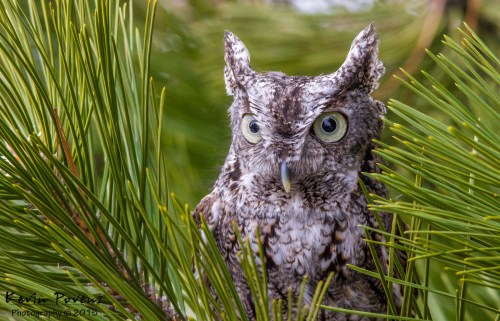
Know your Michigan Birds: Eastern Screech Owl

Eastern Screech Owl by Kevin Povenz

Eastern Screech Owl, photo by Kevin Povenz

The Owl Pages says (in part) that the Eastern Screech Owl (Megascops asio):

…is a small, nocturnal woodland Owl with short ear-tufts and yellow eyes. There is a greyish-brown, red and grey morph, with intermediates also occurring. The word “asio” is Latin for ‘Horned Owl’. Eastern Screech Owls have also been called the Common Screech Owl, Ghost Owl, Dusk Owl, Little-eared Owl, Spirit Owl, Little Dukelet, Texas Screech-Owl, Whickering Owl, Little Gray Owl, Mottled Owl, Red Owl, Mouse Owl, Cat Owl, Shivering Owl, and the Little Horned Owl.

…A nocturnal bird, with activity beginning after sunset. The Eastern Screech-Owl flies fairly rapidly with a steady wingbeat (about 5 strokes/second). They rarely glide or hover, but may fly with erratic movements, when manoeuvring through wooded areas. Their wings are broad and the head is held tucked in giving the bird a stubby appearance when flying.When threatened, an Eastern Screech Owl will stretch its body and tighten its feathers in order to look like a branch stub to avoid detection, but will take flight when it knows it has been detected. In open roosts, gray-phase birds tend to roost next to a tree trunk, whereas red-phase birds tend to roost in outer foliage, possibly because of thermal requirements.

…Eastern Screech Owls hunt from dusk to dawn, with most hunting being done during the first four hours of darkness. They hunt mainly from perches, occasionally hovering to catch prey. This Owl mainly hunts in open woodlands, along the edges of open fields or wetlands, or makes short forays into open fields. When prey is spotted, the Owl dives quickly and seizes it in its talons. They will also capture flying insects on the wing.

…Breeding season for Eastern Screech Owls is generally around mid April, but may range from mid March to mid May. They have an elaborate courtship ritual. Males approach females, calling from different branches until they are close. The male then bobs and swivels his head, bobs his entire body, and even slowly winks one eye at the female. If she ignores him, bobbing and swivelling motions intensify. If she accepts him, she moves close and they touch bills and preen each other.

… Eastern Screech Owls inhabit open mixed woodlands, deciduous forests, parklands, wooded suburban areas, riparian woods along streams and wetlands (especially in drier areas), mature orchards, and woodlands near marshes, meadows, and fields. They will avoid dense forests because Great Horned Owls use that habitat. They will also avoid high elevation forests. Eastern Screech Owls roost mainly in natural cavities in large trees, including cavities open to the sky during dry weather. In suburban and rural areas they may roost behind loose boards on buildings, boxcars, or water tanks. They will also roost in dense foliage of trees, usually on a branch next to the trunk, or in dense scrubby brush.

Read on for lots more about screech owls and definitely make owlpages.com your go-to for all things owlish (including screech owl gear).

View Kevin’s photo bigger on Flickr, see a lot more in his fantastic Birds of Prey slideshow and follow him at Kevin Povenz Photos on Facebook.