Under the Sign of the Lion

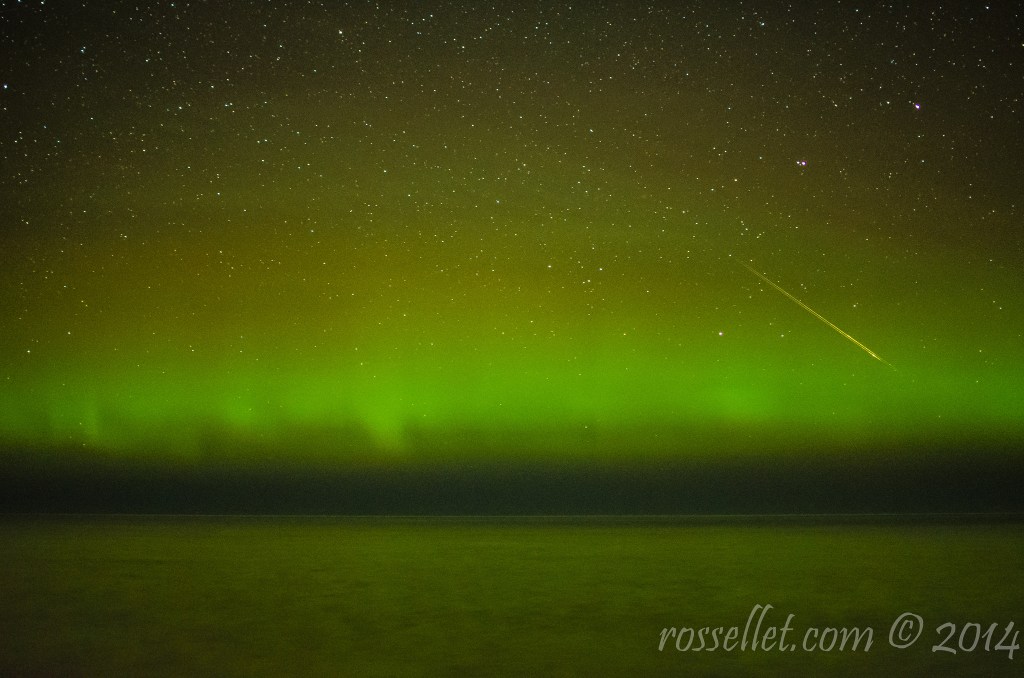
Aurora Fireball by Ross Ellet

I featured this photo 8 years again, but with the incredible run of northern lights we’ve been having and the massive spike in interest in getting out under the night sky coupled with the rise of the Detroit Lions as an NFL superpower, it’s a great time to bring back this feature from Space.com on How to Watch the Leonids Meteor Shower:

The Leonid meteor shower will be active from Nov. 3 to Dec. 2 this year and will peak overnight from Nov. 17 to 18. The Leonids are produced when Earth passes through the debris left behind by comet 55P/Tempel-Tuttle during its highly elliptical orbit around the sun every 33 years. The Leonids are considered some of the fastest meteors, zipping through the sky at 44 miles (71 kilometers) per second, according to NASA. They can also result in impressive fireballs producing long, bright and colorful meteor streaks.

The Leonids’ radiant is located in the sickle-shaped head of the constellation Leo, the lion. Leonid meteor hunting can be incredible, or a total bust. It all depends on where its parent body, Comet 55P/Tempel-Tuttle, will be in its orbit and the kind of debris clumps that will be around when our planet passes through this comet’s orbit. The Leonids put on big shows in 1966, 1999 and 2001, according to AMS, when the comet was making its closest approach to the sun. It will be several years until observers get a big show from the Leonids.

Ross took this photo ten years ago in late September of 2014 and shared:

The sky was cloudy most of the night, but at 3:30am there wasn’t a cloud in the sky. We made our way to the lakeshore and sure enough the northern lights were dim on the northern horizon. At one point you could hear the howl of a distant wolf pack while the northern lights were out. Then moments later a slow move fireball flashed across the sky. It lasted a couple seconds and the brightness pulsed as it moved through the atmosphere. After that the aurora faded, but several more meteors (some very bright) streaked above us.

Ssee more in his Porcupine Mtns gallery on Flickr, and definitely check out Ross Ellet’s Picturesque Adventures for much more!!

Support Michigan in Pictures with Patreon

How to see Comet A3

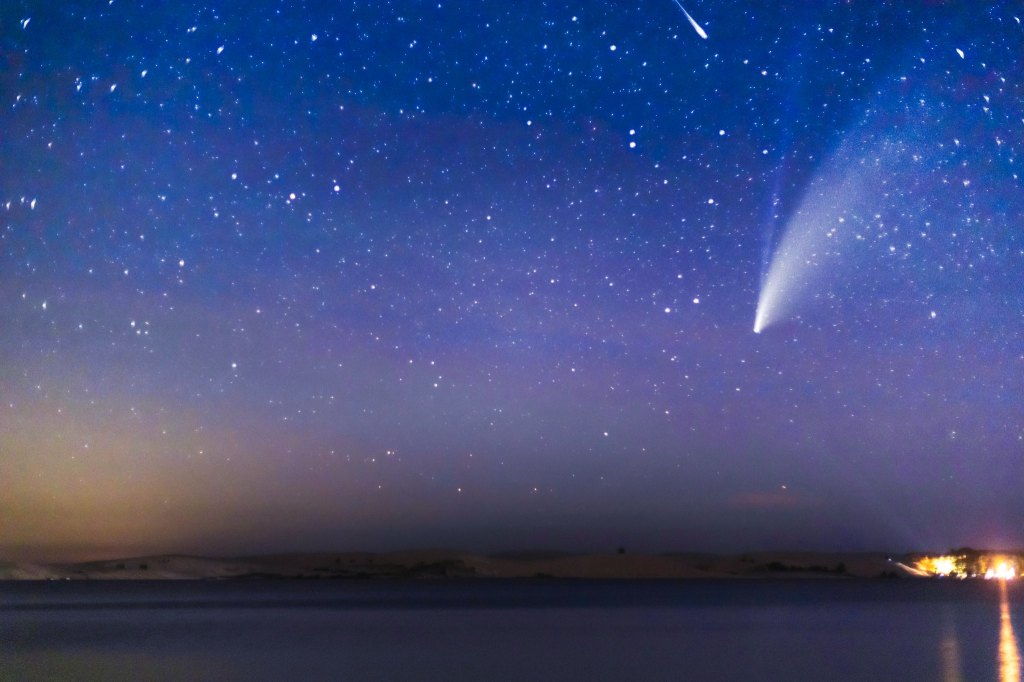
Neowise and meteor by Gary Syrba

There were hopes that Comet C/2023 A3 Tsuchinshan–ATLAS aka Comet A3 would be the comet of the century. While it is not quite that, it does appear that it will be visible for the next couple of weeks just after sunset, even to the naked eye! The good folks at EarthSky offer a helpful checklist to spot Comet A3:

  1. Be sure you’re looking at the correct direction and time. Comet A3 will be visible low in the west after sunset beginning around October 14.
  2. You need a dark, unobstructed sky. Start looking when the sky is dark, but close to sunrise or sunset. Make sure there aren’t hills, trees or buildings blocking your view.
  3. If you can’t see the comet with your eye, try your phone. Most cell phone cameras provide a night or low-light mode. But capturing an image of the comet will require that you hold the camera firmly – or lean against a fixed object like a tree – to avoid shaky or blurred image.
  4. AFTER you’ve located the comet, use binoculars or your eyes to sweep in that area in the sky.

Gary took this shot of Comet Neowise back in July of 2020. See more in his Night Skies gallery on Flickr and view & purchase his work on his website.

Support Michigan in Pictures with Patreon

Earth to get an extra moon on Sunday!

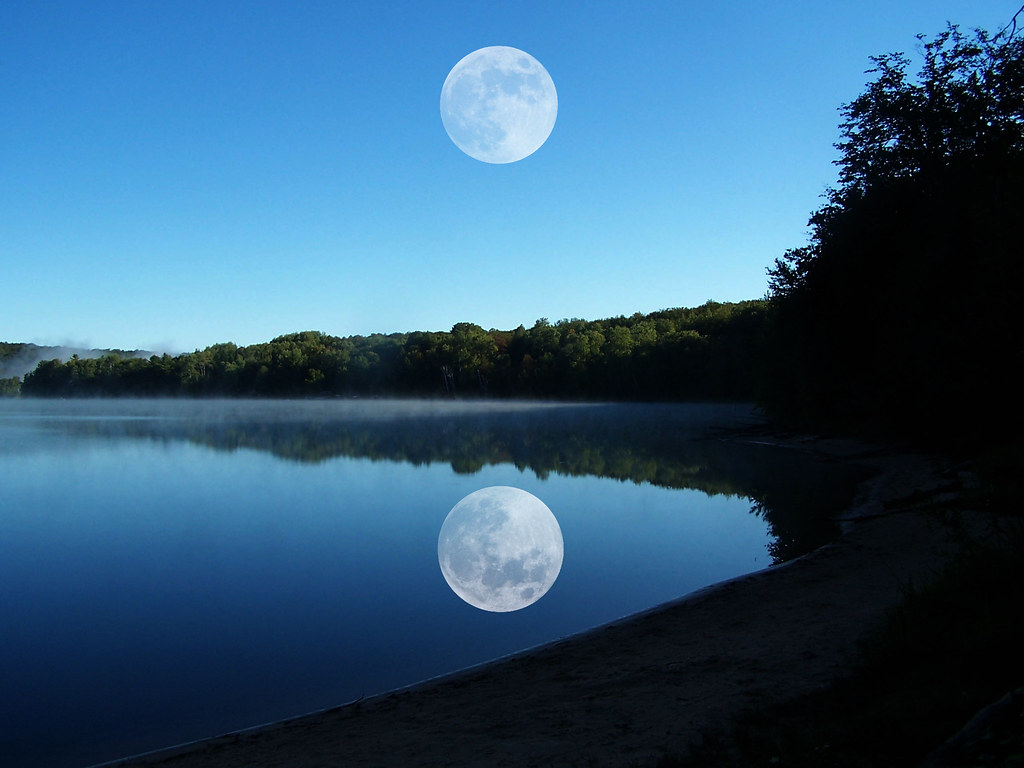
He leads me beside the still waters… by Kathy

CNN shares that the Earth will (briefly) be getting a “mini-moon” on Sunday:

The newly discovered asteroid, named 2024 PT5, will temporarily be captured by Earth’s gravity and orbit our world from September 29 to November 25, according to astronomers. Then, the space rock will return to a heliocentric orbit, which is an orbit around the sun.

…The space rock could be anywhere between 16 and 138 feet (5 and 42 meters) in diameter, potentially larger than the asteroid that entered Earth’s atmosphere over Chelyabinsk, Russia in 2013 … But as a mini-moon, Asteroid 2024 PT5 isn’t in any danger of colliding with Earth now or over the next few decades, de la Fuente Marcos said. The space rock will orbit about 2.6 million miles (4.2 million kilometers) away, or about 10 times the distance between Earth and the moon.

Kathie shares that Thumb Lake in Charlevoix County was foggy and lovely when she took this back in October of 2009. See more in her Top 40 gallery on Flickr. Also I get that we’re all worked up about AI, but please look at the 2009 date of the photo ;)

Support Michigan in Pictures with Patreon

Supermoon Eclipse Tuesday night!

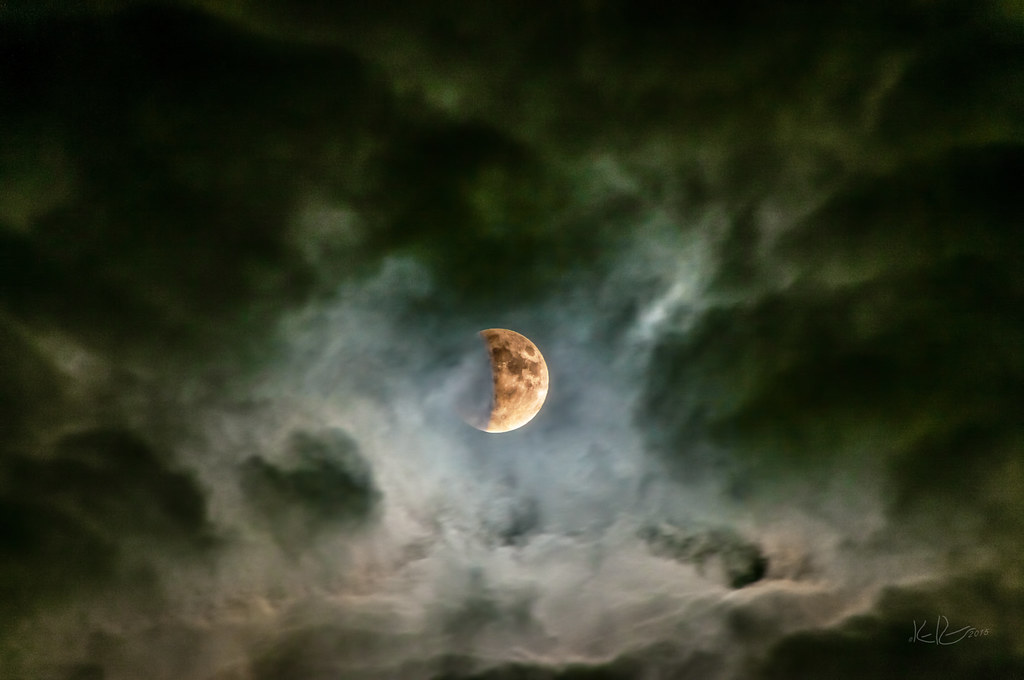
Super Moon Total Lunar Eclipse by Kenneth Raymond

Bridge Michigan shares that the supermoon tomorrow night (September 17) could be (literally) overshadowed by another astronomical event, a partial lunar eclipse:

Full moons are likely every month, but supermoons, which occur when the moon is closest to Earth, are rarer. Only 25% of all full moons are supermoons, according to NASA. The next ones are Oct. 17 and Nov. 15. But the September supermoon will be brighter and red because of the partial lunar eclipse, which is when the Earth passes between the sun and the moon, and casts its shadow on the moon.

“Supermoon is a popular science term for when full moons occur close to the perigee of the moon’s orbit about Earth,” said Seth Jacobson, natural science professor at Michigan State University.

“Lunar eclipses occur at full moons when the sun, Earth and moon are all in the same plane and in that order. In this case, the moon will simultaneously be closer and in almost the exact same plane, so we get a partial lunar eclipse and a supermoon at the same time. The chance of both occurring during the same full moon cycle is about 5% or once every one-and-a-half years,” Jacobson said.

The partial eclipse is predicted at 10:44.

I’ve featured this sweet shot Kenneth took this during the total lunar eclipse of Steptember 27, 2015 before & I will probably do so again! See more in his Night Sky gallery on Flickr and view & purchase his work on his website.

Support Michigan in Pictures with Patreon

Zodiacal Light on Isle Royale

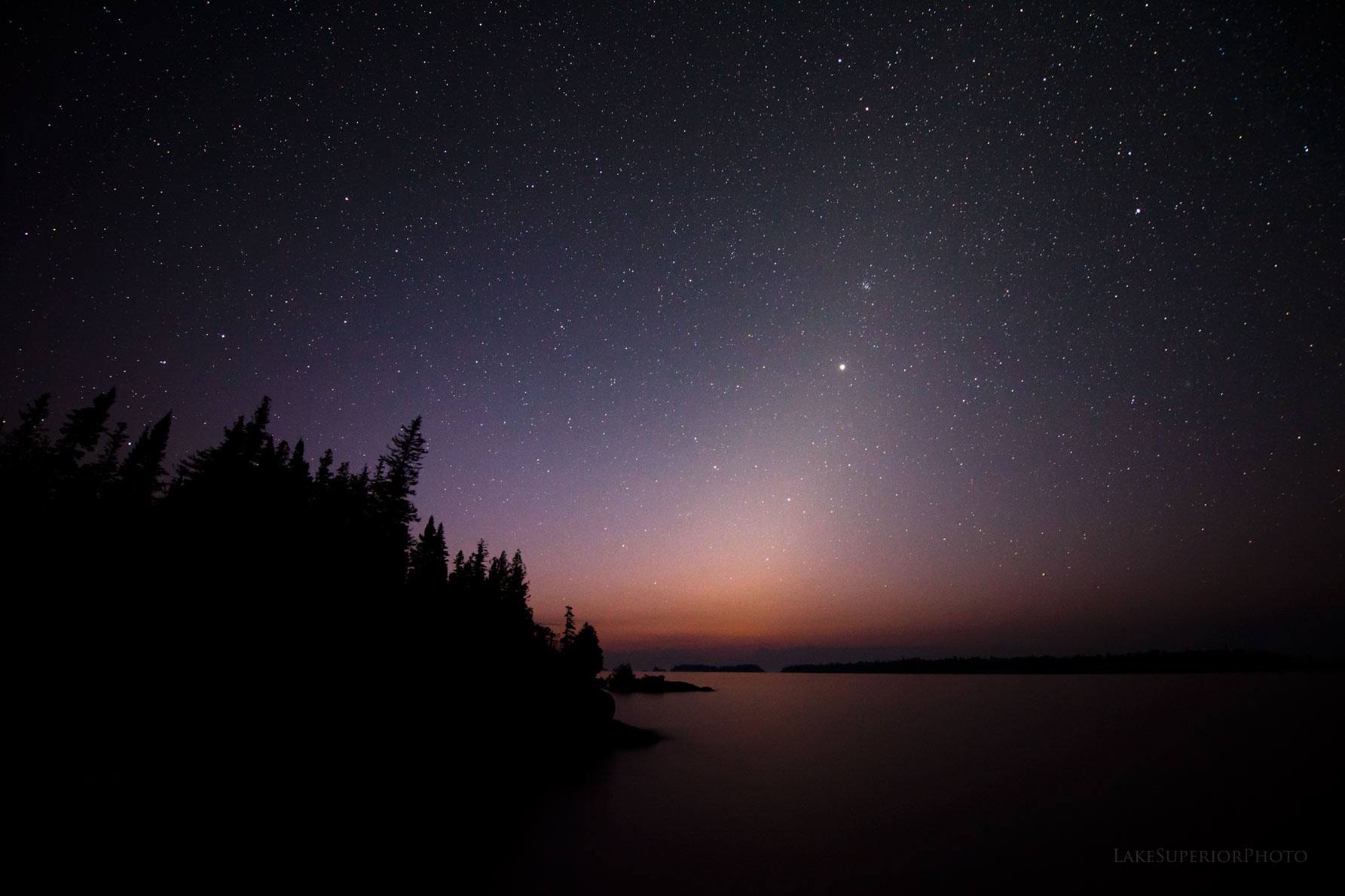
Zodiacal Light by Shawn Malone

Zodiacal Light on Isle Royale, photo by Shawn Stockman Lightseeker/Lake Superior Photo

The Earth Science Picture of the Day is pretty much my favorite photo blog. Regarding the Zodiacal Light, Rudi Dobesberger and blog curator Jim Foster wrote:

Zodiacal light is now thought to be caused by dust particles scattering sunlight in the orbits of comets. In both hemispheres it’s best observed in late winter/early spring after sunset and late summer/early fall before sunrise. However, it can be detected before astronomical twilight (morning) or after astronomical twilight (evening) at other times of the year as well, providing that the sky is quite dark.

Head over to the EPOD for more and definitely subscribe!

The photo above is from Shawn’s recent journey to Isle Royale. Follow her at Lake Superior Photo on Facebook and view and purchase many more photos – including a gallery of Isle Royale pictures –  on her website.

Blood Moon kicks off the Lunar Eclipse Tetrad

Shadow Moon by Michael Seabrook

Shadow Moon, photo by Michael Seabrook

For as long as we know, celestial signs have been read to signify calamity and change, and apparently the total lunar eclipse in the early morning hours of April 15, 2014 that kicks off a two-year tetrad of lunar eclipses is no exception.

In What is a Blood Moon? on one of my favorite blogs, EarthSky, Bruce McClure and Deborah Byrd explain (in part) a subject you might be hearing about this week:

We’ve been receiving a number of inquiries about Blood Moons in 2014 and 2015. The Blood Moons most people are asking about are not part of astronomy. Their origin is religious, at least according to Christian pastor John Hagee, who wrote a 2013 book about Blood Moons. However, both astronomers and some proponents of Christian prophesy are talking about the upcoming lunar tetrad – a series of total lunar eclipses – which begins on the night of April 14-15, 2014. We at EarthSky don’t have any special knowledge about the purported Blood Moons of Biblical prophesy. But, since they’re moons, and since people are asking us, we wanted to reply.

The full moon nearly always appears coppery red during a total lunar eclipse. That’s because the dispersed light from all the Earth’s sunrises and sunsets falls on the face of the moon at mid-eclipse. Thus the term blood moon can be and probably is applied to any and all total lunar eclipses…

Both astronomers and followers of certain Christian pastors are talking about the lunar tetrad of 2014-2015. What is a tetrad? It’s four successive total lunar eclipses, with no partial lunar eclipses in between, each of which is separated from the other by six lunar months (six full moons)

We’re not experts on prophecy of any kind. But we’ll tell you what we know about the new definition for Blood Moon that has raised so many questions recently.

From what we’ve been able to gather, two Christian pastors, Mark Blitz and John Hagee, use the term Blood Moon to apply to the full moons of the upcoming tetrad – four successive total lunar eclipses, with no partial lunar eclipses in between, each of which is separated from the other by six lunar months (six full moons) – in 2014 and 2015. John Hagee appears to have popularized the term in his 2013 book Four Blood Moons: Something is About to Change.

As if we didn’t have enough to look forward to on April 15th! Read on for lots more. The four eclipses are this one, October 8 2014 and April 4 & September 28, 2015. Here’s the eclipse viewing times for Michigan – times for other time zones can be found on EarthSky.

The April 15th eclipse begins at 2 AM Eastern time when the edge of the moon first enters the amber core of Earth’s shadow. Totality occurs during a 78 minute interval beginning around 3 o’clock in the morning on the east coast, midnight on the west coast. Weather permitting, the red moon will be easy to see across the entirety of North America.

Eastern Daylight Time (April 15, 2014)
Partial umbral eclipse begins: 1:58 a.m. EDT on April 15
Total eclipse begins: 3:07 a.m. EDT
Greatest eclipse: 3:46 a.m. EDT
Total eclipse ends: 4:25 a.m. EDT
Partial eclipse ends: 5:33 a.m. EDT

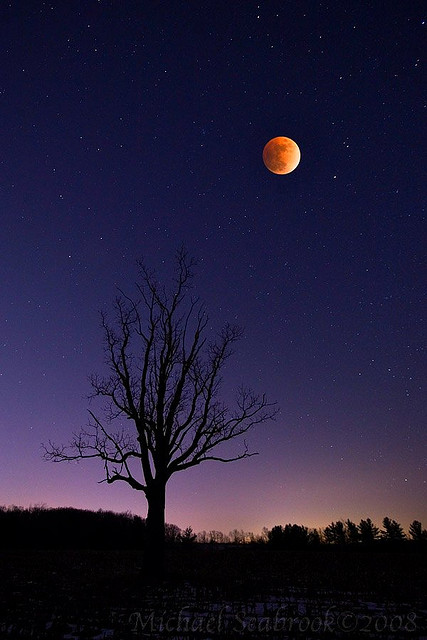
Michael took this photo of the lunar eclipse on February 20, 2008. View it bigger and see more in his The Moon slideshow.

More of the moon on Michigan in Pictures!

The month of the Pleiades … and legendary aurora borealis

Orion Aurora

Orion Aurora, photo by Kevin’s Stuff

This EarthSky article on the Pleiades gives some great lore and viewing tips and says that:

In our Northern Hemispheres skies, the Pleiades cluster is associated with the winter season. It’s easy to imagine this misty patch of icy-blue suns as hoarfrost clinging to the dome of night. Frosty November is often called the month of the Pleiades, because it’s at this time that the Pleiades shine from dusk until dawn. But you can see the Pleiades cluster in the evening sky well into April.

You can read much more at EarthSky.org and also might want to check out this story of the Pleiades.

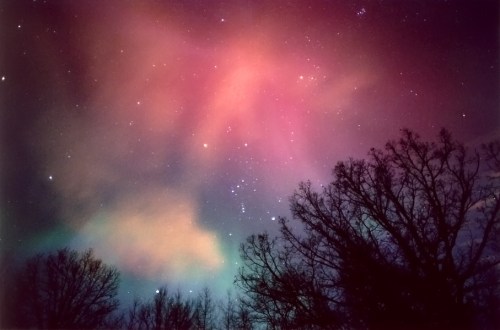
November is also the month of the Aurora, delivering some of the best northern lights action. Kevin took this photo during one of the best solar storms in the last several decades on November 10, 2004. He wrote the following (in part) after viewing these lights:

It was a Dark and (Solar) Stormy Night. Stormy with shafts and rays of light streaming from the heavens.

We all knew there was a chance of another auroral display tonight. We were waiting. And then around 10:30pm or so (from Grand Rapids), the wait was over. This time I went out with my brother, taking back roads and such until we finally found a great spot in northeastern Kent County. We ended up off Old Belding Rd on Lessiter Rd, which is on the way to the Grattan Raceway.

The road faced north, so we were shooting right down the middle of it. There were some clouds around to the north, but nothing too bothersome. Most of the action was to the northeast, with not much seen in the way of color except green, and an occasional red and blue. There were curtains, rays, shafts, and some really good pulsing going on.

I of course used my 35mm film camera, and my brother had his Canon Digital SLR. I was a tad pickier this time, and only shot 3 rolls by the time 1:30 rolled around, and it started to wane. Also, we were getting some clouds coming in, so we bailed.

On the way back to civilization, I noticed it was picking up again … I finally found a place a few miles down the road with a good northern horizon, and set up the camera again.

Oh… My… God. The curtains! The pulsing rays!! The pulsing shafts of light as they flickered up the magnetic lines of force to the corona. I was seeing pulsating shafts from the south!! All of them converging near Orion, forming another spectacular corona. I shot, moved the camera, and shot again. Always looking for the best display, and ever mindful to watch for composition (at least I was keeping my photographers’ hat on during this), I shot frame after frame. At one point I was going to leave, as it was dying again. But as I put my camera in the car, it flared up to the point I HAD to get set up again; another roll of film in the camera. I finally stopped around 3:00, as it was dying down, and also because I knew if I didn’t force myself, I’d shoot until I ran out of film. … In all my years of observing the aurora, I’ve never seen such intense pulsating effects. Also, the coronas (all 5 I counted) had more detail in them than I had ever seen.

Check his photo out bigger with Kevin’s helpful note showing the Pleiades cluster in the top right and see more including a few more from November 2004 in his Aurora slideshow.

More of the night sky on Michigan in Pictures.

Capturing Comet PANSTARRS

Comet Pan-Starrs ... 3-17-13

Comet Pan-Starrs … 3-17-13, photo by Ken Scott

EarthSky.org is a fantastic site for all things astronomical, and their post detailing everything you need to know about Comet PANSTARRS has great info on the first of 2013 major comets. The comet was discovered by the PANSTARRS telescope in Hawaii and they explain that:

Comet PANSTARRS is still visible through binoculars in the Northern Hemisphere, if you know right where to look. Note where the sun sets in the west. Some 60 to 75 minutes after sundown, seek for the comet about two to three binocular fields to the right, or upper right, of the sunset point on the horizon. Comet PANSTARRS now sets at nightfall or very early evening at mid-northern latitudes. From here on out, the comet will dim a bit day by day, while the waxing moon will brighten daily. So it’s hard to say how much longer Comet PANSTARRS will be readily visible through binoculars. Each day, Comet PANSTARRS goes a few degrees northward (to the right) on the sky’s dome, toward the constellation Cassiopeia the Queen.

…No matter how bright it gets in March, the comet will surely fade as April arrives, as it moves away from the sun and back out into the depths of space. But it will be located far to the north on the sky’s dome and will be circumpolar for northerly latitudes in the Northern Hemisphere. That means it might be visible somewhere in the northern sky throughout the night for northern observers. What’s more, the comet will be near in the sky to another beautiful and fuzzy object in our night sky, the Andromeda Galaxy (M31), the nearest large spiral galaxy to our Milky Way. If the comet truly is bright then, and if it still has a substantial tail, it’ll be an awesome photo opportunity!

Read on for more and also check out the michpics post on Comet ISON which has the possibility of  being so bright that you can see it in the daytime!

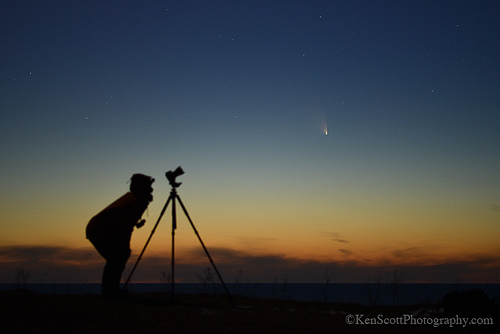
Ken shot this last weekend. You can see it on black, check out the sunset he captured before this and see more great work in his Night Sky slideshow. If you’re looking to purchase this or other shots, definitely head over to KenScottPhotography.com!

More nighttime photography on Michigan in Pictures.

Northern Lights likely this week!

Northern Lights

Northern Lights, photo by BeaverTripp

The Space Weather Prediction Center of the National Oceanic and Atmospheric Administration says that minor to moderate auroral activity is likely through January 20th. Translation? Northern Lights are likely this week!

You can click to register for space weather alerts and also view the current space weather.

Stephen captured this photo in July of 2012 on Moss Lake in the U.P. Check his photo out as big as the sky and in his Northern Lights slideshow.

Much (much) more Aurora Borealis information & photos on Michigan in Pictures!